

Turn this metric into a baseline for your team
Preview a system-level engineering health report, then connect GitHub when you are ready to compare this metric with your own delivery history.
Read-only GitHub · Your code stays yours · Team-level by default · No credit card
Engineering metrics are everywhere. Every tool promises "elite" performance. Every vendor has a dashboard. Yet most engineering leaders still struggle with the same question: what should we actually measure? This comprehensive guide cuts through the noise to give you a framework for metrics that drive decisions - not just reports. If you're new to software metrics, start there first.
What engineering metrics should you actually track?
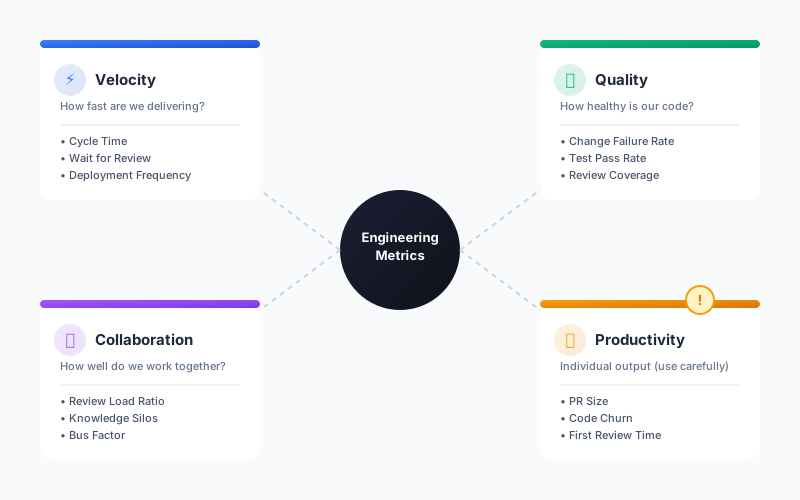
Track metrics across four categories: velocity (cycle time, deployment frequency), quality (change failure rate, review coverage), collaboration (review load balance, knowledge silos), and productivity (team throughput, not individual output). Start with 5 to 7 metrics. Every metric should answer a specific question and lead to a specific action. If a metric wouldn't change any decision you make, stop tracking it. CodePulse covers all four categories from GitHub data in a single dashboard.
"The best engineering metrics answer questions you're already asking. If a metric doesn't change a decision you'd make, stop measuring it."
Why Do Most Engineering Metrics Programs Fail?
According to the 2024 DORA State of DevOps Report, organizations with mature metrics programs achieve 2.2x faster delivery times. But here's what the report doesn't tell you: most teams measuring DORA metrics aren't improving. They're just reporting.
The difference between metrics that work and metrics that waste time comes down to one thing: action orientation. Good metrics tell you what to fix. Bad metrics tell you how you're doing without telling you why.
🔥 Our Take
Most engineering metrics programs fail because they measure outputs instead of outcomes. Lines of code, commit counts, and velocity points are activity metrics - they tell you people are busy, not that they're effective.
The best teams measure outcomes: Did the customer get value faster? Is the codebase healthier? Are developers able to ship with confidence? Everything else is noise.
The Three Questions Every Metric Should Answer
Before adding any metric to your dashboard, ask:
- What decision does this inform? If the answer is "none," don't measure it.
- What action would we take if this metric changed? If you wouldn't change anything, it's not useful.
- Can this metric be gamed? If yes, how do we detect gaming? Metrics without countermeasures become Goodhart's Law in action.
What Are the Four Categories of Engineering Metrics?
After analyzing thousands of engineering teams, we've identified four categories of metrics that matter. Everything else is either a vanity metric or a derivative of these core areas. The scope of what engineering teams actually own is narrower than what people conflate it with - our engineering management vs project management guide draws the line and helps you pick the right metrics for the right role.
1. Velocity Metrics: How Fast Are We Delivering?
Velocity metrics measure your team's ability to move code from idea to production. The gold standard here is cycle time - the time from first commit to merge. Unlike story points or velocity, cycle time is objective and hard to game.
| Metric | What It Measures | Good Range |
|---|---|---|
| Cycle Time | First commit to merge | 24-72 hours |
| Wait for Review | Idle time before first review | < 4 hours |
| Review Time | First review to approval | < 8 hours |
| Deployment Frequency | PRs merged per day | > 1/day per team |
The key insight: cycle time breaks down into four components, and optimizing the wrong component wastes effort. Most teams assume "coding time" is the bottleneck when it's actually "wait for review." See our cycle time breakdown guide for detailed analysis.
"Your cycle time is dominated by your slowest phase. A 2-day review wait makes 1-hour coding time optimizations irrelevant."
2. Quality Metrics: How Healthy Is Our Code?
Quality metrics prevent velocity at all costs. High deployment frequency is meaningless if you're shipping bugs. Quality metrics act as the countermeasure to velocity gaming.
| Metric | What It Measures | Target |
|---|---|---|
| Change Failure Rate | Deployments causing issues | < 15% |
| Test Pass Rate | CI passing on merge | > 95% |
| Review Coverage | PRs with at least one review | 100% |
| Merge Without Approval | PRs merged with no approval | < 5% |
The most dangerous metric to ignore is merge without approval rate. Teams that allow unreviewed merges "to move fast" accumulate hidden technical debt and security vulnerabilities. For more on this, see our risky deployments guide.
3. Collaboration Metrics: How Well Do We Work Together?
Collaboration metrics reveal the hidden dynamics of your team. Who reviews whose code? Are knowledge silos forming? Is review load distributed fairly?
| Metric | What It Measures | What to Watch |
|---|---|---|
| Review Load Ratio | Reviews given vs PRs created | Ratio close to 1.0 |
| Reviewer Diversity | Unique reviewers per author | > 3 different reviewers |
| Knowledge Silos | Single-owner files | < 10% of codebase |
| Bus Factor | Critical knowledge concentration | > 2 for all critical paths |
Review load imbalance is a leading indicator of burnout. Your "fast" reviewer might actually be overloaded. Learn how to detect this in our review load balancing guide.
4. Productivity Metrics: What About Individual Output?
Here's where we part ways with most engineering analytics vendors. Individual productivity metrics are dangerous. They destroy trust, encourage gaming, and measure the wrong things. Our guide to developer productivity metrics that don't backfire covers which ones help and which to drop.
🔥 Our Take
Lines of code as a productivity metric is embarrassing today. AI coding assistants have made LOC meaningless. The best engineers do invisible work: mentoring, architecture, documentation, unblocking others.
If you must measure individual productivity, use it for self-improvement and debugging - never for performance reviews or comparisons. The moment developers know they're being scored, they'll game the metrics.
If you do track individual metrics, use them directionally:
- PR Size: Smaller is usually better (easier to review, less risk)
- Code Churn: High churn might indicate refactoring (good) or thrashing (bad)
- First Review Time: How quickly someone unblocks others
For a balanced approach, see our guide to measuring performance without micromanaging.
Which Metrics Framework Should You Use?
You don't need to invent your own metrics. Several proven frameworks exist - the key is choosing the right one for your situation. Once you've picked a framework, our engineering analytics tools comparison covers which platforms actually calculate it well.
DORA Metrics
Best for: Teams focused on delivery performance and DevOps maturity.
The four DORA metrics - deployment frequency, lead time for changes, change failure rate, and mean time to recovery - are the industry standard for measuring software delivery. According to the DORA research, these metrics correlate with organizational performance, not just engineering performance.
The catch: DORA metrics were designed for research across thousands of organizations. Using them as team KPIs invites gaming. Read our DORA guide for how to use them correctly.
SPACE Framework
Best for: Teams that want a more holistic view including developer experience.
SPACE covers five dimensions: Satisfaction, Performance, Activity, Communication, and Efficiency. It's more comprehensive than DORA but harder to measure - satisfaction requires surveys, not just Git data.
See our SPACE framework guide for implementation details.
Custom Framework (The 7-Metric Dashboard)
Best for: VPs and directors who need board-ready metrics.
We recommend a minimal dashboard with just 7 metrics that cover all four categories without overwhelming stakeholders. These 7 metrics tell a complete story about engineering health. For VPs and directors specifically, see our VP of Engineering metrics guide for board-ready reporting.
Get the full 7-metric dashboard guide.
📊Track All Four Categories in CodePulse
CodePulse gives you visibility into all four metric categories from a single dashboard:
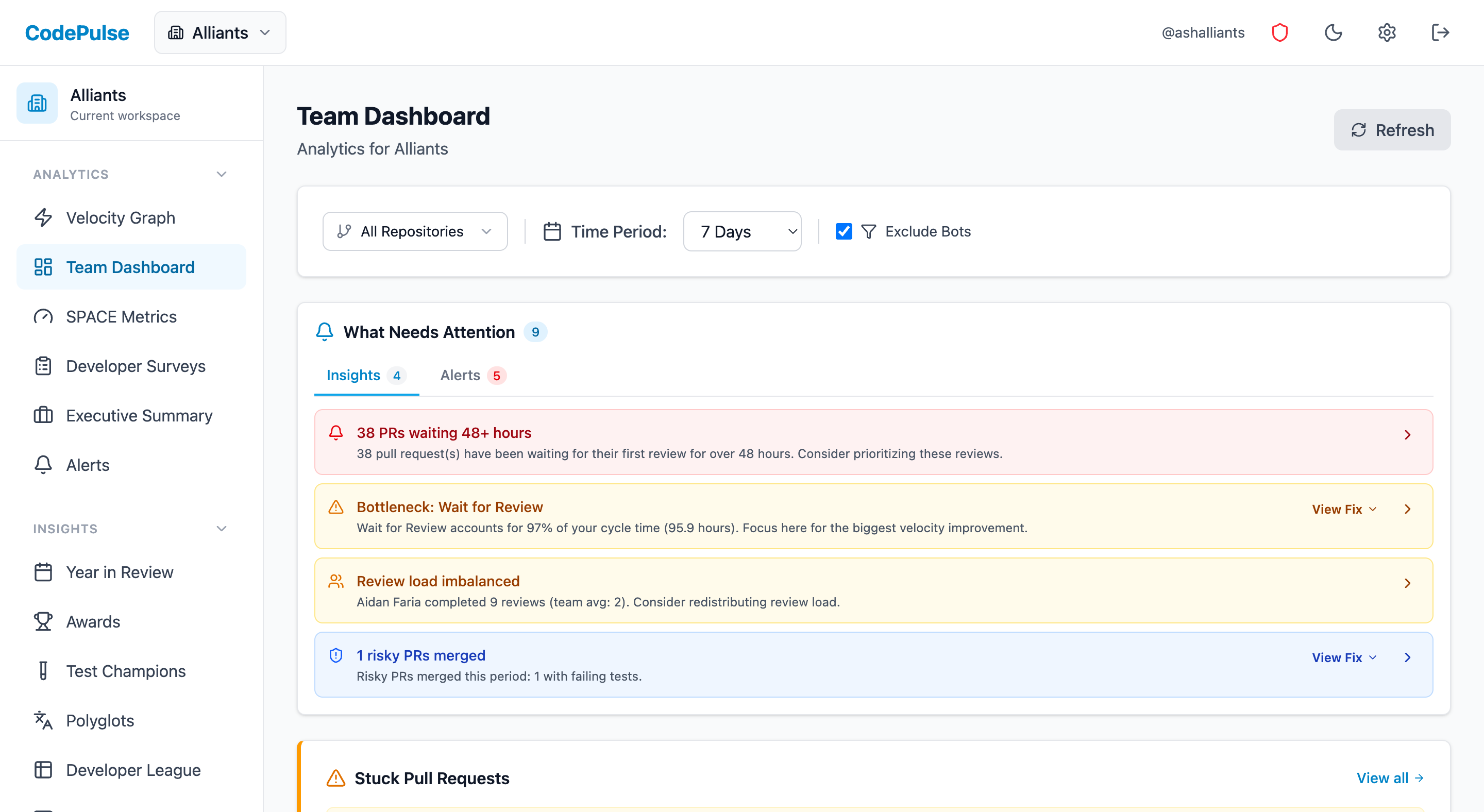
- Dashboard - Cycle time breakdown, deployment frequency, quality metrics
- File Hotspots - Knowledge silos, bus factor analysis
- Review Network - Collaboration patterns, review load balance
- Review Insights - Code review culture and sentiment analysis
What Are the Biggest Engineering Metrics Mistakes?
After working with hundreds of engineering teams, we've identified the patterns that consistently derail metrics programs.
Mistake 1: Measuring Everything
More metrics doesn't mean more insight. It means more noise. The teams with 50+ metrics on their dashboard aren't data-driven - they're data-overwhelmed. Nobody looks at dashboards that take 10 minutes to parse.
Fix: Start with 5-7 metrics. Add more only when you have a specific question your current metrics can't answer.
Mistake 2: Comparing Teams Against Each Other
Every team has different context. A platform team's cycle time shouldn't be compared to a product team's. A fintech team with compliance requirements moves differently than a consumer app team.
Fix: Compare teams against their own trajectory. "Team A improved 20% this quarter" is meaningful. "Team A is faster than Team B" is not.
Mistake 3: Using Metrics for Performance Reviews
"The moment you tie metrics to compensation, you stop measuring productivity and start measuring people's ability to game metrics."
Fix: Use metrics for system improvement, not individual evaluation. Performance reviews should include context that metrics can't capture: mentorship, unblocking others, architectural decisions.
Mistake 4: Setting Targets Without Understanding Baselines
Teams that set targets like "achieve elite DORA status" without knowing their starting point are setting themselves up for failure or gaming. You can't improve what you haven't measured.
Fix: Spend 30 days establishing baselines before setting any improvement targets. Focus on understanding why your metrics are where they are.
Mistake 5: Ignoring the Human Side
Metrics programs fail when they feel like surveillance. Engineers who feel watched and measured become disengaged. They'll hit the numbers while doing the minimum to not get flagged.
Fix: Communicate the purpose. Metrics are for understanding systems, not judging people. See our guide to building trust with metrics.
How Do You Build an Engineering Metrics Program in 30 Days?
Here's how to implement an engineering metrics program that actually works.
Week 1: Establish Baselines
- Connect your repositories to a metrics tool
- Measure current cycle time, deployment frequency, and review coverage
- Identify your biggest bottleneck (usually wait for review)
- Document team context: size, domain, regulatory requirements
Week 2: Identify Quick Wins
- Find PRs that are stuck (waiting > 24 hours for review)
- Identify knowledge silos (files with single owners)
- Look for uneven review load distribution
- Pick one improvement area to focus on
Week 3: Implement Process Changes
- Set up alerts for stuck PRs
- Establish review SLAs (e.g., first review within 4 hours)
- Address the biggest bottleneck with a specific practice change
- Share metrics transparently with the team
Week 4: Review and Iterate
- Compare metrics to baseline - did the intervention work?
- Get team feedback: Are the metrics useful? Are they gaming-resistant?
- Adjust or add metrics based on new questions that arise
- Plan next improvement cycle
Deep Dive Guides by Topic
Ready to go deeper? Here are our detailed guides organized by topic:
Velocity & Delivery
- Cycle Time Breakdown: The 4 Phases That Matter
- How We Cut PR Cycle Time by 47%
- PR Cycle Time Benchmarks by Team Size
- Deployment Frequency & Lead Time
Quality & Risk
- Code Hotspots & Knowledge Silos
- Detecting Risky Deployments
- Code Churn Analysis
- Change Failure Rate & MTTR
Collaboration & Culture
Frameworks & Methodology
The Bottom Line
Engineering metrics aren't about achieving "elite" status or hitting arbitrary benchmarks. They're about understanding your system well enough to improve it.
The best metrics programs share three characteristics:
- Action-oriented: Every metric drives a decision or investigation.
- Trust-building: The team understands why they're being measured and sees the benefit.
- Continuously refined: Metrics evolve as your understanding deepens.
Start simple. Measure cycle time, review coverage, and one risk indicator. Add more only when you have questions your current metrics can't answer. Remember: the goal isn't a prettier dashboard - it's a healthier engineering organization.
"Metrics should make your team more effective, not more measured. If your engineers dread the metrics review, you're doing it wrong."
Frequently Asked Questions
The most important metrics cover four categories: velocity (cycle time and deployment frequency), quality (change failure rate and review coverage), collaboration (review load balance and knowledge silo percentage), and risk (merge without approval rate). Start with cycle time and review coverage as your first two metrics since they provide the most actionable insights with the least effort.
Now measure this metric on your own repositories
Connect read-only GitHub in about five minutes and get your baseline, your trend, and the constraint behind it. Your fourteen usable trial days start when the first repository finishes syncing.
Read-only GitHub · Your code stays yours · Team-level by default · No credit card
See These Features in Action
Board-ready engineering performance in a single page.
Break down cycle time into coding, waiting, review, and merge phases.
Related Guides
DORA Metrics Explained: The 4 Keys Without the Hype
A complete breakdown of the four DORA metrics - deployment frequency, lead time, change failure rate, and MTTR - with honest benchmarks and gaming traps to avoid.
Why Microsoft Abandoned DORA for SPACE (And You Should Too)
Learn how to implement the SPACE framework from Microsoft and GitHub research to measure developer productivity across Satisfaction, Performance, Activity, Communication, and Efficiency.
Engineering Metrics Dashboard: The 7 Metrics You Need
Skip vanity metrics. Here are the 7 engineering metrics VPs actually need to track team performance, delivery, and quality.
Engineering Metrics That Won't Get You Reported to HR
An opinionated guide to implementing engineering metrics that build trust. Includes the Visibility Bias Framework, practical do/don't guidance, and a 30-day action plan.
New to Metrics? Start With These 5 (Skip the Rest)
New to software metrics? This beginner-friendly guide covers what to measure, what to avoid, and how to use data to improve your engineering team.
Software Engineering KPIs: 15 That Actually Work
Most teams confuse metrics with KPIs. This guide explains the KPI Pyramid framework - leading indicators, lagging indicators, and business outcomes - plus the anti-patterns that destroy team effectiveness.