
Turn this metric into a baseline for your team
Preview a system-level engineering health report, then connect GitHub when you are ready to compare this metric with your own delivery history.
Read-only GitHub · Your code stays yours · Team-level by default · No credit card
A healthy median PR cycle time for teams of 5-15 engineers is 24-48 hours from first commit to merge, according to DORA and industry benchmarks. Elite teams merge in under 24 hours; teams above 72 hours have significant room to improve. The most common bottleneck is wait time for first review, which accounts for 40-60% of total cycle time. CodePulse breaks down your cycle time by phase - coding, waiting, review, and merge - so you can pinpoint exactly where delays happen and track progress against these benchmarks over time.
What is a good PR cycle time benchmark?
For teams of 5-15 engineers, a healthy median PR cycle time is 24-48 hours. Elite teams (per DORA research) merge in under 24 hours. Teams above 72 hours have significant room for improvement. These benchmarks vary by PR type: bug fixes should merge same-day, feature PRs in 1-2 days, and architecture changes may take 3-5 days. The most common bottleneck is wait time for first review, which accounts for 40-60% of total cycle time in most teams. CodePulse breaks down your cycle time by phase so you can see exactly where to focus.
This guide provides PR cycle time and DORA metric benchmarks based on team size and industry, along with guidance on how to use benchmarks constructively without falling into common traps. If you need to put a dollar figure on closing the gap, our free engineering analytics ROI calculator estimates the return on investing in this kind of visibility.
Why Do PR Cycle Time Benchmarks Matter (and What Are Their Limits)?
The Value of Benchmarks
Benchmarks help you:
- Calibrate expectations: Know if your 3-day cycle time is excellent or needs work
- Set realistic goals: Target improvements based on what's achievable
- Justify investment: Show leadership how you compare to industry standards
- Identify opportunity: Large gaps to benchmarks indicate room for improvement
The Limits of Benchmarks
But benchmarks also have significant limitations:
- Context matters: A fintech with compliance requirements will naturally be slower than a startup moving fast
- Self-reported data: Most benchmarks come from surveys, which tend to skew optimistic. Observed data avoids that: our benchmark built only from pull requests that actually received a review is measured from public GitHub activity rather than asked about, and filtering to reviewed PRs makes it comparable to how an enterprise team really works
- Survivor bias: Companies that track metrics well enough to participate in surveys are already above average
- Measurement differences: "Cycle time" can be measured from PR open, first commit, or ticket start - definitions vary
Key principle: Use benchmarks as a starting point for conversation, not as absolute targets. Your goal is continuous improvement from your current baseline, not hitting an arbitrary external number.
How Does PR Cycle Time Vary by Team Size?
How Team Size Affects Cycle Time
Larger teams typically have longer cycle times due to:
- Coordination overhead: More people to align with
- Review queues: More PRs competing for reviewer attention
- Specialization: Specific reviewers needed for specific code
- Process overhead: Larger orgs have more required approvals, checks, etc.
Benchmarks by Team Size
Based on industry data from DORA, LinearB, and CodeClimate reports (2023-2024):
PR Cycle Time Benchmarks (first commit → merged)

Small Teams (< 10 engineers):
  Elite:    < 4 hours
  Strong:   4-12 hours
  Average:  12-36 hours
  Needs work: > 36 hours

Medium Teams (10-50 engineers):
  Elite:    < 12 hours
  Strong:   12-24 hours
  Average:  1-3 days
  Needs work: > 3 days

Large Teams (50-200 engineers):
  Elite:    < 24 hours
  Strong:   1-2 days
  Average:  2-5 days
  Needs work: > 5 days

Enterprise (200+ engineers):
  Elite:    < 2 days
  Strong:   2-3 days
  Average:  3-7 days
  Needs work: > 7 days
Breaking Down Cycle Time
Total cycle time is the sum of several stages. Knowing where time is spent helps you target improvements:
Cycle Time Components:

Time to first review:
  Elite:    < 1 hour
  Strong:   1-4 hours
  Average:  4-24 hours
  Needs work: > 24 hours

Review iterations (time in review):
  Elite:    < 2 hours
  Strong:   2-8 hours
  Average:  8-24 hours
  Needs work: > 24 hours

Time to merge (after approval):
  Elite:    < 1 hour
  Strong:   1-4 hours
  Average:  4-12 hours
  Needs work: > 12 hours
📊 How CodePulse Helps
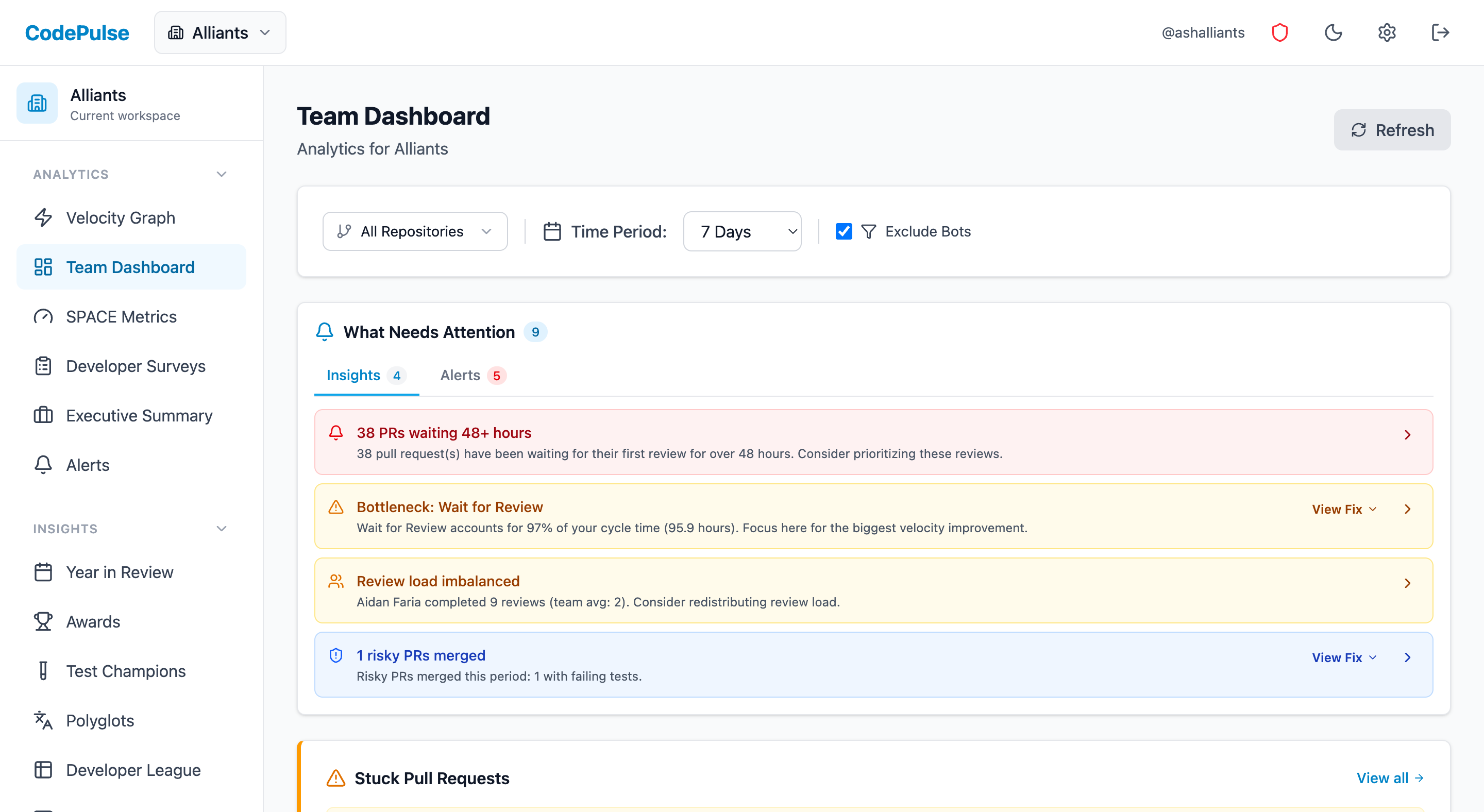
CodePulse automatically calculates your PR cycle time and shows how you compare:
- Dashboard shows your current cycle time, PRs merged, and deployment frequency
- Benchmarks compares your metrics to industry peers by team size and vertical
- Executive Summary provides a health grade (A-F) based on how you compare to best practices
What Do DORA Benchmarks Say About PR Cycle Time by Industry?
The Four DORA Metrics
DORA (DevOps Research and Assessment) tracks four metrics that correlate with software delivery performance. Use our DORA metrics calculator to assess your team's performance level:
- Deployment Frequency: How often you deploy to production
- Lead Time for Changes: Time from commit to production
- Change Failure Rate: Percentage of deployments causing failures
- Mean Time to Recovery: How quickly you recover from failures
DORA Benchmarks (2024 State of DevOps Report)
Deployment Frequency:
  Elite:    Multiple times per day
  High:     Weekly to daily
  Medium:   Monthly to weekly
  Low:      Less than monthly

Lead Time for Changes:
  Elite:    Less than 1 hour
  High:     1 day to 1 week
  Medium:   1 week to 1 month
  Low:      More than 1 month

Change Failure Rate:
  Elite:    0-5%
  High:     5-10%
  Medium:   10-15%
  Low:      > 15%

Mean Time to Recovery:
  Elite:    Less than 1 hour
  High:     Less than 1 day
  Medium:   1 day to 1 week
  Low:      More than 1 week
Industry Variations
Different industries have different constraints and typical performance levels:
SaaS / Consumer Tech:
  Typical deployment: Daily to multiple times daily
  Typical lead time: < 1 day
  Context: Fast iteration, A/B testing culture

Fintech / Financial Services:
  Typical deployment: Weekly
  Typical lead time: 1-2 weeks
  Context: Compliance reviews, risk management

Healthcare / Life Sciences:
  Typical deployment: Bi-weekly to monthly
  Typical lead time: 2-4 weeks
  Context: Regulatory requirements, validation

Enterprise B2B:
  Typical deployment: Weekly to bi-weekly
  Typical lead time: 1-2 weeks
  Context: Customer coordination, stability focus

E-commerce:
  Typical deployment: Daily
  Typical lead time: < 1 day
  Context: Competitive pressure, rapid iteration
How Do You Use PR Cycle Time Benchmarks Constructively?
Step 1: Know Your Current State
Before comparing to benchmarks, accurately measure your current performance:
- Use consistent definitions (what counts as "cycle time" for you?)
- Measure over a meaningful period (at least 30-90 days)
- Segment by team, repo, or PR type if needed
- Exclude outliers thoughtfully (don't hide problems)
Step 2: Choose Relevant Comparisons
Don't compare apples to oranges:
- Match team size: A 5-person startup shouldn't compare to Google
- Match industry: A bank shouldn't target SaaS startup metrics
- Match maturity: A 2-year-old company differs from a 20-year-old one
Step 3: Focus on Improvement, Not Rank
The goal isn't to be "elite" by external standards. It's to:
- Improve from your current baseline
- Remove obstacles blocking your team
- Sustain improvements over time
A team that goes from 5-day cycle time to 3-day cycle time has achieved more than a team that was always at 1 day but hasn't improved.
Step 4: Investigate Gaps Thoughtfully
If you're significantly below benchmarks, ask why before taking action:
- Is it a measurement issue? Maybe you're measuring differently
- Is it justified? Compliance requirements, quality standards
- Is it a process problem? Too many approvals, slow CI
- Is it a people problem? Not enough reviewers, skill gaps
Step 5: Set Incremental Targets
Don't try to jump from "needs work" to "elite" overnight:
Example improvement roadmap:

Current state: 5-day average cycle time

Quarter 1 target: 4 days (20% improvement)
  Focus: Reduce time to first review

Quarter 2 target: 3 days (25% improvement)
  Focus: Reduce review iterations

Quarter 3 target: 2 days (33% improvement)
  Focus: Improve PR size and quality

Quarter 4 target: 1.5 days (25% improvement)
  Focus: Automation and process refinement
How Do You Set Your Own PR Cycle Time Targets?
Building a Target-Setting Framework
Use this framework to set meaningful targets:
1. Baseline (where are we?)
- Measure current performance over 90 days
- Understand variance (some weeks better than others)
- Identify biggest time sinks
2. Aspiration (where could we be?)
- Look at benchmarks for similar teams
- Look at your own best weeks/teams
- Talk to engineers about what feels achievable
3. Constraints (what limits us?)
- Compliance or regulatory requirements
- Team size and availability
- Technical limitations (slow CI, monorepo)
4. Target (what should we aim for?)
- Ambitious but achievable (20-30% improvement per quarter)
- Specific and measurable
- Time-bound
Example Target-Setting
Team: Platform team, 15 engineers, fintech

Baseline:
  PR cycle time: 4.2 days
  Time to first review: 18 hours
  Review iterations: 2.1 average
  Deployment frequency: 2x per week

Benchmarks (medium fintech teams):
  PR cycle time: 2-3 days
  Time to first review: 4-8 hours
  Review iterations: 1.5 average
  Deployment frequency: 3-5x per week

Constraints:
  - Compliance requires 2 approvers
  - Can't deploy Friday-Sunday
  - Some specialists only available certain days

Targets (next quarter):
  PR cycle time: 3.0 days (29% improvement)
  Time to first review: 8 hours (56% improvement)
  Review iterations: 1.8 average (14% improvement)
  Deployment frequency: 3x per week (50% improvement)

Actions:
  - Implement review SLA (4-hour target)
  - Add second approver from each specialty area
  - Improve PR templates to reduce iterations
Avoiding Common Traps
- Don't game the metric: Splitting PRs artificially or merging without proper review defeats the purpose
- Don't ignore context: A 5-day cycle time for a complex, well-reviewed PR is better than 4 hours of rubber-stamping
- Don't compare unfairly: Your maintenance team shouldn't be held to feature team benchmarks
- Don't forget quality: Faster isn't better if change failure rate increases
Benchmarks are useful reference points, but they are not the goal. What matters is whether your team is getting better over time and shipping without burning out. Use benchmarks to spot opportunities, not as targets to hit.
What Is a Healthy PR Lifecycle for Enterprise Engineering Teams?
"Healthy" doesn't mean the same thing at every scale. A 200+ engineer enterprise organization runs more required approvals, more specialized reviewers, and more compliance gates than a 10-person startup, so a healthy PR lifecycle looks different too. As the team-size benchmarks above show, enterprise teams (200+ engineers) sit at 2-3 days for a "strong" cycle time versus under 24 hours for small teams, and that gap is process overhead, not a lack of urgency.
At enterprise scale, the PR lifecycle has three checkpoints worth watching separately: time to first review (the biggest lever - our breakdown of 117,000+ reviewed PRs found that waiting for review accounts for the vast majority of total cycle time), review duration (how long the back-and-forth takes once a reviewer engages), and merge time (approval to merge, often slowed by required checks or a second approver). Our analysis of enterprise-scale reviewed PRs found a median cycle time of just 3 hours, but that figure only covers PRs that actually get reviewed, which skews faster than raw org-wide averages that include self-merges and stale PRs.
The honest answer: a healthy lifecycle is one that's fast enough to keep feedback loops tight, consistent enough that engineers aren't blocked for days waiting on a single approver, and stable as headcount grows, not a fixed number copied from a benchmark table. Track your own trend against your own baseline first, then use industry benchmarks as a sanity check.
Frequently Asked Questions
For small teams (under 10 engineers), target under 12 hours. Medium teams (10-50) should aim for 1-2 days. Large teams (50-200) typically achieve 2-3 days at the "strong" level. Enterprise teams (200+) often see 2-3 days as strong performance due to coordination overhead.
Now measure this metric on your own repositories
Connect read-only GitHub in about five minutes and get your baseline, your trend, and the constraint behind it. Your fourteen usable trial days start when the first repository finishes syncing.
Read-only GitHub · Your code stays yours · Team-level by default · No credit card
See These Features in Action
Explore all featuresRelated Guides
DORA Metrics Explained: The 4 Keys Without the Hype
A complete breakdown of the four DORA metrics - deployment frequency, lead time, change failure rate, and MTTR - with honest benchmarks and gaming traps to avoid.
We Cut PR Cycle Time by 47%. Here's the Exact Playbook
A practical playbook for engineering managers to identify bottlenecks, improve review processes, and ship code faster - without sacrificing review quality.
Engineering Metrics Dashboard: The 7 Metrics You Need
Skip vanity metrics. Here are the 7 engineering metrics VPs actually need to track team performance, delivery, and quality.
No CI/CD Access? Here's How Google Measures DORA Anyway
Measure DORA Four Keys (deployment frequency, lead time, change failure rate, time to restore) using only GitHub data - no CI/CD integration required.
Why the 70/30 Rule Is Killing Your Engineering Team
Find the right balance between shipping new features and maintaining existing code using engineering metrics and data-driven strategies.
The Data That Made My CFO Say Yes to 5 New Engineers
Build a data-driven business case for engineering headcount using throughput metrics, benchmarks, and trend analysis that executives understand.