
Understand the system around the team, not a developer leaderboard
Preview team-level workload, collaboration, and delivery signals designed for process improvement rather than performance grading.
Read-only GitHub · Your code stays yours · Team-level by default · No credit card
Code review is where engineering culture lives or dies. It is where knowledge transfers, quality standards are enforced, and engineers learn from each other. But it is also where toxic dynamics can take root: dismissive comments, endless nitpicking, or reviews that feel like gatekeeping rather than collaboration. According to research by Bacchelli and Bird at Microsoft, the top motivation developers cite for code review is finding defects, but the top actual outcome is knowledge transfer - a mismatch that shapes how teams experience the process.
How do you assess and improve code review culture?
Assess code review culture by tracking measurable signals: time to first review, review rounds per PR, reviewer concentration, approval rate skew, and comment sentiment distribution. CodePulse surfaces these metrics automatically through its Review Insights and Review Network pages. Fix the most damaging pattern first - usually dismissiveness, because it destroys psychological safety faster than any other dysfunction.
This guide shows you how to assess your code review culture, identify problematic patterns with measurable data, and build psychological safety that makes reviews productive rather than painful.
What Makes a Healthy Review Culture?
The Purpose of Code Review
Before assessing your culture, align on why code review exists. A 2013 study by Bacchelli and Bird at Microsoft found that while developers expect code review to primarily catch bugs, the most frequent actual benefit is knowledge dissemination. That finding reframes the entire purpose:
- Knowledge sharing: Spreading understanding of the codebase
- Quality assurance: Catching bugs and design issues before production
- Mentorship: Helping engineers grow through feedback
- Consistency: Maintaining coding standards across the team
- Collaboration: Building shared ownership of the code
Notice what is NOT on this list: gatekeeping, proving superiority, or blocking progress. If your reviews primarily serve those functions, you have a culture problem, not a process problem.
Signs of a Healthy Review Culture
In a healthy culture, you will see:
- Fast turnaround: Reviews happen within hours, not days
- Constructive tone: Feedback is specific, actionable, and kind
- Two-way dialogue: Authors and reviewers discuss, not dictate
- Balanced participation: Everyone reviews, not just seniors
- Learning mindset: Reviews are opportunities to learn, not tests to pass
- Appropriate depth: Major issues get attention; trivial ones do not block
For more on balancing review load across your team, see Review Load Balancing Guide.
What Are the Signs of Toxic Review Patterns?
Toxic review patterns are often invisible to the people perpetuating them. The table below maps five common dysfunctions to their measurable signals, so you can detect them with data rather than relying on complaints that may never surface. The network view - who reviews whom, and where gatekeepers concentrate - is covered in our code review network analysis guide and often catches patterns the table below can't see.
| Pattern | Toxic Signal | Healthy Benchmark | CodePulse Metric |
|---|---|---|---|
| Gatekeeping | One reviewer blocks 40%+ of PRs; 3+ review rounds on simple changes | No reviewer blocks more than 20% of PRs; 1-2 rounds typical | Reviewer concentration, review rounds |
| Rubber Stamping | Approval in under 2 minutes on 500+ line PRs; zero comments on complex changes | Review time scales with PR size; at least 1 substantive comment on large PRs | Review time vs PR size, comment count, rubber stamp detection |
| Nitpicking | 20+ comments per PR, mostly about style; blocking on non-standard preferences | Style handled by automation; human comments focus on logic and design | Comments per PR, actionable comment ratio |
| Dismissiveness | High negative sentiment score; terse comments without explanation | Mostly neutral/positive tone; feedback explains the "why" | Sentiment given/received, constructive ratio |
| Neglect | Time to first review exceeds 24 hours; PRs sit days without acknowledgment | First review within 4 hours during business hours | Time to first review, wait for review hours |
"The most dangerous review pattern is not the one that slows you down. It is the one that silences your team. Dismissive reviews do not just block a PR - they teach engineers to stop trying."
Pattern 1: The Gatekeeper
One or two senior engineers who block most PRs, often with extensive change requests that reflect personal preferences more than genuine quality concerns.
Signs:
- Same reviewers block a disproportionate number of PRs
- Multiple review rounds are common for simple changes
- Engineers dread getting reviewed by specific people
- "Let me rewrite this" instead of "consider changing X"
Impact: Slower delivery, learned helplessness, attrition
Pattern 2: The Rubber Stamp
Reviews approved in minutes with "LGTM" and no substantive feedback, regardless of PR complexity. A study of code review at Microsoft found that "understanding" was the second most common review outcome - but rubber stamps eliminate that benefit entirely.
Signs:
- Very short review times even for large PRs
- No comments or questions on complex changes
- Bugs slip through that review should have caught
- Reviews feel like a checkbox, not a conversation
The pattern is not rare, and it is not confined to teams under pressure. Our Rubber Stamp Index read every merged pull request in 222 of the most-starred projects on GitHub during August 2026: 5% were merged within five minutes of being opened, and in the busiest projects 70% carried no approving review from anyone but the author.
Impact: Quality issues, knowledge silos, false sense of security
Pattern 3: The Nitpicker
Reviews dominated by style preferences, formatting, and trivial issues while missing substantial concerns. This is a form of Parkinson's law of triviality (bike-shedding): it is easier to argue about variable names than to reason about system design.
Signs:
- Dozens of comments about naming and formatting
- Blocking merges over style preferences not in the style guide
- Missing actual bugs while debating indentation
- "We don't usually do it this way" without explaining why
Impact: Frustration, wasted time, important issues ignored
Pattern 4: The Dismisser
Harsh, terse, or dismissive feedback that makes authors feel stupid or inadequate.
Signs:
- Comments like "Why would you do this?" or "This is wrong"
- No explanation of what is better or why
- Sarcasm or condescension
- Engineers avoid asking questions in reviews
Impact: Destroyed psychological safety, fear of contribution
Pattern 5: The Silent Treatment
PRs that sit unreviewed for days, with no acknowledgment or explanation.
Signs:
- Long time-to-first-review metrics
- Authors repeatedly pinging for reviews
- No SLAs or expectations for review turnaround
- "I didn't have time" as the default excuse
Impact: Blocked work, frustration, context decay
For distributed teams, async review challenges compound these issues. See Async Code Review for Distributed Teams.
How Do You Measure Review Sentiment?
Quantitative Signals
Data can reveal culture problems before they become retention problems:
- Review rounds per PR: High average suggests gatekeeping or poor initial PRs
- Time to first review: Long waits suggest capacity issues or deprioritization
- Reviewer concentration: Few people doing most reviews is a bottleneck and a burnout risk (see Burnout Signals in Git Data)
- Comments per PR: Extremely high or low both warrant investigation
- Approval rate by reviewer: Some reviewers may block disproportionately
Sentiment Analysis
Beyond numbers, the tone of review comments matters. Sentiment analysis categorizes comments as:
- Positive: Encouraging, appreciative, collaborative
- Neutral: Factual, objective, informational
- Negative: Critical, dismissive, harsh
A healthy distribution has mostly neutral (factual feedback) with some positive (encouragement) and minimal negative (reserved for serious issues). If negative sentiment exceeds 15-20% of total comments, that is a red flag worth investigating.
Sentiment Red-Flag Glossary
Specific phrases in review comments often signal deeper cultural problems. In our experience analyzing review data, these patterns correlate with the dysfunctions above:
| Phrase or Pattern | Likely Problem | What to Investigate |
|---|---|---|
| "nit:" on 10+ comments per PR | Bike-shedding | Is the team using linters/formatters? Are nits blocking merge? |
| "Why would you..." / "This is wrong" | Dismissiveness / low psychological safety | Is this reviewer's negative sentiment score above the team average? |
| "Are you sure about this?" (repeated) | Low trust / passive-aggressive gatekeeping | Does this reviewer have a higher block rate than peers? |
| "LGTM" with zero comments (on large PRs) | Rubber stamping / review fatigue | Is this reviewer overloaded? Check their review load ratio |
| "We don't do it that way here" | Undocumented conventions / resistance to change | Is there an actual style guide? Is the convention enforced by tooling? |
| Long threads on minor points | Ego-driven debate / unclear decision authority | Does the team have a "reviewer has final call" or "author decides" policy? |
💬 How CodePulse Measures Review Culture
CodePulse tracks review culture metrics automatically from your GitHub data:
- Code Review Insights shows sentiment scores per developer (given and received), constructive ratio, actionable comment ratio, and negative comment counts
- Review Network visualizes who reviews whom, identifying concentrated reviewers and review load imbalances
- Rubber stamp detection flags PRs approved in under 1 minute with zero comments
- Time to first review and review response time tracked per developer
Navigate to Review Insights in the sidebar to see your team's sentiment distribution and identify reviewers whose tone may need attention.
How Do You Improve Feedback Quality?
The Feedback Framework
Good review feedback is:
- Specific: Points to exact lines/patterns, not vague concerns
- Actionable: Explains what to change, not just what is wrong
- Educational: Includes "why" so the author learns
- Proportionate: Major issues get attention; minor ones do not block
- Kind: Assumes good intent, respects the person
"A substantive but dismissive review does more damage than a shallow but kind one. Thoroughness without empathy teaches engineers to dread feedback. Trust compounds; harshness erodes it."
Comment Classification
Establish a team convention for categorizing feedback. This single practice reduces friction more than almost any other review process change, because it separates "must fix" from "nice to have" and eliminates ambiguity about reviewer intent:
Conventions like these hold better when they live somewhere the team reads rather than in a wiki page nobody opens. Writing them into a Claude Code review skill applies the same categories to every change automatically.
[blocking] - Must be addressed before merge
  "This SQL query is vulnerable to injection"

[suggestion] - Consider changing, but okay to disagree
  "This could be cleaner with a map() instead of forEach()"

[question] - Seeking to understand, not necessarily requesting change
  "Why did you choose this approach over X?"

[nitpick] - Very minor, purely stylistic, don't block on this
  "Minor: extra blank line here"

[praise] - Highlighting good work
  "Great error handling here!"
Reframing Common Patterns
- "This is wrong"
- "Why would you do this?"
- "LGTM"
- "This is inefficient"
- "We don't do it that way"
- "This won't work because X. Consider doing Y instead."
- "Can you help me understand the reasoning here? I'm wondering if X might be simpler."
- "Looks good! The error handling in the retry logic is solid."
- "[suggestion] This could be O(n) instead of O(n^2) by using a Set. Example: ..."
- "Our convention is X because of Y. See the style guide at Z."
The Role of AI Code Review Tools
AI review tools (GitHub Copilot code review, CodeRabbit, and similar) can meaningfully improve review culture by handling the low-value work that drives nitpicking. When a linter or AI catches formatting issues, variable naming inconsistencies, and simple bugs automatically, human reviewers can focus on architecture, business logic, and mentorship.
The risk: teams may start treating AI review as a substitute for human engagement. AI tools do not build relationships, transfer tacit knowledge, or notice when a junior engineer is struggling. Use AI to reduce the noise; keep human review for the signal. For guidance on balancing reviewer load, see Optimal Reviewer Count Guide.
🔥 Our Take
Review tone matters more than review thoroughness. Every time. A team with kind but shallow reviews will improve faster than a team with thorough but hostile ones, because psychological safety is the prerequisite for learning.
Google's Project Aristotle identified psychological safety as the single strongest predictor of team effectiveness across 180+ teams. In code review, that means engineers who feel safe asking questions, admitting confusion, and submitting imperfect code produce better work over time than engineers who are afraid to make mistakes. If you have to choose between a reviewer who catches every bug but terrifies juniors and one who misses some things but builds trust, choose trust. You can add linters and tests for coverage. You cannot automate psychological safety.
How Do You Build Psychological Safety in Reviews?
What Psychological Safety Means
Psychological safety, as defined by Harvard professor Amy Edmondson in her foundational 1999 research, is the belief that you will not be punished or humiliated for speaking up with questions, concerns, or mistakes. In code review, this translates to concrete behaviors:
- Authors feel safe submitting imperfect code for feedback
- Reviewers feel safe asking "basic" questions
- Everyone feels comfortable admitting they do not know something
- Mistakes are learning opportunities, not blame targets
"Engineers who dread reviews will eventually leave. Engineers who learn and grow through reviews become your best advocates and your strongest retention asset."
Leader Behaviors That Build Safety
- Model vulnerability: As a leader, ask questions in reviews. Admit when you do not understand. This signals that not-knowing is acceptable.
- Praise publicly, correct privately: Celebrate good reviews in team channels; address toxic patterns in 1:1s.
- Respond to mistakes with curiosity: "What happened?" not "Who is responsible?"
- Normalize iteration: "It is rare to get it perfect on the first try - that is what review is for."
Team Practices That Help
- Review guidelines document: Explicit expectations for tone and process remove ambiguity. For a framework on rolling out metrics and process changes without triggering resistance, see Engineering Metrics Rollout Playbook.
- Pair reviewing: Senior and junior review together, modeling good feedback in real time
- Review retrospectives: Periodically ask "How are our reviews working?" and actually change things based on the answers
- Anonymous feedback channel: Let people report toxic patterns safely
Addressing Toxic Patterns
When you identify a problem reviewer or pattern:
- Start with data: "I noticed your reviews average 3 rounds while team average is 1.5"
- Assume good intent: "I am sure you are trying to maintain quality. Help me understand your approach"
- Clarify impact: "The team has mentioned feeling blocked. That is affecting velocity"
- Collaborate on solutions: "What could we adjust to maintain quality while unblocking faster?"
- Follow up: Check back in 2-4 weeks. Use CodePulse's Review Insights to track whether sentiment and turnaround time improve
For more on measuring team health without creating a surveillance culture, see Measuring Team Performance Without Micromanaging.
How Do You Build a Review Culture That Lasts?
Code review culture is not a one-time fix. It requires ongoing attention, measurement, and reinforcement. The teams that sustain healthy review practices share three characteristics:
- They measure it: You cannot improve what you do not track. Sentiment scores, review turnaround, and reviewer load ratios should be reviewed monthly, the same way you review velocity or incident counts.
- They talk about it: Review culture is a standing topic in retros. "How did reviews feel this sprint?" is as important as "Did we hit our commitments?"
- They invest in it: Review is not overhead. It is where your team's collective intelligence compounds. Invest in review culture like you invest in architecture: thoughtfully, iteratively, and with the long term in mind.
Review culture also interacts with review coverage and PR prioritization. A team with great sentiment but only 60% review coverage still has a process gap. A team with fast review turnaround but toxic tone will still lose people. Both dimensions matter.
The payoff for getting this right is a team that ships fast, maintains quality, and actually enjoys working together. That combination is rare, and it is your strongest competitive advantage for hiring and retention.
Frequently Asked Questions
Code review sentiment is a measure of the emotional tone in pull request comments and feedback. It classifies review comments as positive (encouraging, appreciative), neutral (factual, objective), or negative (dismissive, harsh). Tracking sentiment over time reveals whether your review culture is collaborative or corrosive, and helps identify specific reviewers or teams where tone needs improvement.
Get this view for your own teams
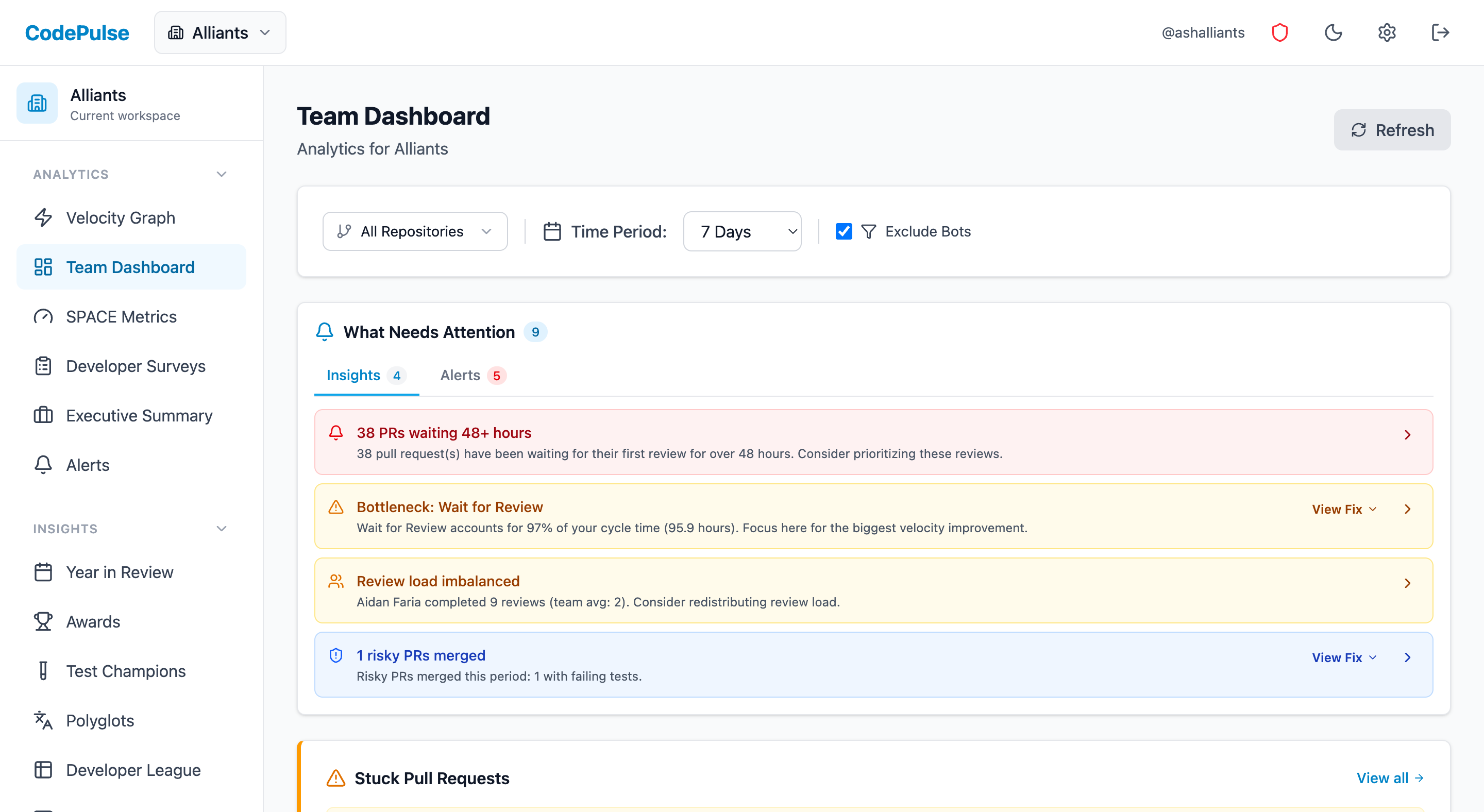
Connect GitHub for team-level workload, review distribution, and delivery signals. Individual views stay off unless your organisation explicitly turns them on.
Read-only GitHub · Your code stays yours · Team-level by default · No credit card
See These Features in Action
Interactive graph of review relationships and workload distribution.
Measure review thoroughness and feedback quality across the team.
Related Guides
Remote Code Reviews Are Broken. Here's the 3-Timezone Fix
How to run effective code reviews across time zones without sacrificing quality or velocity.
Your Best Engineer Is About to Quit (Check Review Load)
Learn how to identify overloaded reviewers, distribute review work equitably, and maintain review quality without burning out your senior engineers.
Engineering Metrics That Won't Get You Reported to HR
An opinionated guide to implementing engineering metrics that build trust. Includes the Visibility Bias Framework, practical do/don't guidance, and a 30-day action plan.
The Exact Number of Reviewers Per PR (Research Says 2, But...)
Research-backed guidance on how many reviewers you need per pull request, with strategies for matching review depth to risk level.
Your Git Data Predicts Burnout 6 Weeks in Advance
Use the STRAIN Score framework to detect developer burnout from Git data. Identify after-hours patterns, review overload, and intensity creep before they cause turnover.
100% Review Coverage Is a Lie (What Actually Matters)
Why 100% review coverage matters, how to track it, and practical steps to build a consistent code review culture across your team.
The Git Query That Finds Your New Hire's Perfect Mentor
Use Git activity data to accelerate new hire onboarding, identify domain experts for pairing, and track ramp-up progress.
Engineering Awards That Won't Destroy Your Culture
Build a data-driven recognition program that celebrates engineering achievements without creating toxic competition. 15 award categories, program design checklist, and measurement framework.