
Understand the system around the team, not a developer leaderboard
Preview team-level workload, collaboration, and delivery signals designed for process improvement rather than performance grading.
Read-only GitHub · Your code stays yours · Team-level by default · No credit card
Engineering metrics have a trust problem. When developers hear "we're going to start tracking metrics," the reaction is often skepticism or outright resistance. And that's understandable - poorly implemented metrics have been used to micromanage, pressure, and unfairly evaluate engineers for decades.
"If you're using individual developer metrics for performance reviews, you've already lost. You'll get exactly what you measure: gamed numbers and eroded trust."
But here's the uncomfortable truth: not measuring is also a choice with consequences. According to the 2025 LeadDev Engineering Leadership Report, 40% of engineering teams report being less motivated than a year ago, and two-thirds of engineers are experiencing some level of burnout. Without visibility, these problems fester - decisions get made without data, resources are misallocated based on who's loudest, and burnout goes unnoticed until someone quits.
This guide shows you how to implement measurement that builds trust, improves transparency, and helps your team perform better - without the dysfunction that gives metrics a bad name.
The Visibility Bias Problem
Before diving into what to measure, we need to acknowledge the elephant in the room: metrics create visibility bias.
🔥 Our Take
"High performer" is often just "most visible." The developer with the most commits might just be breaking work into tiny pieces. The one with the fastest cycle time might be cherry-picking easy tasks.
Git metrics tell you what happened, not who's valuable. The best engineers often do invisible work: architecture decisions that prevented problems, mentorship that made someone else better, documentation that saved hours of confusion, or the careful code review that caught a security vulnerability. None of that shows up in commit counts.
Visibility bias is why the most important engineering work is unmeasurable. If you only track what's countable, you'll undervalue what matters. This isn't an argument against metrics - it's an argument for using metrics as one input among many, never as the final word.
The Visibility Bias Framework
When evaluating any metric, ask: "Does this measure value or just visibility?"
| Metric | What It Actually Measures | Visibility Bias Risk |
|---|---|---|
| Commits per day | How often someone saves work | High - rewards small commits over thoughtful batching |
| Lines of code | How verbose someone's coding style is | High - penalizes refactoring and deletion |
| PRs merged (individual) | How many discrete changes shipped | High - rewards task-splitting over collaboration |
| Team cycle time | How fast the system moves work through | Low - measures process, not individuals |
| Review coverage % | What percentage of code gets reviewed | Low - measures team discipline |
| Knowledge distribution | How many people can work on each area | Low - measures resilience, not productivity |
"The developer who deleted 500 lines while maintaining functionality has done better work than the one who added 500. Metrics that can't see that are worse than useless."
Team-Level vs Individual Metrics: A Clear Line
The single most important principle: focus metrics at the team level, not the individual level. This isn't just nice-to-have ethics - it's better engineering management.
🔥 Our Take
If you're using individual developer metrics for performance reviews, you've already lost. The moment you compare Alice's cycle time to Bob's, you've turned teammates into competitors.
Metrics are for understanding systems, not judging people. Performance reviews should use metrics as conversation starters, not scorecards. The question isn't "Why is Alice slower than Bob?" but "What's blocking the team from shipping faster?"
Do This, Not That
- "Alice's PRs take 3 days, Bob's take 1 day"
- "Developer leaderboard by commits"
- "Review performance scores by person"
- "Who shipped the most this sprint?"
- "Our team's average cycle time is 2.1 days - where are the bottlenecks?"
- "Team velocity trend over the quarter"
- "Review load distribution across the team"
- "Did we deliver on our sprint commitments as a team?"
When Individual Data Is Actually Useful
Individual data isn't inherently bad - it's how you use it that matters. Here are the legitimate use cases:
- Self-reflection: Developers reviewing their own patterns and trends to improve their workflow
- 1:1 coaching: Manager and report looking at data together to identify support needs - never as a surprise
- Workload balancing: Identifying if someone is overloaded or underutilized (see burnout signals)
- Spotting blockers: Finding if someone is stuck waiting on reviews or dependencies
- Knowledge risk: Identifying code hotspots and knowledge silos that need attention
The key: individual data should be used for the engineer, not against them. If you're pulling up someone's metrics to build a case for a PIP, you've already failed at management.
The Gaming Problem (And Why It's Your Fault)
Every time you attach rewards or punishment to a metric, you invite gaming. This isn't a character flaw in your engineers - it's basic human behavior. The problem is the system you created, not the people responding rationally to incentives.
Goodhart's Law in Action
"When a measure becomes a target, it ceases to be a good measure."
Here's what gaming looks like in practice:
- Lines of code
- Commits per day
- PRs merged
- Fast cycle time (individual)
- Low defect count
- Verbose code, copy-paste, avoided refactoring
- Tiny meaningless commits, split work artificially
- Cherry-picked easy tasks, avoided complex work
- Rushed reviews, less thorough testing, smaller PRs
- Unreported bugs, defensive testing, blame-shifting
"The solution isn't to find 'un-gameable' metrics - they don't exist. The solution is to use metrics for insight, not incentives."
How to Prevent Gaming
- Never tie metrics directly to compensation or performance ratings. Metrics inform conversations; they don't replace judgment.
- Use multiple metrics together. Gaming one metric usually hurts another. If someone's cycle time drops but their review quality does too, that's visible.
- Focus on team metrics. It's much harder to game something when the whole team is measured together.
- Review trends, not absolutes. A team improving from 5 days to 4 days is progress, regardless of whether another team is at 2 days.
- Be transparent about the game. Tell your team exactly what you measure and why. Sunlight is the best disinfectant.
The Leadership Perception Gap
The 2025 LeadDev Engineering Leadership Report surveying 600+ engineering professionals reveals a troubling burnout reality:
- 22% of engineers report critical burnout levels
- 24% report moderate burnout, with only 21% categorized as "healthy"
- 40% of teams are less motivated than a year ago
When two-thirds of your engineers are experiencing some level of burnout but leadership thinks everything is fine, you have a visibility problem. This is exactly what happens when you don't measure - you don't see problems until they become resignations.
📊How CodePulse Helps Spot Burnout Early
Navigate to Developers to see workload distribution and after-hours commit patterns:
- Review load ratio shows who's doing 3x the reviews
- Commit time distribution reveals after-hours work patterns
- Trend data shows if workload is increasing over time
- See our STRAIN Score framework for burnout risk assessment
Good metrics close the perception gap. They give leadership visibility into what's actually happening - not to micromanage, but to make better decisions about resources, timelines, and priorities.
Building a Healthy Metrics Culture
Start with Why (And Be Honest)
Before rolling out metrics, be crystal clear about the purpose. Your team will see through corporate-speak instantly.
- "We want to identify and remove obstacles"
- "We want to celebrate when we improve"
- "We want data to inform process experiments"
- "We want to spot burnout before it's too late"
- "We want to know who's not pulling their weight"
- "We need to justify the team's existence"
- "We want to rank developers against each other"
- "Leadership is demanding numbers"
If your honest answer is in the right column, fix that first. Metrics won't solve a trust problem - they'll amplify it.
The Non-Negotiables
- Full transparency: Everyone sees the same data leadership sees. No secret dashboards for managers.
- Published methodology: How each metric is calculated is documented and accessible.
- Team involvement: The team chooses what to measure, not management. 3-5 metrics max.
- Explicit commitments: State what you will and won't do with the data. Put it in writing.
- Regular review: Revisit your metrics quarterly. Are they still serving their purpose?
Sample Commitments to Your Team
Our Engineering Metrics Commitments:

1. Metrics will NEVER be used in performance reviews
   without context and conversation.

2. Individual data will NOT be shared with HR or
   used in layoff decisions.

3. We will review our metrics approach quarterly
   and adjust based on team feedback.

4. Any team member can request their individual
   data be excluded from team discussions.

5. The team decides what we measure. Management
   facilitates, not dictates.

Signed: [Engineering Manager]
Date: [Date]
Getting Buy-In from Engineers
The broader leadership context - why data-driven engineering leadership works when metrics serve the team rather than the other way around - is covered in our data-driven engineering leadership guide. It's the framing we'd use to open this conversation with a skeptical team.
Acknowledge Past Harm
If your organization has misused metrics before - or if your engineers have been burned at previous companies - acknowledge it directly:
"I know metrics have been used poorly, both here and at other companies many of you have worked at. Here's what we're doing differently, and here's how you can hold me accountable if we slip."
Start Small and Iterate
Don't roll out comprehensive metrics dashboards on day one. This is a trust-building exercise, not a technology rollout.
- Start with 2-3 team-level metrics
- Use them for a quarter
- Gather honest feedback
- Adjust or remove metrics that aren't helping
- Expand gradually only if trust is building
Give Engineers Access First
Let developers see their own trends and patterns before managers do. Self-reflection is valuable and non-threatening. When engineers can see their own data first, the power dynamic shifts.
📊How CodePulse Supports This
CodePulse is designed for transparency, not surveillance:
- Same dashboard for ICs and managers - no hidden views
- Team-level metrics front and center
- Individual data available for self-reflection
- No ranking, scoring, or "performance" labels
The Ultimate Test
Ask your engineers: "Do you find our metrics useful for improving how we work?"
If the answer is no, you have more work to do. If the answer is "yes, but I don't trust how they're being used," you have a leadership problem, not a metrics problem. If the answer is genuinely yes, you're building a healthy metrics culture.
What to Measure (And What to Avoid)
Recommended Team-Level Metrics
- PR cycle time (team average): How fast does work flow through the system? See our cycle time reduction guide.
- Review coverage %: What percentage of code is reviewed before merging?
- Deployment frequency: How often does the team ship to production?
- Review load distribution: Is review work spread evenly or concentrated? See review load balancing.
- Knowledge distribution: How many people can work on each part of the codebase? See knowledge silos.
Metrics That Cause Harm When Used Individually
| Metric | Why It's Harmful | What to Track Instead |
|---|---|---|
| Lines of code | In the age of AI coding assistants, it's not just useless - it's counterproductive | Team velocity trends |
| Commits per day | Incentivizes meaningless micro-commits | Team deployment frequency |
| PRs merged (individual) | Rewards task-splitting, penalizes collaboration | Team throughput |
| Story points completed | Story points are estimation tools, not productivity measures | Sprint completion rate (team) |
| Hours logged | Measures presence, not productivity; penalizes efficiency | Outcomes delivered |
"The fact that anyone still tracks lines of code in 2025 is embarrassing. In the age of AI coding assistants, it's not just useless - it's counterproductive."
Your 30-Day Action Plan
Ready to implement metrics the right way? Here's your step-by-step plan:
30-Day Implementation Plan
Week 1: Foundation
- Audit any existing metrics usage - what's being tracked and how it's being used
- Have honest conversations with 3-5 engineers about their past experiences with metrics
- Draft your commitments document (see template above)
Week 2: Design
- Facilitate a team discussion on what "healthy" looks like
- Collaboratively choose 2-3 team-level metrics to start with
- Document methodology for calculating each metric
Week 3: Rollout
- Share commitments document with the team
- Set up dashboards with full team visibility
- Establish a baseline - where are you today?
Week 4: Calibrate
- Review data together as a team
- Discuss what's useful and what's noise
- Adjust or remove anything that isn't helping
- Schedule quarterly reviews
Trust takes time to build. Don't expect immediate buy-in. Consistent, ethical use of metrics over months and years is what builds a healthy culture. One violation of your commitments will set you back further than you can recover in a quarter.
🚀Get Started with CodePulse
CodePulse is built for teams who want insight without surveillance:
- Team-level metrics by default, individual data opt-in
- Transparent methodology - see exactly how everything is calculated
- No secret manager dashboards - everyone sees the same data
- Try your dashboard and see the difference
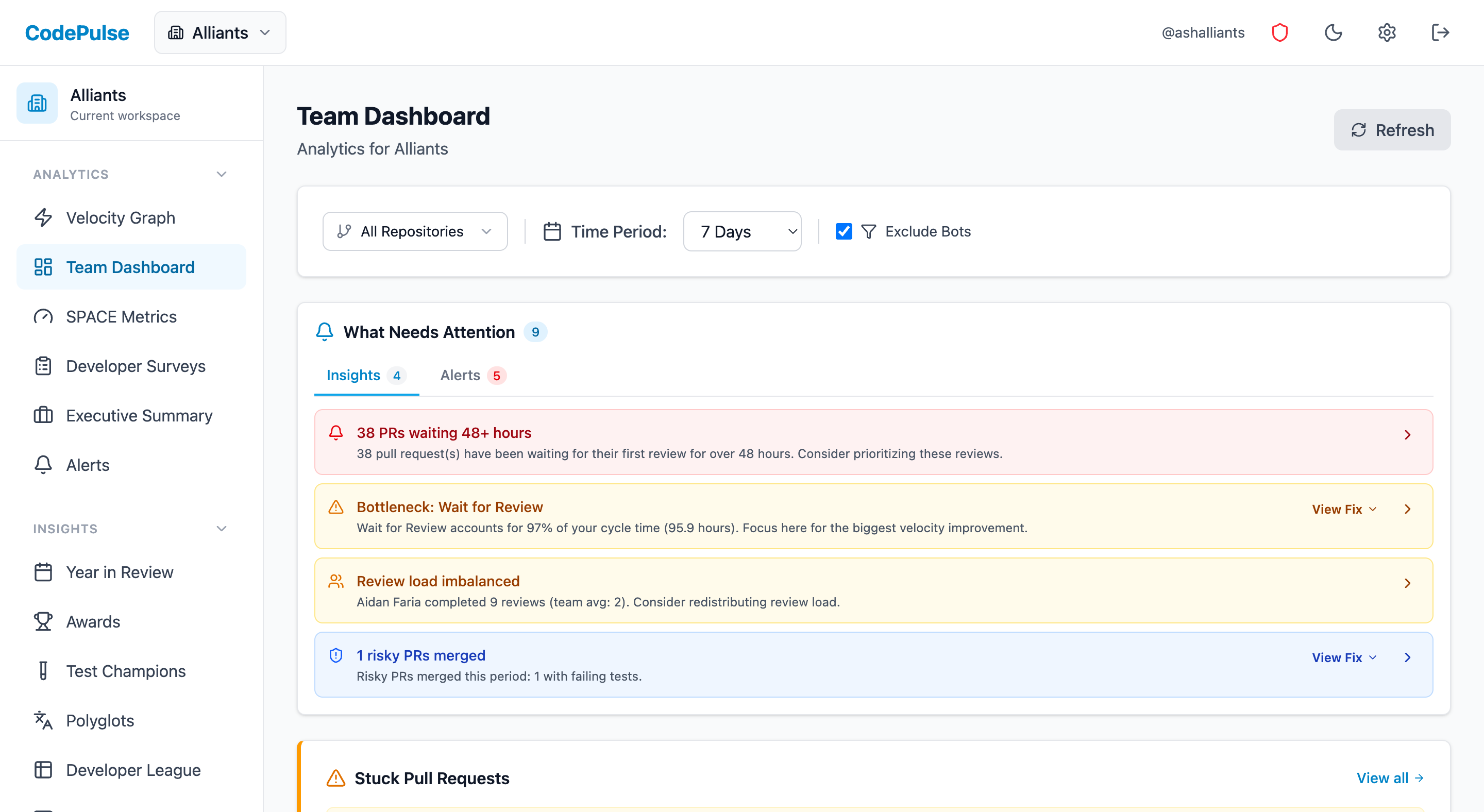
Get this view for your own teams
Connect GitHub for team-level workload, review distribution, and delivery signals. Individual views stay off unless your organisation explicitly turns them on.
Read-only GitHub · Your code stays yours · Team-level by default · No credit card
See These Features in Action
Compare contribution patterns for coaching, not surveillance.
Board-ready engineering performance in a single page.
Related Guides
Engineering Metrics Dashboard: The 7 Metrics You Need
Skip vanity metrics. Here are the 7 engineering metrics VPs actually need to track team performance, delivery, and quality.
Your Git Data Predicts Burnout 6 Weeks in Advance
Use the STRAIN Score framework to detect developer burnout from Git data. Identify after-hours patterns, review overload, and intensity creep before they cause turnover.
The 'Bus Factor' File That Could Kill Your Project
Use the Bus Factor Risk Matrix to identify where knowledge concentration creates hidden vulnerabilities before someone leaves.
Your Best Engineer Is About to Quit (Check Review Load)
Learn how to identify overloaded reviewers, distribute review work equitably, and maintain review quality without burning out your senior engineers.
Daily Standups: The 15-Minute Meeting Most Teams Get Wrong
Daily standups are the most common - and most commonly misused - meeting in software. This guide shows better formats (async, walk-the-board, exception-based), rules that work, and anti-patterns to avoid.
The Git Query That Finds Your New Hire's Perfect Mentor
Use Git activity data to accelerate new hire onboarding, identify domain experts for pairing, and track ramp-up progress.
Engineering Awards That Won't Destroy Your Culture
Build a data-driven recognition program that celebrates engineering achievements without creating toxic competition. 15 award categories, program design checklist, and measurement framework.
I Turned Around a Failing Team in 87 Days
You've inherited a struggling engineering team. Here is your 90-day data-driven playbook to diagnose what's broken, implement quick wins, avoid common mistakes, and restore trust.
Engineering Team Management: Using Data to Lead Without Micromanaging
Managing software teams requires balancing delivery, quality, team health, and individual growth. This guide shows how to use data for visibility while avoiding surveillance, with practical scenarios and communication patterns.
The Performance Review Framework That Doesn't Destroy Trust
Learn how to measure engineering performance fairly and effectively without creating toxic culture, gaming, or surveillance dynamics.
7 KPIs That Separate Great VPs From Struggling Ones
The essential metrics for VPs of Engineering, Directors, and CTOs. Covers executive dashboards, DORA metrics, team health, and stakeholder communication.