
Understand the system around the team, not a developer leaderboard
Preview team-level workload, collaboration, and delivery signals designed for process improvement rather than performance grading.
Read-only GitHub · Your code stays yours · Team-level by default · No credit card
The fastest way to destroy an engineering culture is to roll out metrics that feel like surveillance. The second fastest is to avoid measurement entirely because you're afraid of that outcome. This guide shows you how to build a metrics program that engineers actually trust - one that helps them succeed rather than polices their behavior.
Trust isn't just a nice-to-have. Without it, you'll get gaming, resentment, and attrition. With it, you'll get genuine improvement and engaged teams.
Why Developers Fear Metrics (And They're Often Right)
The Surveillance Pattern
Developers have seen metrics used badly. They've experienced or heard horror stories about:
- Lines of code tracking: Leading to verbose code and gaming
- Commit counting: Leading to tiny, meaningless commits
- Stack ranking: Where helping others hurts your score
- Secret dashboards: Where managers see data developers don't
- Metrics as punishment: Low numbers leading to PIPs or firing
Why skepticism is rational
"At my last company, they tracked everything. Low performers got called out in meetings. People gamed the metrics. Good engineers left."
"If management can see my PR count, they'll judge me without context. They won't know I spent the month on that gnarly refactor."
"If I resist metrics now, maybe I can avoid the surveillance culture before it starts."
When Skepticism Is Warranted
Developer skepticism is a healthy immune response. Metrics CAN be used badly. The solution isn't to dismiss concerns - it's to design a system that addresses them. For a deep dive into ethical measurement approaches, see our guide on non-invasive engineering analytics.
Insight vs Surveillance: The Critical Difference
The Purpose Test
The difference between insight and surveillance comes down to purpose and design:
| Insight Culture | Surveillance Culture |
|---|---|
| Metrics help teams identify obstacles | Metrics identify "low performers" |
| Everyone sees the same data | Managers have secret dashboards |
| Focus on team patterns | Focus on individual output |
| Metrics prompt conversations | Metrics trigger consequences |
| Context always considered | Numbers judged at face value |
| Developers helped by data | Developers threatened by data |
The "For You or Against You" Test
Ask developers: "Do you feel these metrics are being used to help you, or to evaluate you?" If the answer is "evaluate," you have a trust problem - regardless of your intentions.
Perception matters more than intent
"I look at cycle time to find bottlenecks and help the team improve."
"Manager is tracking how fast I work. If my numbers are low, I'm in trouble."
The Fix
- Explain purpose explicitly and repeatedly
- Show how data has helped (not punished)
- Involve developers in choosing what to measure
- Never use metrics in performance reviews
Team-Level Metrics vs Individual Tracking
Why Team-Level Is Safer
Team-level metrics reduce the risk of surveillance culture:
- No individual ranking: Can't compare Alice to Bob
- Shared ownership: Team succeeds or struggles together
- Context built in: Team members know what affected their numbers
- Collaboration encouraged: Helping others helps the team metric
This is exactly why bottleneck detection should stay at the team level: review wait time, stuck PRs, and cycle-time phase breakdowns expose where work is stalling in the pipeline without pointing a finger at any one developer. For the full methodology, see how to find team bottlenecks without surveillance.
When Individual Data Is Appropriate
Individual data isn't inherently bad. It depends on how it's used:
Appropriate individual data uses
- Performance reviews based on metrics
- Rankings or stack ranking
- Compensation decisions
- Comparison without context
- Self-reflection: Developer controls their own data, not shared without consent
- Coaching conversations: Developer present and involved, context discussed, no surprises
- Workload balancing: Used to help (not judge), redistributes work fairly
- Recognition: Celebrates positives, never punishes negatives
For more on team metrics, see our guide on measuring without micromanaging.
Transparency: What to Share and How
The Transparency Spectrum
- Full transparency: Everyone sees all data, including individual metrics
- Team transparency: Everyone sees team data; individuals see only their own
- Hierarchical: Managers see more than ICs
- Opaque: Only leadership sees metrics
For trust, aim for team transparency at minimum. Developers should never be surprised by data their manager can see.
What Should Be Visible
Recommended visibility levels
Communicating About Metrics
How you talk about metrics matters as much as what you measure:
- Explain the "why": Connect each metric to a concrete benefit for developers
- Acknowledge limitations: "This metric doesn't capture X, and that's okay"
- Share improvements: "We identified this bottleneck and fixed it using the data"
- Invite feedback: "What would you add or remove from what we track?"
Getting Developer Buy-In Before Rollout
Involve Developers in Design
The best way to build trust is to make developers co-designers:
- Advisory group: Include skeptical engineers, not just enthusiasts
- Metric selection: Let developers vote on what to measure
- Dashboard design: Get input on what's useful vs. noise
- Policy setting: Agree on how data will (and won't) be used
The Rollout Checklist
Trust-building rollout checklist
Before Launch
- Developer advisory group formed
- Metrics selected with developer input
- Clear policy: "We will never use this for..."
- FAQ addressing common concerns
- Leadership aligned on trust-first approach
At Launch
- All-hands explanation of purpose
- Demo of what developers can see
- Open Q&A session
- Written commitment to policies
- Feedback channel established
After Launch
- Weekly check-ins during first month
- Adjustments based on feedback
- Visible examples of positive use
- Celebration of improvements found
- Ongoing feedback loop
For detailed rollout guidance, see our engineering metrics rollout playbook.
Signs of Healthy (Or Toxic) Metrics Culture
Healthy Culture Indicators
- Developers use dashboards voluntarily: They find the data useful
- Metrics come up in retros: "Our cycle time increased - let's discuss why"
- Teams suggest new metrics: "Can we track X? It would help us see Y"
- Context is always part of the conversation: Numbers are starting points, not verdicts
- No gaming: People don't split PRs or avoid certain work to look better
Toxic Culture Warning Signs
Watch for these red flags - they indicate your metrics program has veered into surveillance territory. For a deeper understanding of why metrics get gamed, see our guide on Goodhart's Law in engineering metrics.
- Metric gaming: Behavior changes to optimize numbers, not outcomes
- Avoidance: Developers avoid looking at or discussing metrics
- Resentment: "They're just watching us" sentiment
- Context ignored: Managers citing numbers without asking why
- Performance linkage: Metrics showing up in reviews despite promises
Quick health check questions
"Do you find our metrics dashboards useful?"
"Do you feel metrics are used fairly?"
"Would you be comfortable if your manager looked at your individual data?"
"Have metrics ever helped you personally?"
If the answers are mostly "no" or hesitant, you have trust work to do.
📊 How CodePulse Supports Trust
CodePulse is designed with trust-building principles:
- Team-level metrics as the default view
- No secret dashboards - everyone sees the same data
- Individual data available for self-reflection
- Awards - Recognition focused on positive contributions
💡 The Ultimate Test
Ask yourself: "Would I be comfortable if every engineer saw exactly how I use their data?" If the answer is yes, you're building trust. If you'd hesitate to share your dashboard usage, you may be veering into surveillance territory.
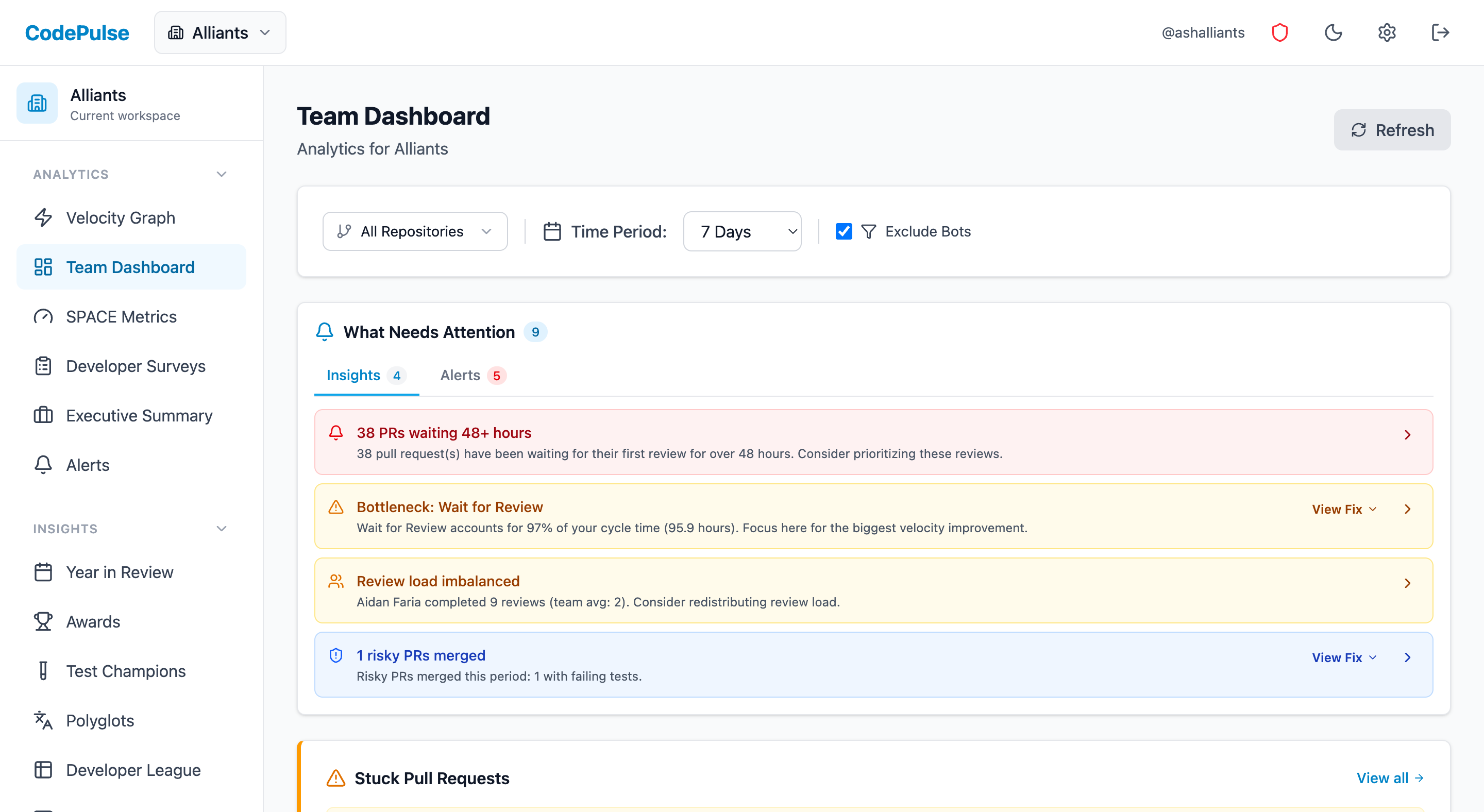
Get this view for your own teams
Connect GitHub for team-level workload, review distribution, and delivery signals. Individual views stay off unless your organisation explicitly turns them on.
Read-only GitHub · Your code stays yours · Team-level by default · No credit card
See These Features in Action
Board-ready engineering performance in a single page.
Compare contribution patterns for coaching, not surveillance.
Related Guides
Engineering Metrics That Won't Get You Reported to HR
An opinionated guide to implementing engineering metrics that build trust. Includes the Visibility Bias Framework, practical do/don't guidance, and a 30-day action plan.
Engineering Metrics Rollout: The Trust-First Playbook
A change management playbook for rolling out engineering metrics without triggering developer resistance. Covers communication plans, staff engineer buy-in, trial structure, and anti-gaming safeguards.
Developer Productivity Metrics That Don't Backfire
Stop treating engineers like factory workers. Learn which developer productivity metrics destroy trust, why lines of code fail, and how to measure productivity, including with AI tools, without surveillance.
Non-Invasive Engineering Analytics: Measure Without Surveillance
Build engineering visibility without destroying trust. Learn what non-invasive analytics means, which data sources respect privacy, and the CodePulse philosophy.
Why Adding Engineers Made Us Slower (Brooks' Law Is Real)
Understand Brooks' Law and the hidden costs of scaling. Learn why adding engineers temporarily slows you down and how to minimize the efficiency dip.
The 50-Engineer Cliff: Why Everything Breaks After Series B
The definitive guide to engineering metrics for the Series B transition. Learn why Hero Mode breaks at 50 engineers, how to build a tiered metrics stack, what boards actually want to see, and when to hire vs. optimize.