
Understand the system around the team, not a developer leaderboard
Preview team-level workload, collaboration, and delivery signals designed for process improvement rather than performance grading.
Read-only GitHub · Your code stays yours · Team-level by default · No credit card
Recognition programs can be powerful tools for reinforcing engineering culture, or they can create toxic competition that drives your best people away. The difference lies in what you celebrate, how you measure it, and whether the program feels authentic or performative. This guide walks through building a recognition program that works for engineering teams, with specific award categories, program design principles, and measurement strategies.
How do you build a developer recognition program that works?
An effective developer recognition program uses multiple award categories covering speed, quality, collaboration, and consistency. It runs monthly or quarterly with transparent, data-driven criteria supplemented by peer nominations. According to Gallup research, employees who receive recognition at least a few times per month are 5x more likely to feel connected to their company culture. The best programs celebrate specific behaviors, not vanity metrics like lines of code.
Why Do Recognition Programs Matter for Engineering Teams?
Recognition is not a nice-to-have perk. It is a retention tool, a culture signal, and a management lever rolled into one. According to Gallup's workplace research, only about one in three U.S. workers strongly agree that they received recognition or praise for doing good work in the past seven days. A joint Workhuman-Gallup study found that doubling that ratio could yield a 9% improvement in productivity and a 22% reduction in safety incidents across industries.
"The single cheapest intervention a manager can make is specific, timely recognition. It costs nothing and compounds over months."
But engineers are not average employees when it comes to recognition. They tend to be skeptical of gamification, allergic to empty praise, and deeply concerned about fairness. Generic "Employee of the Month" programs fall flat in engineering orgs because they reward vague qualities instead of observable contributions.
What Engineers Actually Respond To
Engineers respond to recognition that is specific, technically credible, and tied to something they can see in their own work. "Great job this quarter" means nothing. "You reviewed 47 PRs with an average turnaround of 2.3 hours and caught 3 bugs before they hit production" means everything. The difference is precision.
- Specificity over generality: Name the exact contribution, not a vague category
- Peer credibility: Recognition from teammates who understand the work carries more weight than manager praise alone
- Intrinsic alignment: Celebrate craft, learning, and helping others, not just output volume
- Fairness: Transparent criteria everyone can inspect, not opaque manager decisions
For more on balancing measurement with trust, see our guide on measuring team performance without micromanaging.
What Award Categories Drive the Right Behavior?
A single "top performer" award creates a zero-sum game. Multiple categories let different strengths surface and give more people a reason to care. CodePulse uses 15 award categories grouped into four themes, each tied to a measurable metric from Git and PR data.
| Theme | Award | What It Measures | Why It Matters |
|---|---|---|---|
| Speed & Efficiency | Speed Champion | Fastest median cycle time | Ships quickly without cutting corners |
| Lightning Reviewer | Fastest review response time | Keeps teammates unblocked | |
| Unblock Hero | Fastest time to first review | Reduces wait-for-review bottlenecks | |
| Rapid Shipper | Fastest P95 cycle time | Handles even complex work efficiently | |
| Code Quality | Quality Guardian | Highest test pass rate | Catches issues before production |
| Clean Code Advocate | Smallest average PR size | Writes reviewable, focused changes | |
| Careful Coder | Fewest PRs with failing checks | Consistent quality bar | |
| Refactoring Hero | Highest code churn rate | Actively pays down tech debt | |
| Collaboration | Team Player | Reviews more PRs than they create | Multiplier who makes others faster |
| Code Mentor | Most reviews given | Invests in team growth | |
| Collaboration Star | Most diverse reviewer set | Works across team boundaries | |
| Cross-Pollinator | Touches most areas of codebase | Reduces knowledge silos | |
| Consistency | Steady Contributor | Most consistent daily commits | Reliable, sustainable pace |
| Reliable Shipper | Most PRs merged consistently | Dependable delivery cadence | |
| Productivity Champion | Highest lines of code per day | High-volume contributor |
Notice that these categories deliberately balance speed with quality and individual output with team contribution. A program that only rewards speed will incentivize sloppy work. A program that only rewards volume will penalize the architect who spends a month on one critical design.
🏆 How to See This in CodePulse
Navigate to Awards & Leaderboards to see all 15 developer award categories calculated automatically from your Git and PR data:
- Filter by theme (Speed, Quality, Collaboration, Consistency) to focus on specific strengths
- Switch to the Review Quality Awards tab for 5 additional categories based on comment analysis
- Filter by repository and time period (weekly through yearly)
- Export results to CSV for team meetings or retrospectives
What Separates Good Recognition Programs from Bad Ones?
Most recognition programs fail quietly. Nobody complains, but nobody cares either. The program exists on paper, gets mentioned in an all-hands twice a year, and has zero effect on behavior or retention. Here is what separates programs that work from programs that waste everyone's time.
| Dimension | Programs That Work | Programs That Fail |
|---|---|---|
| Frequency | Monthly or quarterly | Annual ceremony only |
| Criteria | Transparent, measurable, published | Opaque manager discretion |
| Nomination Source | Peers + data + managers together | Manager-only selection |
| Categories | Multiple (speed, quality, collaboration) | Single "top performer" award |
| Specificity | "Reviewed 47 PRs in 2.3h avg" | "Great teamwork this quarter!" |
| Coverage | 60%+ of team recognized per year | Same 3 people win every time |
| Metrics Used | Behaviors (review speed, quality) | Vanity metrics (LOC, hours) |
| Compensation Link | Recognition is its own reward | Tied directly to bonuses |
🔥 Our Take
Most recognition programs fail because they are performative. A plaque at a yearly ceremony is not recognition. It is a ritual. Recognition works when it is specific enough that the recipient thinks "they actually noticed what I did," frequent enough to reinforce behavior, and peer-driven enough that the whole team buys in.
If your recognition program only has one award and the same person wins it every quarter, you do not have a recognition program. You have a popularity contest. Use multiple categories tied to different strengths so that the quiet reviewer, the consistent shipper, and the refactoring hero all get their moment.
How Do You Prevent Recognition from Becoming Toxic?
The line between healthy recognition and toxic competition is thinner than most managers realize. Watch for these warning signs that your program is backfiring:
- Gaming behavior: Engineers splitting PRs artificially to inflate counts, rushing reviews without reading code, or cherry-picking easy work
- Resentment: Repeated comments like "the metrics don't capture my work" or "why does the same person always win?"
- Hoarding: Engineers stop helping each other because collaboration dilutes their individual numbers
- Burnout spikes: People overworking to hit award criteria, especially around the end of a measurement period
"If your recognition program makes anyone work harder but not smarter, it is broken. Recognition should celebrate sustainable excellence, not incentivize unsustainable sprints."
The fix is structural, not motivational. Use multiple categories so one person cannot dominate. Include "most improved" awards to give newer team members a path. Add team-level awards alongside individual ones. And never reward lines of code, hours worked, or raw PR count, as all three incentivize the wrong behaviors. For more on detecting the early warning signs, see our guide on spotting burnout signals in Git data.
What NOT to Reward
- Lines of code: Incentivizes verbosity, penalizes refactoring
- Hours worked: Rewards presence over impact
- Raw PR count: Encourages splitting work artificially
- Being "first": Creates unhealthy races that sacrifice thoroughness
How Do You Implement Data-Driven Recognition?
Using Git and PR data for recognition removes subjective bias and surfaces contributions that managers often miss. A data-driven approach has clear advantages: the criteria are consistent, the selection is auditable, and it scales from teams of 5 to teams of 500 without additional manager overhead.
But Data Needs Context
Data alone is not enough. A developer might have low PR count because they spent the quarter mentoring three new hires, doing critical architecture work that does not show in PRs, handling production incidents, or waiting on external dependencies. Always combine data with human judgment. Data identifies candidates; humans validate context.
Implementation Checklist
Recognition Program Setup
Program Design
- Define 5-15 award categories covering different strengths
- Set measurable criteria for each award
- Choose cadence: monthly for fast teams, quarterly for project-based teams
- Plan announcement format (team meeting, Slack channel, all-hands)
- Document criteria publicly so everyone can inspect them
- Add a peer nomination channel for contributions data misses
Each Award Cycle
- Pull metric data for the eligible period
- Identify top candidates per category
- Review for context: any mitigating factors like PTO, oncall, or onboarding duties
- Select winners and write specific praise
- Announce with concrete details, not generic compliments
- Gather feedback: ask the team if the program feels fair and useful
Making Announcements Meaningful
The announcement matters as much as the selection. Vague praise feels performative. Specific praise feels earned.
Award Announcement Examples
- "Congrats to Alice for Lightning Reviewer award!"
- "This quarter's Lightning Reviewer: Alice Chen"
- "Alice reviewed 47 PRs with an average turnaround of 2.3 hours."
- "Her reviews consistently caught issues before production, and 3 teammates mentioned her feedback helped them improve."
- "Thanks for keeping the team unblocked, Alice!"
Getting buy-in for data-driven programs requires trust. If your team is skeptical of metrics, start by reading our engineering metrics rollout playbook before launching awards.
How Do You Know If Your Recognition Program Is Working?
A recognition program is an investment. Like any investment, you need to measure whether it is paying off. Track these indicators over 6-12 months to evaluate program health:
- Participation breadth: What percentage of the team has been recognized at least once? Target 60%+ per year. If the same 5 people win every cycle, the program is too narrow.
- Retention delta: Compare voluntary attrition rates between engineers who have been recognized and those who have not. Gallup's retention research links strong recognition practices to materially lower voluntary turnover, with employees who receive high-quality recognition significantly more likely to stay at their organization years into the future.
- Engagement signal: Do people mention awards in Slack, refer to them in 1:1s, or nominate peers proactively? Organic engagement means the program has cultural traction.
- Behavior change: After launching a "Lightning Reviewer" award, did average review response times actually improve? If awards are not shifting behavior, they are just decoration.
- Survey feedback: Ask directly: "Does our recognition program make you feel appreciated and motivated, or does it create stress?" If the answer is not clearly positive, iterate.
"A recognition program you cannot measure is a recognition program you cannot improve. Track participation breadth, retention delta, and behavior change, or you are just guessing."
For a broader view on developer experience metrics that connect to recognition, see our guide on developer joy metrics.
How Do You Celebrate Beyond Individual Metrics?
Not every valuable contribution shows up in Git data. Some of the most important engineering work, like mentoring new hires, improving documentation, fixing flaky tests, handling on-call incidents, and cross-team coordination, leaves no trace in PR metrics. A complete recognition program needs a peer nomination channel for these contributions alongside data-driven awards.
Team-Level Recognition
Some achievements are collective and should be celebrated that way:
- Milestone completions: "The Platform team shipped the new API gateway after 3 months of work"
- Quality improvements: "Zero production incidents this quarter for the Payments team"
- Process wins: "Checkout team reduced median cycle time by 40%"
Growth Recognition
Sometimes the most meaningful recognition is for growth, not absolute performance. "Most improved" awards, breakthrough-moment celebrations, and learning-leader categories give newer engineers a realistic path to recognition that does not require competing against tenured contributors on raw output.
Recognition done right reinforces your engineering culture and makes people want to stay. Done wrong, it drives away exactly the people you most want to keep. Be specific, be transparent, and keep listening to your team about what feels authentic versus what feels forced.
Frequently Asked Questions
A good developer recognition program is specific, frequent, and tied to observable behaviors rather than subjective opinions. It uses multiple award categories so different strengths get visibility, combines data-driven selection with peer nominations, and runs on a regular cadence (monthly or quarterly). The criteria should be transparent and public so everyone understands what earns recognition.
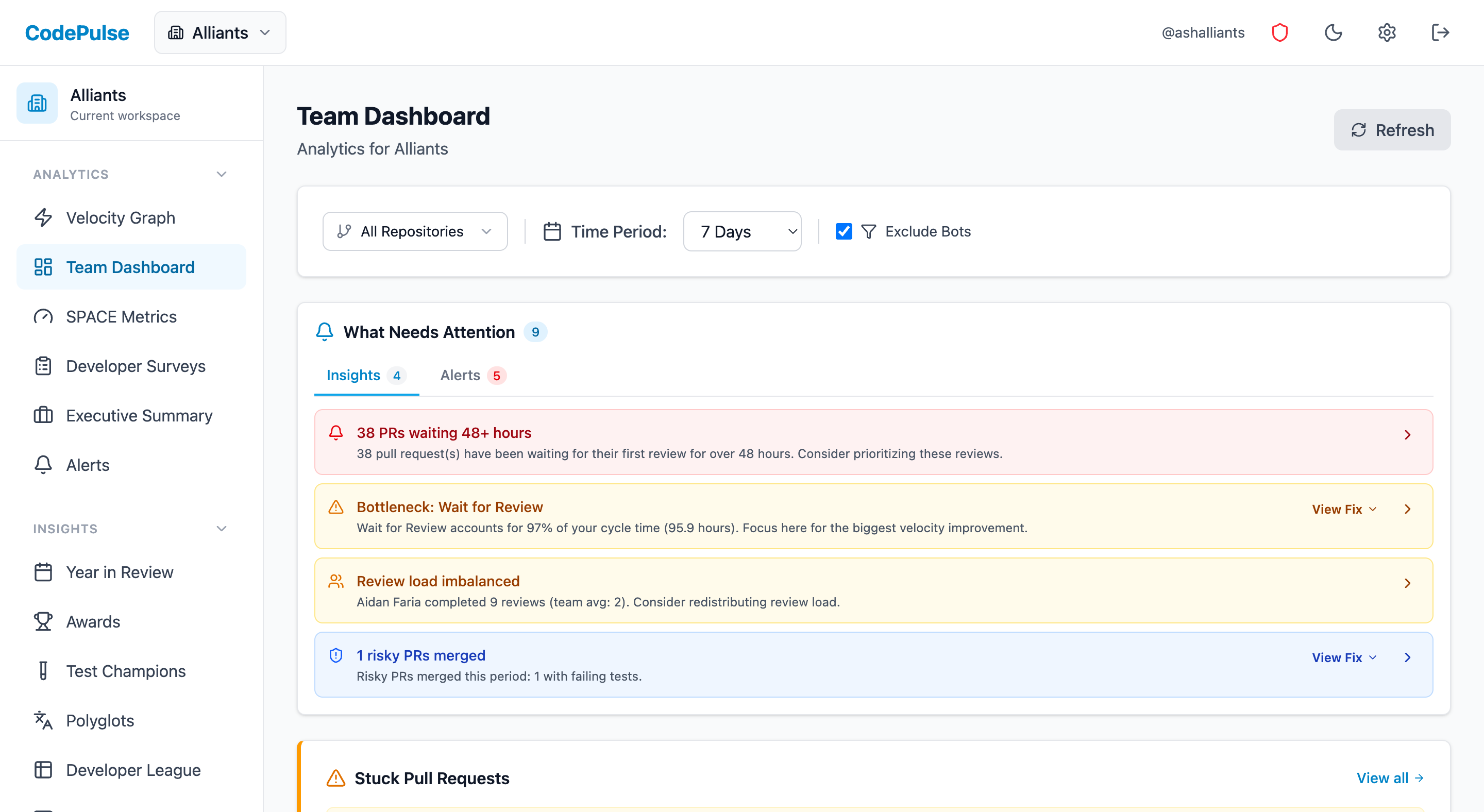
Get this view for your own teams
Connect GitHub for team-level workload, review distribution, and delivery signals. Individual views stay off unless your organisation explicitly turns them on.
Read-only GitHub · Your code stays yours · Team-level by default · No credit card
See These Features in Action
Explore all featuresRelated Guides
Engineering Metrics That Won't Get You Reported to HR
An opinionated guide to implementing engineering metrics that build trust. Includes the Visibility Bias Framework, practical do/don't guidance, and a 30-day action plan.
Your Git Data Predicts Burnout 6 Weeks in Advance
Use the STRAIN Score framework to detect developer burnout from Git data. Identify after-hours patterns, review overload, and intensity creep before they cause turnover.
Engineering Metrics Rollout: The Trust-First Playbook
A change management playbook for rolling out engineering metrics without triggering developer resistance. Covers communication plans, staff engineer buy-in, trial structure, and anti-gaming safeguards.
Developer Joy Metrics: Measuring What Makes Developers Happy
Developer joy isn't soft - it's strategic. Learn measurable proxies for developer happiness, warning signs in git data, and how to build joy-aware teams.
Daily Standups: The 15-Minute Meeting Most Teams Get Wrong
Daily standups are the most common - and most commonly misused - meeting in software. This guide shows better formats (async, walk-the-board, exception-based), rules that work, and anti-patterns to avoid.
The Git Query That Finds Your New Hire's Perfect Mentor
Use Git activity data to accelerate new hire onboarding, identify domain experts for pairing, and track ramp-up progress.
5 Signs Your Code Review Culture Is Toxic (Fix #3 First)
Assess and improve your code review culture. Identify toxic patterns and build psychological safety in your engineering team.