
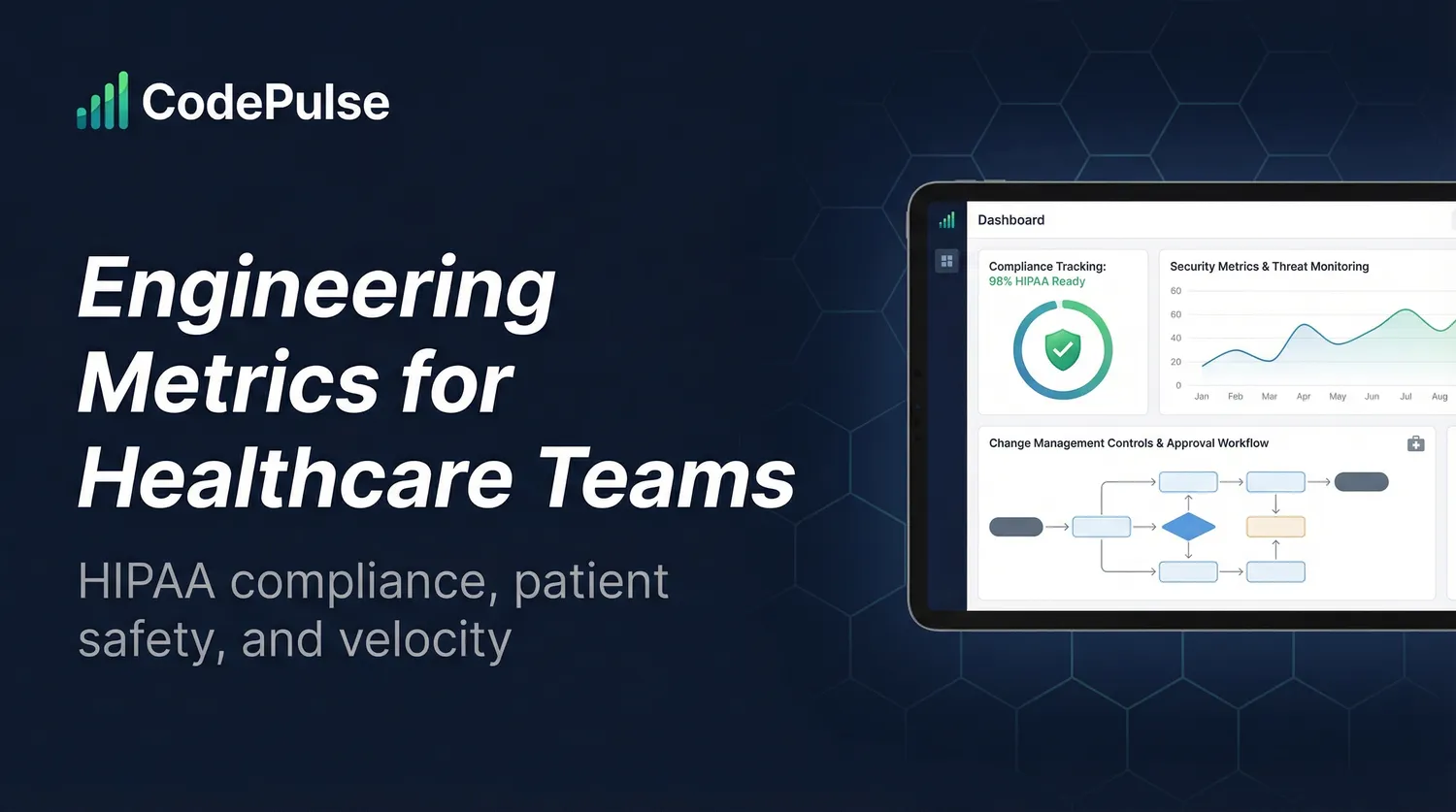
Inspect the output before you grant repository access
Preview the report first. When you are ready, start with selected repositories through a read-only GitHub connection, and your code stays yours.
Read-only GitHub · Your code stays yours · Team-level by default · No credit card
Building software for healthcare requires more than good engineering practices-it demands rigorous compliance with FDA regulations, HIPAA privacy rules, and international medical device standards. Learn how engineering metrics help healthcare teams maintain regulatory compliance while shipping quality software.
🔥 Our Take
Healthcare teams waste months preparing for audits because they treat compliance as an event, not a process.
The teams that breeze through FDA inspections are the ones monitoring review coverage and test failure rates weekly - not the ones scrambling to pull GitHub data six weeks before an auditor arrives. If you're building medical device software and your review coverage isn't at 100% right now, you have a compliance gap that no last-minute documentation can fix. Engineering metrics aren't about velocity optimization in healthcare; they're your audit trail made quantifiable.
Regulatory Requirements: FDA, HIPAA, and Engineering
Healthcare software teams operate under a unique set of constraints. If you're building medical devices (covered by FDA 21 CFR Part 820 and IEC 62304), electronic health records (governed by HIPAA), or clinical decision support tools, you need to demonstrate:
- Documented design controls including design reviews and verification testing (FDA 21 CFR Part 820.30)
- Change control procedures that assess risk and require appropriate review (IEC 62304 Section 8)
- Traceability from requirements through testing to deployment (FDA Design Control Guidance)
- Electronic signature compliance with audit trails for all changes (21 CFR Part 11)
Traditional engineering metrics focus on velocity and throughput. Healthcare engineering metrics must prioritize quality assurance and audit readiness. When a FDA auditor asks "How do you ensure all medical device software changes are reviewed?", you need quantitative evidence, not anecdotes.
"In healthcare software, every unreviewed pull request is a potential 483 observation waiting to happen."
IEC 62304 Software Safety Classification
Understanding your software safety classification under IEC 62304 determines the rigor required for your engineering processes. The standard defines three classes:
- Class A (No injury possible): Software that cannot contribute to a hazardous situation. Minimal documentation requirements.
- Class B (Non-serious injury possible): Software that could contribute to non-serious injury. Requires documented development process, testing, and change control.
- Class C (Death or serious injury possible): Most stringent requirements including detailed architecture documentation, unit testing, and full traceability.

Most medical device software falls into Class B or C, which means you need quantifiable evidence of your review and testing processes. Engineering metrics provide this evidence automatically, without manual log-keeping that's prone to gaps and errors.
For a broader view of how to implement metrics across your organization, see our Engineering Metrics Rollout Playbook.
Why CodePulse Never Sees PHI
Healthcare teams are rightfully cautious about any tool that could process Protected Health Information (PHI). PHI lives in your production systems, patient databases, clinical applications, and logs. CodePulse connects to none of them. It has one integration: a read-only connection to your source-control provider. It never clones your repository and never reads your files.
CodePulse reads pull request, commit, and review metadata - titles, commit messages, timestamps, authorship, review activity, and the short snippet GitHub attaches to an inline review comment. It does not request:
- Your source files, whether as file contents or a repository clone
- Full pull request patches or complete source-code diffs
- Any data from production systems, patient databases, or application logs
- Write access to connected repositories
In practice that means the only route PHI could ever reach CodePulse is if someone typed it into a PR title, a commit message, or a review comment - which is already a problem for your HIPAA posture regardless of which analytics tool you use. Keeping PHI out of source control is a control you should have anyway, and it is the one thing worth confirming before you connect. Like any vendor with a data connection, include CodePulse in your vendor risk assessment; the Trust Center has the permission list and a downloadable security overview to make that quick. For more on our security approach, see our Security and Compliance Guide.
HIPAA Security Rule and Development Tools
The HIPAA Security Rule requires covered entities to implement administrative, physical, and technical safeguards for electronic PHI. When evaluating engineering analytics tools, your compliance team will want to understand:
- Data scope: What data does the tool access? Does it include any PHI?
- Storage location: Where is data stored? Is it encrypted at rest and in transit?
- Access controls: Who can access the data? Are there audit logs?
- Business Associate Agreement (BAA): Is a BAA required? What are the vendor's HIPAA obligations?
Because CodePulse accesses only GitHub metadata (PR titles, timestamps, review status) and never touches code content or production data, it typically falls outside the scope requiring a BAA. However, always confirm with your compliance team based on your specific architecture.
For organizations with strict data residency requirements, we also offer self-hosted deployment. See our Self-Hosted vs SaaS Engineering Analytics guide for deployment options.
Documenting Review Processes for Auditors
FDA design control regulations require documented evidence that design changes are reviewed by appropriate personnel. IEC 62304 mandates that medical device software changes undergo review before release, with the rigor proportional to the software safety classification.
GitHub pull requests create this documentation automatically - if you can prove they're actually happening. This is where review coverage metrics become critical.
CodePulse tracks your review coverage percentage: the proportion of merged pull requests that received at least one code review before merging. For healthcare teams, this should be 100% for repositories containing medical device software or systems that touch PHI.
During a regulatory audit, you can demonstrate:
- Historical review coverage trends showing consistent enforcement of review policies
- Identification of any pull requests merged without review (which should trigger investigation)
- Reviewer participation rates across your engineering team
- Time-to-first-review metrics showing responsiveness of your review process
These metrics transform your GitHub workflow from an informal process into auditable quality system records. When an auditor asks "How do you ensure design reviews happen?", you have quantitative proof.
"A GitHub pull request with a documented review is a design control record. A pull request without one is a compliance liability."
For detailed guidance on optimizing your review process while maintaining compliance, see our Review Coverage Guide and Code Reviewer Best Practices.
Quality Gates: Test Failure Tracking for Medical Software
IEC 62304 requires verification testing appropriate to the software safety class. For Class B and Class C medical device software, you need thorough testing and evidence that tests pass before release.
CodePulse's test failure rate metric tracks the percentage of pull requests that have failing status checks at the time they're merged. This is your early warning system for quality gate bypass.
A non-zero test failure rate indicates:
- Pull requests are being merged despite failing automated tests
- Status check configurations may be incomplete or misconfigured
- Branch protection rules may not be properly enforced
- Manual overrides are happening without proper justification
For healthcare software, your test failure rate should be 0.0%. Any deviation requires investigation and documentation. Was there an emergency hotfix that bypassed normal procedures? Document it. Did a critical status check fail due to infrastructure issues unrelated to code quality? That needs a written justification and risk assessment.
Learn more about interpreting and improving this metric in our Test Failure Rate Deep Dive.
Verification and Validation Documentation
IEC 62304 distinguishes between verification (did we build the software correctly?) and validation (did we build the correct software?). Engineering metrics support verification by providing evidence that:
- Automated tests passed before code was merged (test failure rate = 0%)
- Code was reviewed by qualified personnel (review coverage = 100%)
- Changes followed your documented development process (risky changes flagged and escalated)
Validation requires additional clinical testing and user acceptance testing that occurs outside your engineering workflow. However, having clean verification evidence makes validation audits significantly easier - auditors can focus on clinical outcomes rather than questioning your development process.
Change Control with Risk Scoring
IEC 62304 Section 8 requires a change control process that includes risk analysis for every change. Similarly, FDA quality system regulations require evaluation of changes that could affect device safety or regulatory compliance.
CodePulse's risky changes detection automatically identifies pull requests with characteristics that merit additional scrutiny:
- Large change size: PRs touching many files or adding/removing many lines of code
- No approval: Changes merged without documented review
- Failing status checks: Tests or quality gates were bypassed
- Critical file changes: Modifications to infrastructure, deployment configs, or security-critical code
- Rushed review: Approved within minutes of submission without adequate review time
- External contributor: Changes from outside your organization
- Complex branching: Long-lived branches with many commits that increase merge risk
Each pull request receives a risk score (0-10) based on these factors. For healthcare teams, high-risk changes should trigger:
- Additional review by senior engineers or architects
- Enhanced testing beyond standard automated tests
- Documented risk assessment per your change control procedure
- Possible regression testing of affected features
This risk scoring provides objective criteria for escalating changes that need extra attention, making your change control process both more efficient and more defensible. For implementation details, see Detecting Risky Deployments.
21 CFR Part 11 and Electronic Records
FDA 21 CFR Part 11 establishes requirements for electronic records and electronic signatures. For engineering teams, this means your GitHub-based workflow must maintain:
- Audit trails: Complete history of who made what changes and when (GitHub provides this natively)
- Access controls: Role-based permissions ensuring only authorized personnel can approve changes
- Electronic signatures: Reviewer approvals that are attributable and cannot be repudiated
- System validation: Evidence that your development tools function as intended
CodePulse complements these requirements by providing aggregate metrics that prove your controls are working consistently over time. An audit trail shows what happened; engineering metrics show that your process is being followed systematically.
📊How to See This in CodePulse
Find these healthcare-focused quality metrics in the app:
- Quality metrics overview: Navigate to /dashboard to see review coverage, test failure rate, and quality trends
- Risky changes tracking: Visit /risky-changes to see risk-scored pull requests and filter by risk factors
Healthcare Engineering Compliance Checklist
Use this checklist to assess your engineering team's regulatory readiness. These metrics should be monitored continuously, not just before audits.
Healthcare Engineering Compliance Checklist
Review Process (IEC 62304, FDA Design Controls)
- Review coverage = 100% for all medical device repositories
- All reviewers are documented and qualified per your QMS
- Review turnaround time meets your SLA (recommended: <24 hours)
- Branch protection rules enforce review requirements
- No direct commits to protected branches
Testing & Verification (IEC 62304 Section 5.5)
- Test failure rate = 0% for production releases
- All status checks configured and required before merge
- Automated test coverage meets target (Class B: 80%+, Class C: 95%+)
- Integration tests run on every PR
- Regression test suite maintained and passing
Change Control (IEC 62304 Section 8)
- High-risk changes receive additional review
- Change rationale documented in PR descriptions
- Impact analysis completed for infrastructure changes
- External contributor changes receive enhanced scrutiny
- Emergency changes documented with post-hoc risk assessment
Traceability (FDA Design Control Guidance)
- PRs linked to requirements (Jira/Linear tickets)
- Design decisions documented in code comments or ADRs
- Release notes generated from merged PRs
- Deployment logs maintained with version correlation
Audit Trail (21 CFR Part 11)
- GitHub audit logs enabled and retained
- Access control lists documented and reviewed quarterly
- Electronic signatures (approvals) are attributable
- System access restricted to authorized personnel
- Metric exports available for compliance reporting
Continuous Monitoring
- Weekly review of quality metrics
- Alerts configured for compliance threshold breaches
- Monthly trend analysis in engineering leadership meetings
- Corrective actions documented when metrics indicate issues
For teams new to engineering metrics, our Engineering Metrics Rollout Playbook provides a step-by-step implementation guide, while the DORA Metrics Guide covers industry-standard performance benchmarks.
Preparing for Regulatory Audits
When preparing for FDA inspections, ISO 13485 certification audits, or internal quality system reviews, engineering metrics provide objective evidence that your development processes are working as documented.
Here's how to use CodePulse data during audit preparation:
Pre-Audit Review (4-6 weeks before)
- Review coverage analysis: Verify 100% coverage for medical device repositories. Investigate any gaps and ensure proper documentation exists for legitimate exceptions.
- Test failure rate check: Confirm 0% test failure rate. Document any historical instances where tests were bypassed, with dated rationale and risk assessments.
- Risky change review: Identify high-risk changes from the past 12 months. Verify that each has appropriate additional review documentation.
- Trend analysis: Prepare charts showing improvement or stability in key quality metrics over the audit period.
Audit Documentation Package
Create an audit-ready documentation package that includes:
- Written procedures linking GitHub workflows to quality system requirements
- Exported metric reports showing compliance with review and testing requirements
- Sample pull requests demonstrating proper review and approval workflows
- Evidence of corrective actions taken when metrics identified process breakdowns
- Role-based access controls and audit trail documentation (21 CFR Part 11 compliance)
Common Auditor Questions and Metric-Based Answers
Q: "How do you ensure software changes are reviewed before release?"
A: Present review coverage metrics showing 100% of PRs in medical device repositories received documented review. Show reviewer assignment rules and escalation for unreviewed changes.
Q: "How do you prevent untested code from reaching production?"
A: Show test failure rate at 0% combined with branch protection rules. Demonstrate that status checks are required before merging.
Q: "How do you handle changes that bypass normal procedures?"
A: Use risky changes detection to identify process deviations. Show documentation of risk assessment and additional review for high-risk changes.
Q: "Can you demonstrate traceability from requirements to deployment?"
A: While CodePulse tracks the engineering execution, combine this with issue tracking (Jira/Linear) for full requirements traceability. Pull request metrics prove that implementation followed proper development procedures.
Continuous Compliance
The most audit-ready organizations don't scramble before inspections - they monitor compliance continuously. Set up alerts for:
- Review coverage dropping below 100% in critical repositories
- Any non-zero test failure rate
- Multiple high-risk changes in a short time period
- Trends indicating process degradation
Regular review of these metrics in engineering leadership meetings embeds quality awareness into your development culture. When auditors arrive, you're simply showing them data you already use to manage quality.
"The best audit preparation is no preparation at all - just showing auditors the same dashboards your team uses every week."
For guidance on setting up automated alerts, see our Alert Rules Guide. To understand how to export data for compliance documentation, check Export Engineering Metrics to CSV.
International Standards and Global Teams
Healthcare software development increasingly spans multiple regulatory jurisdictions. Beyond FDA and HIPAA, global teams must consider:
- EU MDR (Medical Device Regulation): Requires technical documentation including software lifecycle records
- ISO 13485: Quality management system standard with documentation requirements similar to FDA QSR
- GDPR: European data protection requirements that parallel HIPAA for patient data
- Health Canada MDR: Canadian medical device regulations with traceability requirements
- TGA (Australia): Therapeutic Goods Administration requirements for software as a medical device
The good news: engineering metrics that satisfy FDA requirements generally satisfy international standards as well. IEC 62304 is recognized globally, and review coverage plus test failure rates are universally relevant compliance evidence.
Multi-Site Development Teams
Global healthcare companies often have engineering teams across multiple time zones and locations. Engineering metrics become even more critical for ensuring consistent quality practices across sites.
Key considerations for distributed healthcare engineering teams:
- Consistent review standards: Use metrics to verify all sites maintain 100% review coverage
- Review handoffs: Track time-to-first-review to identify delays caused by timezone gaps
- Training validation: Compare quality metrics across sites to identify training needs
- Audit coordination: Ensure all sites have access to the same compliance dashboards
For teams managing review workload across timezones, our Review Load Balancing Guide and Async Code Review for Distributed Teams provide detailed strategies.
Software Bill of Materials (SBOM) and Supply Chain
FDA's cybersecurity guidance and emerging regulations increasingly require healthcare software manufacturers to maintain a Software Bill of Materials (SBOM) - a complete inventory of components, libraries, and dependencies in your software.
While CodePulse doesn't generate SBOMs directly, engineering metrics support your supply chain compliance by:
- Tracking dependency updates: PRs that update dependencies can be flagged for security review
- External contributor monitoring: Changes from outside your organization receive automatic scrutiny
- Change velocity trends: Sudden spikes in dependency-related PRs may indicate vulnerability responses
Combine CodePulse with tools like Dependabot, Snyk, or GitHub's dependency graph to maintain full supply chain visibility.
Building a Compliance Culture
Regulatory compliance shouldn't feel like a burden imposed on engineers - it should be embedded in how your team works. Engineering metrics help by making compliance visible and measurable.
Strategies for building a compliance-aware engineering culture:
- Transparency: Share quality metrics in team standups and retrospectives
- Celebrate compliance: Recognize teams and individuals who maintain 100% review coverage
- Blameless post-mortems: When metrics reveal issues, focus on process improvement, not punishment
- Engineer involvement: Include engineers in audit preparation and regulatory discussions
- Automation: Use branch protection and required status checks so compliance is the path of least resistance
For more on building engineering culture with metrics, see Measuring Team Performance Without Micromanaging and Building Trust with Engineering Metrics.
Conclusion
Engineering metrics for healthcare teams serve a dual purpose: they improve development efficiency while providing objective evidence of regulatory compliance. By tracking review coverage, test failure rates, and risky changes, you create an audit trail that demonstrates your quality system is working as intended.
Because CodePulse never reads your files and never touches a production or clinical system, you get those signals without adding a PHI pathway. That keeps the security review short: a read-only connection, a documented permission list, and no new place for patient data to live. The result is a more confident engineering team and smoother regulatory audits.
The healthcare software teams that thrive under regulatory scrutiny share common characteristics: they monitor quality metrics continuously, they treat compliance as a byproduct of good engineering practices rather than a separate workstream, and they use data to prove what they already know - that their development process produces safe, reliable software.
For teams building Class II medical devices, managing EHR integrations, or developing clinical decision support tools, engineering metrics provide the quantifiable evidence that regulators expect and that quality teams need. Start with review coverage and test failure rate, then expand to risk scoring and trend analysis as your compliance program matures.
Related Guides
Continue learning about engineering metrics for regulated industries and specialized use cases:
- Engineering Metrics for FinTech Teams - Similar compliance challenges in financial services
- Security and Compliance Guide - Deep dive into CodePulse security architecture
- DORA Metrics Guide - Industry-standard performance benchmarks
- Engineering Metrics Rollout Playbook - Step-by-step implementation guide
- Test Failure Rate Guide - Detailed guide to tracking and improving test quality
- Review Coverage Guide - Comprehensive guide to code review metrics
- Detecting Risky Deployments - How risk scoring identifies high-risk changes
Turn the idea in this guide into a baseline for your team
See what the finished analysis looks like, then connect GitHub when you are ready. CodePulse measures delivery systems from read-only workflow data—never individual output.
Read-only GitHub · Your code stays yours · Team-level by default · No credit card
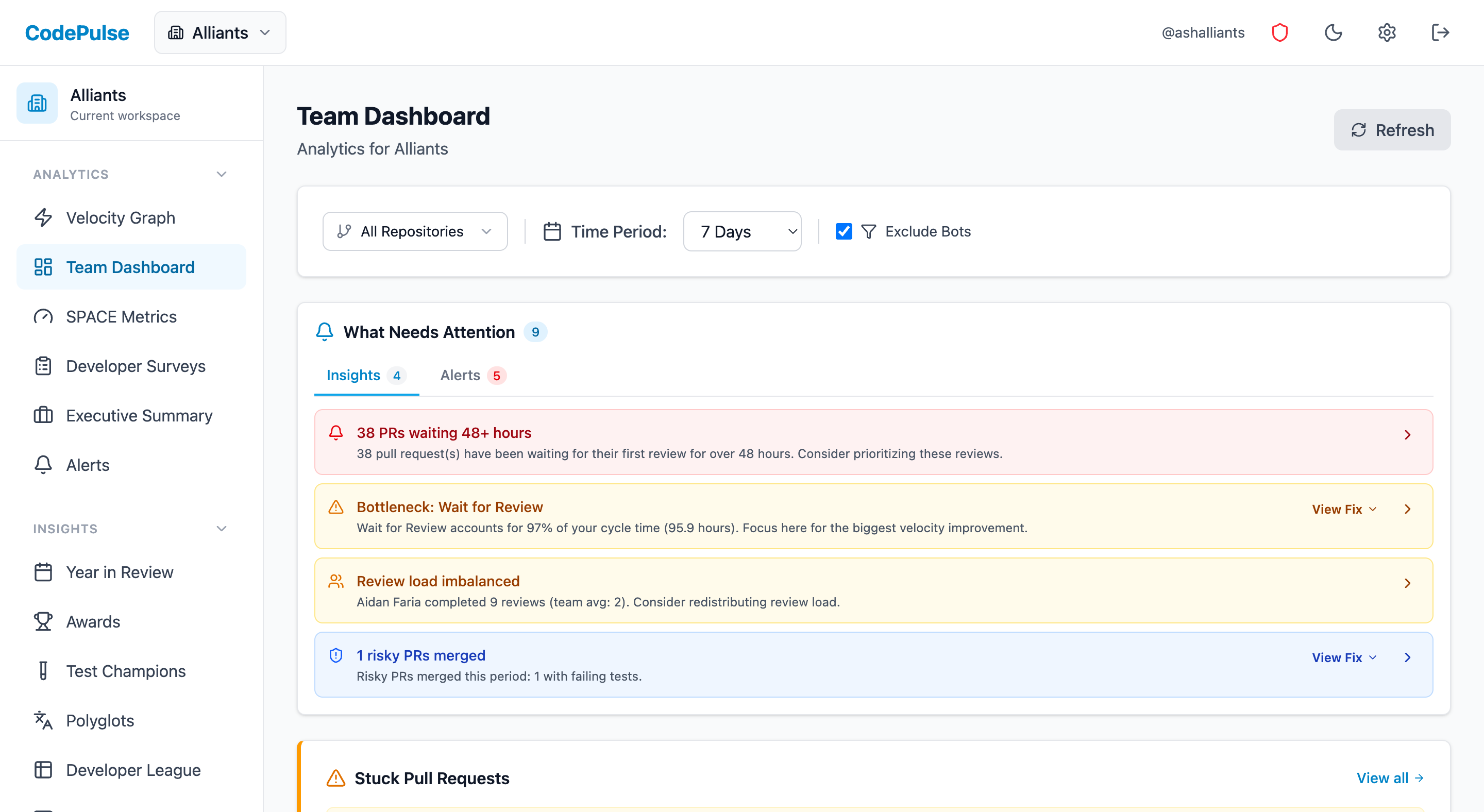
Start with one repository and a read-only connection
You choose the repositories. CodePulse cannot push, merge, or modify anything, and never clones your code. Expand the scope only once the output has earned it.
Read-only GitHub · Your code stays yours · Team-level by default · No credit card
See These Features in Action
Board-ready engineering performance in a single page.
Track all four DORA metrics and benchmark against industry standards.
Related Guides
The SOC 2 Question That Eliminates 80% of Analytics Vendors
Everything you need to know about data security, SOC 2 compliance, and privacy when evaluating engineering analytics platforms.
Your CI Is Crying for Help. Here's What It's Telling You
Understand what test failure rate measures, identify patterns causing CI failures, and implement strategies to improve your pipeline reliability.
The PR Pattern That Predicts 73% of Your Incidents
Learn how to identify high-risk pull requests before they cause production incidents.
The GitHub Permission Mistake That Gets Security Rejected
Understand GitHub OAuth scopes and app permissions required for engineering analytics tools, with security best practices.