
Understand the system around the team, not a developer leaderboard
Preview team-level workload, collaboration, and delivery signals designed for process improvement rather than performance grading.
Read-only GitHub · Your code stays yours · Team-level by default · No credit card
If you are an engineering leader about to introduce metrics to your org, this is the change management playbook. Most metrics rollouts fail because of bad communication, not bad tooling. A 2024 LinearB survey found that 63% of developers worry metrics will be used for surveillance. This guide covers the full rollout sequence: staff engineer pre-briefing, communication templates, trial structure, sentiment measurement, anti-gaming guardrails, and expansion criteria. These steps prevent the trust erosion that sinks adoption, from 200-developer deployments to single-team pilots.
How do you roll out engineering metrics without destroying trust?
Start with staff engineer buy-in 3-4 weeks before announcing. Communicate explicitly what metrics will NOT be used for (performance reviews, stack ranking). Run a 2-4 week trial with 1-2 volunteer teams, measure the trial itself (sentiment, usage, actionable insights), and expand only after 70%+ positive sentiment. The key is transparency: give engineers the same dashboard access as leadership.
Related guides in this series
- VP Board Metrics - the 7 numbers to show once the rollout succeeds
- DORA Metrics Explained - the four keys your teams will be tracking
- Platform Engineering Metrics - different benchmarks for infrastructure teams during rollout
- Analytics ROI Calculator - build the budget case before the rollout starts
Why Do Most Metrics Rollouts Fail?
Common Failure Patterns
Engineering metrics rollouts typically fail in predictable ways:
- The Surveillance Trap: Leadership announces "we're tracking metrics now" without explaining why. Engineers immediately assume the worst - that metrics will be used to identify and eliminate low performers. Trust evaporates overnight.
- The Weaponization Problem: Metrics are introduced as neutral tools but quickly become ammunition in performance reviews, promotion decisions, or layoffs. Once this happens even once, the damage is irreversible.
- The Context-Free Dashboard: Managers get excited about dashboards showing "who merged the most PRs" without understanding that high output doesn't equal high impact. Engineers optimize for metrics instead of outcomes.
- The Transparency Failure: Executives see one set of metrics, managers see another, and engineers are left guessing what's being measured and why. This breeds paranoia and resistance.
The Trust Problem with Developer Metrics
Developers have a long memory for metrics abuse. Many have worked at companies where:
- Commit counts were used to justify performance improvement plans
- Lines of code became a performance target, leading to bloated codebases
- PR velocity metrics pressured engineers to ship fast over shipping well
- "Data-driven" layoff decisions targeted developers with low activity metrics
When you announce a metrics initiative, these past experiences color how your team receives the news. You're not starting from neutral - you're starting from skeptical or actively hostile.
🔥 Our Take
Individual metrics destroy trust. The moment you rank developers by commits or PRs, you have lost.
Every successful metrics rollout we have seen starts with team-level aggregates, not individual leaderboards. Individual data should only be visible to the individual themselves and their direct manager, used for coaching, never for ranking. The fastest way to kill a metrics initiative is to use it in a performance review before you promised you would not.
"The first time metrics are used to punish someone, your entire initiative is dead. It does not matter how many times you said 'this is for improvement.' One incident of weaponization undoes months of trust-building."
Success Factors for Metrics Adoption
Organizations that successfully adopt engineering metrics share these characteristics:
- Clear, repeated communication about purpose, scope, and boundaries
- Staff engineer buy-in from respected technical leaders
- Transparency about what's measured and how decisions are made
- Gradual rollout with trial periods and feedback loops
- Demonstrable value that helps teams improve, not just leadership monitor
The foundation is trust. As we explore in our guide on measuring team performance without micromanaging, metrics must be positioned as tools for improvement, not surveillance.
How Do You Build an Effective Communication Plan?
Messaging Framework for Different Audiences
Different stakeholders need different messages:
For Engineers
Engineers care about autonomy, fairness, and not being unfairly judged. Your message should:
- Explain the specific problems metrics will help solve
- Explicitly state what metrics will NOT be used for (performance reviews, stack ranking)
- Emphasize team-level metrics over individual metrics
- Invite their input on what to measure
- Commit to transparency about methodology and data access
Sample message: "We're introducing CodePulse to help us identify bottlenecks in our development process and remove obstacles that slow us down. These metrics will focus on team-level patterns, not individual performance. You'll have full access to the same dashboards leadership sees. We're starting with a 4-week trial with the Platform team and will adjust based on your feedback before expanding."
For Engineering Managers
Managers need practical guidance on how to use metrics constructively:
- Training on interpreting metrics in context
- Clear boundaries on what's appropriate vs inappropriate use
- Examples of "good" conversations driven by metrics data
- Coaching on addressing resistance from their teams
Sample message: "CodePulse gives you visibility into your team's development patterns - where work is getting stuck, who might be overloaded, and which processes are creating friction. Use this data to ask better questions in 1:1s and retrospectives, not to evaluate individual performance. We'll provide training on interpreting metrics and using them for team improvement."
For Executives
Executives want to understand ROI, strategic alignment, and high-level trends:
- Connection to business objectives (faster shipping, higher quality, better retention)
- Comparison to industry benchmarks
- Visibility into organizational health and capacity
- Early warning signals for process problems
Sample message: "CodePulse provides data-driven visibility into engineering efficiency and quality. We'll track metrics like deployment frequency, cycle time, and code quality trends to identify improvement opportunities and measure impact of process changes. This supports our strategic goal of increasing engineering velocity by 30% this year."
For more on building the business case, see our engineering analytics ROI guide.
What to Communicate Before, During, and After Rollout
Before Rollout (2-4 Weeks Prior)
- All-hands announcement explaining the "why" and "what"
- Written FAQ document addressing common concerns
- Open Q&A session with leadership
- One-on-one conversations with staff engineers and team leads
- Survey to gauge concerns and questions
During Trial Period
- Weekly check-ins with trial teams
- Real-time Slack/email support for questions
- Transparency about early findings and adjustments
- Demo sessions showing how to interpret dashboards
After Trial/During Expansion
- Retrospective summary sharing what was learned
- Changes made based on feedback
- Success stories and positive outcomes
- Ongoing office hours or support channels
- Quarterly review of metrics approach with opportunities for input
Template Communication Plan
| Timeline | Audience | Channel | Message |
|---|---|---|---|
| Week -4 | Staff Engineers | 1:1 meetings | Early preview, gather input, request advocacy |
| Week -3 | All Engineering | All-hands | Announce initiative, explain rationale, set expectations |
| Week -3 | All Engineering | Email + FAQ doc | Written reference with details and boundaries |
| Week -2 | All Engineering | Open Q&A | Address concerns, clarify misconceptions |
| Week -1 | Trial Team | Team meeting | Trial kickoff, dashboard demo, set trial goals |
| Weekly during trial | Trial Team | Check-in | Feedback collection, issues resolution |
| End of trial | All Engineering | Email + Demo | Share results, lessons learned, next steps |
Addressing Concerns Proactively
Don't wait for concerns to surface - address them directly in your initial communications:
- "Will this be used in performance reviews?" Be explicit. If the answer is "no individual metrics will be used for reviews," say so clearly and commit to it.
- "Are you tracking my every commit?" Explain what granularity you're measuring at. Team-level aggregates feel very different than keystroke logging.
- "What if my metrics look bad because I'm doing important but invisible work?" Acknowledge that metrics miss context. That's why they're inputs to conversations, not automated judgments.
- "Who has access to this data?" Be specific about visibility. Does HR see it? Does the CEO? Do other teams?
How Do You Get Staff Engineer Buy-In?
Why Staff Engineers Are Critical for Adoption
Staff engineers are cultural leaders. When they endorse an initiative, it signals safety and legitimacy to the broader engineering organization. When they resist, even silently, it creates doubt and skepticism.
Staff engineers also have the technical credibility to spot methodological problems in how metrics are calculated or interpreted. They can become advocates or saboteurs depending on how you engage them.
Involving Them as Advisors, Not Subjects
Don't just inform staff engineers about the metrics initiative - invite them to shape it:
- Early preview: Show them the tools and approach 3-4 weeks before broader announcement.
- Solicit feedback: Ask "What concerns you about this?" and "What would make this useful for you?"
- Incorporate their input: If they raise valid concerns about methodology or misuse potential, adjust the approach. Show you're listening.
- Request advocacy: Ask if they're comfortable being advocates. Don't demand it, but make it clear their support would help.
- Create an advisory group: Form a working group of staff engineers to review metrics quarterly and recommend adjustments.
Using Metrics to Help (Not Measure) Individual Contributors
Reframe metrics as tools that help engineers, not evaluate them:
- Workload visibility: "Metrics help us see if you're overloaded so we can rebalance work"
- Blocker identification: "We can spot when you're stuck waiting on others and intervene"
- Recognition: "Good work that's invisible in standups becomes visible in metrics"
- Career development: "Seeing your patterns over time can help with growth conversations"
Framing Metrics as Team Improvement Tools
Staff engineers care deeply about team effectiveness. Position metrics as tools that:
- Identify process bottlenecks slowing the entire team
- Measure whether process experiments are working
- Provide objective data for retrospectives and planning
- Help advocate for resources or headcount with data
- Improve cross-team coordination by surfacing integration issues
How Do You Run a Successful Trial Period?
Trial Structure and Timeline
A trial period reduces risk and builds confidence. Recommended approach:
- Duration: 2-4 weeks minimum. Long enough to see patterns, short enough to maintain momentum.
- Scope: 1-2 teams (10-20 engineers). Small enough to manage, large enough to be representative.
- Selection criteria: Choose teams with respected leads who are open to the initiative, not struggling teams you're trying to "fix."
What to Measure During Trial
Don't just measure engineering metrics - measure the trial itself:
- Usage: Are people actually looking at dashboards?
- Sentiment: Weekly surveys asking "How useful do you find this?" (1-5 scale)
- Concerns raised: Track questions and worries that come up
- Actionable insights: Document specific improvements teams make using metrics
- Time investment: How much time does the trial add to team workflows?
CodePulse's 14-Day Trial Model
CodePulse offers a 14-day free trial that's ideal for low-risk evaluation:
- Quick setup: GitHub OAuth integration takes 5 minutes
- Immediate data: Historical data sync provides 6 months of context
- Full feature access: No artificial limitations during trial
- Easy expansion: Add repositories and users as you scale
Recommended trial structure with CodePulse:
- Day 1-2: Connect GitHub, complete initial sync, review data quality
- Day 3-4: Demo sessions with trial team showing key dashboards
- Day 5-10: Team uses dashboards in daily work and retrospectives
- Day 11-12: Feedback collection via surveys and focus groups
- Day 13-14: Synthesis and decision on expansion
Success Criteria for Expanding Adoption
Define clear "go/no-go" criteria before starting the trial:
- Sentiment threshold: 70%+ of trial participants rate it 4 or 5 out of 5
- Usage threshold: 80%+ of trial participants view dashboards at least weekly
- Value demonstration: At least 2-3 concrete improvements driven by metrics
- No major concerns: No unresolved issues about privacy, fairness, or misuse
- Data quality: Metrics are accurate and representative (verify with data quality best practices)
What Should You Show Stakeholders in a Demo?
Executive Demo: ROI and Business Impact (15 minutes)
Focus: High-level trends and business outcomes
- Organization overview (2 min): Show overall deployment frequency, cycle time trends, and team health indicators. "We're deploying 3x per week, up from 1.5x last quarter."
- Strategic initiatives (5 min): Connect metrics to business goals. "Our investment in automated testing is showing results - test failure rate down 40%."
- Capacity planning (3 min): Show workload distribution and where teams are overloaded. "These charts inform our H2 hiring plan."
- Competitive benchmarking (3 min): If available, show how your metrics compare to industry standards. "We're in the 75th percentile for deployment frequency."
- Q&A (2 min): Address executive concerns
Key message: "CodePulse gives us data-driven visibility into engineering productivity and quality, helping us make better strategic decisions."
Manager Demo: Bottleneck Identification (20 minutes)
Focus: Actionable insights for team improvement
- Team dashboard overview (3 min): Show the team's key metrics - cycle time, review time, PR size, deployment frequency.
- Bottleneck analysis (5 min): "Notice review time has increased. Let's drill into who's doing reviews and where delays happen."
- Workload balancing (4 min): "This view shows commit and PR distribution. Sarah's carrying a much heavier load than others - let's discuss."
- Process experiments (4 min): "You mentioned trying smaller PRs. Here's how average PR size has changed over the last month."
- 1:1 conversation starters (2 min): "These patterns can inform your 1:1s - not as judgments, but as discussion points."
- Q&A (2 min)
Key message: "Use these metrics to spot obstacles and have better conversations with your team, not to evaluate individuals."
Engineer Demo: Recognition and Team Health (15 minutes)
Focus: Personal insights and team improvement
- Individual dashboard tour (3 min): "You can see your own patterns - commits, PRs, reviews over time. This is private to you."
- Recognition features (3 min): "The Developer Awards highlight contributions that are often invisible - like being a responsive reviewer or helping with onboarding."
- Team health indicators (4 min): "These team-level metrics show where we're improving and where we're struggling. You have the same visibility leadership has."
- Contributing to improvement (3 min): "In retrospectives, we'll use these metrics to identify what to fix - like if review times are slowing us down."
- Q&A (2 min): Address privacy and misuse concerns directly
Key message: "These tools are here to help you and recognize your work, not to judge or micromanage you."
Key Features to Highlight for Each Audience
| Audience | Features to Emphasize | Why It Matters |
|---|---|---|
| Executives | Org-wide trends, benchmarking, ROI tracking | Strategic visibility and investment justification |
| Managers | Bottleneck identification, workload balancing, process experiments | Practical team improvement tools |
| Engineers | Individual dashboards, Developer Awards, transparency | Personal value and trust building |
How Do You Scale from Trial to Organization-Wide Adoption?
Gradual Rollout Strategy
Don't go from trial to full organization overnight. Use a phased approach:
Phase 1: Pilot Team (Weeks 1-4)
- 1-2 teams, 10-20 engineers
- Intensive support and feedback collection
- Rapid iteration on concerns and feature requests
- Document success stories and lessons learned
Phase 2: Department Expansion (Weeks 5-12)
- Expand to 3-5 teams within the same department
- Pilot team members become peer advocates
- Refine training materials based on Phase 1 learnings
- Start incorporating metrics into retrospectives and planning
Phase 3: Organization-Wide Rollout (Weeks 13+)
- Open access to all teams
- Self-service onboarding with support resources
- Regular office hours for questions and training
- Ongoing feedback mechanism and quarterly reviews
Handling Resistance and Concerns
Even with good change management, some resistance is inevitable:
- The skeptic: Doesn't trust leadership's intentions. Response: Invite them to the advisory group. Give them influence over how metrics are used.
- The burned engineer: Scarred by past metrics abuse. Response: Acknowledge that experience. Show how this is different. Give them time to observe before requiring engagement.
- The privacy advocate: Fundamentally uncomfortable with activity tracking. Response: Respect the concern. Ensure opt-out mechanisms where possible. Be transparent about what's collected and why.
- The metric gamer: Immediately starts optimizing for metrics. Response: Address it quickly and publicly. "We noticed X is optimizing for PR count. This defeats the purpose. Metrics are for insight, not targets."
Continuous Improvement of Metrics Practices
Metrics initiatives should evolve based on feedback and changing needs:
- Quarterly reviews: Assess what's working and what needs adjustment
- Methodology updates: Refine calculations as you learn edge cases
- New metrics: Add metrics that teams request or find valuable
- Deprecated metrics: Remove metrics that aren't useful or are being misused
- Training refreshers: Periodic training on interpreting metrics and avoiding common pitfalls
CodePulse Features That Support Adoption
Built-in Change Management Support
- Transparent Methodology: Every metric includes documentation on how it's calculated, making the "black box" transparent
- Team-First Design: Default views emphasize team-level metrics, not individual rankings
- Developer Awards: Recognition system that celebrates diverse contributions, building goodwill
- Flexible Privacy Controls: Organization admins can configure what data is visible to whom
- Bot Detection: Automatically excludes automated accounts from metrics, improving accuracy
- Historical Context: 6-month data backfill provides context, not just current snapshots
- Export Capabilities: Teams can export their own data for self-analysis
Measuring Adoption Success
Track these indicators to gauge whether your rollout is succeeding:
- Active users: Percentage of engineers who view dashboards at least weekly
- Sentiment scores: Regular surveys measuring trust and perceived value
- Organic usage: Teams voluntarily incorporating metrics into retrospectives and planning
- Improvement initiatives: Number of process changes directly driven by metrics insights
- Positive anecdotes: Unsolicited testimonials about metrics being useful
- Expansion requests: Teams not yet onboarded asking to be included
When to Pause or Pivot
Be willing to pause or adjust if adoption isn't working:
- Sentiment scores remain negative after trial adjustments
- Evidence of metrics being weaponized or gamed
- Persistent concerns about privacy or fairness
- Low engagement despite communication efforts
A failed rollout you catch early and fix is better than a forced rollout that erodes trust long-term.
"Metrics adoption is a trust exercise disguised as a technology rollout. Get the trust right, and the technology takes care of itself."
📊 How to See This in CodePulse
CodePulse is designed with change management in mind, making rollouts smoother:
- Navigate to Dashboard to show team-level metrics (not individual rankings)
- Use Developer Awards to demonstrate recognition-first, not surveillance
- Share Executive Summary with leadership for board-ready views
- Every metric includes transparent methodology documentation
Frequently Asked Questions
Two to four weeks minimum. This is long enough to see meaningful patterns in the data and collect genuine feedback, but short enough to maintain momentum. Choose 1-2 teams with respected leads who are open to the initiative, not struggling teams you are trying to fix.
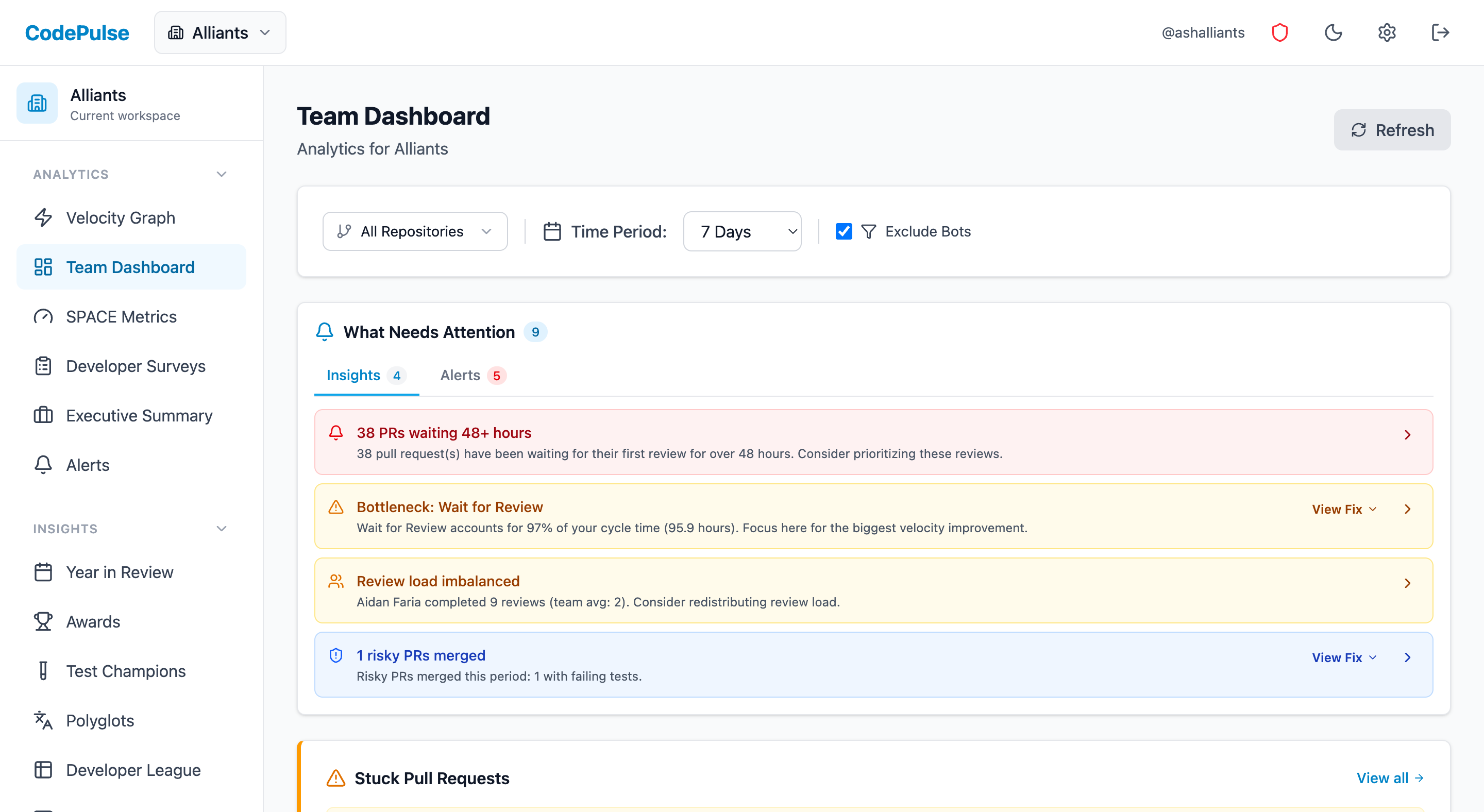
Get this view for your own teams
Connect GitHub for team-level workload, review distribution, and delivery signals. Individual views stay off unless your organisation explicitly turns them on.
Read-only GitHub · Your code stays yours · Team-level by default · No credit card
See These Features in Action
Explore all featuresRelated Guides
Engineering Metrics That Won't Get You Reported to HR
An opinionated guide to implementing engineering metrics that build trust. Includes the Visibility Bias Framework, practical do/don't guidance, and a 30-day action plan.
Engineering Analytics ROI: The Budget Approval Playbook
Calculate the ROI of engineering analytics tools with formulas for time savings, payback period, and a business case template tailored to CFOs, CTOs, and CEOs.
Your Engineering Metrics Are Lying to You
Learn how engineering analytics tools ensure data accuracy through bot filtering, file exclusions, and reliable sync mechanisms.
The Git Query That Finds Your New Hire's Perfect Mentor
Use Git activity data to accelerate new hire onboarding, identify domain experts for pairing, and track ramp-up progress.
Engineering Awards That Won't Destroy Your Culture
Build a data-driven recognition program that celebrates engineering achievements without creating toxic competition. 15 award categories, program design checklist, and measurement framework.
5 Signs Your Code Review Culture Is Toxic (Fix #3 First)
Assess and improve your code review culture. Identify toxic patterns and build psychological safety in your engineering team.