
Find quality and ownership risk before it becomes an incident
Preview how CodePulse combines review depth, risky changes, hotspots, and knowledge concentration without turning activity into individual scores.
Read-only GitHub · Your code stays yours · Team-level by default · No credit card
Code review is one of the most effective quality gates in software development, but only when it actually happens. The SmartBear/Cisco code review study found that lightweight peer review catches 60-90% of software defects, making it more effective than testing alone at preventing bugs from reaching production. This guide covers how to measure review coverage, where gaps form, what benchmarks to target, and how to build a process that catches the right problems without slowing your team down.
What is review coverage and why does it matter?
Review coverage is the percentage of pull requests that receive at least one code review before merging. Elite teams maintain 95%+ coverage. The SmartBear/Cisco code review study found that peer review catches 60-90% of defects before production, making it one of the most reliable predictors of code quality. CodePulse tracks review coverage and merge-without-approval rates automatically from your GitHub data.
What Does Review Coverage Actually Measure?
The Core Metric
Review Coverage is the percentage of pull requests that receive at least one code review before merging or closing.
Review Coverage = (PRs with first_review_at / Total Active PRs) x 100

Example:
  Total active PRs this month: 150
  PRs that received at least one review: 142
  Review Coverage: 142/150 = 94.7%
The Companion Metric: Merge Without Approval Rate
Review coverage tells you whether PRs get looked at. Merge Without Approval Rate tells you whether PRs get approved. The distinction matters: a reviewer can leave comments without approving, or a PR can be merged while review is still in progress.
Merge Without Approval Rate = (PRs merged without approval / Total merged) x 100

This catches cases where:
  - Someone reviewed but didn't approve
  - Review comments exist but no final approval
  - Branch protection was bypassed
Together, these two metrics form a complete picture. High review coverage with a high merge-without-approval rate means reviews are happening but not completing, which points to process bottlenecks or impatient authors.
There is a newer reason to read coverage carefully: a growing share of it is not human. We measured who actually reviews public code and found roughly a third of reviews come from AI agents that comment and move on without approving. A coverage figure that counts those the same as a human sign-off is answering a different question from the one you are asking.
What Counts as a Review?
Not all reviews are equal. A one-word "LGTM" after 30 seconds is technically a review, but it does nothing to protect your codebase. Here is a framework for distinguishing genuine review from rubber-stamping:
| Review Type | Indicators | Value |
|---|---|---|
| Rubber Stamp | Approved in under 2 minutes, no comments, no inline feedback | Near zero. Creates false confidence in coverage numbers. |
| Surface Review | Style or formatting comments only, no logic review | Low. Linters handle this better. |
| Substantive Review | Comments on logic, edge cases, architecture, or test coverage | High. This is what prevents defects. |
| Deep Review | Checks out code locally, runs tests, suggests alternatives | Highest, but does not scale to every PR. |
CodePulse detects rubber-stamp approvals (reviews completed in under 1 minute) as a risky change signal, helping you distinguish real coverage from checkbox coverage. For more on review quality and sentiment analysis, see our dedicated guide.
What Are Good Review Coverage Benchmarks?
Benchmarks depend on team size and process maturity. Based on the DORA State of DevOps research and CodePulse's Engineering Health Score thresholds, here is how to interpret your numbers:
| Grade | Review Coverage | Merge Without Approval | What It Means |
|---|---|---|---|
| A (Elite) | > 95% | < 2% | Strong review discipline. Exceptions are rare and documented. |
| B (High) | > 80% | < 5% | Good habits with occasional gaps, usually hotfixes or bot PRs. |
| C (Medium) | > 60% | < 15% | Inconsistent process. Some repos or developers bypass review regularly. |
| D (Low) | > 40% | < 30% | Review is optional in practice. High defect risk. |
| F (Critical) | < 40% | > 30% | No review culture. Production incidents are likely frequent. |
Source: CodePulse Engineering Health Score thresholds, aligned with DORA research on high-performing teams.
"Review coverage below 80% is not a metrics problem. It is a process problem dressed up as a culture problem. Fix the process first: branch protection, CODEOWNERS, review SLAs. Culture follows."
Why Does Review Coverage Predict Production Quality?
The Research
The SmartBear/Cisco code review study analyzed over 2,500 code reviews across a Cisco development team and found that lightweight peer review (the kind done in pull requests) catches 60-90% of defects. That makes it the most cost-effective defect detection method available, cheaper per bug found than testing, QA, or post-release fixes.
Research from Microsoft Research on modern code review found that code review at Microsoft does more than catch bugs. It transfers knowledge between team members, maintains code consistency, and teaches junior developers. Skip the review, and you skip all of that.
Knowledge Sharing and Bus Factor
- Context distribution: Every review means at least one other person understands the change
- Mentorship: Junior developers learn patterns, idioms, and pitfalls from senior feedback
- Reduced knowledge silos: No code is known by only one person. Review is one of the few mechanisms that transfers tribal knowledge without a separate documentation effort. Review coverage is directly tied to your change failure rate because unreviewed changes are more likely to cause production incidents.
Compliance and Audit Trails
Regulated industries (fintech, healthcare, defense) require documented review processes. SOC 2 audits check whether separation of duties exists in code changes. Low review coverage is a compliance gap that auditors will flag, separate from the quality risk.
"The most expensive bug is the one that reaches production because nobody looked at the code. The second most expensive is the one that reaches production because someone looked at the code for 30 seconds and hit Approve."
🔥 Our Take
100% review coverage is a vanity metric. What matters is 100% coverage on changes that can hurt you.
A team that reviews every dependency bump with the same rigor as a payment system refactor is wasting reviewer hours. The goal is risk-weighted coverage: enforce strict review on security-sensitive code, infrastructure changes, and large PRs. Let automated checks handle the rest. Chasing 100% flat coverage leads to rubber-stamping, where reviewers approve without reading because they are drowning in low-value reviews. That is worse than having a few unreviewed PRs, because it destroys the trust signal that review is supposed to provide.
📊 How to Track This in CodePulse
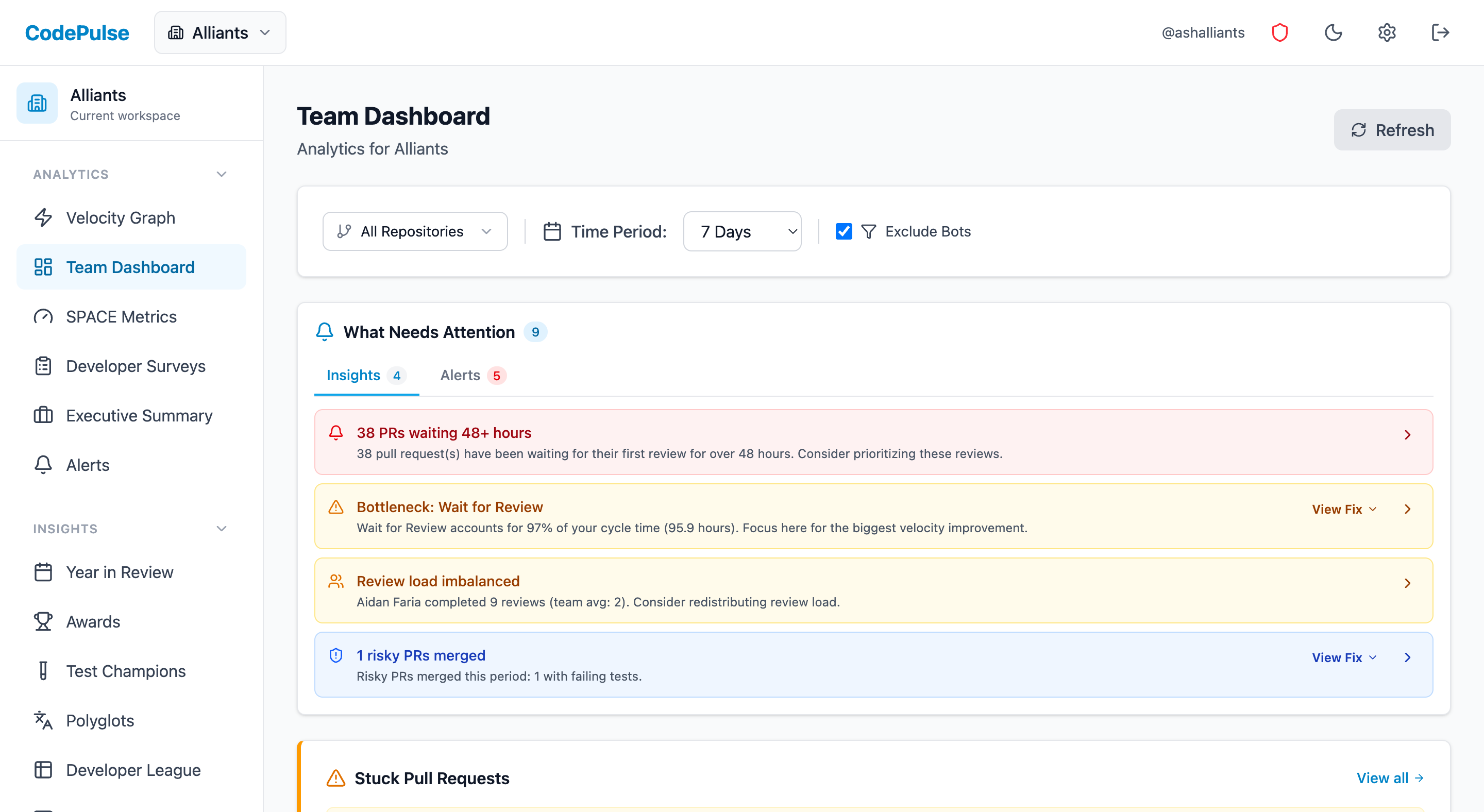
CodePulse tracks both Review Coverage and Merge Without Approval automatically from your GitHub data:
- Dashboard: Review Coverage card shows current percentage and trend over time
- Merge Without Approval: Separate card tracking PRs merged without explicit approval
- Review Network: Visualize who reviews whom to spot isolated developers
- Review Insights: Sentiment analysis on review comments to detect rubber-stamping
- Risky Changes: Flags rubber-stamp approvals (under 1 minute), self-merges, and bypassed branch protection
- Filter by repository to find which repos have the widest gaps
Where Do Coverage Gaps Form?
1. Hotfix Bypasses
Production incidents create pressure to skip review. The fix ships, the incident resolves, and nobody goes back to review what was merged.
Signs:
- Merge without approval rate spikes on certain days
- Admin bypasses of branch protection
- Comments like "hotfix" or "emergency" in unreviewed PRs
Fix: Create an expedited review process for emergencies. Fast-track, not no-track. Pair program on hotfixes instead of skipping review entirely. Require post-incident review of all hotfixes within 24 hours.
2. Bot and Dependency PRs
Dependabot, Renovate, and internal automation tools generate high volumes of PRs that often auto-merge without human review.
Fix: CodePulse has an "Exclude Bots" toggle so you can see human-only coverage separately. For dependency updates, require CI to pass before auto-merge and flag security-sensitive dependency updates for human review.
3. Senior Developer Self-Merges
Senior developers or tech leads bypass review because they are "trusted." This is the most damaging gap because it signals to the team that review is optional for the right people.
Fix: Everyone gets reviewed. Seniority is not an exemption. Senior reviews serve knowledge sharing, not just bug catching. When a staff engineer self-merges, the team learns that review is a suggestion, not a standard. For more on balancing review load across seniority levels, see our Optimal Reviewer Count Guide.
4. Small and "Trivial" Changes
One-line fixes, typo corrections, and config changes often skip review because they seem too small to bother with. But small changes are quick to review (under 2 minutes), and even single-line changes can introduce bugs: an off-by-one error, a wrong variable name, or a config value that breaks production.
Fix: Enforce review for all PRs through branch protection. Small PRs are the fastest to review. "It is trivial" is not a valid reason to skip the one process that catches trivial mistakes.
How Do You Build Consistent Review Coverage?
Step 1: Enforce with Branch Protection
Technical enforcement is the foundation. Culture alone does not sustain 95%+ coverage; process does.
GitHub Branch Protection Settings:
  [x] Require a pull request before merging
  [x] Require approvals (at least 1)
  [x] Dismiss stale pull request approvals when new commits are pushed
  [x] Require review from Code Owners (if using CODEOWNERS)

Also consider:
  [x] Require status checks to pass
  [x] Require branches to be up to date before merging
Step 2: Define Ownership with CODEOWNERS
CODEOWNERS routes review requests to the right people automatically, which eliminates the "nobody was assigned" gap:
# .github/CODEOWNERS

# Default owners for everything
* @your-org/engineering

# Frontend team owns UI code
/src/components/ @your-org/frontend
/src/pages/ @your-org/frontend

# Backend team owns API
/api/ @your-org/backend

# Security team must review auth changes
/src/auth/ @your-org/security
/api/auth/ @your-org/security
Step 3: Set Review SLAs
Coverage gaps often form because reviews take too long, and authors merge without waiting. Setting explicit SLAs prevents this:
- First review: Within 4 business hours of request
- Follow-up review: Within 2 hours of author addressing feedback
- Small PRs (<100 lines): Same-day turnaround expected
For strategies on reducing review wait times and managing your PR review queue, see our dedicated guide.
Step 4: Set Up Alerts for Coverage Drops
Catch regressions before they become habits:
Alert: Review Coverage Warning
  Metric: review_coverage_percent
  Operator: <
  Threshold: 95
  Severity: warning
  Description: "Review coverage dropped below 95%"

Alert: Merge Without Approval Critical
  Metric: merge_without_approval_rate_percent
  Operator: >
  Threshold: 5
  Severity: critical
  Description: "More than 5% of merges bypassing approval"
"If your review coverage drops and nobody notices for two weeks, you do not have a review culture. You have a review accident that has been working so far."
How Do You Use Review Patterns to Find Gaps?
Identifying Isolated Developers
The Review Network visualization shows who reviews whom. Look for developers with few connections. They either:
- Do not get enough reviews (a coverage gap)
- Do not give enough reviews (not contributing to team knowledge)
Address isolation by explicitly assigning these developers as reviewers or ensuring their PRs get timely review. CODEOWNERS and round-robin assignment help here.
Spotting Review Bottlenecks
If the network shows one or two people as central hubs handling most reviews, they are bottlenecks. When those people go on vacation or get pulled into a project, review coverage drops because nobody else picks up the slack. See our Reduce PR Cycle Time guide for strategies to distribute review load more evenly.
Coverage Target Summary
| Metric | Target | Why |
|---|---|---|
| Review Coverage | ≥ 95% | Elite threshold per DORA-aligned benchmarks |
| Merge Without Approval | ≤ 5% | Allows rare documented exceptions (hotfixes) |
| Time to First Review | < 4 hours | Prevents authors from bypassing due to wait time |
| Rubber Stamp Rate | < 10% | Reviews under 1 minute should be the exception |
If you are below these targets, start with branch protection (technical enforcement), then work on SLAs and CODEOWNERS to make reviews faster and more consistent. Culture follows process, not the other way around.
Frequently Asked Questions
Code review coverage is the percentage of pull requests that receive at least one human review before merging. It is calculated as (PRs with at least one review / Total merged PRs) x 100. A team with 142 reviewed PRs out of 150 total has 94.7% review coverage.
See which files and owners carry your real risk
Connect GitHub and get your churn hotspots, single-owner modules, and review-depth signals ranked by exposure. No repository cloning, no file contents read.
Read-only GitHub · Your code stays yours · Team-level by default · No credit card
See These Features in Action
Interactive graph of review relationships and workload distribution.
Measure review thoroughness and feedback quality across the team.
Related Guides
Your Best Engineer Is About to Quit (Check Review Load)
Learn how to identify overloaded reviewers, distribute review work equitably, and maintain review quality without burning out your senior engineers.
5 Signs Your Code Review Culture Is Toxic (Fix #3 First)
Assess and improve your code review culture. Identify toxic patterns and build psychological safety in your engineering team.
The Exact Number of Reviewers Per PR (Research Says 2, But...)
Research-backed guidance on how many reviewers you need per pull request, with strategies for matching review depth to risk level.
DORA Metrics Explained: The 4 Keys Without the Hype
A complete breakdown of the four DORA metrics - deployment frequency, lead time, change failure rate, and MTTR - with honest benchmarks and gaming traps to avoid.
Ancient PRs Are Murdering Your Velocity. Here's the Triage
Tactical strategies for managing your review queue, prioritizing PRs effectively, and preventing aging PRs from blocking your team.
The PR Pattern That Predicts 73% of Your Incidents
Learn how to identify high-risk pull requests before they cause production incidents.
High Code Churn Isn't Bad. Unless You See This Pattern
Learn what code churn rate reveals about your codebase health, how to distinguish healthy refactoring from problematic rework, and when to take action.