
Inspect the output before you grant repository access
Preview the report first. When you are ready, start with selected repositories through a read-only GitHub connection, and your code stays yours.
Read-only GitHub · Your code stays yours · Team-level by default · No credit card
When evaluating engineering analytics tools, security and compliance considerations often determine which vendors make it past IT review. In regulated industries or any organization that takes code data protection seriously, understanding how these tools handle security is essential.
This guide covers everything you need to know about data security, compliance requirements, and privacy considerations when evaluating GitHub analytics platforms. We'll dive into SOC 2, GDPR, audit trail requirements, and the access control patterns that separate enterprise-ready solutions from tools that will get rejected by your security team.
🔥 Our Take
Security compliance shouldn't slow you down - it should be invisible infrastructure.
The best engineering analytics tools automate compliance instead of creating manual gates. If your security review process for a metrics tool takes longer than the tool itself saves you, something's broken. Judge vendors on the size of the data boundary first - read-only scopes, no repository cloning, encryption by default, a public DPA - and treat a SOC 2 report as confirmation of controls you can already see, not as a substitute for reading them. A certified vendor with broad code access is a bigger risk than an uncertified one that never reads your files.
Why Security Matters for Engineering Analytics
Engineering analytics tools require access to some of your most sensitive organizational data: your source code repositories, developer activity, and workflow patterns. This access creates both opportunity and risk.
For teams in regulated industries like healthcare or finance, the stakes are even higher. See our Engineering Metrics for Healthcare Guide for industry-specific compliance considerations including FDA and HIPAA requirements.
What's at Stake
- Source code exposure: Some tools request read access to code content, which could expose proprietary algorithms or security vulnerabilities
- Developer activity data: Commit history, PR patterns, and review activity reveal how your team works - information competitors would value
- Organizational structure: Team composition, reporting lines, and project assignments are often inferable from repository access patterns
- Third-party risk: A breach at your analytics vendor could expose your data even if your own systems are secure
The Stakes Are Higher Than You Think
Unlike a compromised marketing tool or CRM, a breach of your engineering analytics platform could expose:
- Security vulnerabilities in your codebase (via commit messages or PR titles)
- Unreleased features and competitive roadmap information
- Internal process and quality issues
- Individual developer performance data (with potential HR/legal implications)
"The best security posture is minimal attack surface. Tools that don't need your code shouldn't ask for it."
Data Access & Permissions
The first question to ask any engineering analytics vendor: "What data do you actually need access to?"
GitHub OAuth Scopes
GitHub uses OAuth scopes to define what data an application can access. Here's what different scopes mean:
| Scope | Access Granted | Risk Level |
|---|---|---|
repo | Full access to code, commits, PRs, issues | High |
read:org | Organization membership and team info | Medium |
read:user | User profile information | Low |
admin:repo_hook | Create and manage webhooks | Medium |
Three Levels of Repository Access
A critical distinction: does the tool need to read your actual source code, or just metadata about your development process? For engineering analytics focused on team metrics - cycle times, review coverage, deployment frequency - metadata is sufficient:
- Metadata includes: PR titles, timestamps, author usernames, review status, merge dates, commit counts, file change counts
- Review discussion includes: Review comments and the short code snippet GitHub attaches to an inline comment so the comment makes sense in context
- Full code access includes: Cloning the repository, reading file contents, or pulling complete pull request diffs
The middle category is where most buyers get confused, so it is worth being precise. A tool cannot tell you whether your reviews are substantive without reading the review comments, and a review comment without its snippet is meaningless. That is a very different ask from cloning your repository. When you evaluate a vendor, separate the three: metadata, review discussion, and full code access. Ask which of the three they take and why.
Tools that need full code access for features like AI code review or security scanning have legitimate reasons. But if a tool is calculating PR cycle time and asking to clone your repository or read file contents, that's a red flag.
For reference, CodePulse sits in the first two categories: metadata plus review discussion, including the inline-comment snippet. It never clones your repository and never reads your files. The full boundary and permission list are on our Trust Center.
Questions to Ask Vendors
- Do you clone our repository or read file contents? Most analytics tools do not need to. Ask separately about review comments - a tool that measures review quality will need those, and should say so plainly rather than hiding behind a vague claim about reading nothing but metadata.
- What's your minimum required scope? Be wary of tools requesting full
repoaccess when they only need metadata. - Can I limit access to specific repositories? Granular control is better than all-or-nothing access.
- How do you handle GitHub Apps vs OAuth Apps? GitHub Apps offer more granular permissions than traditional OAuth.
The Principle of Least Privilege
The best engineering analytics tools request only the permissions they absolutely need. A tool that calculates PR cycle times doesn't need to read your source code - it only needs metadata about when PRs were opened, reviewed, and merged.
SOC 2 Compliance Considerations
SOC 2 (Service Organization Control 2) is the most common compliance framework for SaaS vendors handling sensitive data. If your organization requires SOC 2 compliance from vendors, here's what to look for.
SOC 2 Trust Service Criteria
SOC 2 evaluates vendors across five "Trust Service Criteria":
- Security: Protection against unauthorized access - this is the foundation. All SOC 2 reports must include Security. Controls include network security, access management, vulnerability scanning, and incident response.
- Availability: System uptime and reliability. This covers disaster recovery, backup procedures, and capacity planning.
- Processing Integrity: Data processed correctly and completely. Important for analytics tools where calculation accuracy matters.
- Confidentiality: Protection of confidential information through encryption, access controls, and data classification.
- Privacy: Personal data handled appropriately per stated policies. Critical for tools processing developer activity data.
Type I vs Type II
- SOC 2 Type I: Point-in-time assessment. Confirms controls are designed appropriately. Think of it as "we have the right policies."
- SOC 2 Type II: Assessment over a period (usually 6-12 months). Confirms controls are operating effectively over time. Think of it as "we actually follow our policies consistently."
Type II is more rigorous and generally preferred by enterprise security teams. A vendor with only Type I certification may be early in their compliance journey or may have recently changed their controls.
"SOC 2 Type I tells you a vendor has policies. Type II tells you they follow them. Always ask for Type II."
What to Request from Vendors
- SOC 2 report or attestation letter: Most vendors will share under NDA
- Report date: SOC 2 reports expire. Ensure the report is current (within last 12 months)
- Scope of audit: Confirm the audit covers the specific service you're evaluating
- Any exceptions or qualifications: Review for any noted deficiencies
- Trust criteria covered: Security is mandatory, but for analytics tools you should also look for Confidentiality and Privacy
SOC 2 Red Flags
- "We're working on SOC 2" with no timeline - compliance takes 6-12 months minimum
- Type I report only with no Type II planned
- Report is older than 12 months
- Scope doesn't cover the product you're evaluating
- Multiple exceptions in the report (some exceptions are normal, many are concerning)
Audit Trail Requirements
For regulated industries, audit trails aren't optional - they're mandatory. Engineering analytics tools should support full logging of who accessed what, when, and why.
What an Audit Trail Should Capture
- Authentication events: Who logged in, when, from where, success/failure
- Authorization changes: Permission grants, role changes, org membership
- Data access: Which reports were viewed, which exports were generated
- Configuration changes: Settings modifications, integration setup
- Administrative actions: User management, organization settings
Audit Trail Best Practices
Security Audit Trail Checklist for Engineering Analytics
Authentication & Access
- All login attempts logged (success and failure)
- Session duration and termination recorded
- IP addresses and user agents captured
- MFA events (enrollment, authentication) tracked
- SSO/SAML authentication events logged
Authorization & Permissions
- Role assignments and changes recorded
- Permission grants and revocations tracked
- Organization membership changes logged
- Repository access changes captured
- API key creation and rotation logged
Data Access & Export
- Report views logged with viewer identity
- Data exports tracked (format, scope, recipient)
- Filtered searches recorded (what was queried)
- Dashboard access logged
- Individual developer data views tracked
Configuration & Administration
- Integration setup and changes logged
- Alert rule creation and modification tracked
- Metric configuration changes recorded
- Data retention settings changes logged
- Billing and subscription changes captured
Incident Response Requirements
- Logs retained for minimum 12 months (or per policy)
- Logs tamper-evident (immutable or signed)
- Real-time alerting on suspicious patterns
- Log export available for SIEM integration
- Compliance reporting generation available
Review Cadence
- Weekly: Review failed login attempts
- Monthly: Review permission changes
- Quarterly: Full audit trail review
- Annually: Compliance audit preparation
For teams following DORA metrics, audit trails also support change failure rate analysis - you can correlate deployment events with access patterns to understand who had context on changes that caused incidents.
Access Control Patterns
Not everyone in your organization should see the same data. Enterprise-ready engineering analytics tools implement role-based access control (RBAC) that maps to your org structure.
Common Access Control Models
| Role | Typical Access | Restrictions |
|---|---|---|
| Executive | Org-wide aggregated metrics, trends | No individual developer data |
| Engineering Manager | Team metrics, individual contributors on their team | Only their direct/indirect reports |
| Tech Lead | Repository metrics, PR details for their repos | No HR-sensitive performance data |
| Developer | Their own metrics, team aggregates | No peer individual data |
| Admin | Configuration, integrations, user management | Separate from data access |
Access Control Questions to Ask
- Can we define custom roles beyond the defaults?
- Can access be scoped to specific teams or repositories?
- Is there separation between admin access and data access?
- Can we integrate with our existing identity provider (Okta, Azure AD)?
- Are access changes logged in the audit trail?
Strong access controls also support healthy team dynamics. See our guide on code reviewer best practices for how transparent metrics can improve review culture without creating surveillance anxiety.
Privacy & PII Handling
Engineering analytics tools process data about individual developers - their commits, PRs, review activity, and work patterns. This creates privacy considerations even if no traditional PII (like social security numbers) is involved.
What Counts as Developer PII?
In the context of engineering analytics:
- Directly identifiable: GitHub usernames, email addresses, real names
- Indirectly identifiable: Contribution patterns, working hours, coding style
- Behavioral data: Response times, review participation, activity levels
Privacy Questions to Ask
- Who can see individual developer metrics? Can line managers see individual data? Can executives? Can other developers?
- Can metrics be anonymized or aggregated? Some tools allow team-level views without individual identification.
- What's your data retention policy? How long is developer activity data stored?
- Can developers see their own data? Transparency builds trust.
- How do you handle data deletion requests? If a developer leaves, can their data be removed?
GDPR Compliance
If you have developers in the EU, GDPR applies. Key requirements:
- Lawful basis: You need a legal basis for processing developer data (usually "legitimate interest" for business operations)
- Data minimization: Collect only what's necessary for the stated purpose
- Right to access: Developers can request a copy of their data
- Right to erasure: Developers can request deletion (with some exceptions for legal requirements)
- Data Processing Agreement: Required when using third-party processors
- Data transfer mechanisms: For US-based vendors, Standard Contractual Clauses (SCCs) are typically required
GDPR-Specific Questions for Vendors
- Do you have a Data Processing Agreement (DPA) template?
- Where is data stored? (EU data centers preferred for EU employees)
- Do you support Standard Contractual Clauses for international transfers?
- How do you handle data subject access requests (DSARs)?
- What's your data deletion process and timeline?
- Do you have a designated Data Protection Officer?
"GDPR isn't just about where data is stored - it's about demonstrating ongoing accountability for how it's used."
Self-Hosted vs SaaS Security Tradeoffs
One of the biggest security decisions is whether to use a cloud-hosted (SaaS) solution or deploy on your own infrastructure. Each has distinct security implications.
| Factor | SaaS | Self-Hosted |
|---|---|---|
| Data residency | Vendor-controlled location | Your choice of infrastructure |
| Patching/Updates | Vendor-managed | Your responsibility |
| Network isolation | Public internet (with encryption) | Can run in private network |
| Compliance burden | Vendor handles SOC 2, etc. | Your responsibility to certify |
| Incident response | Vendor-led | Your team handles |
For a deeper dive on this decision, see our guide: Self-Hosted vs SaaS Engineering Analytics.
When Self-Hosted Makes Sense
- Regulatory requirements mandate on-premises data storage
- You have a dedicated platform team to manage infrastructure
- You need network isolation that SaaS can't provide
- You're in defense/government with specific certifications (FedRAMP, etc.)
When SaaS Is the Better Choice
- You want to outsource security patching and updates
- SOC 2 compliance from the vendor is sufficient for your needs
- You don't have platform engineering capacity for another system
- Time to value is more important than complete data control
Vendor Evaluation Checklist
Use this checklist when evaluating engineering analytics vendors for security and compliance:
Data Access
- ☐ What GitHub scopes/permissions are required?
- ☐ Does the tool access code content or just metadata?
- ☐ Can access be limited to specific repositories?
- ☐ Is GitHub App or OAuth App used?
- ☐ How are API tokens stored and rotated?
- ☐ What happens to access if we revoke permissions?
Data Security
- ☐ Is data encrypted at rest (AES-256 or equivalent)?
- ☐ Is data encrypted in transit (TLS 1.2+)?
- ☐ Where is data stored geographically?
- ☐ What's the data retention policy?
- ☐ How is data deleted when contract ends?
- ☐ Is there customer data isolation (not shared databases)?
Compliance
- ☐ Is SOC 2 Type II certification available?
- ☐ Is the SOC 2 report current (within 12 months)?
- ☐ Are there any audit exceptions?
- ☐ Is GDPR compliance documented?
- ☐ Are DPAs (Data Processing Agreements) available?
- ☐ What other certifications exist (ISO 27001, HIPAA BAA)?
Privacy
- ☐ Who can view individual developer metrics?
- ☐ Can data be aggregated to protect individuals?
- ☐ Can developers see their own data?
- ☐ How are data deletion requests handled?
- ☐ Is there a clear privacy policy?
- ☐ How is data subject access request (DSAR) process?
Access Control & Authentication
- ☐ Is SSO/SAML supported?
- ☐ Is MFA available/required?
- ☐ Are there role-based access controls?
- ☐ Can permissions be scoped to teams/repos?
- ☐ Is there separation of admin and data access?
- ☐ Are access changes logged?
Audit & Monitoring
- ☐ Are all user actions logged?
- ☐ How long are audit logs retained?
- ☐ Can logs be exported to SIEM?
- ☐ Is there real-time alerting on suspicious activity?
- ☐ Are logs tamper-evident?
Infrastructure
- ☐ What cloud provider is used?
- ☐ Is the infrastructure SOC 2 compliant?
- ☐ Are there uptime/SLA guarantees?
- ☐ Is there a security incident response plan?
- ☐ Is penetration testing performed regularly?
- ☐ Is there a status page for service health?
Vendor Security
- ☐ Does the vendor have a security team?
- ☐ Is there a bug bounty or vulnerability disclosure program?
- ☐ How are vendor employee access controls managed?
- ☐ What background checks are performed on employees?
- ☐ Is there cyber insurance?
- ☐ What's the notification timeline for security incidents?
This checklist should be part of your standard vendor evaluation process. Most reputable engineering analytics vendors will be able to address these questions readily - be cautious of vendors who can't or won't provide clear answers.
Implementation Best Practices
Once you've selected a vendor, these practices ensure a secure deployment:
Initial Setup
- Start with minimal repositories: Connect a few non-sensitive repos first to validate behavior
- Review permissions before granting: Understand exactly what access you're providing
- Enable SSO immediately: Don't rely on username/password authentication
- Configure access controls: Set up roles before inviting users
- Enable audit logging: Start capturing events from day one
Ongoing Security Hygiene
- Quarterly review of user access and permissions
- Monthly review of audit logs for anomalies
- Annual vendor security review (request updated SOC 2)
- Immediate access revocation when employees leave
- Regular review of connected repositories and scopes
Incident Response Preparation
- Document the vendor's security contact and escalation path
- Understand their incident notification timeline
- Know how to quickly revoke access if needed
- Have a communication plan for stakeholders
- Include the vendor in your incident response tabletops
Conclusion
Evaluating engineering analytics tools for security and compliance doesn't have to be a months-long process. Focus on the fundamentals: minimal data access, current SOC 2 Type II certification, clear privacy policies, and strong access controls.
The best vendors have already invested in compliance infrastructure - your job is to verify it meets your requirements, not to negotiate custom security arrangements. Use the checklist above to structure your evaluation, and don't hesitate to walk away from vendors who can't provide clear, documented answers.
For more on choosing the right deployment model for your security requirements, see our guide on Self-Hosted vs SaaS Engineering Analytics. And for understanding how metrics fit into your overall engineering improvement strategy, check out our DORA Metrics Guide.
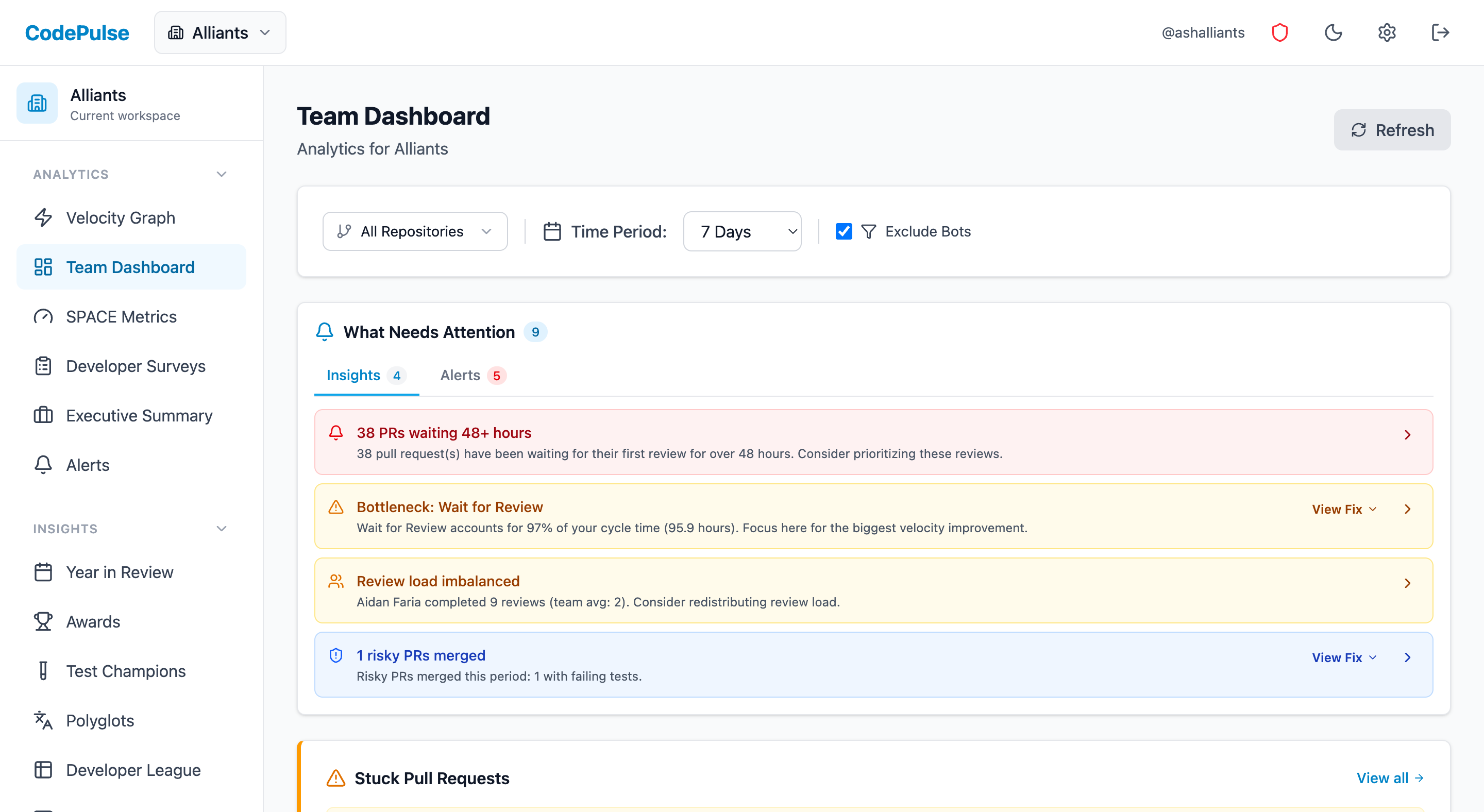
Start with one repository and a read-only connection
You choose the repositories. CodePulse cannot push, merge, or modify anything, and never clones your code. Expand the scope only once the output has earned it.
Read-only GitHub · Your code stays yours · Team-level by default · No credit card
See These Features in Action
Explore all featuresRelated Guides
Jellyfish vs LinearB vs Swarmia: Full 2026 Comparison
Compare Jellyfish, LinearB, Swarmia, Allstacks, Haystack and more engineering analytics tools. Features, pricing, cycle time benchmarks, and integrations.
Engineering Metrics Dashboard: The 7 Metrics You Need
Skip vanity metrics. Here are the 7 engineering metrics VPs actually need to track team performance, delivery, and quality.
The GitHub Permission Mistake That Gets Security Rejected
Understand GitHub OAuth scopes and app permissions required for engineering analytics tools, with security best practices.
How Fintech Teams Pass Audits Without the Documentation Panic
How fintech engineering teams use metrics to maintain regulatory compliance, enforce separation of duties, and prepare for audits.
HIPAA-Compliant Metrics: The Checklist That Saved Our Audit
How healthcare and life sciences engineering teams use metrics to meet FDA requirements, maintain HIPAA compliance, and ensure software quality.
DevSecOps Metrics: Security Without Killing Velocity
Learn how to measure the "Sec" in DevSecOps using GitHub data. Track check failure rates, time-to-fix vulnerabilities, and security impact on delivery speed.