
See exactly where your delivery flow is waiting
Preview the phase-by-phase report for review pickup, active review, and merge time. Connect in about five minutes; the initial analysis runs after sync.
Read-only GitHub · Your code stays yours · Team-level by default · No credit card
Code review is one of the highest-leverage activities in software development. Done well, it improves code quality, shares knowledge, and builds team cohesion. Done poorly, it becomes a bottleneck that frustrates everyone. This guide covers data-driven best practices for making code review effective.
Research shows that code review catches 60-90% of defects before they reach production - but only when reviews are thorough and timely. Most teams leave significant value on the table by not optimizing their review process.
Key Code Review Metrics
Before improving your review process, you need to measure it. These metrics provide a baseline and track progress. For concrete healthy vs. unhealthy ranges on comment volume specifically, our PR comments benchmarks post has percentile distributions from 800K+ PRs. If you are also weighing which tool should be tracking these metrics for you, see our code review platforms comparison.
Speed Metrics
| Metric | Definition | Target |
|---|---|---|
| Time to first review | PR opened → first review comment | < 4 hours |
| Review turnaround | Changes requested → author response | < 4 hours |
| Time to approval | First review → final approval | < 24 hours |
| Total review time | PR opened → approved | < 24 hours |
Quality Metrics
| Metric | Definition | Target |
|---|---|---|
| Review coverage | % of PRs with at least one review | 100% |
| Comments per PR | Average review comments | 2-5 (varies by PR size) |
| Iteration cycles | Back-and-forth before merge | 1-2 |
| Self-merge rate | PRs merged by author without review | < 5% (emergencies only) |
Distribution Metrics
| Metric | Definition | Warning Sign |
|---|---|---|
| Review load balance | Reviews per person distribution | Top reviewer > 3x average |
| Reviewer concentration | % of reviews by top 3 reviewers | > 50% |
| Cross-team reviews | Reviews from outside the team | < 10% |
CodePulse tracks all these metrics automatically. View them in your Dashboard and Review Network.
Best Practices for Reviewers
1. Review Promptly
Fast feedback keeps authors in context and maintains flow. Set personal SLAs:
- Small PRs (< 100 lines): Review within 2 hours
- Medium PRs (100-400 lines): Review within 4 hours
- Large PRs (> 400 lines): Ask for breakdown or review within 8 hours
Tip: Block 30 minutes in the morning and afternoon for review duty.
2. Understand Before Commenting
Before leaving comments:
- Read the PR description and linked issues
- Understand the full context of the change
- Run the code locally for significant changes
- Check if your concern is addressed elsewhere in the PR
3. Categorize Your Feedback
Not all comments are equally important. Use prefixes to signal priority:
- BLOCKER: Must fix before merge (security, correctness, breaking change)
- SUGGESTION: Recommended improvement, but not required
- NIT: Minor style/preference issue, author's discretion
- QUESTION: Seeking clarification, not necessarily a change request
4. Be Specific and Actionable
Good review comments explain the problem AND suggest a solution:
❌ Unhelpful
"This is confusing"
✅ Helpful
"This function does two things (validation and transformation). Consider splitting into `validateInput()` and `transformData()` for clarity."
5. Approve When Ready
Don't hold PRs hostage for minor issues. If your feedback is all NITs or SUGGESTIONs, approve with comments. This signals trust in the author to address feedback appropriately.
Best Practices for PR Authors
1. Make PRs Easy to Review
The easier your PR is to review, the faster and better feedback you'll get:
- Keep PRs small: Under 400 lines when possible
- Write clear descriptions: What, why, and how to test
- Self-review first: Catch obvious issues before requesting review
- Add context: Screenshots, test commands, relevant docs
2. Respond to Feedback Gracefully
Code review is a conversation, not a judgment:
- Thank reviewers for thorough feedback
- Ask clarifying questions if comments are unclear
- Explain your reasoning if you disagree (but stay open-minded)
- Address all comments, even if just with "Done" or "Won't fix because..."
3. Request Reviews Strategically
Choose reviewers who can provide meaningful feedback:
- Domain experts: For business logic changes
- Code owners: For changes to their areas (check CODEOWNERS)
- Fresh eyes: For architecture decisions
- Juniors: Include them for knowledge sharing (with a senior backup)
💡 The Right Number of Reviewers
Two reviewers catch most defects; beyond that, you get diminishing returns. See our Optimal Reviewer Count Guide for detailed benchmarks.
Team-Level Review Practices
Set Clear Review SLAs
Document expectations so everyone knows what "timely" means. For a comprehensive framework, see our PR SLA implementation guide.
- First review: Within 4 business hours
- Follow-up reviews: Within 2 business hours
- Emergency fixes: Within 1 hour (with clear escalation path)
Set up Alert Rules in CodePulse to notify the team when PRs exceed these thresholds.
Balance Review Load
Review bottlenecks form when a few people handle most reviews. Use the Review Network to identify imbalances and:
- Rotate "reviewer of the day" duty
- Pair juniors with seniors on reviews
- Spread CODEOWNERS responsibilities
- Track review load in sprint planning
Create Review Guidelines
Document what your team cares about in reviews:
- What must be covered (security, performance, edge cases)
- What's out of scope for review (style issues handled by linters)
- When to request additional reviewers
- How to handle disagreements
Diagnosing Review Problems
Problem: Reviews Take Too Long
| Symptom | Likely Cause | Solution |
|---|---|---|
| Long wait for first review | Unclear ownership, no SLAs | Set SLAs, use alerts |
| Many iteration cycles | PRs too large, unclear requirements | Smaller PRs, better specs |
| Reviews sit after approval | Author forgot or CI issues | Auto-merge, CI alerts |
Problem: Review Quality Is Low
| Symptom | Likely Cause | Solution |
|---|---|---|
| Bugs escaping to production | Rubber-stamp approvals | Review guidelines, pair reviews |
| No comments on PRs | Too busy, review fatigue | Balance load, smaller PRs |
| Only style comments | No guidelines, safety focus | Automated linting, training |
Problem: Review Culture Is Toxic
| Symptom | Likely Cause | Solution |
|---|---|---|
| Defensive authors | Harsh feedback, public criticism | Feedback training, comment prefixes |
| Reviewers avoiding feedback | Past conflicts, fear of confrontation | Blameless culture, 1:1 resolution |
| Review gatekeeping | Senior-only approval rules | Distribute trust, pair reviews |
Automating Review Workflows
Automate the repetitive parts so humans can focus on what matters:
The checklist items above are the best candidates. Encoding them in a Claude Code review skill gets the mechanical findings out of the way before a human opens the pull request.
GitHub Native Features
- CODEOWNERS: Auto-request reviews from the right people
- Branch protection: Require reviews before merge
- Suggested changes: Let reviewers propose specific edits
CodePulse Alerts
- Stale PR alerts: Notify when PRs exceed age thresholds
- Review load alerts: Flag when reviewers are overloaded
- Coverage alerts: Catch PRs merged without review
External Tools
- Linters: Catch style issues before review (ESLint, Prettier)
- Static analysis: Find bugs automatically (SonarQube, CodeClimate)
- Security scanners: Catch vulnerabilities (Snyk, Dependabot)
Measuring Review Improvement
Track these metrics over time to see if your improvements are working:
- Time to first review: Should decrease as SLAs take effect
- Total review time: Should decrease with smaller PRs and faster cycles
- Iteration cycles: Should stabilize at 1-2 with clearer communication
- Review load variance: Should decrease as load balances
- Escaped defects: Should decrease with thorough reviews
Use the Dashboard to track trends and the Executive Summary to report progress to leadership.
Related Guides
- Review Load Balancing Guide - distribute review work equitably across your team
- Reducing PR Cycle Time - speed up your entire delivery process
- Optimal Reviewer Count Guide - find the right number of reviewers for your team
- Async Code Review for Distributed Teams - optimize reviews across time zones
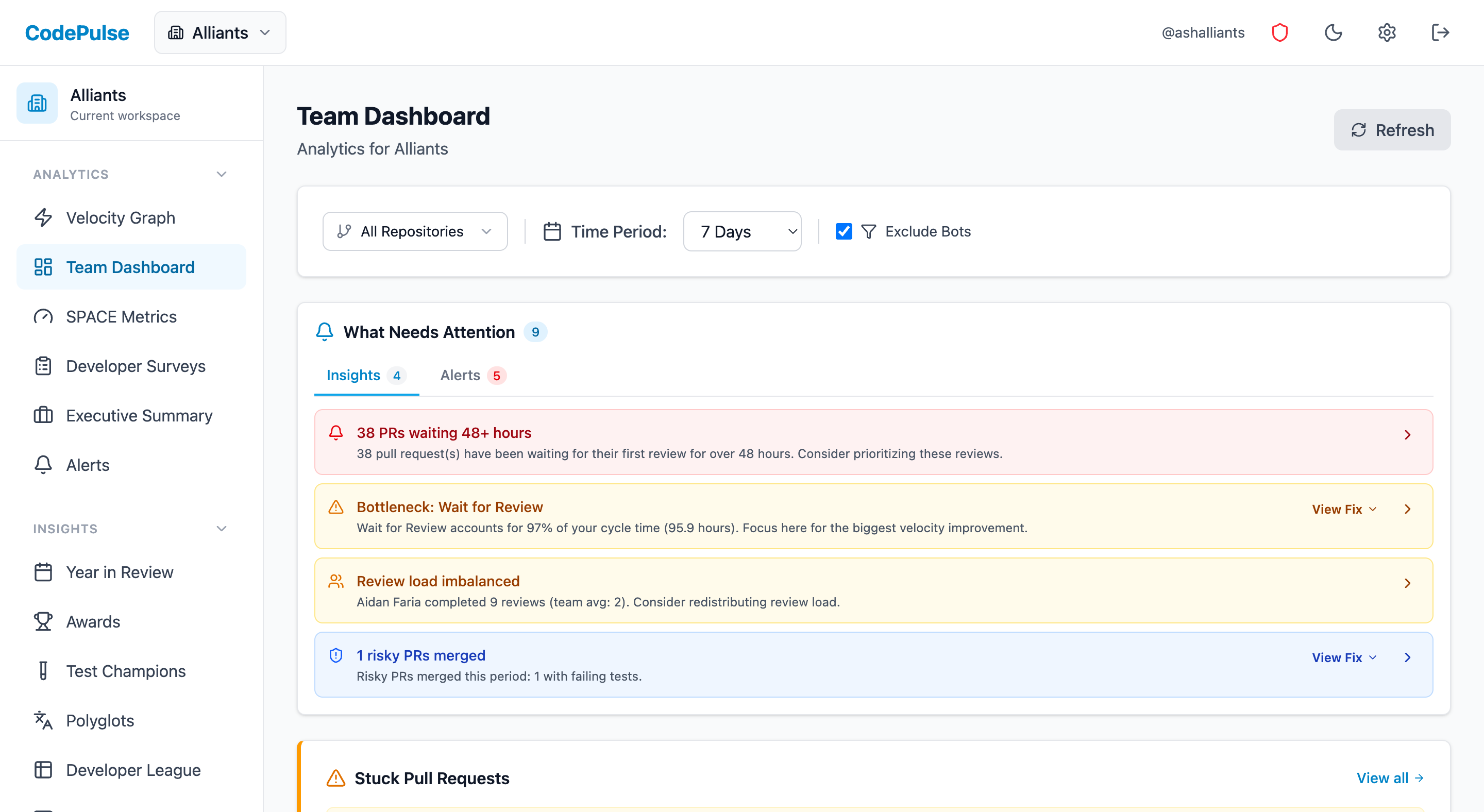
Find out which phase is holding your delivery up
CodePulse splits your cycle time into coding, waiting for review, active review, and merge, so you fix the queue that is actually costing you days. Read-only GitHub, no credit card.
Read-only GitHub · Your code stays yours · Team-level by default · No credit card
See These Features in Action
Interactive graph of review relationships and workload distribution.
Measure review thoroughness and feedback quality across the team.
Related Guides
Your Best Engineer Is About to Quit (Check Review Load)
Learn how to identify overloaded reviewers, distribute review work equitably, and maintain review quality without burning out your senior engineers.
We Cut PR Cycle Time by 47%. Here's the Exact Playbook
A practical playbook for engineering managers to identify bottlenecks, improve review processes, and ship code faster - without sacrificing review quality.
The Exact Number of Reviewers Per PR (Research Says 2, But...)
Research-backed guidance on how many reviewers you need per pull request, with strategies for matching review depth to risk level.
Developer Velocity: Metrics Beyond Story Points
Measure developer and engineering velocity without story points: cycle time, deployment frequency, flow efficiency and sustainable pace, plus what DORA tracks today.
Value Stream Mapping for Software Teams | Guide
Value stream mapping reveals that most lead time is waiting, not working. This guide shows how to map your software delivery flow, calculate flow efficiency, and identify the biggest improvement opportunities.
Identifying Stuck Pull Requests Before They Rot
Detect and unblock stuck PRs before they become abandoned. Learn the 5 patterns that cause PRs to stall and build automated alerts for early intervention.