
Compare the finished analysis before you choose a platform
See the report CodePulse produces from read-only GitHub workflow data, or connect your own repositories and evaluate the fit with real evidence.
Read-only GitHub · Your code stays yours · Team-level by default · No credit card
Self-hosted vs SaaS engineering analytics is a strategic tradeoff: control and customization versus speed and simplicity. This guide helps engineering leaders decide which deployment model fits their security requirements, platform capacity, and reporting goals.
The wrong choice can stall adoption or create unexpected operational overhead. The right choice gives you fast visibility without compromising trust. According to the Jellyfish 2024 State of Engineering Management Report, 43% of engineers feel leadership is "out of the loop" on engineering challenges - the deployment model you choose can either narrow or widen that gap.
"Self-hosted isn't about security - it's about control. SaaS isn't about convenience - it's about focus. Pick based on what you're optimizing for."
Decision Criteria That Actually Matter
Instead of debating philosophy, align the decision to a few concrete constraints. Use this decision matrix to cut through the noise:
| Constraint | Leans Self-Hosted | Leans SaaS |
|---|---|---|
| Security posture | Strict data residency, on-prem mandate | Cloud-first, SOC2/ISO sufficient |
| Platform capacity | Dedicated team for uptime/upgrades | Limited ops bandwidth |
| Time to value | Can afford 3-6 month setup | Need metrics in weeks |
| Customization needs | Domain-specific reports, warehousing | Standard DORA/delivery metrics |
| Budget model | CapEx preferred, internal cost centers | OpEx preferred, predictable billing |
🔥 Our Take
90% of teams who think they need self-hosted analytics actually don't.
They're confusing "security requirements" with "security theater." Unless you have actual regulatory mandates for data residency, the operational cost of self-hosted analytics almost never pays off. Most teams spend so much time maintaining infrastructure that they never get to the insights.
Self-Hosted: The Real Tradeoffs
Self-hosted analytics gives you full control over data and infrastructure, but the tradeoff is operational ownership. Be honest about whether you have the capacity.
When Self-Hosted Actually Makes Sense
- Regulatory requirements: SOX, HIPAA, or industry-specific mandates require data to stay in your environment
- Existing platform team: You already operate similar infrastructure and have runbooks, monitoring, and on-call coverage
- Deep integration needs: You need to join Git data with internal systems (Jira, HR, billing) in a data warehouse
- Custom metrics: Your business requires metrics no vendor offers, and you have the engineering capacity to build them
Self-Hosted Pitfalls (That Nobody Warns You About)
- Time-to-value trap: 6-12 months to meaningful dashboards is common. Leadership loses patience before you deliver value.
- Hidden infrastructure costs: Compute, storage, monitoring, backup, security patching. These compound over time.
- Metrics drift: Without dedicated maintenance, your metrics become unreliable. Bot accounts skew numbers. Schema changes break pipelines.
- Tribal knowledge risk: The engineer who built it leaves. Now you have undocumented infrastructure nobody understands.
- Lower trust paradox: If definitions aren't transparent, teams distrust the numbers even more than they would a vendor's.
Self-Hosted Cost Estimate
Typical self-hosted engineering analytics costs:

Infrastructure (per year):
- Compute/database:       $5,000 - $20,000
- Storage/backup:         $1,000 - $5,000
- Monitoring/logging:     $2,000 - $10,000
- Security/compliance:    $3,000 - $15,000
Subtotal:                 $11,000 - $50,000/year

Engineering time:
- Initial build:          2-4 engineer-months
- Ongoing maintenance:    0.25-0.5 FTE
- At $150K fully-loaded:  $37,500 - $75,000/year

Total first-year cost:    $80,000 - $200,000+
Ongoing annual cost:      $50,000 - $125,000/year
SaaS: The Real Tradeoffs
SaaS analytics trades control for speed. Most teams choose SaaS because they need results without building a data platform.
When SaaS Actually Makes Sense
- Speed matters: You need executive metrics in weeks, not months
- Limited ops capacity: Your platform team is stretched thin or doesn't exist
- Standard metrics work: DORA metrics, cycle time, review efficiency cover your needs
- Cloud-native stack: GitHub/GitLab as your source of truth, no complex on-prem integrations needed
- Predictable budgeting: OpEx model with known per-seat pricing fits your finance model
SaaS Pitfalls (That Vendors Don't Mention)
- Metric definition mismatch: The vendor's "cycle time" might not match your definition. Validate before committing.
- Privacy concerns: Individual developer views can feel like surveillance. Ask about privacy controls upfront.
- Feature creep costs: You sign up for basic analytics, then need advanced features at enterprise pricing.
- Data portability: Can you export your data if you leave? Some vendors make this difficult.
- Integration limits: If you need to join Git data with internal systems, SaaS tools may not support it.
"The best analytics system is the one your team actually uses. A self-hosted system that's never finished is worth less than a SaaS tool deployed in a week."
Total Cost of Ownership: Side-by-Side
TCO analysis isn't just about subscription vs infrastructure. Include opportunity cost of engineering time and risk of delayed insights.
| Cost Area | Self-Hosted | SaaS |
|---|---|---|
| Infrastructure | $11K-50K/year (compute, storage, monitoring) | Included in subscription |
| Maintenance | 0.25-0.5 FTE ongoing | Vendor managed |
| Implementation | 2-4 engineer-months upfront | Days to weeks |
| Customization | Full control, but you build it | Limited to product capabilities |
| Risk | Tribal knowledge, metrics drift | Vendor lock-in, privacy concerns |
| Time to value | 3-12 months | 1-4 weeks |
Break-Even Analysis
Self-hosted typically breaks even vs SaaS at 200-300+ developers, assuming:
- SaaS cost of ~$30/developer/month
- Self-hosted annual cost of ~$75,000 (infra + 0.5 FTE)
- Break-even: ~200 developers = $72,000/year SaaS
But this ignores opportunity cost. If your platform team could be building product instead of analytics infrastructure, the break-even point is much higher.
For detailed ROI modeling, use the Developer Tooling ROI Guide and Engineering Analytics ROI Guide.
The Hybrid Middle Ground
Some teams find a middle path that captures benefits of both models:
Option 1: SaaS + Data Export
Use SaaS for dashboards and alerts, but export raw data to your warehouse for custom analysis. This works if the vendor supports data export.
Option 2: Build Custom, Buy Standard
Use SaaS for standard metrics (DORA, cycle time, review efficiency). Build custom pipelines only for domain-specific metrics you can't get elsewhere.
Option 3: Private SaaS Deployment
Some vendors offer single-tenant or private cloud deployments. You get SaaS convenience with self-hosted data isolation. Ask about pricing - it's typically 2-3x standard SaaS.
Trust, Privacy, and Governance
Regardless of hosting model, trust is a gating factor. The Haystack Analytics study found 83% of developers suffer from burnout - deploying metrics as surveillance makes this worse, not better.
🔥 Our Take
Hosting model doesn't determine trust. Communication does.
We've seen self-hosted systems become surveillance tools, and SaaS platforms used ethically. The difference is always how leadership communicates intent. If engineers don't know how metrics will be used, they'll assume the worst - regardless of where the data lives.
Make sure your analytics platform supports:
- Team-level dashboards by default (not individual leaderboards)
- Transparent metric definitions (documented methodology)
- Access controls for individual views (opt-in, not default)
- Clear communication of intended use (written policy)
For a deeper security and privacy checklist, see the Security and Compliance Guide for GitHub Analytics.
The Deployment Decision Framework
Use this checklist to guide your decision:
CHOOSE SELF-HOSTED IF:
☐ Regulatory mandate for data residency (HIPAA, SOX, etc.)
☐ Existing platform team with spare capacity
☐ Need to join Git data with internal systems
☐ Custom metrics no vendor provides
☐ 3-6 month timeline is acceptable
☐ Budget for ongoing infrastructure + maintenance

CHOOSE SaaS IF:
☐ Need metrics in weeks, not months
☐ Limited or no platform team capacity
☐ Standard DORA/delivery metrics are sufficient
☐ Cloud-native, GitHub/GitLab-centric stack
☐ Predictable per-seat pricing fits budget model
☐ Trust vendor security (SOC2, ISO, etc.)
"The cost of a delayed decision is often higher than the cost of the wrong deployment model. Pick one and iterate."
How CodePulse Fits a SaaS Evaluation
CodePulse is designed for GitHub-based analytics with fast setup and clear metrics. If SaaS is the right fit, evaluate CodePulse by focusing on delivery bottlenecks, review efficiency, and executive reporting readiness.
📊 SaaS Evaluation Checklist in CodePulse
- Use the Dashboard to validate cycle time accuracy against your Git history
- Review reviewer load in the Review Network to check for imbalances
- Check hotspots in File Hotspots to identify risk areas
- Share the Executive Summary with leadership to test communication value
- Set up Alert Rules for stuck PRs to test operational value
If your organization needs a hybrid model or heavy customization, consider the Analytics as Code Guide for build-vs-buy evaluation. For rollout planning once you've decided, see the Engineering Metrics Rollout Playbook.
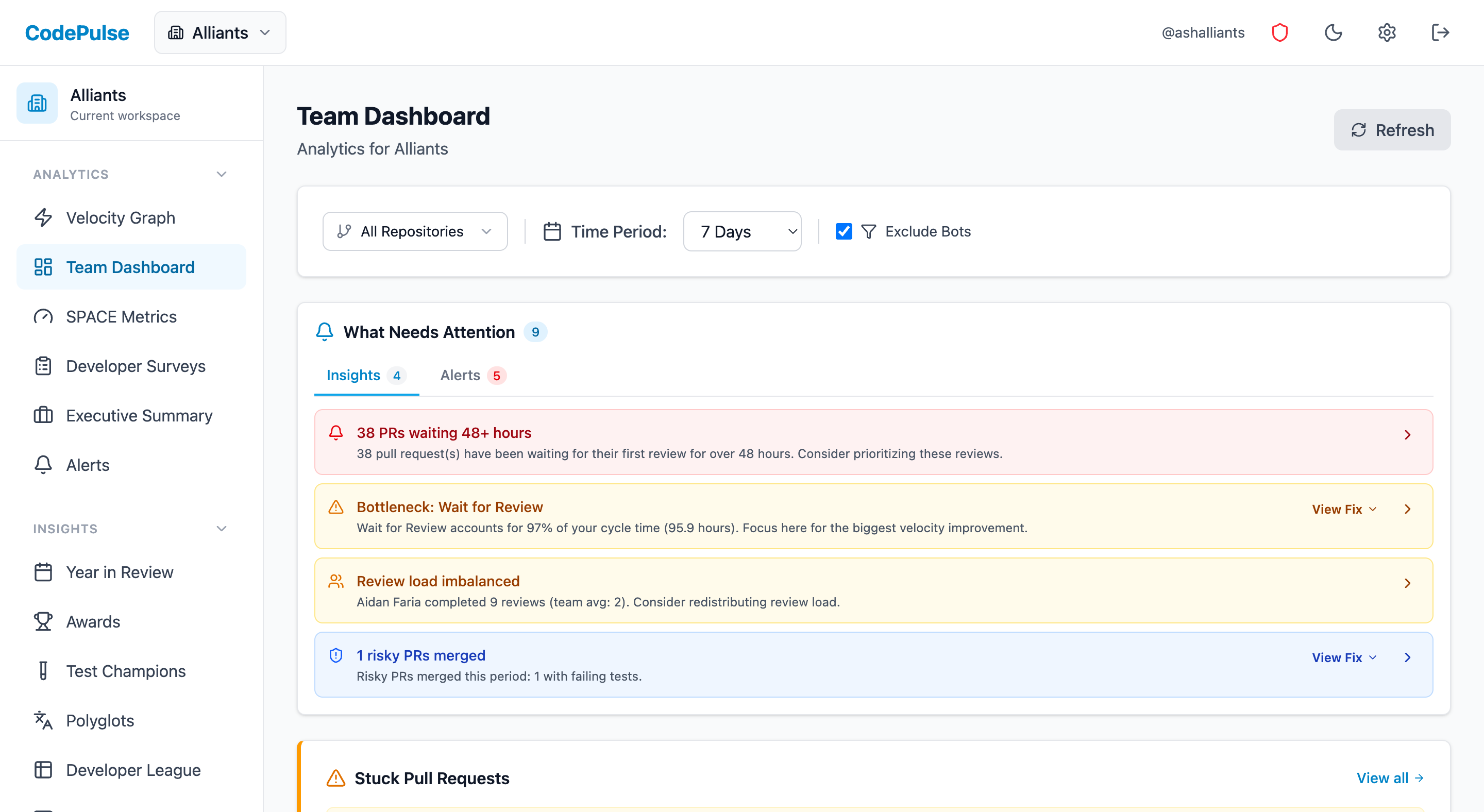
Evaluate CodePulse against your own delivery history
A comparison table only goes so far. Connect read-only GitHub in about five minutes and judge the output on your repositories, at one flat price, with no per-seat math.
Read-only GitHub · Your code stays yours · Team-level by default · No credit card
See These Features in Action
Explore all featuresRelated Guides
Jellyfish vs LinearB vs Swarmia: Full 2026 Comparison
Compare Jellyfish, LinearB, Swarmia, Allstacks, Haystack and more engineering analytics tools. Features, pricing, cycle time benchmarks, and integrations.
The SOC 2 Question That Eliminates 80% of Analytics Vendors
Everything you need to know about data security, SOC 2 compliance, and privacy when evaluating engineering analytics platforms.
We Built Our Own Analytics. Here's Why We Switched to SaaS
Explore building your own engineering analytics from GitHub data, including API examples, rate limit handling, and when to build vs buy.
5 LinearB Alternatives for 2026 (With Pricing)
An honest comparison of CodePulse vs LinearB. We tell you when to choose LinearB instead, because the best tool is the one that makes the right trade-offs for your situation.
Swarmia Pricing in 2026: Is EUR 42/Dev/Month Worth It?
Swarmia now sells four a-la-carte modules, with the Standard bundle at EUR 42/dev/month annual and a free tier for up to 9 developers. We break down each module, calculate real costs, and compare with CodePulse flat pricing.
Allstacks Pricing in 2026: Enterprise Cost Analysis
Allstacks is enterprise-only with estimated costs of $25-50/dev/month. We analyze the real cost of ML-powered delivery forecasting, hidden implementation expenses, and how it compares to simpler alternatives.