
Inspect the output before you grant repository access
Preview the report first. When you are ready, start with selected repositories through a read-only GitHub connection, and your code stays yours.
Read-only GitHub · Your code stays yours · Team-level by default · No credit card
Before connecting any engineering analytics tool to your GitHub organization, you need to understand exactly what access you're granting. This guide explains GitHub OAuth scopes and app permissions, helps you choose between OAuth Apps and GitHub Apps, and provides security best practices for analytics integrations.
For broader security and compliance considerations, see our Security & Compliance Guide for GitHub Analytics.
Understanding GitHub OAuth Scopes
What Are OAuth Scopes?
OAuth scopes define what an application can access when you authorize it. Each scope grants specific permissions. When you see an authorization screen listing scopes, you're seeing exactly what the app will be able to do.
Common Scopes for Analytics Tools
Engineering analytics tools typically need these scopes:
OAuth Scopes for Analytics
Scope: repo
- What it grants: Read access to code, commits, pull requests
- What it grants: Read access to issues and projects
- What it grants: Read access to repository metadata
- Why analytics needs it: Read PR data (open, merged, cycle times)
- Why analytics needs it: Read commit history and review comments
- Why analytics needs it: Read status checks and CI results
Scope: read:org
- What it grants: Read organization membership
- What it grants: Read team membership
- What it grants: Read organization settings (limited)
- Why analytics needs it: Know which repos belong to your org
- Why analytics needs it: Identify team members and filter by organization
Scope: read:user
- What it grants: Read user profile information
- What it grants: Read user email addresses
- Why analytics needs it: Display contributor names/avatars
- Why analytics needs it: Match commits to users and build developer profiles
Scopes Analytics Should NOT Need
Be suspicious if an analytics tool requests these:
- write:repo_hook: Can create webhooks (read-only analytics doesn't need this)
- delete_repo: Can delete repositories (never needed)
- admin:org: Can manage organization settings (never needed)
- write:org: Can modify organization membership (never needed)
- admin:repo_hook: Can manage webhooks (excessive for analytics)
OAuth App vs GitHub App: Which to Choose
OAuth Apps
OAuth Apps are the traditional way to authorize third-party access:
How they work:
- User authorizes the app with their personal GitHub account
- App acts on behalf of that user
- Access is tied to the authorizing user's permissions
Pros:
- Simple setup - just click authorize
- Works immediately across all orgs the user can access
- No organization admin approval required (in most cases)
Cons:
- Access tied to individual user (what if they leave?)
- Harder for admins to audit and control
- Broader scopes than might be necessary
GitHub Apps
GitHub Apps are the newer, more granular approach:
How they work:
- Installed at the organization level by an admin
- App has its own identity, not tied to a user
- Granular permissions per repository
Pros:
- More granular permissions (read-only by default)
- Org-level control - admins can manage centrally
- Survives employee turnover
- Better audit trail
Cons:
- Requires organization admin to install
- More complex setup process
- May need to select specific repositories
Recommendation
Which Should You Choose?
- You need quick setup for evaluation
- You're a small team with simple needs
- Org admin isn't available to approve
- Security/compliance is a priority
- You want org-level control
- You need to limit access to specific repos
- You're deploying across multiple orgs
Minimum Permissions for Analytics
What Analytics Actually Needs
A well-designed analytics tool should need only read access:
GitHub App Permissions (Minimal Set)
Repository Permissions
- Contents: Read (to read commits)
- Pull requests: Read (to read PR data)
- Checks: Read (to read CI status)
- Metadata: Read (always required)
Organization Permissions
- Members: Read (to see org membership)
User Permissions
- Email addresses: Read (optional, for user matching)
Important Note
- NO write permissions should be required for pure analytics
🔐What CodePulse Requires
CodePulse uses a GitHub App with the minimum read-only permissions listed above. We never request write access to your repositories. During setup, you'll see exactly which permissions are requested before authorizing. You can also limit access to specific repositories rather than your entire organization.
Learn more about CodePulse's security model →
Webhook Events (If Used)
Some analytics tools use webhooks for real-time updates:
- Pull request events: Notified when PRs are opened, closed, merged
- Pull request review events: Notified when reviews are submitted
- Push events: Notified when code is pushed
- Check run events: Notified when CI checks complete
Webhooks don't grant additional access - they just notify the app when things happen. The app still needs read permissions to fetch the actual data.
Security Best Practices
Before Authorizing
- Verify the app: Is it from a known vendor? Does the URL match their official site?
- Review scopes carefully: Does the app need everything it's requesting?
- Check vendor security: Do they have a security page? SOC 2? See our Security & Compliance Guide
- Understand data handling: Where is your GitHub data stored? Who can access it?
After Authorizing
- Audit regularly: Review authorized apps in GitHub Settings → Applications
- Revoke unused apps: Remove access for tools you no longer use
- Monitor access: GitHub's audit log shows app activity (on Enterprise plans)
- Update when needed: Re-authorize if the vendor changes scopes
Organizational Controls
For GitHub organizations, admins can control third-party access:
Organization Settings to Review
Settings > Third-party access
- OAuth App access policy: Require admin approval
- GitHub App installations: Review and approve
- SAML/SSO requirements: Can require SSO for app access
Settings > Audit log (Enterprise)
- Track app authorizations
- Monitor data access patterns
- Alert on suspicious activity
Token Security
When analytics tools store tokens:
- Encryption at rest: Tokens should be encrypted in the vendor's database
- Limited exposure: Tokens shouldn't be visible in UIs or logs
- Rotation capability: You should be able to revoke and re-authorize
- Minimal storage: Ideally, only access tokens stored (not refresh tokens forever)
Multi-Organization Setup
Personal vs Organization Accounts
GitHub has two account types that affect analytics setup:
- Personal accounts: Individual developers with personal repos
- Organization accounts: Teams with shared repos and membership
Most analytics tools focus on organizations, where team metrics make sense.
Multiple Organizations
If you have multiple GitHub organizations:
Multi-Org Setup Options
Option 1: Single Authorizing User
- One person authorizes across all orgs they can access
- Simpler setup
- Risk: Access depends on that person's membership
Option 2: Per-org GitHub App Installation
- Each org admin installs the app
- Better isolation and control
- More setup work
Option 3: Separate Analytics Accounts per Org
- Complete isolation between orgs
- Best for unrelated orgs (e.g., different companies)
- Most overhead
Enterprise GitHub
GitHub Enterprise (Cloud or Server) adds considerations:
- Enterprise-level app management: Can approve apps across all orgs
- SAML/SSO integration: Apps may need to work with your IdP
- IP allowlisting: Analytics vendor IPs may need to be allowed
- Audit requirements: Enterprise plans have better logging for compliance
Troubleshooting Access Issues
Common problems and solutions:
Troubleshooting Guide
Problem: "Not seeing all my repositories"
- Check if app has access to private repos
- Verify org hasn't restricted third-party access
- Re-authorize with broader scope if needed
Problem: "Access suddenly stopped working"
- Token may have expired - re-authorize
- User who authorized may have lost access
- Org admin may have revoked app access
Problem: "Getting rate limited"
- GitHub limits API calls per token
- Analytics tool should handle this gracefully
- Consider GitHub App (higher limits) vs OAuth App
Revoking Access
To remove an analytics tool's access:
- User level: Settings → Applications → Authorized OAuth Apps → Revoke
- Org level (OAuth App): Org Settings → Third-party access → Remove
- Org level (GitHub App): Org Settings → Installed GitHub Apps → Uninstall
Revoking access immediately stops the app from making new API calls. Any cached data remains with the vendor per their data retention policy.
For a comprehensive tool comparison including permission requirements, see our Engineering Analytics Tools Comparison.
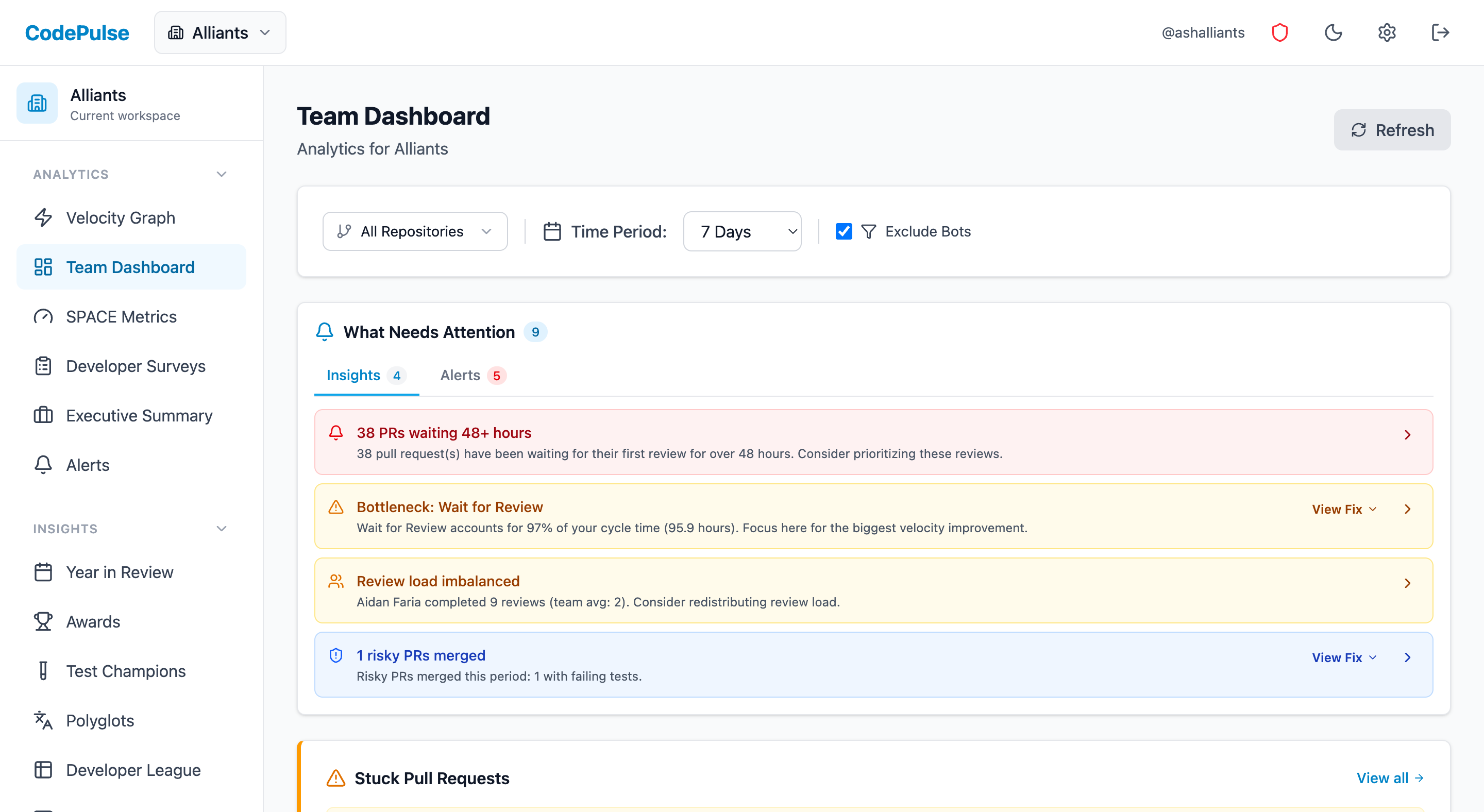
Start with one repository and a read-only connection
You choose the repositories. CodePulse cannot push, merge, or modify anything, and never clones your code. Expand the scope only once the output has earned it.
Read-only GitHub · Your code stays yours · Team-level by default · No credit card
See These Features in Action
Explore all featuresRelated Guides
The SOC 2 Question That Eliminates 80% of Analytics Vendors
Everything you need to know about data security, SOC 2 compliance, and privacy when evaluating engineering analytics platforms.
Jellyfish vs LinearB vs Swarmia: Full 2026 Comparison
Compare Jellyfish, LinearB, Swarmia, Allstacks, Haystack and more engineering analytics tools. Features, pricing, cycle time benchmarks, and integrations.
How Fintech Teams Pass Audits Without the Documentation Panic
How fintech engineering teams use metrics to maintain regulatory compliance, enforce separation of duties, and prepare for audits.
HIPAA-Compliant Metrics: The Checklist That Saved Our Audit
How healthcare and life sciences engineering teams use metrics to meet FDA requirements, maintain HIPAA compliance, and ensure software quality.
DevSecOps Metrics: Security Without Killing Velocity
Learn how to measure the "Sec" in DevSecOps using GitHub data. Track check failure rates, time-to-fix vulnerabilities, and security impact on delivery speed.