
See exactly where your delivery flow is waiting
Preview the phase-by-phase report for review pickup, active review, and merge time. Connect in about five minutes; the initial analysis runs after sync.
Read-only GitHub · Your code stays yours · Team-level by default · No credit card
Code review is challenging enough when your team sits in the same office. When you're distributed across time zones - with engineers in San Francisco, London, and Singapore - review processes that worked synchronously can grind to a halt.
This guide covers practical strategies for running effective async code reviews across distributed teams without sacrificing quality or velocity.
🔥 Our Take
Async review isn't a compromise - it's often better than synchronous review. The forced discipline of writing clear, self-explanatory PRs and comments produces higher-quality feedback than the hallway conversations most teams rely on.
Distributed teams that master async reviews often outperform co-located teams because they've built systems that don't depend on serendipitous availability. Your timezone spread is a feature: it means someone is always awake to review, deploy, and respond to incidents.
The Challenge of Distributed Reviews
When your team spans 8+ hours of timezone difference, the simple act of getting a PR reviewed becomes complex:
The Timezone Tax
- Review handoff delays: A developer in Singapore opens a PR at their end of day. The reviewer in London won't see it for 8 hours. If there's feedback, another 8 hours pass before the author can respond.
- Multi-day review cycles: What would take 2 hours with same-room reviewers can take 2-3 days across timezones.
- Context decay: By the time feedback arrives, the author has moved on to other work and must context-switch back.
"A PR that takes 3 days to merge isn't 3x slower than a 1-day PR - it's infinitely slower in terms of developer momentum and morale."
Communication Challenges
- Missing context: Synchronous discussion ("Hey, can you explain this approach?") isn't possible, so review comments need to be self-explanatory.
- Tone misinterpretation: Written feedback without real-time clarification can come across harsher than intended.
- Decision delays: Architectural discussions that would resolve in a 10-minute conversation can take days via comment threads.
The Real Cost
A study by Google found that PR review time is one of the strongest predictors of developer satisfaction. Long review cycles don't just slow delivery - they frustrate your team and erode engagement.
For more on why review latency matters, see our guide on Reducing PR Cycle Time.
Setting Up Async Review Workflows
Design for Asynchrony from the Start
The key insight: don't try to make synchronous processes work asynchronously. Instead, redesign for async-first.
Principle 1: Front-load context
In async reviews, the reviewer can't ask quick questions. Every PR should include:
- Clear description of what the change does and why
- Links to relevant tickets, design docs, or discussions
- Specific areas where review focus is needed
- Any tradeoffs made and why
- Screenshots or videos for UI changes
Principle 2: Make PRs smaller
Large PRs are the enemy of async review. A 500-line PR requires significant context to review and likely generates multi-round feedback. Smaller PRs (under 200 lines) can often be reviewed and approved in a single pass.
Principle 3: Clear approval criteria
When a reviewer can't quickly ask "is this blocking or just a suggestion?", comments need to be explicit. Establish conventions:
- Blocking: "This must be fixed before merge"
- Non-blocking: "Consider changing this, but okay to merge as-is"
- Question: "Can you explain X?" (not blocking)
- Nitpick: "Style preference only"
For a complete framework on comment conventions, see our Code Reviewer Best Practices guide.
PR Template for Async Reviews
## Summary
[What does this PR do? Why?]

## Related Issues
[Link to tickets/issues]

## Type of Change
- [ ] Bug fix
- [ ] New feature
- [ ] Refactoring
- [ ] Documentation

## Review Focus
[What areas need careful review?]

## Testing Done
[How was this tested?]

## Screenshots/Videos
[For UI changes]

## Async Context
- **Best reviewer timezone:** [APAC/EMEA/Americas]
- **Urgency:** [Standard/Expedited/Critical]
- **Video walkthrough:** [Link if complex]

## Checklist
- [ ] Tests added/updated
- [ ] Documentation updated
- [ ] Breaking changes noted
Timezone-Aware Review Assignment
Smart reviewer assignment can dramatically reduce review latency in distributed teams.
Follow-the-Sun Model
Assign reviewers based on timezone overlap with the PR author. When a Singapore engineer opens a PR, assign a reviewer from APAC or EMEA who will see it first - not someone in the Americas who won't be online for 12 hours.
Regional Review Pools
Create reviewer pools by timezone region:
- APAC: Singapore, Sydney, Tokyo (UTC+8 to UTC+11)
- EMEA: London, Berlin, Tel Aviv (UTC+0 to UTC+3)
- Americas: San Francisco, New York, Sao Paulo (UTC-8 to UTC-3)
When assigning reviewers, prioritize pools with the most overlap with the author's timezone.
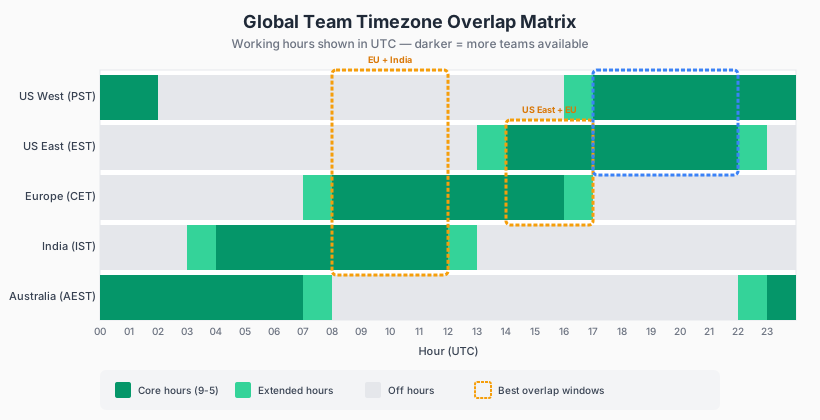
Timezone Overlap Matrix
Understanding where your team's working hours overlap is critical for planning review handoffs. Here's a practical overlap matrix:
Timezone Overlap Matrix
Working Hours: 9am-6pm local
| Location | SF (UTC-8) | NYC (UTC-5) | London (UTC) | Berlin (UTC+1) | Singapore (UTC+8) |
|---|---|---|---|---|---|
| SF (UTC-8) | 9h | 6h | 1h | 0h | 0h |
| NYC (UTC-5) | 6h | 9h | 4h | 3h | 0h |
| London (UTC) | 1h | 4h | 9h | 8h | 1h |
| Berlin (UTC+1) | 0h | 3h | 8h | 9h | 2h |
| Singapore (UTC+8) | 0h | 0h | 1h | 2h | 9h |
Optimal Review Assignment by Author Timezone
| Author Location | 1st Choice Reviewer | 2nd Choice Reviewer | Handoff Strategy |
|---|---|---|---|
| APAC (Singapore) | APAC colleague | EMEA morning | End-of-day handoff to EMEA |
| EMEA (London) | EMEA colleague | Americas afternoon | Morning reviews, PM handoff |
| Americas (SF) | Americas colleague | EMEA end-of-day | Late-day reviews, overnight EMEA |
Async Review SLA by Timezone Spread
Ownership-Based Assignment
For critical code paths, expertise may trump timezone. Define clear code ownership:
- Primary owner: The expert who should review complex changes (even if timezone-delayed)
- Secondary reviewers: Others who can review straightforward changes in a faster timezone
"The best reviewer isn't always the fastest reviewer. But the fastest wrong reviewer is always the worst choice."
Escalation Paths
If a PR needs urgent review and the ideal reviewer is unavailable, have clear escalation:
- Request review from anyone in the relevant timezone
- Ping the on-call or review-duty engineer
- As a last resort, page the ideal reviewer (for emergencies only)
For formalizing these escalation paths, consider implementing PR Review SLAs with timezone-aware targets.
Mastering Written Context
In async reviews, written communication is your primary tool. The quality of your PR description and comments directly impacts review efficiency.
The 5-Minute Rule for PR Descriptions
A reviewer should be able to understand the what, why, and how of your PR within 5 minutes of opening it. If they need to message you for basic context, your description has failed.
What to include:
- The problem: What issue or user need does this address?
- The solution: How does this PR solve it? Why this approach?
- Alternatives considered: What other approaches did you consider? Why were they rejected?
- Testing strategy: How did you verify this works? How can the reviewer verify it?
- Risk assessment: What could go wrong? What's the rollback plan?
Self-Review Comments
Before requesting review, add comments to your own PR explaining non-obvious decisions:
- "I chose this data structure because..." (preempts performance questions)
- "This looks complex, but it handles edge case X..." (preempts simplification requests)
- "I know this deviates from our pattern, because..." (preempts consistency comments)
These self-comments dramatically reduce review round-trips because reviewers get answers before they ask questions.
Video Walkthroughs for Complex Changes
For PRs that touch multiple files or implement complex features, a 3-5 minute video walkthrough is worth 1,000 words of documentation:
- When to record: Architectural changes, new patterns, complex refactoring, anything over 400 lines
- What to cover: Walk through the code in logical order (not file order), explain key decisions, demo the feature
- Tools: Loom, Vidyard, or even a simple screen recording
- Length: Keep it under 5 minutes. Longer videos don't get watched.
Video Walkthrough Template (3-5 minutes)
0:00 - 0:30 | Context
- "This PR implements X to solve Y"
- Show the ticket/issue
0:30 - 1:00 | Demo (if applicable)
- Show the feature working
- Point out key behaviors
1:00 - 3:00 | Code Walkthrough
- Start with entry point
- Walk through logical flow
- Highlight key decisions
3:00 - 4:00 | Testing
- Show tests passing
- Explain edge cases covered
4:00 - 5:00 | Questions for Reviewer
- "I'm unsure about X, would appreciate thoughts"
- "Please pay special attention to Y"
Timezone Handoffs
When a PR can't be completed in a single timezone's working day, you need a handoff strategy.
The Handoff Comment
At end of day, if a PR is still in progress, leave a handoff comment summarizing:
- Current status (reviewed but waiting for changes, partially reviewed, etc.)
- What you've reviewed and what's left
- Any blocking concerns you've identified
- What the next reviewer should focus on
HANDOFF COMMENT EXAMPLE:
========================

**Handoff to APAC team (end of EMEA day)**

**Status:** Partial review complete, waiting for author response on 2 items

**Reviewed:**
- [x] API endpoint changes (looks good)
- [x] Database migration (approved)
- [ ] Frontend components (not started)

**Open threads:**
1. Security concern on line 47 (blocking) - waiting for author
2. Performance question on line 92 (non-blocking)

**For next reviewer:**
- Frontend changes haven't been reviewed yet
- If author addresses security concern, this is good to merge
- @alex-apac can you take a look at the React components?
Designated Handoff Windows
Establish specific times when teams overlap and can discuss PRs synchronously if needed:
- APAC/EMEA handoff: 9am London / 5pm Singapore
- EMEA/Americas handoff: 5pm London / 12pm NYC / 9am SF
- Americas/APAC handoff: 5pm SF / 9am Singapore+1
Use these windows for complex discussions, not routine reviews. Most async reviews shouldn't need synchronous time.
Communication Best Practices
Write Better Review Comments
In async reviews, your comments are all the reviewer has. Make them count:
Be specific:
- Bad: "This doesn't look right"
- Good: "This query runs N+1 times. Consider eager loading the association."
Provide solutions, not just problems:
- Bad: "This could be more efficient"
- Good: "This could be more efficient. Consider using a Set instead of an Array for O(1) lookups. Example: `const seen = new Set();`"
Be explicit about severity:
- Bad: "Maybe change this?"
- Good: "[Non-blocking] Consider renaming this variable for clarity. Fine to merge as-is if you disagree."
Use Conventional Comment Prefixes
Adopt team-wide conventions for comment prefixes:
[blocking]- Must be addressed before merge[question]- I need more context[suggestion]- Take it or leave it[nitpick]- Very minor, purely stylistic[praise]- This is great!
"In async communication, kindness scales. A comment that reads as curt to one person reads as hostile to someone parsing it at 2am in their timezone."
Resolve Comments Explicitly
When addressing feedback, respond to each comment explicitly so the reviewer doesn't have to re-review everything:
- "Fixed in latest commit (abc123)"
- "Good catch, updated - see line 47"
- "I'd prefer to keep this because [reason]. Let me know if you disagree, happy to chat async."
Video for Complex Discussions
Some discussions don't work well in text. For architectural debates or complex explanations, record a short Loom video instead of writing a novel-length comment.
When to use video:
- Explaining visual changes or UI behavior
- Walking through complex logic that's hard to describe in text
- Demonstrating a bug or edge case
- Resolving a back-and-forth that's gone 3+ rounds
Tools and Automation
Automated Reviewer Assignment
Use GitHub's CODEOWNERS or similar features to automatically assign reviewers based on file paths. Combine with timezone-aware assignment tools for optimal results.
For ensuring even distribution of reviews, see our guide on Review Load Balancing.
Review Reminders
Set up automated reminders for PRs waiting on review:
- Slack notification after 4 hours without review
- Escalation to team channel after 8 hours
- Manager notification after 24 hours
Important: Adjust these thresholds based on timezone spread. A PR opened at end-of-day in APAC shouldn't trigger escalation before EMEA's workday starts.
Timezone-Aware Notifications
Configure your notification tools to respect working hours:
- Slack: Use Do Not Disturb schedules and defer notifications
- GitHub: Schedule notifications delivery to match work hours
- Custom bots: Route urgent requests to the on-call person in the active timezone
Bot Comments for Common Issues
Automate repetitive feedback with bots. If your team repeatedly comments about missing tests or documentation, let a bot handle it:
- Danger/Peril for PR size warnings
- Custom GitHub Actions for team-specific checks
- Linting and formatting feedback automated via CI
Metrics to Track
Measure your async review effectiveness:
- Time to first review: How long until someone looks at the PR?
- Review rounds: How many back-and-forth cycles before merge?
- Total cycle time: From PR opened to merged
- Cross-timezone reviews: Percentage of reviews crossing major timezone boundaries
- Handoff success rate: How often do handoffs resolve the PR vs. add another day of delay?
Track these metrics weekly and look for trends. If time-to-first-review is climbing, investigate why and adjust your process.
Building an Async-First Culture
Default to Async, Escalate to Sync
The best distributed teams don't eliminate synchronous communication - they reserve it for when it's truly valuable. Design your async review process to handle 90% of cases smoothly, and use video calls for the complex 10% that really needs real-time discussion.
Establish Review Response Expectations
Make review expectations explicit and timezone-aware:
- Same timezone: First review within 4 working hours
- Adjacent timezone (+/- 3h): First review within 6 working hours
- Distant timezone (+/- 6h+): First review within one business day
Respect Timezone Boundaries
Async-first means respecting that people in other timezones aren't "on call" for you:
- Don't @-mention people outside their working hours unless it's truly urgent
- Use scheduled messages to deliver notifications at the start of their day
- Never expect same-day turnaround from someone in a non-overlapping timezone
Document Decisions, Not Just Code
In async environments, decisions made in ad-hoc calls are invisible to the rest of the team. Create a culture of documenting:
- ADRs (Architecture Decision Records): For significant technical decisions
- PR comments: Summarize any sync discussions that happened
- Team wiki/docs: For patterns and conventions
📊 How CodePulse Helps
CodePulse provides visibility into your distributed review patterns:
- Time to First Review: Track how timezone distribution affects initial response times
- Review Cycle Time: Identify which PRs are getting stuck in cross-timezone loops
- Review Network: See collaboration patterns between regional teams
- Developer Metrics: Ensure review load is balanced across timezones
Frequently Asked Questions
Related Guides
- Review Load Balancing - ensure review work is distributed fairly across your distributed team
- Reducing PR Cycle Time - strategies for faster reviews that apply especially well to async workflows
- Code Reviewer Best Practices - how to write reviews that work well in async contexts
- Implementing PR Review SLAs - formalize review expectations with timezone-aware targets
Find out which phase is holding your delivery up
CodePulse splits your cycle time into coding, waiting for review, active review, and merge, so you fix the queue that is actually costing you days. Read-only GitHub, no credit card.
Read-only GitHub · Your code stays yours · Team-level by default · No credit card
See These Features in Action
Explore all featuresRelated Guides
We Cut PR Cycle Time by 47%. Here's the Exact Playbook
A practical playbook for engineering managers to identify bottlenecks, improve review processes, and ship code faster - without sacrificing review quality.
Engineering Metrics That Won't Get You Reported to HR
An opinionated guide to implementing engineering metrics that build trust. Includes the Visibility Bias Framework, practical do/don't guidance, and a 30-day action plan.
Your Best Engineer Is About to Quit (Check Review Load)
Learn how to identify overloaded reviewers, distribute review work equitably, and maintain review quality without burning out your senior engineers.
3 GitHub Review Features That Cut Our Review Time in Half
Most teams underuse GitHub native review features. Learn CODEOWNERS, branch protection, and suggested changes to speed up reviews without new tools.
Software Project Planning: Stop Guessing, Start Forecasting
Most project plans fail because they're based on estimates, not data. This guide shows how to plan software projects using git metrics, historical velocity, and probabilistic forecasting.
DevOps Observability: Logs, Metrics, and Traces
Observability goes beyond monitoring to help you understand why systems break, not just when. This guide covers the three pillars (logs, metrics, traces), implementation strategies, and tool comparisons.
The 300-Line Rule: Why Big PRs Are Sabotaging Your Team
The research-backed case for smaller pull requests, how to measure PR size effectively, and practical strategies for breaking down large changes.
Measure Deploy Frequency Without CI/CD (The Hack)
Master DORA deployment frequency and lead time using GitHub data alone, without requiring CI/CD pipeline access.
Your PR Cycle Time Is Fine (Here's the Benchmark)
What is a good PR cycle time? Benchmarks and targets based on team size, industry, and engineering maturity.