
Compare the finished analysis before you choose a platform
See the report CodePulse produces from read-only GitHub workflow data, or connect your own repositories and evaluate the fit with real evidence.
Read-only GitHub · Your code stays yours · Team-level by default · No credit card
Looking for Propelo alternatives (formerly LevelOps)? We compared 7 engineering analytics tools side-by-side, covering DORA metrics depth, CI/CD integration, pricing, and who each tool actually serves. We also tell you when Propelo is the right choice, because honesty matters more than conversions.
Propelo (rebranded from LevelOps) is a value stream management platform focused on DORA metrics, CI/CD pipeline analytics, and engineering workflow optimization. It pulls data from Git providers, CI/CD systems, and project management tools to surface delivery performance metrics. Not every team needs the CI/CD depth that Propelo offers. Below we break down what Propelo does well, where it falls short, and how seven alternatives stack up. Also comparing other tools? See our LinearB alternative and Swarmia alternative guides.
"DORA metrics are signals, not KPIs. The moment you gamify deployment frequency, your teams will ship empty deployments to hit the number."
What Is Propelo (Formerly LevelOps)?
Propelo, formerly known as LevelOps, is a software engineering analytics platform focused on measuring and improving software delivery performance. The platform centers on DORA metrics (deployment frequency, lead time for changes, change failure rate, mean time to recovery) and extends into value stream management across the CI/CD pipeline.
The platform integrates with GitHub, GitLab, Bitbucket, Jenkins, CircleCI, GitHub Actions, Jira, Azure DevOps, and several CI/CD systems. According to the 2024 DORA Report, teams that measure all four DORA metrics consistently are 1.8x more likely to meet or exceed their reliability targets.
Propelo targets mid-to-large engineering teams (100+ engineers) that need visibility across both the code review and deployment pipeline. Pricing is not publicly listed and follows an enterprise sales model.
7 Best Propelo Alternatives and Competitors
Each of these tools takes a different approach to engineering analytics. We've included honest strengths and trade-offs for each.
1. CodePulse
Best for: 10-200 engineer teams who want deep PR-level insights and cycle time analysis without CI/CD pipeline complexity.
- Cycle time breakdown into four actionable stages (coding, waiting, review, merge)
- Review network visualization showing collaboration patterns and bottlenecks
- File hotspot and knowledge silo detection at the file level
- GitHub, Jira, and Linear integrations
- Self-serve setup in under 5 minutes
Pricing: Free for up to 10 developers. Pro from $199/month, Business from $449/month. Monthly billing, cancel anytime.
Trade-off: No CI/CD pipeline integration. No deployment frequency or MTTR tracking. Built for PR-level insights, not full pipeline visibility.
2. LinearB
Best for: Teams wanting PR workflow automation alongside DORA-style metrics and sprint tracking.
- gitStream workflow automation for code review routing and standards
- DORA metrics with investment mapping
- Multi-git-provider support (GitHub, GitLab, Bitbucket)
- Sprint tracking and Jira integration
Pricing: Free tier for up to 8 contributors. Paid plans from ~$420/contributor/year.
Trade-off: Less CI/CD pipeline depth than Propelo. Focused more on PR workflow than deployment pipeline analytics. Read our full LinearB comparison.
3. Sleuth
Best for: Teams wanting deployment-centric DORA metrics with automatic change tracking and incident correlation.
- Deployment tracking with automatic change detection
- DORA metrics calculated from actual deployment events
- Change failure rate tracking with incident management integration
- GitHub, GitLab, Bitbucket, and multiple CI/CD integrations
Pricing: Free for small teams. Growth plans from $20/developer/month.
Trade-off: Heavily deployment-focused. Less depth on PR analytics and developer collaboration patterns. Read our full Sleuth comparison.
4. Swarmia
Best for: Teams that prioritize developer experience measurement alongside delivery metrics and DORA tracking.
- SPACE and DORA frameworks built in
- Developer experience surveys with quantitative scoring
- Working agreements for team-level standards
- CI/CD visibility and Slack integration
Pricing: Free tier for companies with fewer than 10 developers. Lite from EUR 20/user/month.
Trade-off: CI/CD integration is lighter than Propelo's. Less suited for teams whose primary concern is pipeline optimization. Read our full Swarmia comparison.
5. Jellyfish
Best for: Enterprise teams (50+ engineers) needing OKR alignment and investment categorization for board-level reporting.
- 25+ integrations including GitHub, GitLab, Jira, CI/CD, and HR systems
- Investment categorization (feature vs. debt vs. support)
- OKR alignment connecting engineering work to business outcomes
- AI tool ROI tracking
Pricing: ~$588/contributor/year (~$49/month) based on third-party sources.
Trade-off: Less focused on DORA and CI/CD analytics than Propelo. More business-alignment than engineering workflow optimization. Read our full Jellyfish comparison.
6. Allstacks
Best for: Enterprise teams needing predictive delivery forecasting with portfolio-level visibility.
- Value stream intelligence with delivery risk forecasting
- Initiative-level tracking across teams
- Broad integration set (GitHub, GitLab, Bitbucket, Jira, Azure DevOps)
- Typically operational within 24-48 hours
Pricing: Enterprise pricing, contact sales.
Trade-off: Focused on delivery prediction, not CI/CD pipeline analytics. Less DORA-centric than Propelo.
7. Waydev
Best for: Enterprise teams needing finance-friendly R&D tracking alongside engineering delivery metrics.
- 130+ metrics across the delivery lifecycle
- Cost capitalization and R&D tax credit support
- Sprint forecasting and capacity planning
- DORA metrics included in the broader metric set
Pricing: Enterprise pricing, contact sales.
Trade-off: DORA is one of many metric categories, not the primary focus. Less CI/CD pipeline depth than Propelo. Read our full Waydev comparison.
Quick Comparison: All 7 Propelo Alternatives
| Tool | Best For | DORA | CI/CD | Free Tier | Pricing |
|---|---|---|---|---|---|
| CodePulse | PR-level cycle time | Partial | No | Yes (10 devs) | From $199/mo |
| LinearB | PR automation + metrics | Yes | Limited | Yes (8 devs) | ~$420/yr per dev |
| Sleuth | Deployment tracking | Yes (deep) | Yes | Yes | From $20/dev/mo |
| Swarmia | Developer experience | Yes | Yes | Yes (14 devs) | From EUR 20/mo |
| Jellyfish | Business alignment | Yes | Yes | No | ~$49/dev/mo |
| Allstacks | Delivery forecasting | Yes | Limited | No | Enterprise |
| Waydev | R&D cost tracking | Yes | Limited | No | Enterprise |
Propelo vs CodePulse: A Closer Look
Since we build CodePulse, we owe you the most transparent comparison. These tools focus on different slices of the engineering workflow:
| Aspect | Propelo | CodePulse |
|---|---|---|
| Primary focus | DORA metrics and CI/CD pipeline analytics | PR-level cycle time and team collaboration |
| Pipeline coverage | Full (code to deploy to incident) | PR lifecycle only (code to merge) |
| Target team size | 100+ engineers | 10-200 engineers |
| Setup time | Days to weeks | Minutes (self-serve) |
| CI/CD integration | Deep (Jenkins, CircleCI, GitHub Actions, etc.) | None |
| Pricing | Enterprise (contact sales) | Free tier, Pro from $199/mo |
What Propelo Does Well
Credit where it's due: Propelo excels at things CodePulse doesn't attempt:
Full Pipeline Visibility
Propelo tracks the entire software delivery pipeline from code commit through CI/CD build, test execution, deployment, and incident response. If your bottleneck is in the build/deploy pipeline (not just code review), Propelo's coverage matters.
DORA Metrics Depth
While many tools claim DORA support, Propelo calculates DORA metrics from actual pipeline data rather than approximating from Git events. Deployment frequency comes from real deployment events, not merged PRs. Change failure rate connects to incident management systems. This accuracy matters if you're using DORA for genuine improvement, not just reporting.
CI/CD Pipeline Analytics
Propelo provides visibility into build times, test execution patterns, and pipeline bottlenecks. If your CI pipeline takes 45 minutes and you need to understand why, Propelo can break that down. This is a genuine gap in most engineering analytics tools.
Value Stream Mapping
Propelo visualizes the full value stream from idea to production. You can see where time is spent across the entire delivery process, not just within the PR lifecycle. For teams practicing lean engineering, this end-to-end view is valuable.
Where Propelo Struggles
Based on market research and user feedback, these are Propelo's known pain points:
Brand Confusion
The rebrand from LevelOps to Propelo created confusion in the market. Searching for "LevelOps" now leads to mixed results. This matters because social proof, reviews, and community knowledge are harder to find under the new name.
Limited Market Presence
Compared to LinearB, Swarmia, or Jellyfish, Propelo has less market visibility. Fewer independent reviews, case studies, and community discussions make it harder to evaluate without going through the sales process.
Enterprise-Only Approach
No public pricing, no free tier, no self-serve trial. If you want to evaluate Propelo, you need to schedule a demo. For teams that want to start measuring this week, this is a friction point.
DORA-Centric Lens
Propelo's strength in DORA can also be a limitation. If your team's challenges are around code review bottlenecks, knowledge silos, or review load imbalance (not deployment pipeline issues), Propelo's DORA-first approach may not surface the insights you need.
* Our Take
DORA metrics are necessary but not sufficient. Deployment frequency tells you how often you ship. It doesn't tell you why PRs sit in review for 3 days, which developer is a review bottleneck, or which files are single-owner risks. If you start and stop at DORA, you'll know your symptoms but not your diagnosis.
We built CodePulse to answer the questions DORA raises but can't resolve: where exactly in your PR lifecycle is time being wasted, and who can fix it?
Where CodePulse Fits Better
CodePulse is purpose-built for teams who want to understand their PR lifecycle and collaboration patterns deeply:
Granular Cycle Time Breakdown
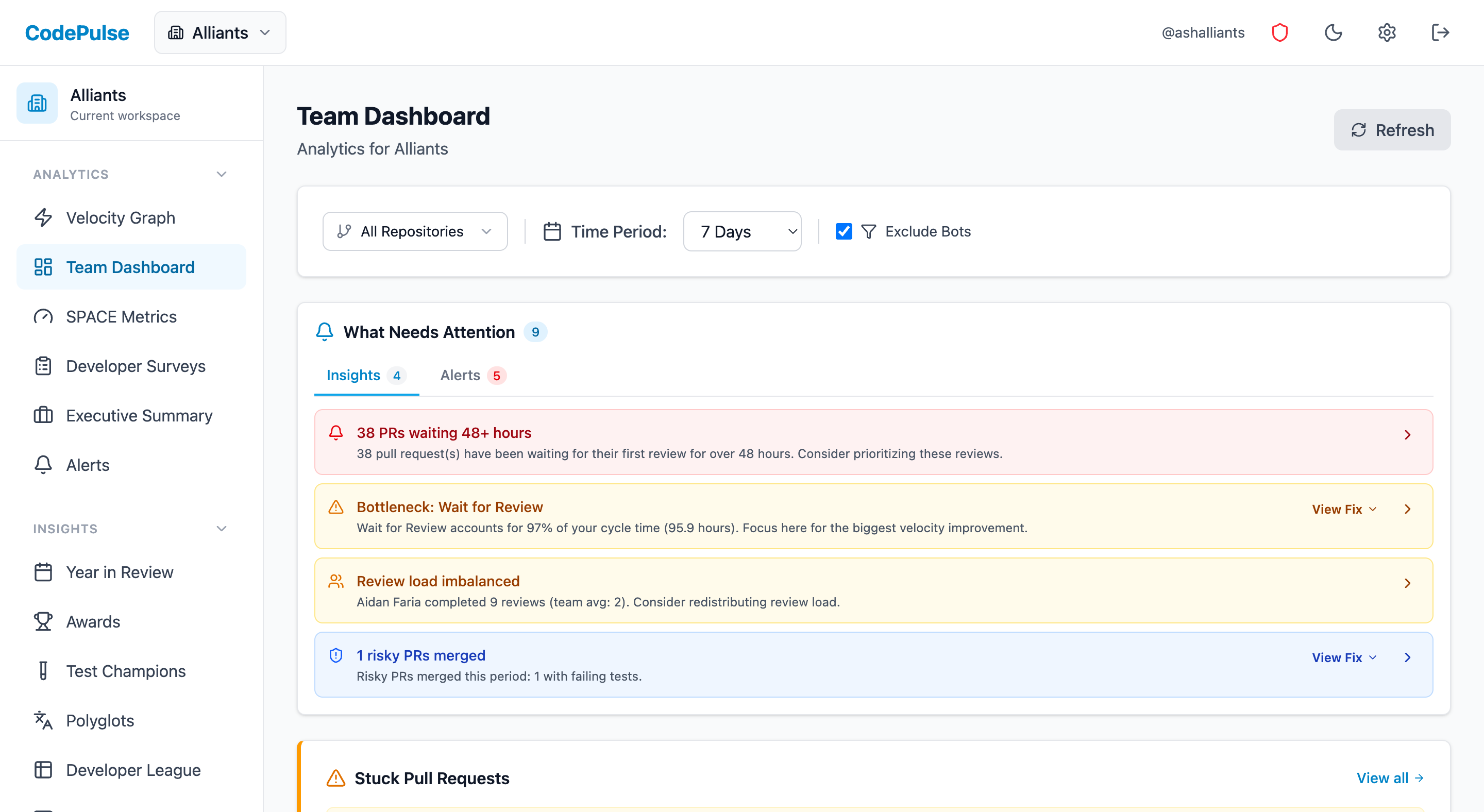
Where Propelo shows lead time as a DORA metric, CodePulse breaks the PR lifecycle into four actionable stages. The Dashboard shows exactly where time is spent: coding, waiting for review, in review, and merging. This isn't "your lead time is 3 days." It's "your team wastes 18 hours waiting for the first review, but actual review takes only 4 hours."
Review Network Visualization
The Review Network shows collaboration patterns as an interactive graph. You can see who reviews whose code, identify review load imbalance, and spot isolated team members. Propelo tracks reviews as part of the pipeline, but CodePulse makes collaboration patterns visible and actionable.
Knowledge Silo Detection
The File Hotspots view identifies high-churn files and knowledge silos at the file level. This is a risk category that DORA metrics don't capture at all: you can have elite DORA scores while critical knowledge lives in one person's head.
Developer Recognition
The Developer Awards celebrate contributions across 15+ categories. This anti-surveillance approach is deliberately different from DORA-style scorecards. We measure contribution quality and collaboration, not just throughput.
* How to See This in CodePulse
Navigate to Dashboard to see your PR cycle time broken into 4 phases:
- Coding time: first commit to PR open
- Wait for review: PR open to first review
- Review time: first review to approval
- Merge time: approval to merge
- Filter by repo or time period to find bottlenecks
"DORA tells you how fast you deploy. It doesn't tell you why your best reviewer is drowning in 40 review requests per week while others handle 5."
When to Choose Propelo Instead
We believe in being honest about when CodePulse isn't the right choice. Choose Propelo if:
| Situation | Why Propelo |
|---|---|
| You need full DORA metrics from pipeline data | Propelo calculates DORA from actual deployment events, not Git approximations |
| Your bottleneck is CI/CD, not code review | Propelo has deep pipeline analytics CodePulse doesn't offer |
| You need value stream mapping (idea to production) | Propelo covers the full delivery lifecycle beyond PRs |
| You use multiple CI/CD systems | Propelo integrates with Jenkins, CircleCI, GitHub Actions, and more |
| You need change failure rate tracking | Propelo connects deployments to incidents natively |
If 3+ of these apply, Propelo is probably the better fit. CodePulse is great at the PR lifecycle; Propelo covers more of the pipeline.
CodePulse Limitations (We're Being Honest)
- No CI/CD integration: We don't track build times, deployment events, or pipeline bottlenecks
- No deployment frequency tracking: We measure PR merge rate, not deployment rate
- No MTTR tracking: We don't connect to incident management systems
- No value stream mapping: We focus on the PR lifecycle, not idea-to-production
- No GitLab or Bitbucket: GitHub-only for version control
- Smaller team focus: Optimized for 10-200 engineers, not 500+
Decision Matrix
| Your Situation | Recommendation |
|---|---|
| 10-50 engineers, GitHub-focused, want fast setup | CodePulse |
| Need full DORA from actual deployment data | Propelo or Sleuth |
| CI/CD pipeline is the bottleneck | Propelo |
| Code review and PR cycle time are the bottleneck | CodePulse (deeper on this specific problem) |
| Need OKR alignment and board reporting | Jellyfish |
| Want PR workflow automation | LinearB |
| Prioritize developer experience surveys | Swarmia |
| Need deployment-centric DORA with change tracking | Sleuth |
| Engineering Manager wanting team health insights | CodePulse |
| Want insights today, not next month | CodePulse |
"The best engineering analytics tool is the one that answers your actual question. If your question is about deployment pipelines, don't buy a PR analytics tool. And vice versa."
The Honest Verdict
Propelo and CodePulse optimize different parts of the engineering workflow. Propelo covers the full pipeline from code to production. CodePulse goes deeper on the PR lifecycle and team collaboration. They're complementary, not competing.
Choose Propelo if your primary concern is pipeline performance, DORA metrics accuracy, and value stream visibility from idea to production.
Choose CodePulse if your primary concern is PR cycle time, review bottlenecks, knowledge silos, and team collaboration patterns.
Choose Sleuth if you want deployment-focused DORA metrics with a lighter setup than Propelo.
Choose LinearB if you want PR workflow automation (gitStream) alongside metrics.
If you're not sure where your bottleneck is, start with a free engineering health audit rather than a shortlist. It takes 5 minutes to set up, reads the GitHub history you already have, and will tell you whether your problem is in code review or elsewhere - which decides what you should be shopping for. For a broader comparison, see our engineering analytics tools comparison guide.
Frequently Asked Questions
LevelOps rebranded to Propelo. The product and team remain the same; only the name changed. If you're searching for LevelOps reviews or comparisons, look for Propelo instead. The core focus on DORA metrics and CI/CD analytics carried over to the new brand.
Related Comparisons
Exploring other options? Check out these guides:
- Athenian Alternative - The closest peer to Propelo in positioning and analytics depth
- LinearB Alternative - For teams focused on workflow automation and gitStream
- Sleuth Alternative - For teams focused on deployment-centric DORA metrics
- Swarmia Alternative - For teams focused on developer experience and working agreements
- Engineering Analytics Tools Comparison - Comprehensive comparison of all major platforms
- Best Engineering Analytics Tools - Our top picks for different team sizes and needs
Evaluate CodePulse against your own delivery history
A comparison table only goes so far. Connect read-only GitHub in about five minutes and judge the output on your repositories, at one flat price, with no per-seat math.
Read-only GitHub · Your code stays yours · Team-level by default · No credit card
See These Features in Action
Track all four DORA metrics and benchmark against industry standards.
Break down cycle time into coding, waiting, review, and merge phases.
Related Guides
5 LinearB Alternatives for 2026 (With Pricing)
An honest comparison of CodePulse vs LinearB. We tell you when to choose LinearB instead, because the best tool is the one that makes the right trade-offs for your situation.
Sleuth Alternative: Why Teams Switch to CodePulse
Honest comparison of Sleuth vs CodePulse for engineering analytics. Feature comparison, pricing, and a decision framework for choosing the right tool.
Swarmia Alternatives: Cheaper, Deeper Analytics 2026
A Swarmia alternative worth considering: where Swarmia falls short on customization and per-seat pricing, and which cheaper, GitHub-native tools fit better.
Jellyfish vs LinearB vs Swarmia: Full 2026 Comparison
Compare Jellyfish, LinearB, Swarmia, Allstacks, Haystack and more engineering analytics tools. Features, pricing, cycle time benchmarks, and integrations.
Best Engineering Analytics Tools for 2026 (Ranked by Real Users)
We ranked the 10 best engineering analytics tools based on metric depth, setup speed, pricing transparency, and privacy posture. Honest pros and cons for each.