
Compare the finished analysis before you choose a platform
See the report CodePulse produces from read-only GitHub workflow data, or connect your own repositories and evaluate the fit with real evidence.
Read-only GitHub · Your code stays yours · Team-level by default · No credit card
The engineering analytics market has grown significantly over the past few years. For engineering leaders looking for executive visibility or team-level velocity improvements, there are now several platforms to choose from - see our engineering management platform guide for what the category actually promises before comparing individual vendors below.
This guide provides an objective comparison of the major engineering analytics tools, including their strengths, weaknesses, and ideal use cases.
What are the best engineering analytics tools?
The best engineering analytics tool depends on your team size and primary need. For GitHub-native teams wanting fast setup and depth in code quality and review analytics, CodePulse is the strongest option with a free tier. For teams needing Jira-integrated workflow automation, LinearB offers gitStream and investment tracking. For enterprise organizations (200+ engineers) needing executive portfolio views, Jellyfish provides business alignment reporting. For developer experience focus, Swarmia combines metrics with working agreements.
Engineering Analytics Market Overview
Engineering analytics tools help teams measure and improve software delivery performance. The core value proposition is visibility - understanding how code flows through your development process, where bottlenecks exist, and how to optimize for faster, higher-quality delivery.
What These Tools Measure
Most engineering analytics platforms track some combination of:
- DORA metrics: Deployment frequency, lead time, change failure rate, and mean time to recovery
- PR metrics: Cycle time, review time, merge frequency, and review patterns
- Developer metrics: Contribution patterns, collaboration networks, and workload distribution
- Code quality: Hotspots, knowledge silos, and complexity trends
Common Integration Points
- Git providers: GitHub, GitLab, Bitbucket
- Issue trackers: Jira, Linear, Asana, GitHub Issues
- CI/CD platforms: GitHub Actions, CircleCI, Jenkins
- Communication tools: Slack for alerts and notifications
How We Evaluated
We assessed each platform across several dimensions:
- Data coverage: What metrics can be tracked? How thorough is the analysis?
- Ease of setup: How quickly can you get value from the tool?
- Executive vs. manager focus: Is it designed for high-level visibility or hands-on team management?
- Pricing transparency: Is pricing clear? Is it affordable for teams of various sizes?
- Privacy considerations: How is developer data handled? Can individual performance be tracked?
- GitHub-first experience: How well does it work with GitHub specifically?
Tool-by-Tool Comparison
LinearB
LinearB is one of the more established players in the space, focusing heavily on workflow automation and what they call "Work Breakdown."
Best for: Mid-to-large engineering organizations that use Jira and want tight integration between issue tracking and engineering metrics. If that tracker choice is not settled yet, our Azure DevOps vs Jira comparison works through it before you commit an analytics layer to either.
Pros:
- Strong Jira integration for connecting code to business work
- Workflow automation features including gitStream for auto-assigning reviewers
- Detailed PR analytics with cross-industry benchmarking
- Good documentation and support resources
Cons:
- Pricing can be high for smaller teams; some features require enterprise plans
- Setup can be complex due to many configuration options
- Focus on "gamification" may not suit all team cultures
Starting price: Free tier available; paid plans from ~$20/developer/month.
Haystack (Formerly Hatica)
Haystack focuses on engineering productivity with emphasis on identifying blockers and improving developer experience.
Best for: Teams prioritizing developer experience and wellbeing alongside productivity metrics.
Pros:
- Good focus on identifying process bottlenecks
- Developer wellbeing features built into the platform
- Clean, modern interface with strong PR analytics
Cons:
- Newer to market, still building out features
- Limited self-serve options; pricing requires a sales conversation
Starting price: Contact sales for pricing.
Jellyfish
Jellyfish positions itself as an "Engineering Management Platform" with a focus on strategic planning and resource allocation.
Best for: Large engineering organizations (100+ engineers) that need portfolio-level visibility and resource allocation insights.
Pros:
- Strong portfolio-level views for executives
- Investment allocation tracking (how much time goes to features vs. maintenance)
- Good for large organizations with multiple teams
- Deep Jira integration
Cons:
- Enterprise pricing not accessible for small teams
- Complex setup process that can take weeks
- Overkill for teams not doing strategic portfolio management
Starting price: Enterprise contracts; typically $100,000+/year.
If Jellyfish's enterprise pricing is out of range for your team, see our guide to the best Jellyfish alternatives for smaller engineering teams.
Pluralsight Flow (formerly GitPrime)
One of the original engineering analytics tools, now part of Pluralsight's broader learning platform.
Best for: Organizations already using Pluralsight who want integrated learning and analytics.
Pros:
- Deep git-level analytics with strong historical data analysis
- Integration with Pluralsight learning platform for skill development
- Well-established with a large customer base
Cons:
- Interface feels dated compared to newer tools
- Focus on individual developer metrics has raised privacy concerns
- Part of the larger Pluralsight platform, which may be expensive standalone
Starting price: Part of Pluralsight subscription (Skills starts at $33/user/month); Flow pricing requires sales conversation.
Swarmia
Swarmia positions itself as a developer productivity platform with strong emphasis on working agreements and team health.
Best for: GitHub-centric teams of 20-100 engineers that value developer experience and want team-defined working agreements.
Pros:
- Clean, modern interface with good GitHub integration
- Working agreements feature for team-defined standards
- Strong focus on developer experience and team health
- Investment tracking (features vs. maintenance vs. bugs)
Cons:
- Pricing requires sales conversation for larger teams
- Less depth on code quality signals (hotspots, silos)
- Limited executive reporting compared to Jellyfish
Starting price: ~$15-25/developer/month; contact sales for larger teams.
Allstacks
Allstacks focuses on value stream intelligence with strong portfolio-level visibility and predictive analytics.
Best for: Large organizations (100+ engineers) that need portfolio-level visibility, value stream mapping, and predictive delivery forecasting.
Pros:
- Strong portfolio and initiative tracking
- Predictive delivery forecasting with risk detection
- Good for connecting engineering work to business outcomes
- Wide integration coverage across the toolchain
Cons:
- Enterprise-focused pricing, not transparent
- Complex setup required to realize full value
- Overkill for teams not doing portfolio management
Starting price: Enterprise contracts; contact sales for pricing.
CodePulse
CodePulse is a GitHub-focused engineering analytics platform designed for fast setup and actionable insights.
Best for: GitHub-centric teams of any size who want fast time to value, transparent pricing, and deep PR velocity and code quality insights.
Pros:
- Connects to GitHub in minutes with no complex setup
- Transparent pricing with a generous free tier (50 developers)
- Strong focus on PR cycle time with 4-phase breakdown and review analytics
- Code hotspot and knowledge silo detection (unique in this category)
- Executive summary views alongside team-level details
- Built with privacy in mind: team-level focus, not individual surveillance
Cons:
- GitHub-only (no GitLab or Bitbucket support currently)
- Newer to market compared to some competitors
- Jira integration not as deep as LinearB or Jellyfish
Starting price: Free for up to 50 developers; Pro from $199/month (annual billing).
Why teams pick CodePulse
- Fast time-to-value with GitHub-first setup
- Executive visibility without individual surveillance
- Clear pricing that scales with team size
- Actionable PR flow and risk insights
Cycle Time Benchmarks by Tool
One of the most common questions when evaluating these tools is: "What's a good cycle time?" The answer depends on your team size, PR complexity, and process maturity. Here are industry benchmarks to help calibrate expectations.
What the Data Shows
Based on publicly available data and our analysis of over 3 million PRs:
- Elite teams: Median PR cycle time under 4 hours
- High performers: 4-24 hours median cycle time
- Mid-range: 1-3 days median cycle time
- Needs improvement: 3+ days median cycle time
Cycle Time Breakdown by Phase
The most actionable insight isn't total cycle time - it's understanding where time is actually spent:
| Phase | Elite | Average | What It Measures |
|---|---|---|---|
| Coding Time | <2 hours | 4-8 hours | First commit to PR opened |
| Pickup Time | <1 hour | 4-12 hours | PR opened to first review |
| Review Time | <2 hours | 2-6 hours | First review to approval |
| Merge Delay | <30 min | 1-4 hours | Approval to merge |
Key insight: Most teams find their biggest bottleneck is pickup time (waiting for first review), not the actual review itself. Tools that highlight this specific phase tend to drive faster improvements.
Head-to-Head Tool Comparisons
Since many searches compare specific tools, here's how the major players stack up against each other.
Jellyfish vs LinearB
| Criteria | Jellyfish | LinearB |
|---|---|---|
| Primary Focus | Portfolio & resource allocation | Workflow automation & PR metrics |
| Best Team Size | 100+ engineers | 30-200 engineers |
| Pricing | Enterprise (contact sales) | Per-seat (~$20/dev/month) |
| Setup Time | Weeks (enterprise onboarding) | Days |
| Jira Depth | Deep (initiative tracking) | Deep (work breakdown) |
| Automation | Limited | Strong (gitStream) |
Choose Jellyfish if you need portfolio visibility across 100+ engineers and executive-level resource allocation insights. Choose LinearB if you want workflow automation and your team is 30-200 engineers with strong Jira usage.
Jellyfish vs Swarmia
| Criteria | Jellyfish | Swarmia |
|---|---|---|
| Primary Focus | Executive visibility | Developer experience |
| Best Team Size | 100+ engineers | 20-100 engineers |
| Pricing | Enterprise | Mid-market |
| Philosophy | Top-down (exec reports) | Bottom-up (team health) |
| Working Agreements | No | Yes (key feature) |
| GitHub Depth | Good | Excellent |
Choose Jellyfish if you're a VP/Director who needs to report to the C-suite on engineering investment. Choose Swarmia if you're an engineering manager focused on team health and developer experience.
Swarmia vs LinearB vs Jellyfish
For teams evaluating all three, here's a quick decision framework:
- Under 50 engineers, GitHub-first: Swarmia or CodePulse
- 50-200 engineers, heavy Jira usage: LinearB
- 200+ engineers, executive reporting: Jellyfish
- Want workflow automation: LinearB (gitStream)
- Want working agreements: Swarmia
- Want portfolio allocation: Jellyfish or Allstacks
Allstacks vs Jellyfish
Both target large enterprises with portfolio-level visibility. Allstacks differentiates with predictive analytics and value stream mapping, while Jellyfish focuses more on resource allocation and engineering investment tracking. If you need delivery forecasting, lean toward Allstacks. If you need to show the board where engineering time goes, lean toward Jellyfish.
CodePulse vs Swarmia vs LinearB
For teams under 100 engineers evaluating these three mid-market options:
| Criteria | CodePulse | Swarmia | LinearB |
|---|---|---|---|
| Setup Time | Minutes | Hours | Days |
| Free Tier | Generous (50 devs) | Limited | Limited |
| Pricing Transparency | Public pricing | Contact sales | Visible but complex |
| Code Quality Insights | Hotspots + silos | Basic | Basic |
| Cycle Time Breakdown | 4-phase detailed | Good | Good |
| Workflow Automation | Limited | Working agreements | gitStream |
| Jira Integration | Basic | Good | Deep |
Choose CodePulse if you want the fastest time-to-value, transparent pricing, and deep code health insights (hotspots, knowledge silos). Choose Swarmia if working agreements are critical to your team culture. Choose LinearB if you need deep Jira integration and workflow automation.
When CodePulse Wins
- Speed to first insight: GitHub OAuth → dashboard in under 5 minutes
- Budget-conscious teams: Free tier includes 50 developers, no credit card required
- Code health focus: Only tool in this comparison with real hotspot and knowledge silo detection
- Anti-surveillance philosophy: Team-level metrics by default, no individual leaderboards
- Cycle time visibility: 4-phase breakdown showing exactly where PRs get stuck
The trade-off: CodePulse is GitHub-only (no GitLab/Bitbucket) and has lighter Jira integration than LinearB. If you're evaluating tools and GitHub is your primary workflow, CodePulse delivers the most value per dollar.
Metrics Frameworks That Matter
The best tools connect delivery metrics to business outcomes. If you want executive trust, focus on frameworks that are widely understood and hard to game.
DORA Metrics (Delivery Performance)
- Deployment frequency: How often value reaches production
- Lead time for changes: How quickly code reaches production after merge
- Change failure rate: How often releases cause incidents or rollbacks
- Mean time to recovery: How fast teams restore service after failures
SPACE Framework (Developer Experience)
- Satisfaction: Developer sentiment and friction
- Performance: Outcomes and impact, not raw activity
- Activity: Output volume (use carefully)
- Communication: Collaboration patterns and review networks
- Efficiency: Time spent on rework, waiting, or handoffs
A strong platform ties these metrics to visible changes in throughput, reliability, and team health, rather than using numbers to score individuals.
If you want a deeper walkthrough, see our DORA Metrics Guide and SPACE Framework Metrics Guide.
Other Notable Engineering Analytics Tools
If your evaluation requires broader market coverage, these tools are often compared in third-party roundups. We include them here for completeness.
| Tool | Positioning | Best Fit |
|---|---|---|
| Waydev | Developer analytics and benchmarks | Teams seeking benchmarks and trends |
| Code Climate Velocity | Velocity plus quality focus | Teams prioritizing code quality signals |
| DX | Developer experience analytics | Culture and experience initiatives |
| Faros AI | Data platform for custom analytics | Data teams building bespoke views |
| Plandek | Flow metrics and delivery tracking | Organizations focused on delivery flow |
| Milestone | Engineering intelligence platform | Exec visibility across teams |
| Axify | Engineering analytics platform | Teams exploring modern alternatives |
| Codacy | Code quality with analytics | Quality-driven orgs with CI focus |
Pricing Comparison
Pricing in this space varies significantly, and many vendors require sales conversations for quotes. Here's what we know:
| Tool | Starting Price | Free Tier | Pricing Model |
|---|---|---|---|
| LinearB | ~$20/dev/month | Limited free tier | Per developer |
| Haystack | Contact sales | No | Per developer |
| Jellyfish | Contact sales (enterprise) | No | Enterprise contracts |
| Swarmia | ~$15-25/dev/month | Limited free tier | Per developer |
| Allstacks | Contact sales (enterprise) | No | Enterprise contracts |
| Pluralsight Flow | Part of Pluralsight subscription | No | Subscription bundle |
| CodePulse | Free / from $199/month Pro (annual billing) | Yes, generous | Tiered (first 50 devs included) |
Note: Prices may vary and should be confirmed with vendors directly.
Cost Considerations
- Per-seat vs. per-repo: Most tools charge per developer. Understand how "developer" is defined - active contributors, total seats, or something else?
- Feature gating: Many tools reserve key features for higher tiers. Make sure the features you need are in the plan you're considering.
- Contract length: Enterprise tools often require annual contracts. Smaller tools may offer monthly billing.
Choosing the Right Tool
Decision Summary by Priority
| If your priority is... | Shortlist | Why it fits |
|---|---|---|
| Fast GitHub-first setup | CodePulse, Swarmia | Minimal configuration, immediate insights |
| Executive portfolio visibility | Jellyfish, Allstacks | Portfolio views and cross-team rollups |
| Developer experience focus | Haystack, DX | Strong DevEx and team health emphasis |
| Code quality and risk signals | CodePulse, Code Climate Velocity | Hotspots, quality trends, and risk insights |
| Enterprise scale and planning | LinearB, Jellyfish | Deep integrations and enterprise workflows |
For Startups and Small Teams (5-30 engineers)
Prioritize fast setup, transparent pricing, and simplicity. You don't need portfolio management features yet. Look for tools with free tiers or low per-seat costs.
Recommendation: CodePulse or LinearB's free tier
For Mid-Size Teams (30-100 engineers)
You need more than basic metrics - look for team-level insights, review pattern analysis, and alerting capabilities. Integration with your issue tracker becomes more important.
Recommendation: CodePulse Pro, LinearB, or Haystack
For Large Organizations (100+ engineers)
Portfolio-level visibility, cross-team comparisons, and executive reporting become critical. You may need enterprise features like SSO, advanced permissions, and dedicated support.
Recommendation: Jellyfish, LinearB Enterprise, or CodePulse Business
Questions to Ask During Evaluation
- How long does initial setup take? What data is available immediately?
- How is developer privacy handled? Can managers see individual metrics?
- What happens when we scale? How does pricing change?
- What integrations are included vs. extra cost?
- Can we try before we commit? What's the trial process?
- What support is included? Response time expectations?
Privacy and Security Checklist
Your team will ask about privacy, and your security team will ask about risk. These are the most common blockers in real evaluations.
- Scope control: Can you limit data to specific repos or teams?
- Least privilege: Minimal GitHub scopes and read-only by default
- SSO and access: SAML/SSO, SCIM, and role-based access controls
- Data retention: Clear retention and deletion policies
- Auditability: Audit logs for access and exports
- Compliance: SOC 2 or equivalent security posture
For a deeper security evaluation, see our Security & Compliance Guide for GitHub Analytics.
Implementation Timeline
A practical rollout builds confidence quickly and avoids the perception of surveillance. This is a proven, low-friction approach.
- Week 1: Baseline. Connect a subset of repos and review initial PR cycle time and review bottleneck metrics.
- Weeks 2-3: Trends. Compare team-level trends, identify top blockers, and socialize findings with managers.
- Weeks 4-6: Actions. Apply process changes and measure impact.
- Weeks 8-12: Executive reporting. Establish a recurring leadership summary with clear business outcomes.
If you need help justifying budget, our Engineering Analytics ROI Guide includes a practical business case framework.
How to Avoid Micromanagement
Your engineers will ask whether this is a monitoring tool. The right answer is simple: the platform should help the team improve systems, not rank individuals.
- Use team-level views: Optimize flow, not individual output.
- Focus on wait time: Waiting and handoffs are system issues.
- Share context: Combine metrics with release notes and incidents.
- Communicate intent: Explain the goal: smoother delivery and healthier teams.
For a complete rollout approach, see How to Measure Team Performance Without Micromanaging.
Getting Started
Ready to evaluate engineering analytics tools? Here's a practical approach:
- Define your goals: What problems are you trying to solve? Slow PRs? Lack of visibility? Bottleneck identification?
- Start with a trial: Most tools offer free trials. Connect to a subset of repositories first.
- Involve your team: Get feedback from engineering managers who will use the tool daily, not just executives who will see reports.
- Compare apples to apples: Evaluate at least 2-3 tools against the same criteria before deciding.
- Plan for adoption: The best tool is worthless if nobody uses it. Plan how you'll introduce it to your team.
The right engineering analytics tool should provide visibility without creating surveillance, enable improvement without enabling micromanagement, and deliver value within days, not months.
* Engineering Benchmarks
Based on our analysis of 803,000+ merged PRs across 1,200+ repositories: 90% of PRs over 1,000 lines ship without meaningful review. Median PR cycle time is 3 hours for reviewed PRs. 92% of cycle time is waiting for the first review. Source: CodePulse Engineering Benchmarks
Frequently Asked Questions
It should not be. The best platforms focus on system bottlenecks, review flow, and cross-team collaboration rather than individual ranking.
Once you've selected a tool, see our Engineering Analytics ROI Guide for how to measure the return on your investment.
Evaluate CodePulse against your own delivery history
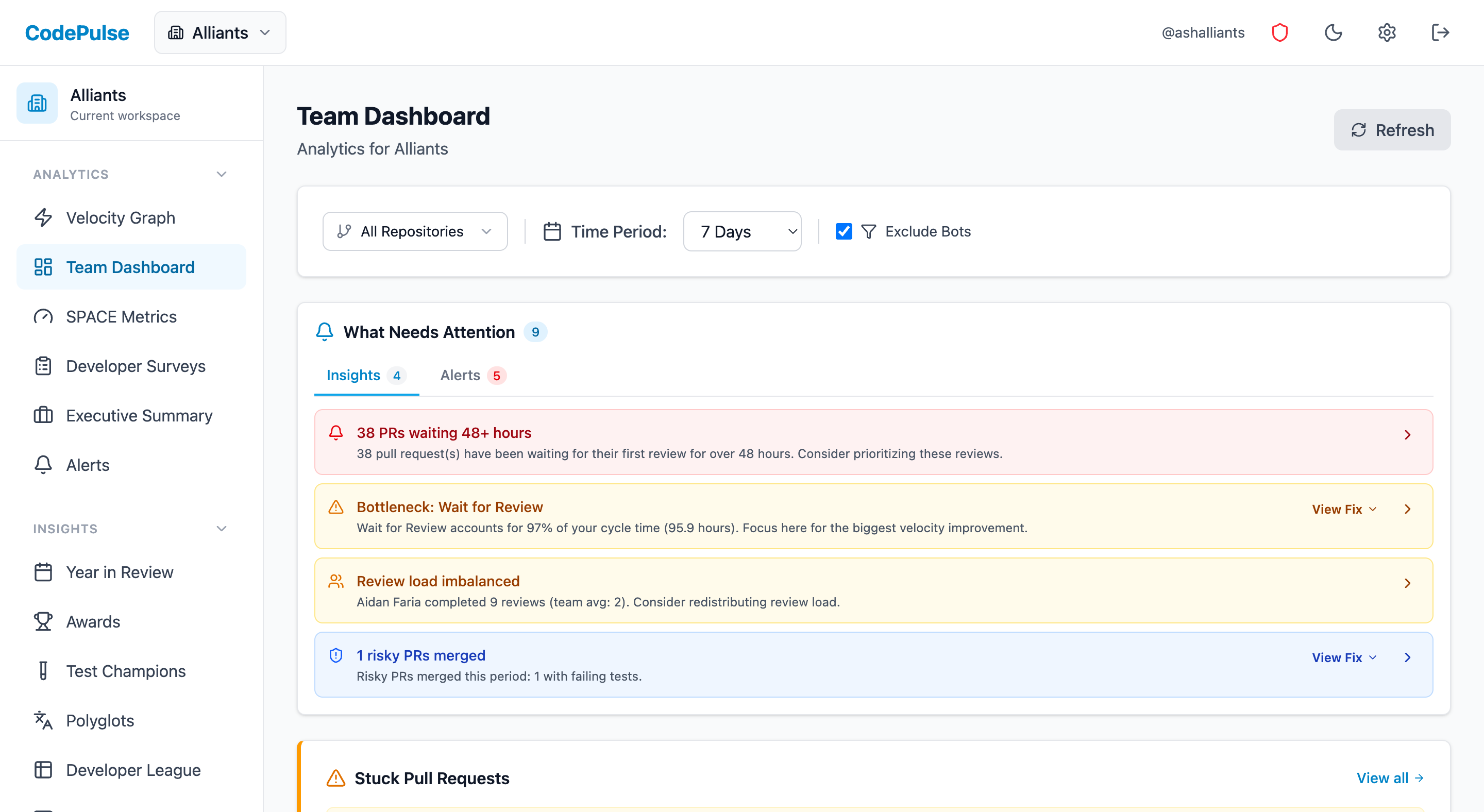
A comparison table only goes so far. Connect read-only GitHub in about five minutes and judge the output on your repositories, at one flat price, with no per-seat math.
Read-only GitHub · Your code stays yours · Team-level by default · No credit card
See These Features in Action
Board-ready engineering performance in a single page.
Track all four DORA metrics and benchmark against industry standards.
Related Guides
Engineering Metrics Dashboard: The 7 Metrics You Need
Skip vanity metrics. Here are the 7 engineering metrics VPs actually need to track team performance, delivery, and quality.
DORA Metrics Explained: The 4 Keys Without the Hype
A complete breakdown of the four DORA metrics - deployment frequency, lead time, change failure rate, and MTTR - with honest benchmarks and gaming traps to avoid.
The SOC 2 Question That Eliminates 80% of Analytics Vendors
Everything you need to know about data security, SOC 2 compliance, and privacy when evaluating engineering analytics platforms.
Engineering Metrics That Won't Get You Reported to HR
An opinionated guide to implementing engineering metrics that build trust. Includes the Visibility Bias Framework, practical do/don't guidance, and a 30-day action plan.
GitPrime Alternative: 3 Owners in 6 Years, Time to Move On
GitPrime became Pluralsight Flow, then was sold to Appfire. Three owners, stagnant development, and a history of stack ranking. Find a modern replacement.
Engineering Analytics ROI: The Budget Approval Playbook
Calculate the ROI of engineering analytics tools with formulas for time savings, payback period, and a business case template tailored to CFOs, CTOs, and CEOs.
The Slack Alert That Catches Stuck PRs Before Standup
How to configure alerts for stuck PRs, review SLA breaches, and key metric changes to stay informed without constant dashboard checking.
Engineering Analytics Tools: What User Reviews Really Say
An aggregation of what reviewers on G2, Capterra, TrustRadius and Gartner Peer Insights say about Jellyfish, Swarmia, LinearB and Allstacks - the recurring complaint patterns vendors do not quote.
Jellyfish vs GitKraken Insights: The Honest Comparison
Jellyfish is the Gartner MQ Leader with quote-only pricing; GitKraken Insights is the nine-month-old challenger at $9-19/contributor. A sourced, vendor-neutral head-to-head - with the third option both leave out.
Azure DevOps vs GitHub: 2026 Comparison (Both Tested)
Azure DevOps vs GitHub compared: pricing, CI/CD, AI features, project management, analytics, and migration paths. Side-by-side guide for engineering leaders choosing between Microsoft platforms.
Evaluating GitHub as a Code Collaboration Platform
An engineering leader's evaluation of GitHub as a code collaboration and DevOps platform: what it does well, where it falls short, and what analytics to layer on top.
Platform Tools: The Build vs Buy Mistake
A practical guide to platform engineering tools, build vs buy decisions, and the metrics that prove platform impact.
Engineering Metrics Tools: What You'll Actually Pay (2026)
The hidden costs and pricing traps in engineering metrics tools. Real pricing data and what vendors hide.
How to Measure Developers Without Becoming the Villain
Learn how to implement engineering metrics that developers actually trust, focusing on insight over surveillance and team-level patterns.