
Compare the finished analysis before you choose a platform
See the report CodePulse produces from read-only GitHub workflow data, or connect your own repositories and evaluate the fit with real evidence.
Read-only GitHub · Your code stays yours · Team-level by default · No credit card
Looking for Athenian alternatives? You are not alone. Users describe Athenian as overwhelming, with metrics that are "presented on the same level" regardless of relevance, a Jira integration that is "underwhelming and confusing," and questions about long-term viability. We compared 7 engineering analytics tools side-by-side so you can find the right fit.
Athenian is an engineering analytics platform focused on velocity metrics, release tracking, and delivery optimization. It connects to GitHub and Jira to surface metrics around lead time, review time, deployment frequency, and team productivity. Pricing starts at $29 per active contributor per month (Standard) or $49 per contributor per month (Premium), billed annually. Not every team needs Athenian's particular mix of features. Below we break down what Athenian does well, where it falls short based on real user feedback, and how seven alternatives compare. Also comparing other tools? See our Jellyfish alternative and Haystack alternative guides.
"Velocity metrics without context create perverse incentives. Shipping faster is only valuable if you're shipping the right things with acceptable quality."
What Is Athenian?
Athenian is an engineering analytics tool that pulls data from GitHub and Jira to surface delivery performance metrics. The platform focuses on velocity (lead time, cycle time, release frequency), quality (review coverage, merge patterns), and alignment (Jira issue to PR mapping). Athenian emphasizes making engineering performance transparent and benchmarkable.
The platform integrates primarily with GitHub and Jira. It targets engineering managers and team leads at mid-size organizations who need visibility into how their teams deliver software. A Jira-only integration list is worth checking against your own stack before you commit, particularly if you are weighing a move to another tracker - our Linear vs Jira comparison covers what that move does to your reporting. According to the 2024 DORA Report, teams with transparent delivery metrics report 30% higher job satisfaction compared to teams without visibility into their own performance.
Athenian's paid plans start at $29 per active contributor per month (Standard) and $49 per contributor per month (Premium), billed annually. The platform has been acquired and integrated into a broader developer tools ecosystem, which affects its roadmap and long-term positioning. The limited public review footprint raises questions about the size of Athenian's active user base.
7 Best Athenian Alternatives and Competitors
Each of these tools takes a different approach to engineering analytics. We've included honest strengths and trade-offs for each.
1. CodePulse
Best for: 10-200 engineer teams who want deeper PR-level insights, collaboration analytics, and knowledge silo detection beyond velocity metrics.
- Cycle time breakdown into four actionable stages (coding, waiting, review, merge)
- Review network visualization showing collaboration patterns and bottlenecks
- File hotspot and knowledge silo detection at the file level
- Developer awards celebrating quality, collaboration, and consistency (not just volume)
- GitHub, Jira, and Linear integrations
- Self-serve setup in under 5 minutes
Pricing: Free for up to 10 developers. Pro from $199/month, Business from $449/month. Monthly billing, cancel anytime.
Trade-off: No release tracking or deployment frequency metrics. No GitLab or Bitbucket support. Focused on PR lifecycle, not release management.
2. LinearB
Best for: Teams wanting PR workflow automation alongside metrics and sprint tracking.
- gitStream workflow automation for code review routing and standards
- DORA metrics with investment mapping
- Multi-git-provider support (GitHub, GitLab, Bitbucket)
- Sprint tracking and Jira integration
Pricing: Free tier for up to 8 contributors. Paid plans from ~$420/contributor/year.
Trade-off: Less focus on velocity benchmarking than Athenian. Automation features come with added complexity. Read our full LinearB comparison.
3. Swarmia
Best for: Teams that prioritize developer experience measurement alongside delivery metrics.
- SPACE and DORA frameworks built in
- Developer experience surveys with quantitative scoring
- Working agreements for team-level standards
- CI/CD visibility and Slack integration
Pricing: Free tier for companies with fewer than 10 developers. Lite from EUR 20/user/month.
Trade-off: Less velocity-focused than Athenian. Survey-based DX measurement adds operational overhead. Read our full Swarmia comparison.
4. Jellyfish
Best for: Enterprise teams (50+ engineers) needing OKR alignment and investment categorization for board-level reporting.
- 25+ integrations including GitHub, GitLab, Jira, CI/CD, and HR systems
- Investment categorization (feature vs. debt vs. support)
- OKR alignment connecting engineering work to business outcomes
- AI tool ROI tracking
Pricing: ~$588/contributor/year (~$49/month) based on third-party sources.
Trade-off: Enterprise-heavy. Overkill for teams that just need velocity and delivery metrics. Read our full Jellyfish comparison.
5. Sleuth
Best for: Teams wanting deployment-centric DORA metrics with change tracking and incident correlation.
- Deployment tracking with automatic change detection
- DORA metrics from actual deployment events
- Change failure rate tracking with incident correlation
- GitHub, GitLab, Bitbucket, and CI/CD integrations
Pricing: Free for small teams. Growth plans from $20/developer/month.
Trade-off: Deployment-focused. Less PR analytics depth than Athenian or CodePulse. Read our full Sleuth comparison.
6. Allstacks
Best for: Enterprise teams needing predictive delivery forecasting and portfolio-level visibility.
- Value stream intelligence with delivery risk forecasting
- Initiative-level tracking across teams
- Broad integration set (GitHub, GitLab, Bitbucket, Jira, Azure DevOps)
- Typically operational within 24-48 hours
Pricing: Enterprise pricing, contact sales.
Trade-off: Focused on delivery prediction, not granular velocity metrics or PR-level analytics.
7. Haystack
Best for: Small to mid-size teams wanting a lightweight alternative focused on developer activity and PR metrics.
- Developer activity dashboards with contribution patterns
- PR metrics and review analytics
- Team-level velocity tracking
- GitHub integration with quick setup
Pricing: Free tier available. Paid plans scale by team size.
Trade-off: Less mature than Athenian on release tracking and Jira integration. Narrower feature set overall. Read our full Haystack comparison.
Quick Comparison: All 7 Athenian Alternatives
| Tool | Best For | GitHub | Jira | Free Tier | Pricing |
|---|---|---|---|---|---|
| CodePulse | PR insights + collaboration | Yes (deep) | Yes | Yes (10 devs) | From $199/mo |
| LinearB | PR automation + metrics | Yes | Yes | Yes (8 devs) | ~$420/yr per dev |
| Swarmia | Developer experience | Yes | Yes | Yes (14 devs) | From EUR 20/mo |
| Jellyfish | Enterprise business alignment | Yes | Yes (deep) | No | ~$49/dev/mo |
| Sleuth | Deployment DORA metrics | Yes | Limited | Yes | From $20/dev/mo |
| Allstacks | Delivery forecasting | Yes | Yes | No | Enterprise |
| Haystack | Lightweight activity tracking | Yes | Limited | Yes | Team-based |
Athenian vs CodePulse: A Closer Look
Since we build CodePulse, we owe you the most transparent comparison. Both tools work with GitHub, but they focus on different insights:
| Aspect | Athenian | CodePulse |
|---|---|---|
| Primary focus | Velocity metrics and release tracking | PR lifecycle and team collaboration |
| Unique strength | Release tracking and velocity benchmarks | Review network, knowledge silos, developer awards |
| Target team size | 20-500 engineers | 10-200 engineers |
| Setup time | Minutes to hours | Minutes (self-serve) |
| GitHub + Jira | Yes (strong Jira mapping) | Yes (GitHub-deep, Jira + Linear) |
| Pricing | Standard $29/contributor/mo, Premium $49/contributor/mo | Free tier, Pro from $199/mo |
| Actionability | Raw data; users report needing to "process" it themselves | Opinionated, persona-driven views with root cause analysis |
| Review footprint | Single-digit reviews on G2, no Capterra listing | Active user base with growing adoption |
"Velocity metrics answer 'how fast are we going?' Collaboration metrics answer 'are we going to sustain this pace?' Both questions matter, but only one predicts burnout."
What Athenian Does Well
Credit where it's due: Athenian excels at things CodePulse doesn't attempt:
Release Tracking
Athenian tracks releases and deployment frequency as first-class concepts. You can see release cadence, what's in each release, and how release cycles correlate with team velocity. If release management visibility is your primary need, Athenian has this built in.
Velocity Benchmarking
Athenian provides velocity benchmarks so you can compare your team's performance against industry standards. This is useful for teams that want to understand where they stand relative to peers, though we'd caution against treating benchmarks as targets (see our take below).
GitHub + Jira Correlation
Athenian maps Jira issues to GitHub PRs and shows the connection between planned work and delivered code. If your planning process runs through Jira and you need to reconcile planned vs. shipped, Athenian's integration handles this well.
Clean UX for Velocity Metrics
Athenian's interface is focused and clean. If velocity metrics (lead time, cycle time, throughput) are your primary concern, the UX delivers those insights without enterprise clutter. This simplicity is a genuine strength compared to heavier platforms like Jellyfish or Faros AI.
What Users Actually Say About Athenian
Athenian has very few public reviews, which is itself a signal worth considering. The reviews that do exist paint a consistent picture of a product with potential that struggles to deliver actionable value. Here is what real users report.
"A powerless tool that decreases workflow."-- G2 reviewer
Overwhelming Metrics Without Guidance
Multiple reviewers describe the same problem: Athenian surfaces a lot of data but does not help you act on it. One user noted that the platform provides "high level data and objective metrics" that are "overwhelming for both executives and team members." Another described having access to "lots of raw information" that needed to be "processed to help with decision-making." When metrics are presented without hierarchy or context, they create noise rather than insight.
Users also report that "some metrics do not suit their needs" and that irrelevant metrics are "presented on the same level" as the ones that matter. If you have to dig through dashboards to find the signal, the tool is creating work rather than reducing it.
Jira Integration Falls Short
Athenian markets Jira integration as a key feature, but users describe the reality differently. The Jira integration is characterized as "underwhelming and confusing," with team changes affecting data accuracy. If Jira-to-PR mapping is a primary reason you are evaluating Athenian, test the integration thoroughly with your actual project structure before committing.
Product Maturity and Viability Concerns
A Gartner Peer Insights reviewer described Athenian as "a young product lacking some maturity" in certain areas. Users report template changes without notice, missing templates, and glitchy uploads. The extremely limited review footprint (single-digit reviews on G2, no Capterra listing) suggests either a very small user base or declining adoption. For teams evaluating a long-term analytics partner, this is a meaningful risk factor.
Where Athenian Struggles
Combining user feedback with our own analysis, these are Athenian's known limitations:
Limited Collaboration Insights
Athenian tracks who reviews code, but doesn't visualize collaboration patterns as a network. You can't easily spot review load imbalance, isolated team members, or cross-team collaboration gaps. These are the insights that prevent bottlenecks and burnout.
No Knowledge Silo Detection
Athenian doesn't analyze file ownership patterns or identify bus factor risks at the file level. If critical code is owned by a single developer, Athenian won't flag it. This is a risk category that velocity metrics completely miss.
Acquisition and Viability Uncertainty
Athenian's integration into a larger organization creates roadmap uncertainty. The very limited public review footprint raises questions about the size of the active user base. Teams evaluating a long-term analytics partner should consider whether Athenian's standalone product direction will continue, shift to serve the acquirer's priorities, or wind down entirely.
Velocity-Only Lens
Athenian excels at "how fast" but is weaker on "how healthy." Speed without context can mask problems: a team might have fast cycle times but terrible review quality, or high throughput but crippling knowledge silos.
* Our Take
Velocity metrics are table stakes. Every engineering analytics tool measures cycle time and throughput. The tools that actually improve engineering health go beyond speed: they show you collaboration patterns, knowledge concentration risks, and review quality. Optimizing for velocity alone is like optimizing a car for top speed without checking the brakes.
We built CodePulse with review networks, file hotspots, and developer awards because sustainable delivery requires more than going fast. It requires going fast safely.
Where CodePulse Fits Better
CodePulse is purpose-built for teams who need more than velocity dashboards:
Review Network Visualization
The Review Network shows collaboration patterns as an interactive graph. You can see who reviews whose code, identify review load imbalance, and spot isolated team members. This is the feature most often cited by teams switching from velocity-only tools: "We knew we were slow, but we didn't know why until we saw the review network."
Knowledge Silo Detection
The File Hotspots view identifies high-churn files and knowledge silos at the file level. When one developer owns a critical file, that's a bus factor risk that no velocity metric captures. CodePulse makes these risks visible on a per-file, per-developer basis.
Granular Cycle Time Breakdown
Both Athenian and CodePulse measure cycle time, but CodePulse breaks it into four stages you can act on. The Dashboard shows coding time, wait for review, review time, and merge time separately. This isn't "your cycle time is 3 days." It's "you spend 18 hours waiting for review and only 4 hours in actual review."
Developer Recognition
The Developer Awards celebrate contributions across 15+ categories: quality, collaboration, consistency, and mentorship, not just speed and volume. Athenian tracks individual velocity; CodePulse recognizes the behaviors that build healthy teams.
* How to See This in CodePulse
Navigate to Review Network to see collaboration patterns Athenian doesn't surface:
- Interactive graph showing who reviews whose code
- Review load distribution across team members
- Isolated developers who may need pairing support
- Cross-team collaboration patterns and gaps
When to Choose Athenian Instead
We believe in being honest about when CodePulse isn't the right choice. Choose Athenian if:
| Situation | Why Athenian |
|---|---|
| Release tracking is your primary need | Athenian tracks releases as first-class objects with cadence analytics |
| You need velocity benchmarks | Athenian provides industry benchmarks for comparison |
| Jira-to-PR mapping is critical | Athenian's Jira integration maps planned work to delivered code |
| You want velocity metrics with minimal setup | Athenian's UX is clean and velocity-focused |
| You need GitLab support | Athenian supports GitLab; CodePulse does not |
If 3+ of these apply, Athenian may be the better fit. Both tools have free tiers, so you can try both and decide based on which insights actually change your behavior.
CodePulse Limitations (We're Being Honest)
- No release tracking: We don't track releases or deployment cadence as separate concepts
- No velocity benchmarks: We don't compare your metrics to industry averages
- No GitLab or Bitbucket: GitHub-only for version control
- No deployment frequency: We measure PR throughput, not deployment events
- Smaller team focus: Optimized for 10-200 engineers, not 500+
These are intentional trade-offs. We chose to go deeper on PR lifecycle analysis, collaboration patterns, and knowledge risk detection rather than trying to cover everything at surface level.
Decision Matrix
| Your Situation | Recommendation |
|---|---|
| 10-50 engineers, GitHub-focused, want fast setup | CodePulse |
| Need release tracking and deployment cadence | Athenian or Sleuth |
| Code review and collaboration are the bottleneck | CodePulse (deeper on review network + silos) |
| Need velocity benchmarks against industry | Athenian |
| Need OKR alignment and board reporting | Jellyfish |
| Want PR workflow automation | LinearB |
| Prioritize developer experience surveys | Swarmia |
| Need deployment-centric DORA metrics | Sleuth |
| Engineering Manager wanting team health, not just speed | CodePulse |
| Want insights today, not next month | CodePulse or Athenian (both have free tiers) |
"The most dangerous metric dashboard is one that only shows speed. Teams that measure velocity without measuring health end up fast, fragile, and burned out."
The Honest Verdict
Athenian and CodePulse overlap on cycle time and PR analytics but diverge on what else they surface. Athenian extends into release tracking and velocity benchmarking. CodePulse extends into collaboration patterns, knowledge silos, and developer recognition.
Choose Athenian if velocity metrics, release tracking, and Jira-to-PR mapping are your primary needs.
Choose CodePulse if you want deeper collaboration insights, knowledge silo detection, review network visualization, and a team-positive approach to metrics.
Choose LinearB if you want PR workflow automation alongside your analytics.
Choose Swarmia if developer experience measurement and surveys are your primary concern.
Both Athenian and CodePulse have free tiers. Try both. The tool that changes your behavior is the right one. For a broader comparison, see our best engineering analytics tools guide.
Frequently Asked Questions
Athenian is an engineering analytics platform focused on velocity metrics, release tracking, and delivery performance. It connects to GitHub and Jira to surface lead time, cycle time, deployment frequency, and the mapping between planned Jira issues and delivered GitHub PRs. It targets engineering managers and team leads who need visibility into delivery speed.
Related Comparisons
Exploring other options? Check out these guides:
- Propelo Alternative - For teams that weighed Propelo before it was acquired by BMC
- LinearB Alternative - For teams focused on workflow automation and gitStream
- Swarmia Alternative - For teams focused on developer experience and working agreements
- Haystack Alternative - For teams wanting lightweight activity tracking
- Engineering Analytics Tools Comparison - Comprehensive comparison of all major platforms
- Best Engineering Analytics Tools - Our top picks for different team sizes and needs
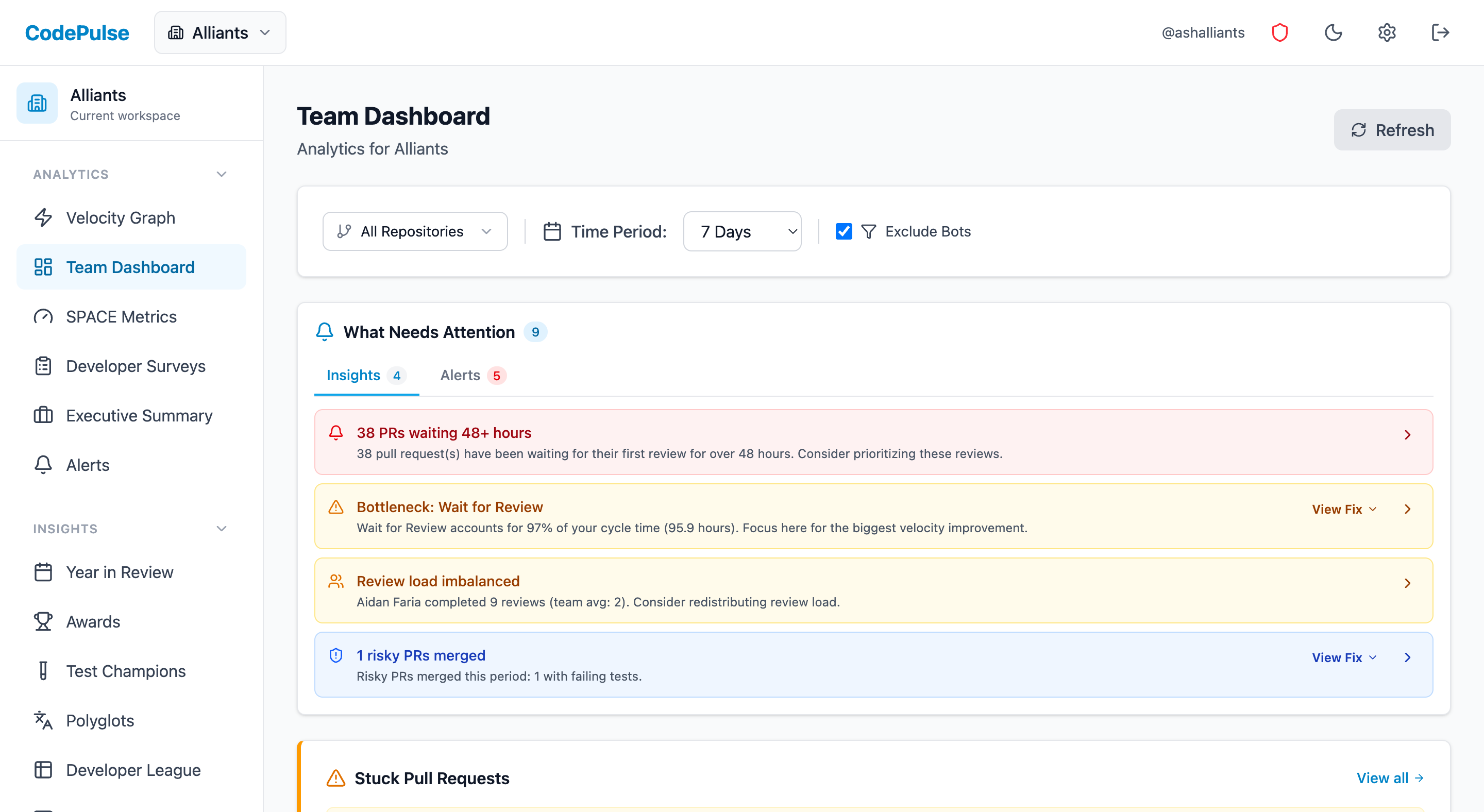
Evaluate CodePulse against your own delivery history
A comparison table only goes so far. Connect read-only GitHub in about five minutes and judge the output on your repositories, at one flat price, with no per-seat math.
Read-only GitHub · Your code stays yours · Team-level by default · No credit card
See These Features in Action
Break down cycle time into coding, waiting, review, and merge phases.
Track all four DORA metrics and benchmark against industry standards.
Related Guides
7 Jellyfish Alternatives for 2026 (Honest Ranking)
Compare 7 Jellyfish alternatives including CodePulse, LinearB, Swarmia, and more. Honest pros, cons, pricing, and integration comparisons.
Haystack vs CodePulse: An Actually Fair Comparison (2026)
An honest comparison of Haystack and CodePulse. Both prioritize team health over surveillance - this guide explains where they differ and when to choose each.
Swarmia Alternatives: Cheaper, Deeper Analytics 2026
A Swarmia alternative worth considering: where Swarmia falls short on customization and per-seat pricing, and which cheaper, GitHub-native tools fit better.
Jellyfish vs LinearB vs Swarmia: Full 2026 Comparison
Compare Jellyfish, LinearB, Swarmia, Allstacks, Haystack and more engineering analytics tools. Features, pricing, cycle time benchmarks, and integrations.
Best Engineering Analytics Tools for 2026 (Ranked by Real Users)
We ranked the 10 best engineering analytics tools based on metric depth, setup speed, pricing transparency, and privacy posture. Honest pros and cons for each.