
Compare the finished analysis before you choose a platform
See the report CodePulse produces from read-only GitHub workflow data, or connect your own repositories and evaluate the fit with real evidence.
Read-only GitHub · Your code stays yours · Team-level by default · No credit card
Choosing the right engineering analytics tool determines whether your team gets actionable visibility or another dashboard nobody opens. We ranked the 10 most relevant platforms based on real evaluation criteria: setup speed, metric depth, pricing transparency, and whether the tool actually changes how you ship software.
This is not a repackaged vendor list. We tested these tools, talked to teams using them, and documented honest trade-offs, including where CodePulse falls short. If you are a VP of Engineering evaluating options, an EM trying to justify a purchase, or a Staff Engineer who wants data without surveillance, this guide is for you.
What is the best engineering analytics tool?
For GitHub-native teams (10-200 engineers) wanting fast setup and deep code review analytics, CodePulse offers the strongest free tier and 5-minute onboarding. For Jira-heavy teams wanting workflow automation, LinearB combines metrics with gitStream. For enterprise organizations (200+ engineers) needing portfolio-level business alignment, Jellyfish provides executive reporting. For developer experience focus with working agreements, Swarmia is the strongest choice. Your best tool depends on your Git provider, team size, and whether you need metrics for engineering leadership or executive reporting.
How We Evaluated
We scored each platform across six dimensions. These are not arbitrary; they map directly to the reasons engineering leaders buy analytics tools in the first place.
| Criteria | Weight | What We Measured |
|---|---|---|
| Metric Depth | 25% | DORA coverage, cycle time breakdown granularity, code quality signals, collaboration metrics |
| Setup Speed | 20% | Time from signup to first actionable insight (minutes vs. weeks) |
| Integration Breadth | 15% | Git providers, issue trackers, CI/CD, Slack, HR systems |
| Pricing Transparency | 15% | Published pricing, free tier, per-seat vs. flat rate, contract requirements |
| Privacy Posture | 15% | Team-level vs. individual tracking, developer-facing transparency, anti-surveillance stance |
| Actionability | 10% | Alerts, automations, recommendations that change behavior vs. passive dashboards |
A tool that scores well on metric depth but poorly on setup speed is an enterprise implementation project, not a product. We weighted accordingly.
The 10 Best Engineering Analytics Tools
The list below focuses on engineering analytics specifically - how your team ships, reviews, and collaborates. If you want the broader category including IDE plugins, workflow automation, and devex platforms, our best developer productivity platforms roundup covers those tools in depth.
1. CodePulse
Best for: GitHub-native teams (10-200 engineers) who want deep PR and review analytics without a multi-week implementation.
CodePulse breaks cycle time into four actionable stages (coding, waiting for review, in review, merge) rather than treating it as a single number. The review network visualization shows who reviews whom and where bottlenecks form. File hotspot detection and knowledge silo analysis surface code health risks before they become incidents.
Strengths:
- 5-minute setup with GitHub App installation. No professional services needed.
- 50+ metrics across velocity, quality, productivity, and collaboration dimensions
- Review sentiment analysis that catches toxic review culture before it festers
- Engineering health score (A-F grade) with DORA benchmarking
- Free tier for up to 10 developers. Pro from $199/month, Business from $449/month.
- Developer awards system that recognizes collaboration, not just output
Limitations (honest):
- GitHub only. No GitLab or Bitbucket support. If your org uses multiple Git providers, CodePulse cannot be your single source of truth.
- No CI/CD integration beyond GitHub Actions status checks. You will not get deployment pipeline visibility from Jenkins, CircleCI, or GitLab CI.
- No OKR alignment or investment categorization (yet). If you need to map engineering work to business objectives for board reporting, look at Jellyfish or Allstacks.
- No calendar integration for meeting load analysis.
Pricing: Free (10 devs), Pro $199/mo, Business $449/mo. No annual contracts required.
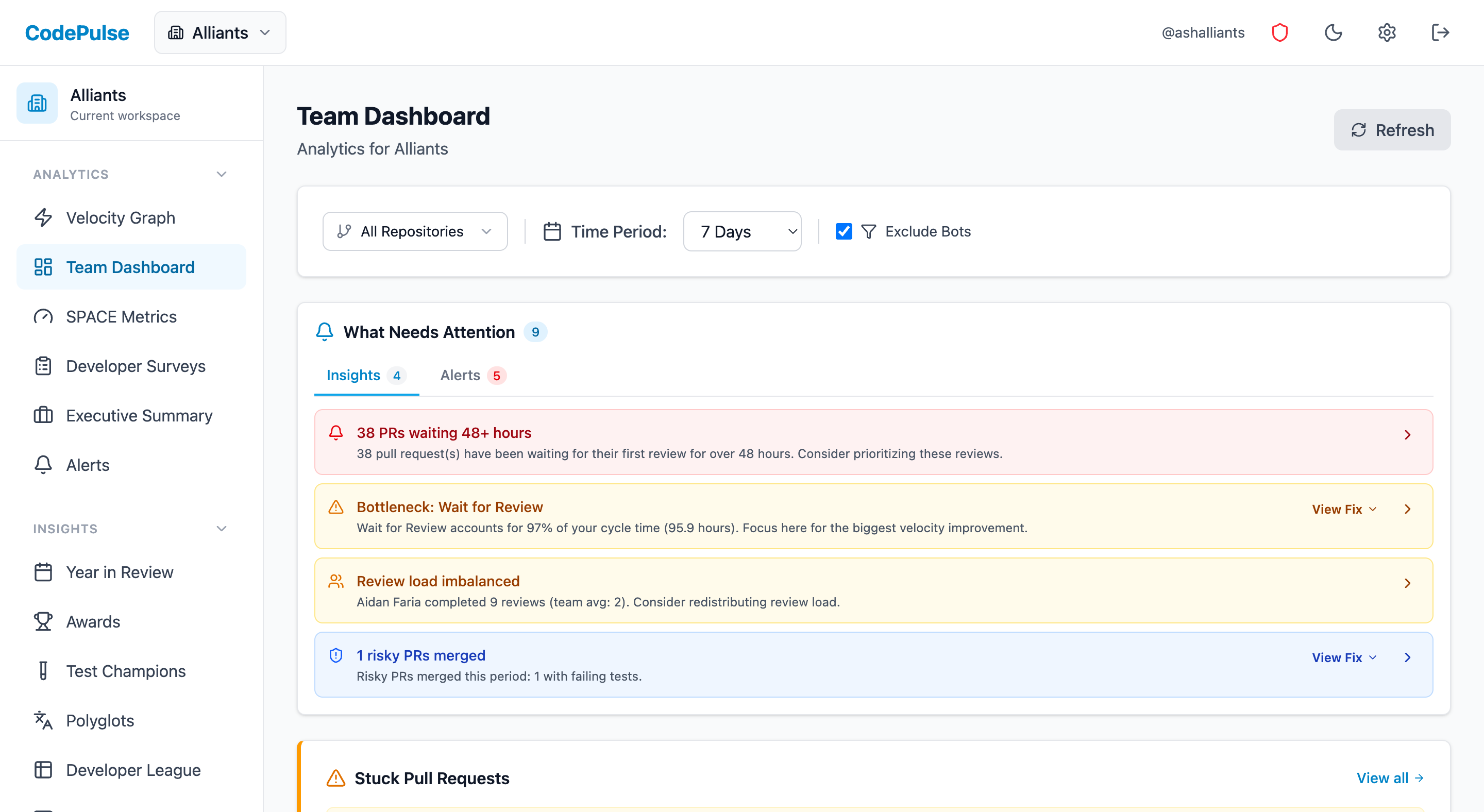
📊 How to See This in CodePulse
Navigate to the Dashboard to see your engineering health score, cycle time breakdown, and DORA metrics at a glance:
- The cycle time card breaks down all 4 stages so you know exactly where PRs stall
- Review Network shows collaboration patterns and identifies overloaded reviewers
- File Hotspots surfaces high-risk files and knowledge silos across repositories
- Executive Summary provides a board-ready engineering health grade
2. Jellyfish
Best for: Enterprise teams (200+ engineers) that need to connect engineering work to business outcomes for executive and board reporting.
Jellyfish is an engineering management platform, not just an analytics tool. It pulls from 25+ integrations including Git, Jira, CI/CD, incident tools, and HR systems to build a portfolio-level view of engineering investment.
Strengths:
- Investment allocation tracking (feature vs. maintenance vs. tech debt)
- OKR alignment that maps commits and PRs to business objectives
- Capacity planning with predictive modeling
- 25+ integrations including GitLab, Bitbucket, Jira, and HR systems
Limitations:
- No published pricing. Third-party sources report ~$588/contributor/year (~$49/mo). Annual contracts required.
- Multi-week implementation with professional services. Not self-serve.
- Overkill for teams under 100 engineers. The ROI does not justify the cost and setup effort.
- Metric depth at the PR level is shallow compared to tools focused on delivery analytics
Pricing: Custom enterprise pricing. Estimated ~$49/contributor/month based on third-party reports.
Evaluating Jellyfish specifically? See our detailed Jellyfish alternative comparison.
3. LinearB
Best for: Teams using Jira + GitHub/GitLab who want PR workflow automation alongside metrics.
LinearB combines engineering metrics with gitStream, an open-source workflow automation engine that routes reviews, enforces standards, and automates PR labeling based on code changes.
Strengths:
- gitStream workflow automation is genuinely useful and open-source
- WorkerB Slack bot for PR notifications and review nudges
- Investment mapping (feature vs. bug fix vs. tech debt)
- Supports GitHub, GitLab, and Bitbucket
Limitations:
- Free tier was discontinued. Pricing starts at ~$39/dev/month.
- Metric depth is weaker than dedicated analytics tools. Cycle time is a single number, not a breakdown.
- gitStream is powerful but has a learning curve. YAML-based rules are not intuitive for everyone.
Pricing: Free plan limited to 7 devs. Pro ~$39/dev/month. Enterprise custom.
See our LinearB alternative comparison for a deeper breakdown.
4. Swarmia
Best for: Teams that want to combine engineering metrics with working agreements and developer experience tooling.
Swarmia takes a developer-experience-first approach. Working agreements let teams set their own standards (e.g., "PRs reviewed within 4 hours") and track adoption without top-down mandates.
Strengths:
- Working agreements framework gives teams ownership of their standards
- Strong Slack integration for real-time notifications
- Investment tracking with automatic work categorization
- GitHub, GitLab, Jira, and Linear integrations
Limitations:
- No published pricing. Requires a demo call. Reports suggest ~$20-40/dev/month.
- Metric depth is intentionally limited to team-level. Individual developer analytics are minimal.
- No code-level analysis (file hotspots, knowledge silos, complexity)
Pricing: Not publicly listed. Estimated ~$20-40/developer/month.
See our Swarmia alternative comparison for more details.
5. Allstacks
Best for: Engineering leaders who want delivery risk prediction and value stream management rather than raw developer metrics.
Allstacks focuses on delivery risk, predicting which projects are likely to miss deadlines based on historical patterns. It integrates with 50+ tools and emphasizes value stream mapping over individual contributor metrics.
Strengths:
- Delivery risk prediction with machine learning
- Value stream mapping from idea to deployment
- 50+ integrations including most Git providers, CI/CD, and project management tools
- Focus on outcomes (delivery) rather than outputs (activity)
Limitations:
- No published pricing. Enterprise sales process required.
- Less useful for day-to-day engineering management. Better for portfolio-level decisions.
- PR-level detail is limited compared to delivery-focused tools
Pricing: Custom enterprise pricing only.
6. Faros AI
Best for: Data engineering teams who want to build custom analytics on top of a normalized engineering data warehouse.
Faros AI takes a different approach: it normalizes data from 50+ engineering tools into a unified data model, then lets you query and visualize it however you want. It is an engineering data platform more than a dashboarding tool.
Strengths:
- Open-source Community Edition available
- Normalized data model across 50+ connectors
- Custom dashboarding with BI tool integration
- Strong for organizations with data engineering capacity
Limitations:
- Requires data engineering expertise to get value. Not plug-and-play.
- No opinionated out-of-the-box dashboards for engineering leaders
- Implementation timeline is weeks to months, not minutes
Pricing: Open-source Community Edition. Enterprise pricing custom.
7. Sleuth
Best for: Teams that define "deployment" as the unit of work and want DORA metrics centered on deploy frequency and change failure rate.
Sleuth is built around the deployment as the atomic unit. It tracks changes from commit through deploy and correlates them with incidents and feature flags. Strong integration with LaunchDarkly, PagerDuty, and CI/CD systems.
Strengths:
- Deployment-centric model with change tracking
- Strong DORA metrics implementation
- LaunchDarkly and feature flag integration
- Impact tracking that connects deploys to incidents
Limitations:
- Weaker on code review and collaboration metrics
- Requires deployment tracking setup. Does not work well if you do not have a well-defined deploy process.
- Smaller team and less frequent updates compared to larger competitors
Pricing: Free for 1 team. Growth from $20/dev/month. Enterprise custom.
8. Waydev
Best for: Organizations that want engineering metrics combined with work-type classification and investment tracking.
Waydev positions itself as an engineering intelligence platform. It offers work-type classification, DORA metrics, and sprint analytics. The platform supports GitHub, GitLab, Bitbucket, and Azure DevOps.
Strengths:
- Broad Git provider support (GitHub, GitLab, Bitbucket, Azure DevOps)
- Automatic work-type classification
- Sprint analytics and planning integration
- R&D capitalization reporting
Limitations:
- UI is less polished than competitors
- Metric definitions can be unclear. Verify how they calculate before benchmarking.
- Customer reviews mention slow support response times
Pricing: Starts at ~$30/dev/month based on third-party reports. Enterprise pricing custom.
9. Pluralsight Flow (formerly GitPrime)
Best for: Large organizations already using Pluralsight for skills development who want to add engineering analytics.
Pluralsight Flow was originally GitPrime, one of the first engineering analytics tools. It was acquired by Pluralsight and integrated into their skills platform. The tool provides active days, commit patterns, and code review metrics.
Strengths:
- Mature product with years of iteration
- Integration with Pluralsight skills platform for development recommendations
- Support for GitHub, GitLab, Bitbucket, and Azure DevOps
- Active days metric that attempts to measure productive work time
Limitations:
- Perceived as a developer surveillance tool by many engineering teams
- Bundled with Pluralsight, which inflates cost if you do not need the learning platform
- Innovation has slowed since acquisition. Newer competitors have passed it on metric depth.
- No free tier
Pricing: Bundled with Pluralsight Skills. Custom pricing. Estimated $30-50/dev/month for combined platform.
10. Haystack
Best for: Small to mid-size teams that want a lightweight, affordable alternative to enterprise platforms.
Haystack focuses on simplicity. It provides core PR analytics, DORA metrics, and team dashboards without the complexity of enterprise platforms. The interface is clean and the setup is quick.
Strengths:
- Clean, simple interface focused on core metrics
- Quick setup with GitHub integration
- Affordable pricing for small teams
- Good Slack integration for team notifications
Limitations:
- Limited metric depth. No file-level analysis, sentiment analysis, or knowledge silo detection.
- GitHub and GitLab only. No Bitbucket or Azure DevOps.
- Smaller feature set means you may outgrow it quickly
Pricing: Free trial available. Paid plans from ~$15/dev/month.
Feature Comparison Table
| Tool | DORA Metrics | Cycle Time Breakdown | Code Quality | Git Providers | Free Tier | Setup Time | Starting Price |
|---|---|---|---|---|---|---|---|
| CodePulse | Yes (4/4) | 4 stages | Hotspots, silos, sentiment | GitHub | Yes (10 devs) | 5 minutes | Free / $199/mo |
| Jellyfish | Yes (4/4) | Basic | Limited | GitHub, GitLab, BB | No | 2-4 weeks | ~$49/dev/mo |
| LinearB | Yes (4/4) | Single number | Basic | GitHub, GitLab, BB | Limited (7 devs) | 30 minutes | ~$39/dev/mo |
| Swarmia | Yes (4/4) | Basic | Limited | GitHub, GitLab | No | 1-2 hours | ~$20-40/dev/mo |
| Allstacks | Yes (4/4) | Value stream | Limited | GitHub, GitLab, BB, ADO | No | 1-2 weeks | Custom |
| Faros AI | Custom | Custom | Custom | 50+ connectors | Open-source | Weeks | Free / Custom |
| Sleuth | Yes (4/4) | Deploy-centric | Basic | GitHub, GitLab, BB | Yes (1 team) | 30-60 min | Free / $20/dev/mo |
| Waydev | Yes (4/4) | Basic | Work-type classification | GitHub, GitLab, BB, ADO | No | 1-2 hours | ~$30/dev/mo |
| Pluralsight Flow | Partial | Basic | Active days | GitHub, GitLab, BB, ADO | No | 1-2 weeks | ~$30-50/dev/mo |
| Haystack | Partial | Basic | None | GitHub, GitLab | Trial | 15 minutes | ~$15/dev/mo |
🔥 Our Take
Most engineering analytics tools are built for the buyer, not the user. The VP signs the contract, the dashboard looks impressive in the demo, and then nobody opens it after month two because the metrics do not connect to daily engineering decisions.
The tools that actually get adopted share three traits: they surface insights in Slack (where engineers already are), they break metrics into actionable components (not just "cycle time is 72 hours"), and they respect developer privacy by defaulting to team-level views. If your analytics tool requires a training session to understand the dashboard, it will become shelfware. Guaranteed.
"The best engineering analytics tool is the one your team actually opens on Monday morning, not the one with the most integrations on the features page."
How to Choose the Right Tool
Skip the feature matrix comparison. Start with three questions. If you want a shortcut, our free developer productivity tool recommender matches your team profile to the right category in a couple of minutes:
1. What Git provider does your team use?
If your entire organization is on GitHub, you have the widest selection. CodePulse, Sleuth, and Haystack are GitHub-optimized. If you use GitLab, Bitbucket, or Azure DevOps, your options narrow to LinearB, Swarmia, Waydev, Allstacks, or Pluralsight Flow. Multi-provider environments should look at Faros AI or Allstacks.
2. Who is the primary consumer of the data?
| Primary Consumer | Best Fit | Why |
|---|---|---|
| VP/Director (Board reporting) | Jellyfish, Allstacks | Portfolio views, investment allocation, OKR alignment |
| Engineering Manager (Team ops) | CodePulse, Swarmia, LinearB | PR-level detail, review bottlenecks, team health |
| Staff/Principal Engineer (Code health) | CodePulse, Faros AI | File hotspots, knowledge silos, code coupling |
| Platform/DevOps (Deployment ops) | Sleuth, Faros AI | Deploy tracking, DORA metrics, incident correlation |
3. What is your team size and budget?
Team Size Decision Framework:
┌─────────────────────────────────────────────────────┐
│ 1-10 engineers     → CodePulse Free or Haystack     │
│ 10-50 engineers    → CodePulse Pro, Swarmia, Sleuth │
│ 50-200 engineers   → CodePulse Business, LinearB    │
│ 200+ engineers     → Jellyfish, Allstacks           │
│ Custom data needs  → Faros AI                       │
└─────────────────────────────────────────────────────┘
"If you spend more time configuring your analytics tool than reading its output, you picked the wrong tool."
"The engineering analytics market has a dirty secret: most platforms track the same DORA metrics using the same Git data. The real differentiator is whether the tool changes behavior or just reports history."
How Do Engineering Analytics Tools Support Remote Teams?
Engineering analytics tools designed for co-located teams break down in distributed environments. Cycle time numbers inflate because they include time-zone handoffs that look identical to "developer is stuck." Review wait time looks catastrophic when half the reviewers are 8 hours offset. Activity spikes outside working hours, which a naive dashboard reads as "high productivity" but is actually "someone is burning out at 11pm."
The analytics tools that handle remote teams well share three properties. They decompose cycle time by time zone so you can see which delays are process problems versus geography problems. They surface after-hours work patterns as a leading burnout signal rather than a productivity gold star. And they normalize review wait time against working-hours overlap, so an 18-hour async wait is not flagged the same as a 90-minute sync wait.
CodePulse and Swarmia both surface time-zone-aware cycle time and weekend-work alerts. LinearB and Jellyfish handle multi-region orgs at scale but require more configuration. DX runs surveys that surface the qualitative side of distributed burnout. For a full decision matrix, see our guide on developer productivity for remote and distributed teams.
Frequently Asked Questions
Engineering analytics tools measure software delivery performance by analyzing data from Git repositories, CI/CD pipelines, and issue trackers. They surface metrics like cycle time, deployment frequency, review throughput, and code quality signals to help engineering leaders make data-driven decisions about process improvements, resource allocation, and team health.
Continue Your Research
If you are evaluating specific tools, these guides go deeper:
- Jellyfish Alternatives and Competitors - detailed feature-by-feature comparison
- LinearB Alternatives and Competitors - gitStream alternatives and workflow automation options
- Swarmia Alternatives and Competitors - working agreements and developer experience tools
- Engineering Analytics Tools Comparison - side-by-side evaluation matrix with deeper technical analysis
Evaluate CodePulse against your own delivery history
A comparison table only goes so far. Connect read-only GitHub in about five minutes and judge the output on your repositories, at one flat price, with no per-seat math.
Read-only GitHub · Your code stays yours · Team-level by default · No credit card
See These Features in Action
Board-ready engineering performance in a single page.
Track all four DORA metrics and benchmark against industry standards.
Related Guides
7 Jellyfish Alternatives for 2026 (Honest Ranking)
Compare 7 Jellyfish alternatives including CodePulse, LinearB, Swarmia, and more. Honest pros, cons, pricing, and integration comparisons.
5 LinearB Alternatives for 2026 (With Pricing)
An honest comparison of CodePulse vs LinearB. We tell you when to choose LinearB instead, because the best tool is the one that makes the right trade-offs for your situation.
Swarmia Alternatives: Cheaper, Deeper Analytics 2026
A Swarmia alternative worth considering: where Swarmia falls short on customization and per-seat pricing, and which cheaper, GitHub-native tools fit better.
Jellyfish vs LinearB vs Swarmia: Full 2026 Comparison
Compare Jellyfish, LinearB, Swarmia, Allstacks, Haystack and more engineering analytics tools. Features, pricing, cycle time benchmarks, and integrations.
Best DORA Metrics Tools for 2026: 8 Platforms Compared
An opinionated comparison of the 8 best tools for automated DORA metrics reporting, ranked by automation depth, setup speed, metric accuracy, pricing transparency, and real-world usefulness for engineering leaders.
Platform Tools: The Build vs Buy Mistake
A practical guide to platform engineering tools, build vs buy decisions, and the metrics that prove platform impact.
Engineering Metrics Tools: What You'll Actually Pay (2026)
The hidden costs and pricing traps in engineering metrics tools. Real pricing data and what vendors hide.