

Compare the finished analysis before you choose a platform
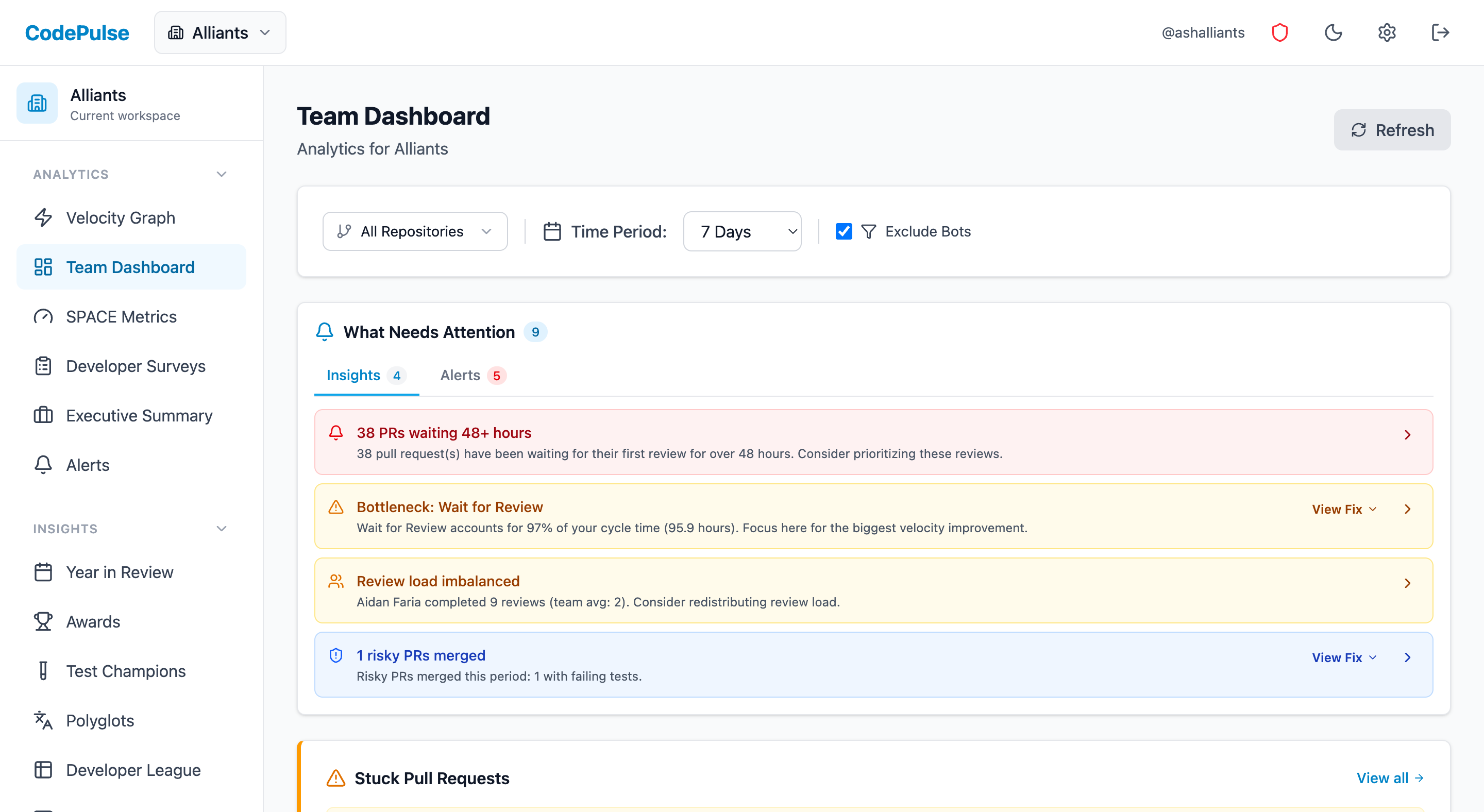
See the report CodePulse produces from read-only GitHub workflow data, or connect your own repositories and evaluate the fit with real evidence.
Read-only GitHub · Your code stays yours · Team-level by default · No credit card
You're searching for a "Waydev alternative," which means something isn't clicking. Maybe the "Impact Score" metric makes no sense after months of use. Maybe you're paying enterprise prices for a dashboard your team doesn't trust. Or maybe the 2020 security breach still gives you pause. This guide won't pretend CodePulse is universally better. Instead, we'll help you figure out which tool makes the right trade-offs for your situation.
"130 metrics sounds impressive until you realize you're only looking at 5 of them. More data isn't better data -- actionable data is better data."
If you've tried Waydev and found yourself struggling to extract meaningful value, you're not alone. A VP of Engineering on Capterra described using the platform for over six months and still being unable to understand developer productivity from its metrics. That's not a user error -- it's a product design choice that prioritizes breadth over clarity.
Both Waydev and CodePulse measure engineering delivery performance. But they make fundamentally different bets. Waydev bets you want an enterprise platform with 130+ metrics, deep integrations across every tool in your stack, and features like cost capitalization for finance teams. CodePulse bets that for most teams, 80% of actionable insights come from GitHub data alone, and the complexity of enterprise platforms creates more overhead than value.
One of those bets is right for you. Let's figure out which.
The Honest Comparison
Here's what each tool actually does well, based on documented features and real pricing as of 2026:
| Aspect | Waydev | CodePulse |
|---|---|---|
| Primary bet | Enterprise breadth (130+ metrics) | GitHub depth with simplicity |
| Data sources | GitHub, GitLab, Bitbucket, Azure DevOps, Gerrit | GitHub only |
| Issue trackers | Jira, GitHub Issues, ClickUp, Azure Boards | GitHub Issues only (native) |
| Setup time | Days to weeks (multiple integrations) | Minutes (one OAuth flow) |
| Cost capitalization | Yes (R&D tracking for finance) | No |
| Sprint tracking | Yes (with forecasting) | No (focused on PR flow) |
| "Ghost engineer" detection | Yes | No (we think this is counterproductive) |
| Review collaboration | Standard metrics | Interactive review network graph |
| Developer recognition | Limited | 15 award categories |
| Security track record | 2020 breach (7.5M user records via OAuth token theft) | No known incidents |
| Core metric clarity | "Impact Score" (users report confusion) | Standard DORA-aligned metrics |
| Data freshness | Standard sync | 15-minute incremental sync |
/// Our Take
"Ghost engineer detection" is a red flag, not a feature.
Waydev markets a feature to find developers with "no commits, PRs, or tickets." We think this creates a culture of surveillance, not improvement. Low output is a symptom - the manager should already know why. If you need software to find "ghost engineers," the problem isn't the engineers.
What Waydev Users Are Actually Saying
We reviewed dozens of verified reviews across Capterra, G2, and TrustRadius to understand the real Waydev experience. Here are the patterns that stood out.
The "Impact Score" Problem
Waydev's proprietary "Impact Score" is central to its value proposition, but users consistently struggle to understand or communicate it. An Engineering Manager on Capterra noted that the concept of "Impact" is "very hard to explain and communicate" to stakeholders. A CTO on the same platform described "getting used to the concept of the 'impact' metric" as one of the tool's main challenges.
"It has been hard to utilize the metrics provided by WayDev in a meaningful way... even after using it for more than 6 months, I haven't been able to use it to understand the productivity and effectiveness of the developers." -- A VP of Engineering on Capterra
Pricing Pushback
Multiple reviewers flag cost as a concern. A CTO described it as "expensive for small teams." Another VP of Engineering rated the platform 3 out of 5 stars, calling it "a bit pricey considering the limited features." A Managing Partner noted the cost exceeds what they pay for Bitbucket and Jira combined.
Technical Reliability
Users report sync issues and slow load times. A CTO on Capterra described receiving "several 500 errors" during setup. A VP of Engineering flagged "commits not reflecting" and said the "loading speed is often challenging." These are not edge cases -- they show up in reviews from verified technical leaders.
The 2020 Security Breach
In 2020, the ShinyHunters hacking group exploited a blind SQL injection vulnerability in Waydev's platform to steal GitHub and GitLab OAuth tokens from an internal database. The stolen tokens were used to breach banking app Dave, exposing 7.5 million users' personal data (names, emails, birth dates, addresses, phone numbers, and hashed passwords). The FBI and CrowdStrike investigated. While Waydev has undoubtedly improved its security posture since then, this incident is worth factoring into your vendor risk assessment, especially given that OAuth tokens represent the most sensitive data an analytics platform handles.
Pricing: What You'll Actually Pay
Waydev publishes their pricing. Here's the comparison as of 2026. Our dedicated Waydev pricing review digs into the contract-level fine print and what typical procurement negotiations actually land at.
| Plan | Waydev | CodePulse |
|---|---|---|
| Entry | $29/contributor/month (Pro) | Free for small teams |
| Mid-tier | $54/contributor/month (Premium) | See pricing |
| Enterprise | Custom pricing | Custom |
| Typical deal size | $4,000-$81,000/year (avg ~$34,000) | Transparent, self-serve |
| Billing | Annual per active contributor | Monthly or annual |
Sources: Waydev Pricing, Vendr, G2
At $29-54/contributor/month, Waydev positions itself as an enterprise tool. For a 100-person engineering team, you're looking at $35,000-65,000/year. The question isn't whether Waydev has more features - it does. The question is whether you'll use those features enough to justify the cost.
When to Choose Waydev Instead
"If you need cost capitalization for R&D tax credits, Waydev wins. No contest. CodePulse doesn't do this, and bolting it on would compromise our simplicity."
Waydev is the better choice if any of these are true for your team:
You need cost capitalization (R&D tracking)
Waydev's cost capitalization feature tracks developer time for ASC 350-40 and IRC 174 compliance- crucial for companies claiming R&D tax credits. CodePulse doesn't have this. If your finance team needs engineering time categorization for capitalization, Waydev is purpose-built for this use case.
You use multiple Git providers
Waydev connects to GitHub, GitLab, Bitbucket, Azure DevOps, and even Gerrit. If your organization has teams spread across different platforms (common after acquisitions), Waydev aggregates everything. CodePulse is GitHub-only. We're not planning to change this - we'd rather go deep on one platform than shallow on many.
Deep Jira integration is essential
If your leadership asks "what percentage of work is features vs. bugs?" or "how long did JIRA-1234 take end-to-end?", you need issue tracker correlation. Waydev integrates with Jira, ClickUp, and Azure Boards. CodePulse only uses native GitHub Issues - no external issue tracker integration.
You need sprint tracking with forecasting
Waydev offers sprint progress tracking, risk visualization, and capacity forecasting. If your organization runs sprints and needs burndown analytics tied to Git data, Waydev has dedicated features for this. CodePulse focuses on PR flow metrics, not sprint planning.
You're a Fortune 500 with complex procurement
Waydev is Y Combinator-backed and used by American Express, Dropbox, and Citibank. They're built for enterprise procurement processes, security reviews, and large-scale deployments. If you need that enterprise pedigree for vendor approval, Waydev has it.
Decision Tree: Waydev vs CodePulse

START HERE
    │
    ▼
Do you need cost capitalization (R&D tax credits)?
    ├── YES → Waydev (CodePulse doesn't have this)
    │
    ▼ NO
Do you use multiple Git providers (GitLab, Bitbucket, Azure)?
    ├── YES → Waydev (CodePulse is GitHub-only)
    │
    ▼ NO
Do you need deep Jira/ClickUp integration?
    ├── YES → Waydev (CodePulse uses GitHub Issues only)
    │
    ▼ NO
Do you need sprint tracking with forecasting?
    ├── YES → Waydev (CodePulse focuses on PR flow)
    │
    ▼ NO
Is GitHub your primary source of truth?
    ├── NO → Waydev or evaluate other enterprise tools
    │
    ▼ YES
Do you value fast setup over 130+ metrics?
    ├── YES → CodePulse (minutes, not weeks)
    │
    ▼ NO → Evaluate both based on specific needs
When CodePulse is the Better Fit
CodePulse is the better choice if these describe your situation:
GitHub is your primary source of truth
If your team lives in GitHub - PRs are your workflow, GitHub Issues or Projects track your work, and you're not deeply integrated with Jira - CodePulse gives you everything you need without the overhead of configuring integrations you won't use.
You want insights in minutes, not weeks
Connect GitHub with one OAuth flow. Get cycle time breakdowns, review network visualizations, and file hotspots immediately. No multi-tool integration project, no "schedule an implementation call."
130+ metrics feels like overload
More metrics isn't better metrics. If Waydev's dashboard feels overwhelming, or you find yourself only looking at the same 5-10 metrics, CodePulse's focused approach might be a better fit. We surface what matters for cycle time improvement, not every possible measurement.
Review collaboration insights matter to you
CodePulse's Review Network is a genuinely differentiated feature. The interactive graph shows who reviews whose code, reveals load imbalances, and identifies isolated team members. Waydev has review metrics, but not this level of collaboration visualization.
You want to recognize diverse contributions
CodePulse's 15 award categories recognize speed, quality, collaboration, and consistency. This surfaces valuable contributions that commit counts miss: the person who reviews the most, maintains quality, or stays consistent. Waydev focuses more on monitoring than recognition.
You find "ghost engineer detection" problematic
If a feature designed to identify "low performers" makes you uncomfortable, you're not alone. Competitors have noted that Waydev "takes a top-down approach" where leaders can only "tell the team 'do better'" after identifying issues, and that the platform "pushes you to focus on individuals rather than systems." CodePulse is built on the philosophy that metrics should improve systems, not surveil individuals.
You need metrics your team can actually trust
If Waydev's "Impact Score" left your team confused, CodePulse uses transparent, well-documented metrics that align with DORA and standard delivery measurement. No proprietary scoring that's "very hard to explain and communicate" to stakeholders. Every metric in CodePulse maps to a decision you can make.
// How to See This in CodePulse
Navigate to Dashboard to see cycle time broken into 4 stages:
- Coding time (first commit to PR open)
- Pickup time (PR open to first review)
- Review time (first review to approval)
- Merge time (approval to merge)
Then explore Review Network and File Hotspots for collaboration and risk insights.
Decision Matrix
Use this matrix to make your decision. Be honest about which scenarios apply to you:
| Your Situation | Recommendation | Why |
|---|---|---|
| Need R&D cost capitalization | Waydev | Purpose-built for ASC 350-40 / IRC 174 compliance |
| Multiple Git providers (GitHub + GitLab) | Waydev | CodePulse is GitHub-only |
| Heavy Jira/ClickUp dependency | Waydev | Deep issue tracker integration |
| Need sprint tracking + forecasting | Waydev | Dedicated sprint analytics |
| Fortune 500 procurement requirements | Waydev | Enterprise pedigree, SOC 2, etc. |
| GitHub-only team, <100 engineers | CodePulse | No integration complexity needed |
| Want fast setup without sales process | CodePulse | Minutes to value, self-serve |
| Review collaboration visualization | CodePulse | Interactive review network is differentiated |
| Developer recognition over surveillance | CodePulse | 15 award categories, no "ghost" detection |
| Metrics overload is a concern | CodePulse | Focused metrics vs. 130+ options |
Understanding the Real Trade-Offs
"The best engineering analytics tool is the one you'll actually use. An unused enterprise platform is worth less than a simple tool that informs decisions."
What you give up with CodePulse
- Cost capitalization: No R&D tracking for tax compliance
- Multiple Git providers: GitHub only - no GitLab, Bitbucket, Azure DevOps
- Deep issue tracking: No Jira/ClickUp integration
- Sprint analytics: No burndown or capacity forecasting
- 130+ metrics: We have ~50 focused metrics, not exhaustive coverage
What you give up with Waydev
- Simplicity: More integrations = more configuration = more maintenance
- Setup speed: Multi-tool integration takes time
- Focused insights: 130 metrics can create analysis paralysis
- Review collaboration depth: Standard metrics vs. interactive network
- Recognition features: Monitoring focus vs. 15 award categories
- Philosophy: "Ghost engineer" detection suggests surveillance mindset
If You're Switching from Waydev
Already using Waydev and considering CodePulse? Here's the honest migration path:
What transfers easily
- GitHub data: CodePulse syncs directly; no export/import needed
- Historical metrics: CodePulse processes last 6 months of PR data automatically
- Team structure: Based on GitHub org, not separate configuration
What you'll lose
- Cost capitalization data: You'll need to maintain this separately or use another tool
- Jira correlation: Issue-to-code tracking goes away
- Sprint analytics: Burndown and forecasting won't transfer
- Multi-provider aggregation: Only GitHub data will be visible
Migration timeline
- Connect GitHub (5 minutes): One OAuth flow to authorize CodePulse
- Initial sync (30-60 minutes): Historical PR data processing
- Explore dashboards (same day): Dashboard, Review Network, File Hotspots
- Set up alerts (optional): Configure notifications for stuck PRs
- Run in parallel (recommended): Keep Waydev for 2-4 weeks while you validate
Compare Other Tools
If Waydev vs. CodePulse isn't quite the right comparison for you, these related guides might help:
- LinearB vs. CodePulse - gitStream automation and multi-provider support
- Jellyfish vs. CodePulse - Enterprise-scale analytics with business alignment
- Swarmia vs. CodePulse - SPACE framework focus and working agreements
- Full Tools Comparison - Overview of all engineering analytics tools
Making Your Decision
Don't let marketing (including ours) make this decision for you. Here's how to decide:
- List your actual requirements: What questions do you need answered? Do you need cost capitalization? Multiple Git providers? Be specific.
- Try free trials: Waydev offers a free trial. CodePulse offers a free tier for small teams. Use both with real data.
- Evaluate after 2 weeks: Which dashboard do you actually open? Which insights changed behavior? Are you using 130 metrics or 10?
- Consider your philosophy: Do features like "ghost engineer detection" align with how you want to lead? Tools shape culture.
"The right tool is the one that makes the right trade-offs for YOUR situation. If Waydev's enterprise features justify the cost for you, use Waydev. If CodePulse's simplicity is what you need, we're here."
The best tool is the one you'll actually use consistently. If that's Waydev because you need cost capitalization and multi-provider support, use Waydev. If that's CodePulse because you want GitHub depth without complexity, we're here. Start your free trial and see if CodePulse is the right trade-off for your team.
Evaluate CodePulse against your own delivery history
A comparison table only goes so far. Connect read-only GitHub in about five minutes and judge the output on your repositories, at one flat price, with no per-seat math.
Read-only GitHub · Your code stays yours · Team-level by default · No credit card
See These Features in Action
Compare contribution patterns for coaching, not surveillance.
Break down cycle time into coding, waiting, review, and merge phases.
Related Guides
5 LinearB Alternatives for 2026 (With Pricing)
An honest comparison of CodePulse vs LinearB. We tell you when to choose LinearB instead, because the best tool is the one that makes the right trade-offs for your situation.
7 Jellyfish Alternatives for 2026 (Honest Ranking)
Compare 7 Jellyfish alternatives including CodePulse, LinearB, Swarmia, and more. Honest pros, cons, pricing, and integration comparisons.
Pluralsight Flow Alternative: Why Teams Are Switching
Pluralsight Flow is built for enterprise reporting - but if you need team-focused insights without leaderboards or enterprise pricing, there are better options. This guide compares the trade-offs.
Swarmia Alternatives: Cheaper, Deeper Analytics 2026
A Swarmia alternative worth considering: where Swarmia falls short on customization and per-seat pricing, and which cheaper, GitHub-native tools fit better.
Waydev Pricing in 2026: What Teams Actually Pay
Waydev Growth starts at $20/dev/month with multi-Git-provider support. We review both tiers, assess the surveillance trade-off, and compare costs with GitHub-focused alternatives.