
Compare the finished analysis before you choose a platform
See the report CodePulse produces from read-only GitHub workflow data, or connect your own repositories and evaluate the fit with real evidence.
Read-only GitHub · Your code stays yours · Team-level by default · No credit card
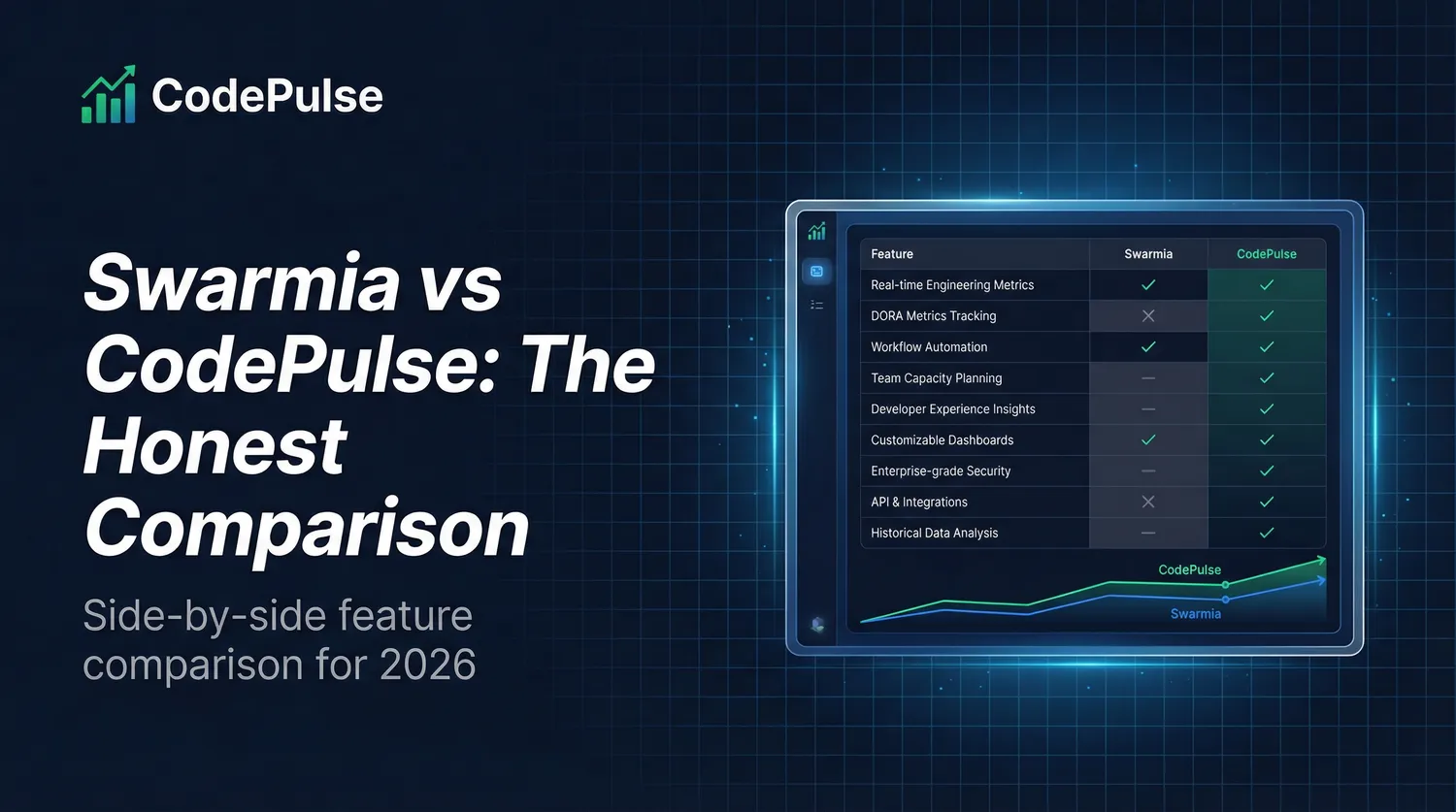
Looking for a Swarmia alternative? Swarmia is a thoughtful, team-first tool, but it has real gaps that send people looking: limited dashboard customization, per-seat pricing that climbs with every GitHub seat, and features some users describe as half-finished. This guide is honest about where Swarmia is strong and where cheaper, GitHub-native alternatives fit better.
How does Swarmia compare to CodePulse?
Swarmia and CodePulse share the same anti-surveillance philosophy: both focus on team health rather than individual productivity tracking. The key differences are integration breadth (Swarmia supports GitHub, GitLab, Bitbucket, Jira, Linear; CodePulse is GitHub-only), developer experience surveys (Swarmia includes built-in pulse surveys; CodePulse does not), and pricing (Swarmia is free for up to 9 devs; CodePulse has a free tier plus flat per-organization pricing that does not scale per developer). If developer sentiment data matters to your team, Swarmia has the edge. If you want deeper GitHub analytics with faster data refresh, CodePulse fits better.
This isn't a hit piece on Swarmia. They've built a thoughtful product focused on developer experience. But if you're reading this, something prompted you to look around. Maybe it's the limited dashboard customization, pricing tied to GitHub seats you don't all use, or features that feel half-finished. This guide explains where our approaches diverge so you can make the right choice for your team.
"The best engineering analytics tool is the one your team actually uses. Neither Swarmia nor CodePulse will help if it sits unopened in a browser tab."
What Swarmia Does Well
Credit where it's due: Swarmia has some genuinely strong features that CodePulse doesn't match:
SPACE Framework Implementation
Swarmia is built around the SPACE framework from Microsoft Research. They've operationalized it with:
- Developer experience surveys: 32-question surveys covering team focus, collaboration, technical debt perception, and overall satisfaction
- Working agreements: Teams set explicit goals ("respond to reviews within 4 hours") and get Slack reminders when they're at risk of missing them
- Investment Balance: Categorize time spent on features vs bugs vs tech debt (requires Jira/Linear integration)
This framework integration is genuinely valuable if developer experience measurement is your primary goal.
European Market Focus
Swarmia is headquartered in Helsinki with pricing in Euros. For European teams, this means:
- Support during European business hours
- GDPR compliance as a first-class concern
- No currency conversion fees
- Data processing within EU where applicable
CI Failure Context
One small but useful feature: Swarmia's Slack notifications include the last 50 lines of CI failure logs. You can often diagnose a broken build without leaving Slack.
🔥 Our Take
There is no "best" engineering analytics tool. There's the tool that makes the right trade-offs for your situation.
CodePulse is great for GitHub-focused teams who want depth without integration complexity. Swarmia is great for teams prioritizing developer experience surveys and SPACE framework alignment. Be honest about what you need - we'd rather lose a sale than gain an unhappy customer.
What Swarmia Users Are Saying
Swarmia generally receives positive reviews, but specific pain points emerge in the "What do you dislike?" sections on G2, Gartner Peer Insights, and industry analyses. Here are the patterns:
Limited customization is the top complaint
"Customization is super limited. Swarmia provides certain data points, and that's all. I don't know how to combine them to create dashboards focused on the items I want to see."
-- G2 reviewer (this theme appears in 11+ reviews)
Users cannot create custom dashboards or track unique KPIs effectively. The pre-defined metrics and reports lack flexibility, and sprint views are limited in how they can be customized to fit team-specific workflows.
Some features feel half-baked
"Several features still feel half-baked. For example, the culture survey lacks depth, the PR review notification has quirks (such as alias selection not working), and capitalization features not offering much real-world solutions."
-- Gartner Peer Insights reviewer (April 2025)
The same reviewer described Swarmia as "conceptually a great product" but one that "still needs polish to deliver on its promise across the board."
Metrics accuracy concerns
G2 reviewers (18 mentions) note metrics issues, particularly around in-progress time analysis, which users report as "inaccurate, leading to confusion in tracking workflow." Scope creep detection sometimes misclassifies minor changes (like adding a small bug fix during review). Users also report missing MTTR and a lack of industry benchmarks to understand where their DORA metrics fall.
Manager-focused, not IC-friendly
"It feels primarily geared toward project and engineering managers rather than individual contributors. ICs struggle to extract actionable insights about how to improve their day-to-day behaviors."
-- Gartner Peer Insights reviewer
Shows what happened, not what to do about it
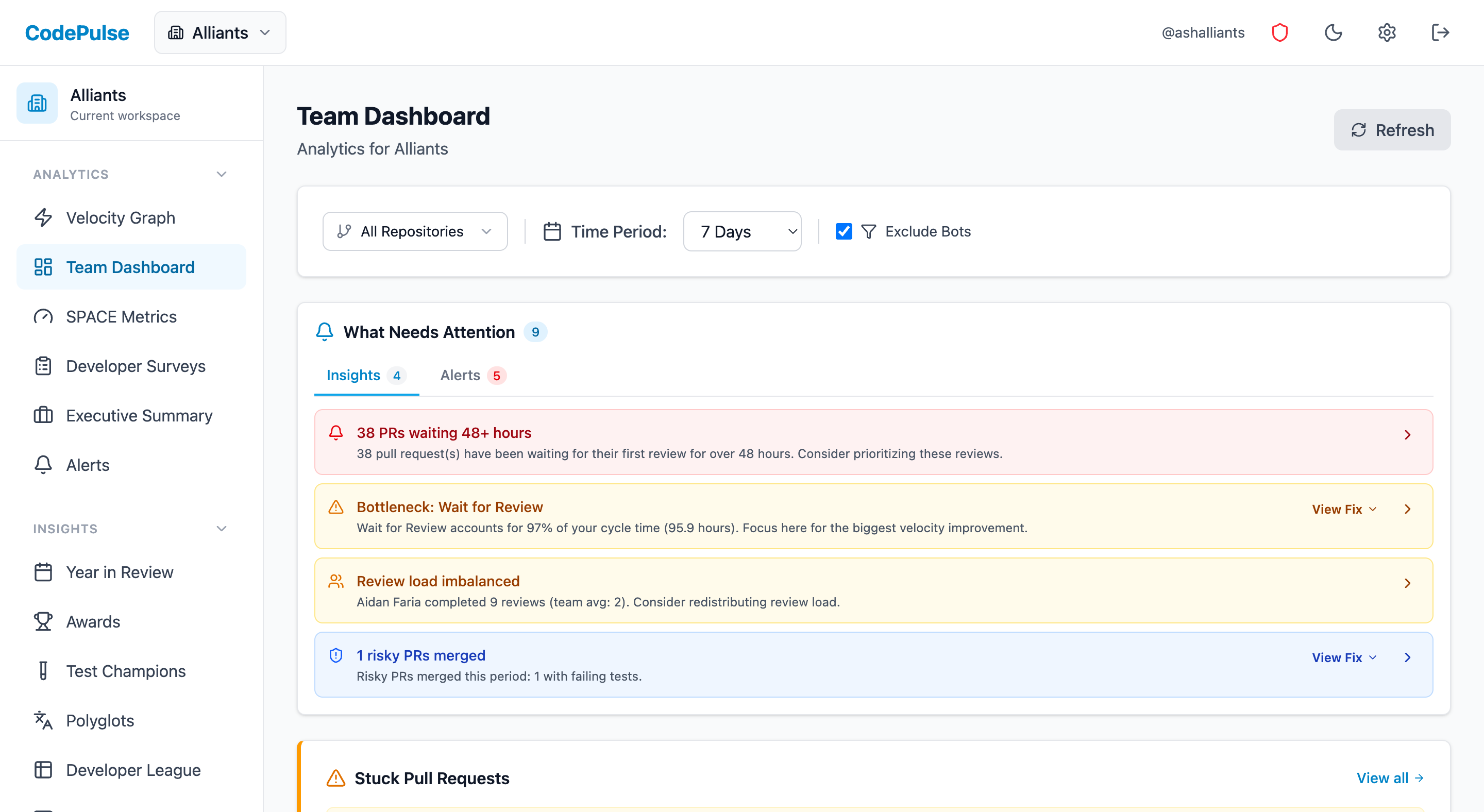
Multiple analyses note that Swarmia's dashboards show "what happened" but lack explanation of root causes or recommended interventions. Teams see charts and numbers but receive little guidance on which actions will actually improve outcomes. CodePulse addresses this with features like File Hotspots and Knowledge Silos that identify the why behind the numbers.
Pricing tied to GitHub seats
Swarmia's pricing is tied to GitHub seats, even though not all users in the GitHub org need analytics. As your headcount grows, costs scale linearly. One reviewer described it plainly: "Great product, ridiculous pricing."
Where the Approaches Differ
Despite the similarities, Swarmia and CodePulse have different philosophies on a few key points:
Integration Philosophy
| Aspect | Swarmia | CodePulse |
|---|---|---|
| Primary data sources | GitHub + Jira/Linear + Slack | GitHub only |
| Setup complexity | Multiple integrations | Single OAuth connection |
| Feature unlock | Some features require project management integration | All features from GitHub data alone |
| Data correlation | Code to issues to investments | Code to code |
| Dashboard customization | Limited (pre-defined views only) | Purpose-built views with CSV export |
| Root cause analysis | Shows what happened, not why | File Hotspots, Knowledge Silos identify root causes |
| Data refresh | Daily sync | 15-minute sync intervals |
Swarmia's multi-integration approach unlocks Investment Balance and work categorization. CodePulse's GitHub-only approach means faster setup but no issue tracker correlation.
Developer Experience vs. Developer Recognition
Swarmia focuses on measuring developer experience through surveys and working agreements. It asks: "How do developers feel about their work?"
CodePulse focuses on recognizing diverse contributions through its Awards system. It asks: "How can we celebrate what developers actually do?"
These aren't mutually exclusive - you could use both. But they reflect different priorities.
Executive Reporting
CodePulse provides an Executive Summary with a health grade (A-F) across delivery speed, code quality, and team collaboration. This is designed for board-level reporting where detailed metrics would overwhelm.
Swarmia's executive view focuses more on investment allocation - where engineering time goes across features, bugs, and maintenance.
"Survey data tells you how developers feel. Git data tells you what they actually do. Neither is complete without context about the other."
When to Choose Swarmia Instead
Be honest with yourself about these criteria. If multiple apply, Swarmia may be the better fit:
- Developer experience is your primary concern: If you're specifically trying to improve how developers feel about their work environment, Swarmia's survey integration and SPACE framework alignment give you the data to track that
- You want the SPACE framework: Swarmia has built their product around SPACE. If your organization has already adopted this framework, Swarmia speaks your language
- You're a European team: Support timezone, GDPR-first design, Euro pricing. These matter for operational efficiency
- Working agreements fit your culture: If your teams respond well to explicit, shared commitments with automated reminders, Swarmia's working agreements feature is genuinely useful
- Investment tracking is critical: If leadership demands visibility into feature vs bug fix vs tech debt allocation, Swarmia's Jira/Linear integration provides this automatically
Where CodePulse Fits Better
CodePulse is the better choice when:
- You use GitHub exclusively: CodePulse extracts maximum value from GitHub data without the noise of correlating disconnected tools
- You want fast time-to-value: Connect GitHub, wait 30 minutes, start getting insights. No multi-day integration projects
- Knowledge silos keep you up at night: CodePulse's File Hotspots analysis shows exactly which files have single-contributor ownership - before someone quits
- You want to recognize diverse contributions: 15+ award categories celebrate reviewers, mentors, and consistent contributors - not just prolific committers
- Executives need simple health metrics: The A-F health grade translates engineering performance into board-room language
📊 How to See This in CodePulse
Navigate to Dashboard to see your cycle time breakdown:
- Coding time, wait for review, review time, and merge time
- Filter by repository to isolate bottlenecks
- Compare time periods to track improvement
Pricing Comparison
Real pricing data (per swarmia.com, July 2026, sourced from Swarmia.com). For the longer-form breakdown of Swarmia's tiers, add-ons, and typical procurement outcomes, see our Swarmia pricing review:
| Plan | Swarmia | CodePulse |
|---|---|---|
| Free tier | Fewer than 10 developers | Yes (small teams) |
| A-la-carte modules | EUR 4-22/dev/month annual (EUR 5-28 monthly), four modules | - |
| Standard (all four modules) | EUR 42/dev/month annual (~$46 USD), EUR 49 monthly | See pricing page |
| Enterprise | EUR 52/dev/month (annual only) | Custom |
| Currency | EUR (European focus) | USD |
Swarmia's free plan, open to companies with fewer than 10 developers, makes it worth trying for early-stage teams. Visit our Pricing page for current CodePulse plans.
Decision Matrix
Use this table to score which tool fits your needs:
| If you need... | Better fit |
|---|---|
| Developer experience surveys | Swarmia |
| SPACE framework alignment | Swarmia |
| Working agreements with reminders | Swarmia |
| Investment tracking (feature/bug/debt) | Swarmia |
| European support/GDPR | Swarmia |
| GitHub-only simplicity | CodePulse |
| Fast setup (minutes, not days) | CodePulse |
| File-level knowledge silo detection | CodePulse |
| Developer recognition/awards | CodePulse |
| Executive health grade (A-F) | CodePulse |
| Interactive review network | CodePulse |
If You're Switching
Both tools sync from Git, so there's no data migration needed. If you're moving from Swarmia to CodePulse:
- Connect GitHub (5 minutes): Authorize CodePulse to access your organization
- Wait for sync (30-60 minutes): Historical PR and commit data processes automatically
- Configure alerts: Set up Alert Rules as a replacement for working agreements (different approach, similar outcome)
- Explore unique features: Review Network, File Hotspots, and Awards provide insights Swarmia doesn't offer
What you'll lose: Developer experience surveys, working agreements with Slack reminders, investment categorization (if you used Jira/Linear), and CI failure logs in Slack.
Honest Verdict
"If Swarmia had built CodePulse's file hotspot analysis, or CodePulse had built Swarmia's developer surveys, one of us would be out of business. The fact that both exist means teams have genuinely different priorities."
Swarmia and CodePulse are both good tools with overlapping capabilities and different strengths. Here's the honest breakdown:
- Choose Swarmia if developer experience measurement, SPACE framework alignment, or European market focus are priorities. Their working agreements feature is genuinely innovative.
- Choose CodePulse if you want maximum value from GitHub data alone, faster setup, executive-ready health grades, or built-in team recognition.
- Try both - Swarmia's free plan covers companies with fewer than 10 developers, and CodePulse offers a free tier too. Connect a subset of repositories to each and see which dashboard your team actually opens.
The best tool is the one your team uses. If Swarmia fits better, use Swarmia. We'd rather you find the right tool than buy the wrong one from us.
For more context on choosing engineering analytics tools, see our Engineering Analytics Tools Comparison guide.
Frequently Asked Questions
Both tools prioritize team health over individual surveillance. Swarmia includes developer experience surveys and a free plan for companies with fewer than 10 developers. CodePulse offers deeper GitHub-native analytics, real-time syncing (15-minute intervals vs daily), and flat per-organization pricing that gets cheaper per head as larger teams grow, instead of per-developer pricing. Swarmia users on G2 report limited dashboard customization and metrics accuracy concerns, particularly around in-progress time analysis. CodePulse focuses on GitHub depth with features like File Hotspots and Knowledge Silos that identify root causes, not just symptoms.
Evaluate CodePulse against your own delivery history
A comparison table only goes so far. Connect read-only GitHub in about five minutes and judge the output on your repositories, at one flat price, with no per-seat math.
Read-only GitHub · Your code stays yours · Team-level by default · No credit card
See These Features in Action
Break down cycle time into coding, waiting, review, and merge phases.
Compare contribution patterns for coaching, not surveillance.
Track all four DORA metrics and benchmark against industry standards.
Related Guides
5 LinearB Alternatives for 2026 (With Pricing)
An honest comparison of CodePulse vs LinearB. We tell you when to choose LinearB instead, because the best tool is the one that makes the right trade-offs for your situation.
7 Jellyfish Alternatives for 2026 (Honest Ranking)
Compare 7 Jellyfish alternatives including CodePulse, LinearB, Swarmia, and more. Honest pros, cons, pricing, and integration comparisons.
Waydev Has 130+ Metrics. That's Too Many (2026)
An honest comparison of CodePulse vs Waydev. We tell you when to choose Waydev instead - because the best tool is the one that makes the right trade-offs for your situation.
Pluralsight Flow Alternative: Why Teams Are Switching
Pluralsight Flow is built for enterprise reporting - but if you need team-focused insights without leaderboards or enterprise pricing, there are better options. This guide compares the trade-offs.
Swarmia Pricing in 2026: Is EUR 42/Dev/Month Worth It?
Swarmia now sells four a-la-carte modules, with the Standard bundle at EUR 42/dev/month annual and a free tier for up to 9 developers. We break down each module, calculate real costs, and compare with CodePulse flat pricing.
Best Propelo Alternative for 2026 (Formerly LevelOps)
Compare 7 Propelo (LevelOps) alternatives including CodePulse, LinearB, Sleuth, and more. Honest pros, cons, pricing, and DORA metrics comparisons.
Engineering Analytics Tools: What User Reviews Really Say
An aggregation of what reviewers on G2, Capterra, TrustRadius and Gartner Peer Insights say about Jellyfish, Swarmia, LinearB and Allstacks - the recurring complaint patterns vendors do not quote.