
Compare the finished analysis before you choose a platform
See the report CodePulse produces from read-only GitHub workflow data, or connect your own repositories and evaluate the fit with real evidence.
Read-only GitHub · Your code stays yours · Team-level by default · No credit card
Looking for Plandek alternatives? Plandek is a value stream management platform built for teams using Jira and Azure DevOps. CodePulse is a GitHub-native analytics platform built for PR insights and delivery metrics. This guide compares both honestly, covers five other alternatives, and tells you exactly when Plandek is the better choice.
Plandek has built a solid reputation in the value stream analytics space, particularly among European enterprises using Jira-heavy workflows and Azure DevOps pipelines. If you are evaluating alternatives, the right choice depends heavily on your Git provider and project management tool. Also comparing tools? See our Jellyfish alternative and LinearB alternative guides.
"The best engineering analytics tool is the one that integrates deeply with your actual stack, not the one with the longest feature list."
What Is Plandek?
Plandek is a value stream management and engineering analytics platform headquartered in London. It connects to Jira, Azure DevOps, GitHub, GitLab, Bitbucket, and CI/CD pipelines to provide end-to-end visibility into the software delivery lifecycle, from issue creation through deployment.
The platform is known for three things: strong Jira integration that maps delivery metrics back to Jira issues and sprints, DORA metrics with benchmarking, and flow analytics that show where work gets stuck across the value stream. Plandek has been recognized by Gartner in the value stream management space.
Pricing: Plandek does not publish specific pricing publicly. Based on available information, expect tiered enterprise pricing with different levels for teams, departments, and organizations. Free trials are available.
Plandek vs CodePulse: Detailed Comparison
Plandek and CodePulse overlap in delivery metrics but diverge sharply in integration depth and focus area:
| Aspect | Plandek | CodePulse |
|---|---|---|
| Primary focus | Value stream management across the SDLC | Deep GitHub analytics for delivery teams |
| Git provider depth | GitHub, GitLab, Bitbucket, Azure DevOps | GitHub (deep native integration) |
| Project management | Jira (deep), Azure Boards | Jira, Linear |
| DORA metrics | Yes, with benchmarking | Velocity-aligned (cycle time focus) |
| Review analytics | Basic review time tracking | Deep (review network, load balancing, patterns) |
| Knowledge silo detection | No | Yes (file-level hotspots) |
| Flow analytics | Yes (Jira-to-deploy pipeline) | PR lifecycle focus |
| Setup time | Days to weeks | Minutes |
| Team size | 50-500+ engineers | 10-200 engineers |
| Pricing | Enterprise (contact sales) | Free tier, Pro from $199/mo |
What Plandek Does Well
Plandek excels in areas where Jira and Azure DevOps workflows are central:
Jira-to-Deploy Flow Visibility
Plandek's strongest feature is mapping the full journey from Jira ticket creation to production deployment. It shows where work gets stuck: is it waiting in the backlog, blocked in code review, stuck in QA, or queued for deployment? For teams whose workflow is Jira-centric, this end-to-end view is genuinely valuable.
Azure DevOps Integration
If your organization uses Azure DevOps for source control and CI/CD, Plandek is one of the few analytics platforms with deep Azure DevOps support. Most competitors (including CodePulse) focus on GitHub and GitLab. For Azure shops, Plandek is often the obvious choice.
DORA Metrics with Benchmarking
Plandek provides all four DORA metrics (deployment frequency, lead time for changes, change failure rate, mean time to recovery) with industry benchmarking. According to the 2024 DORA Report, teams that track and improve their DORA metrics see measurable improvements in both speed and stability.
Sprint Analytics
Plandek connects sprint data from Jira to delivery data from Git, showing sprint completion rates, velocity trends, and spillover patterns. If your team runs Scrum and lives in Jira, these insights connect planning to execution in a way pure Git analytics cannot.
Where Plandek Struggles
Based on market positioning and user feedback, these are Plandek's known limitations:
Limited PR-Level Depth
Plandek tracks PR metrics at a summary level (time to merge, review time). It does not provide the granular review pattern analysis that surfaces which reviewers are overloaded, how collaboration patterns form across teams, or whether review load is balanced. If "why are reviews slow?" is your primary question, Plandek gives you the "what" but not the "who" or "how."
No Knowledge Silo Detection
Plandek does not analyze file-level ownership patterns. It will not flag that one engineer is the sole contributor to a critical authentication module or that a key infrastructure file has a bus factor of 1. CodePulse's File Hotspot analysis catches exactly this risk.
GitHub Depth Gap
Plandek supports GitHub, but its integration depth with GitHub is not as deep as purpose-built GitHub analytics tools. Plandek's strength is breadth (connecting Jira, Git, CI/CD into one pipeline view). CodePulse's strength is depth (extracting every signal GitHub provides about PR lifecycle, review patterns, and code ownership).
Enterprise-Focused Setup
Getting full value from Plandek requires connecting Jira, configuring workflow mappings, and defining your value stream stages. This is appropriate for enterprise teams but adds days or weeks of setup time. Teams wanting immediate insights face a ramp-up period.
* Our Take
Value stream management sounds comprehensive, and it is, but comprehensiveness has a cost. The more data sources a platform stitches together, the more configuration it requires and the more assumptions it makes about your workflow. A purpose-built tool for your primary data source (GitHub, in our case) will always extract deeper signal from that source than a tool that spreads across five providers.
If your value stream crosses four tools (Jira, Azure DevOps, Jenkins, PagerDuty), you need a stitching layer like Plandek. If your delivery bottleneck lives in the PR lifecycle on GitHub, a deep GitHub tool will find it faster.
Where CodePulse Fits Better
CodePulse is purpose-built for teams whose primary delivery workflow runs through GitHub. Teams that specifically evaluated Propelo before its acquisition and are now looking for a direct successor should also consider our Propelo alternative guide - the positioning overlaps with Plandek on several dimensions:
Deep Cycle Time Breakdown
Where Plandek shows aggregate lead time from issue to deploy, CodePulse breaks the PR lifecycle into four actionable stages you can improve individually:
- Coding time: First commit to PR creation
- Wait for review: PR open to first review (the most common bottleneck)
- Review time: First review to approval
- Merge time: Approval to merge
This is not "your lead time is 4 days." It is "your team waits 22 hours for first review, actual review takes 3 hours, and the merge queue adds another 6 hours." That level of specificity tells you exactly what to fix. To catch those waiting PRs without leaving GitHub, our free GitHub PR Chrome extension surfaces PR age and complexity directly in the pull request list.
📊 How to See This in CodePulse
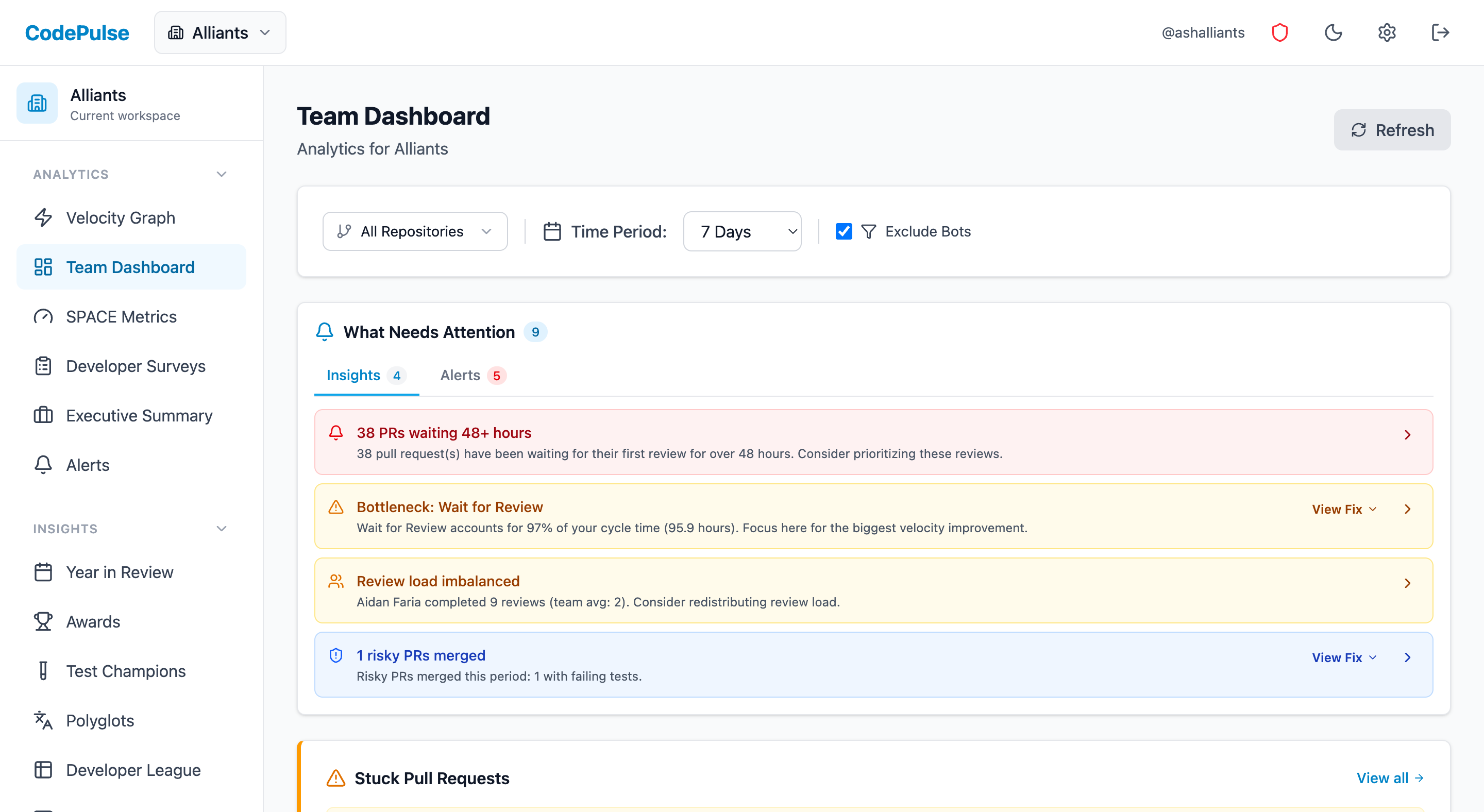
Navigate to the Dashboard to see your four-stage cycle time breakdown:
- Each phase colored distinctly: coding (blue), waiting (amber), review (purple), merge (cyan)
- Filter by repository to isolate team-specific bottlenecks
- Trend over time to see if improvements are sticking
- Drill into individual PRs to understand outliers
Review Network Visualization
The Review Network page shows an interactive graph of who reviews whose code. This surfaces review load imbalance, isolated team members who never get reviews, and cross-team collaboration patterns. Plandek does not provide this level of review analysis.
File Hotspot and Knowledge Silo Detection
The File Hotspots view identifies high-change files with concentrated ownership. When one developer owns a critical file, that is a risk to the organization. CodePulse makes these risks visible and quantifiable.
Minutes to Value
Connect your GitHub organization and get insights in under 30 minutes. No Jira workflow mapping, no value stream configuration, no multi-week implementation.
"If your bottleneck is in the PR lifecycle, you do not need a value stream management platform. You need a tool that understands pull requests deeply enough to tell you exactly where time is wasted."
5 Other Plandek Alternatives
1. CodePulse
Best for: GitHub-first teams wanting deep PR analytics without enterprise overhead. Free tier available.
2. LinearB
Best for: Teams wanting PR workflow automation (gitStream) alongside delivery metrics. Multi-provider support. Read our LinearB comparison.
3. Jellyfish
Best for: Enterprise teams needing OKR alignment, investment categorization, and board-level reporting. Read our Jellyfish comparison.
4. Allstacks
Best for: Teams needing predictive delivery forecasting and initiative-level tracking across multiple tools. Broad integration set including Azure DevOps.
5. Swarmia
Best for: Teams that want developer experience surveys alongside delivery metrics. SPACE and DORA frameworks built in. Read our Swarmia comparison.
Quick Comparison Table
| Tool | Best For | GitHub | Azure DevOps | Jira Depth | Setup | Pricing |
|---|---|---|---|---|---|---|
| Plandek | Jira/Azure value stream | Yes | Yes (deep) | Deep | Days-weeks | Enterprise |
| CodePulse | GitHub PR analytics | Yes (deep) | No | Yes | Minutes | Free tier, from $199/mo |
| LinearB | PR automation + metrics | Yes | No | Deep | Hours | Free tier, ~$420/yr |
| Jellyfish | Business alignment | Yes | No | Deep | Weeks | ~$588/yr per dev |
| Allstacks | Delivery forecasting | Yes | Yes | Yes | 1-2 days | Enterprise |
| Swarmia | DevEx surveys + metrics | Yes | No | Yes | Hours | Free tier, from EUR 20/mo |
Decision Matrix
| Your Situation | Recommendation |
|---|---|
| Jira-heavy workflow, need issue-to-deploy visibility | Plandek |
| Azure DevOps for source control and CI/CD | Plandek (or Allstacks) |
| GitHub-first team, want PR-level insights | CodePulse |
| Need review network and knowledge silo analysis | CodePulse |
| Need DORA metrics with industry benchmarks | Plandek |
| Want fast setup with no Jira configuration | CodePulse (minutes, not weeks) |
| Need sprint analytics tied to Jira | Plandek |
| Budget-conscious team under 50 engineers | CodePulse (free tier available) |
| Need OKR alignment and investment categorization | Jellyfish |
| Want PR automation alongside metrics | LinearB |
When to Choose Plandek
Choose Plandek over CodePulse if these conditions apply:
- Azure DevOps is your primary Git and CI/CD platform
- Jira is central to your workflow and you need issue-to-deploy tracing
- You need all four DORA metrics with benchmarking
- Sprint analytics and velocity tracking are priorities
- You use multiple Git providers (GitHub + GitLab + Bitbucket)
- Value stream mapping across the full SDLC matters
If three or more of these apply, Plandek is likely the better fit for your team. If you are still settling on a project-tracking stack, our comparison of azure devops vs jira can help you decide which one your metrics tool needs to integrate with first.
"Choose based on your stack, not on feature lists. A tool that goes deep on GitHub will always outperform a tool that goes wide across five providers, if GitHub is where your work lives."
Frequently Asked Questions
Plandek is a value stream management platform that provides end-to-end visibility into the software delivery lifecycle. It connects Jira, Azure DevOps, GitHub, GitLab, and CI/CD tools to show where work gets stuck, track DORA metrics, and provide sprint analytics. It is primarily used by engineering leaders at mid-to-large organizations.
Related Comparisons
Exploring other options? Check out these guides:
- Cortex Alternative - For teams evaluating Internal Developer Platform + delivery analytics together
- Engineering Analytics Tools Comparison - Comprehensive comparison of all major platforms
- Best Engineering Analytics Tools - Top picks for engineering analytics
- Value Stream Mapping for Engineering - How to map your delivery value stream
- DORA Metrics Guide - Understanding and implementing DORA metrics
- Jellyfish Alternative - For enterprise engineering management platforms
Evaluate CodePulse against your own delivery history
A comparison table only goes so far. Connect read-only GitHub in about five minutes and judge the output on your repositories, at one flat price, with no per-seat math.
Read-only GitHub · Your code stays yours · Team-level by default · No credit card
See These Features in Action
Break down cycle time into coding, waiting, review, and merge phases.
Track all four DORA metrics and benchmark against industry standards.
Related Guides
7 Jellyfish Alternatives for 2026 (Honest Ranking)
Compare 7 Jellyfish alternatives including CodePulse, LinearB, Swarmia, and more. Honest pros, cons, pricing, and integration comparisons.
5 LinearB Alternatives for 2026 (With Pricing)
An honest comparison of CodePulse vs LinearB. We tell you when to choose LinearB instead, because the best tool is the one that makes the right trade-offs for your situation.
Value Stream Mapping for Software Teams | Guide
Value stream mapping reveals that most lead time is waiting, not working. This guide shows how to map your software delivery flow, calculate flow efficiency, and identify the biggest improvement opportunities.
DORA Metrics Explained: The 4 Keys Without the Hype
A complete breakdown of the four DORA metrics - deployment frequency, lead time, change failure rate, and MTTR - with honest benchmarks and gaming traps to avoid.