
Compare the finished analysis before you choose a platform
See the report CodePulse produces from read-only GitHub workflow data, or connect your own repositories and evaluate the fit with real evidence.
Read-only GitHub · Your code stays yours · Team-level by default · No credit card
Searching for Cortex alternatives? Here is the honest truth: Cortex and CodePulse solve fundamentally different problems. Cortex is an internal developer portal (service catalogs, scorecards, Backstage alternative). CodePulse is engineering analytics (PR insights, cycle time, review patterns). This guide explains what each does, when you need which, and how five other tools compare.
Cortex (cortex.io) has built a strong reputation in the internal developer portal space, competing primarily with Backstage, OpsLevel, and Port. If your search brought you here, you are likely evaluating whether Cortex solves your visibility problem or whether you need something else entirely. Comparing more tools? See our Jellyfish alternative and LinearB alternative guides.
"Most teams searching for a Cortex alternative actually need two different tools: one for service ownership, another for delivery analytics. Conflating the two leads to buying the wrong thing."
What Is Cortex?
Cortex is an internal developer portal that provides a service catalog, scorecards for engineering standards, and a unified interface for discovering and managing microservices. Think of it as a layer on top of your infrastructure: it tracks which team owns which service, whether services meet compliance standards, and how mature each service is against your organization's defined criteria.
The platform integrates with GitHub, GitLab, PagerDuty, Datadog, AWS, Kubernetes, and dozens of other tools to build a comprehensive picture of your service ecosystem. According to Gartner Peer Insights, internal developer portals are one of the fastest-growing categories in platform engineering, with adoption growing over 200% since 2023.
Pricing: Cortex does not publish pricing publicly. Based on third-party reports, expect enterprise pricing starting around $30-50 per developer per month, with annual contracts and tiered feature access.
Cortex vs CodePulse: Different Categories
This is the most important section of this guide. Cortex and CodePulse are not competitors in the traditional sense. They solve different problems for different buyers:
| Aspect | Cortex | CodePulse |
|---|---|---|
| Category | Internal Developer Portal | Engineering Analytics Platform |
| Primary question answered | "Who owns this service and does it meet standards?" | "Why are PRs slow and where are delivery bottlenecks?" |
| Key buyer | Platform Engineering Lead / VP Eng | Engineering Manager / Tech Lead |
| Core data | Service metadata, ownership, compliance | Git activity, PR lifecycle, review patterns |
| Team size sweet spot | 100+ engineers (microservices maturity) | 10-200 engineers |
| Setup time | Weeks (catalog population) | Minutes (GitHub OAuth) |
| Pricing model | Enterprise (contact sales) | Free tier, Pro from $199/mo |
If your primary pain is "we have 200 microservices and nobody knows who owns what," Cortex is the right tool. If your primary pain is "PRs take 5 days to merge and I do not know why," CodePulse is the right tool. Many mature organizations use both.
What Cortex Does Well
Credit where it is due. Cortex excels in areas CodePulse does not attempt:
Service Catalog
Cortex builds a searchable, always-up-to-date catalog of every service in your organization. Engineers can find who owns a service, what its dependencies are, what runbooks exist, and what its SLOs are. For organizations with 50+ microservices, this alone justifies the investment.
Scorecards and Standards
Cortex lets you define engineering standards (e.g., "all services must have a Datadog monitor, an on-call rotation, and a README") and then scores each service against those standards automatically. This drives organizational maturity without manual auditing.
Backstage Alternative
For teams who evaluated Backstage but do not want to maintain an open-source portal themselves, Cortex is the most common managed alternative. It provides similar functionality with less operational overhead. According to the 2024 State of Platform Engineering Report, 78% of organizations building developer portals cite "reducing cognitive load" as the primary motivation.
Initiative Tracking
Cortex tracks migration initiatives (e.g., "migrate all services to Kubernetes" or "add OpenTelemetry to every service") and shows progress across the organization. This is valuable for platform teams driving large-scale adoption.
Where Cortex Falls Short for Analytics
If you landed here searching "Cortex alternative" because you want delivery metrics, here is why Cortex does not fill that gap:
No PR-Level Delivery Analytics
Cortex tracks whether a service exists and meets standards. It does not track how efficiently your team delivers code through that service. Cycle time breakdown, review wait time, merge queue analysis -- these are outside Cortex's scope.
No Review Pattern Analysis
Cortex does not show who reviews whose code, where review bottlenecks form, or whether review load is balanced across the team. If your problem is "two senior engineers review 80% of all PRs," Cortex will not surface that.
No Knowledge Silo Detection
While Cortex tracks service ownership at a team level, it does not analyze file-level knowledge concentration. It will not tell you that one developer is the sole contributor to a critical module -- the kind of bus factor risk that File Hotspot analysis catches.
* Our Take
The internal developer portal market has a marketing problem. Vendors have expanded their messaging so broadly that "developer portal" now sounds like it does everything. It does not. A portal tells you what exists and who owns it. Analytics tells you how efficiently work flows through it. You need both, and they should be separate tools.
Bundling analytics into a portal creates mediocre analytics. Bundling a service catalog into an analytics tool creates a mediocre catalog. Specialization wins.
5 Cortex Alternatives by Category
Because Cortex spans two categories (portal and light analytics), alternatives depend on which problem you are solving:
Portal Alternatives (If You Need a Service Catalog)
1. Backstage (Open Source)
Best for: Organizations with platform engineering teams who want full control.
- Open-source, maintained by Spotify and the CNCF
- Highly extensible plugin architecture
- Free, but requires dedicated engineering effort to maintain
Trade-off: Significant operational overhead. You are running and maintaining a production application. Budget 1-2 FTEs for a mature Backstage deployment.
2. OpsLevel
Best for: Teams wanting Cortex-like features with a different UX approach.
- Service catalog with maturity scorecards
- Checks and campaigns for driving standards adoption
- Strong Kubernetes and infrastructure integrations
Trade-off: Smaller ecosystem of third-party integrations, though buyer-reported data puts OpsLevel well below Cortex on price. See our OpsLevel vs Cortex comparison for the head-to-head on pricing and features.
3. Port
Best for: Platform teams who want a highly flexible, API-first portal.
- Blueprint-based data model lets you define any entity type
- Self-service actions for developers (provision environments, deploy, etc.)
- Free tier for up to 15 users
Trade-off: Flexibility means more upfront configuration. Less opinionated out of the box compared to Cortex.
Analytics Alternatives (If You Need Delivery Metrics)
4. CodePulse
Best for: GitHub-first teams wanting PR analytics, cycle time breakdown, and review insights without enterprise overhead.
- Four-stage cycle time breakdown (coding, waiting, review, merge)
- Review network visualization showing collaboration patterns
- File hotspot and knowledge silo detection
- Self-serve setup in under 5 minutes, free tier available
Trade-off: No service catalog. No GitLab or Bitbucket support. Focused exclusively on delivery analytics.
5. LinearB
Best for: Teams wanting PR workflow automation alongside metrics.
- gitStream for automated code review routing
- DORA metrics with investment mapping
- Multi-git-provider support (GitHub, GitLab, Bitbucket)
Trade-off: More workflow-focused than analytics-focused. Read our full LinearB comparison.
Quick Comparison Table
| Tool | Category | Best For | GitHub | Service Catalog | Delivery Analytics | Pricing |
|---|---|---|---|---|---|---|
| Cortex | Portal | Service ownership + standards | Yes | Yes (core) | Light | Enterprise |
| Backstage | Portal | Full-control portal | Yes | Yes (core) | Via plugins | Free (ops cost) |
| OpsLevel | Portal | Managed scorecards | Yes | Yes (core) | Light | Enterprise |
| Port | Portal | API-first flexibility | Yes | Yes (core) | Light | Free tier |
| CodePulse | Analytics | PR insights + cycle time | Yes (deep) | No | Yes (deep) | Free tier, from $199/mo |
| LinearB | Analytics | PR automation + metrics | Yes | No | Yes | Free tier, ~$420/yr |
Where CodePulse Fills the Analytics Gap
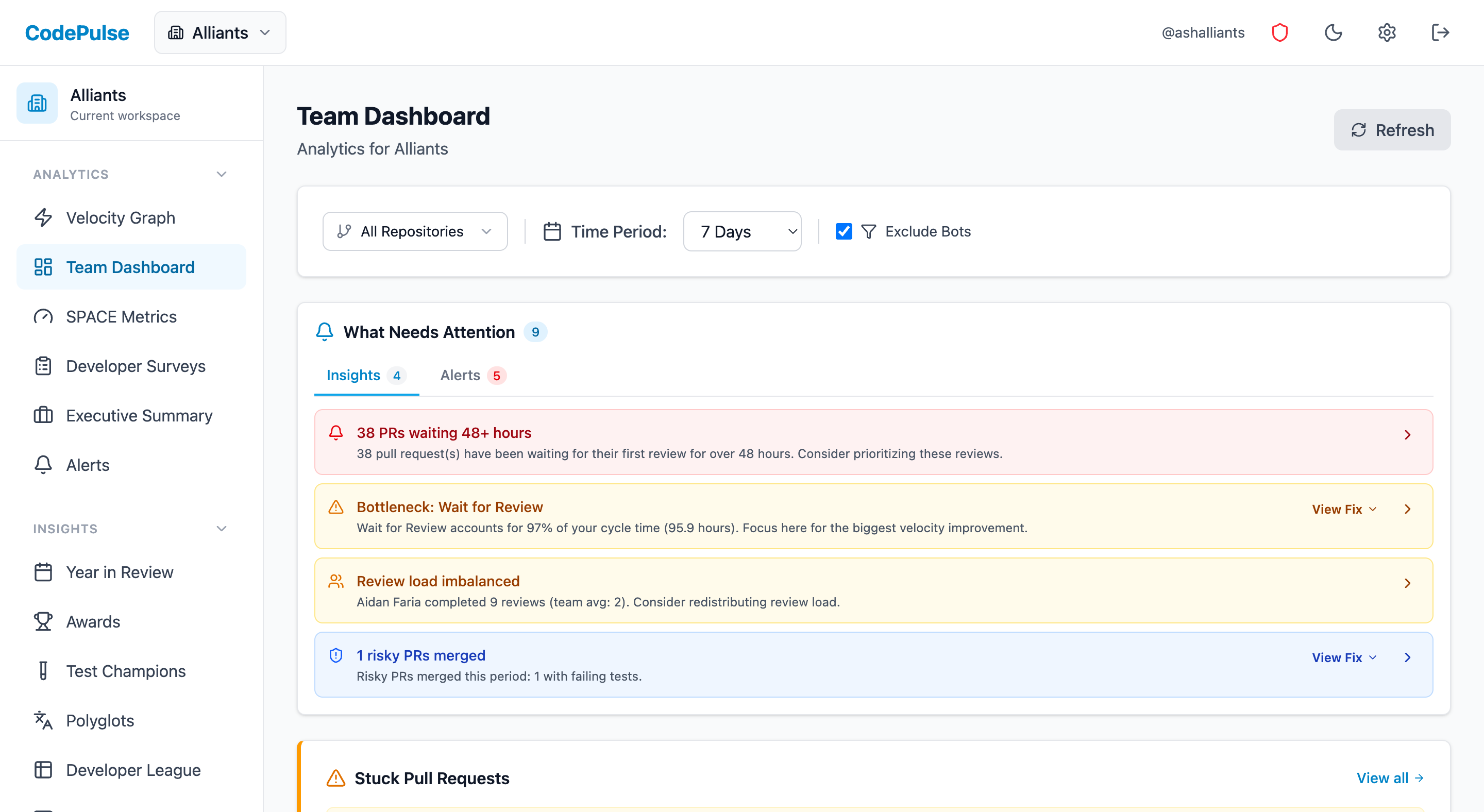
If you are evaluating Cortex and realize you also need delivery analytics, here is specifically what CodePulse adds:
📊 How to See This in CodePulse
Navigate to the Dashboard to see your delivery pipeline broken into actionable stages:
- Cycle time broken into coding, waiting for review, review, and merge phases
- Review load distribution across team members via the Review Network
- File-level risk analysis in File Hotspots
- Executive health grade on the Executive Summary
The pattern we see most: platform teams use Cortex (or Backstage) for service ownership and standards compliance, while engineering managers use CodePulse for delivery efficiency and team health. The tools serve different stakeholders with different questions.
"A service catalog tells you what you built. Delivery analytics tells you how efficiently you are building. Both matter, but they are different questions requiring different tools."
Decision Matrix: What Do You Actually Need?
| Your Situation | Recommendation |
|---|---|
| 100+ microservices, unclear ownership | Cortex (or Backstage/OpsLevel) |
| Need to enforce engineering standards at scale | Cortex |
| PRs take too long, unclear where time is spent | CodePulse |
| Review bottlenecks and knowledge silos | CodePulse |
| Both service catalog AND delivery metrics | Cortex + CodePulse (complementary) |
| Backstage maintenance is too expensive | Cortex or OpsLevel |
| Want maximum portal flexibility | Port |
| Want PR automation alongside metrics | LinearB |
| Small team (under 50 engineers), GitHub-first | CodePulse (Cortex is overkill) |
| Enterprise, multi-provider (GitHub + GitLab) | Cortex + another analytics tool |
When to Choose Cortex
Choose Cortex over analytics tools if these apply:
- You have 50+ microservices and ownership is unclear
- You are building a platform engineering team
- You need to drive standards adoption across dozens of teams
- Service maturity scorecards are a priority
- You evaluated Backstage but do not want to self-host
- You need migration tracking at scale
If more than three of these apply, Cortex is likely the right starting point. You can layer analytics tools like CodePulse on top later.
"The worst outcome is buying a portal expecting analytics, or buying analytics expecting a portal. Know what problem you are solving before you buy."
Frequently Asked Questions
No. Cortex is an internal developer portal focused on service catalogs, scorecards, and engineering standards compliance. While it ingests data from GitHub and other tools, its primary purpose is service ownership and maturity tracking, not delivery analytics like cycle time, review patterns, or PR throughput.
Related Comparisons
Exploring other options? Check out these guides:
- Plandek Alternative - For teams evaluating delivery analytics next to Cortex's IDP focus
- Engineering Analytics Tools Comparison - Comprehensive comparison of all major analytics platforms
- Best Engineering Analytics Tools - Top picks for engineering analytics in 2026
- Internal Developer Platform Metrics - What to measure on your platform engineering team
- Platform Engineering Tools Guide - Complete guide to the platform engineering ecosystem
- Jellyfish Alternative - For teams needing enterprise engineering management
Evaluate CodePulse against your own delivery history
A comparison table only goes so far. Connect read-only GitHub in about five minutes and judge the output on your repositories, at one flat price, with no per-seat math.
Read-only GitHub · Your code stays yours · Team-level by default · No credit card
See These Features in Action
Board-ready engineering performance in a single page.
Track all four DORA metrics and benchmark against industry standards.
Related Guides
7 Jellyfish Alternatives for 2026 (Honest Ranking)
Compare 7 Jellyfish alternatives including CodePulse, LinearB, Swarmia, and more. Honest pros, cons, pricing, and integration comparisons.
5 LinearB Alternatives for 2026 (With Pricing)
An honest comparison of CodePulse vs LinearB. We tell you when to choose LinearB instead, because the best tool is the one that makes the right trade-offs for your situation.
Your IDP Is Failing. Here's How to Prove It (Or Fix It)
Learn how to measure the success of your Internal Developer Platform. Covers adoption metrics, developer experience, delivery impact, and ROI calculation.
Platform Tools: The Build vs Buy Mistake
A practical guide to platform engineering tools, build vs buy decisions, and the metrics that prove platform impact.
OpsLevel vs Cortex: $28.8k vs $75k (and Metrics Gap)
OpsLevel and Cortex compared on sourced buyer pricing ($28,800 vs $75,000 median), documented features, and the metrics gap - plus what neither portal covers and when you do not need an IDP at all.