
Compare the finished analysis before you choose a platform
See the report CodePulse produces from read-only GitHub workflow data, or connect your own repositories and evaluate the fit with real evidence.
Read-only GitHub · Your code stays yours · Team-level by default · No credit card
You're comparing Haystack and CodePulse, and here's the uncomfortable truth: we're philosophically similar. Both companies believe individual developer metrics destroy trust, both prioritize team health over surveillance, and both market ourselves as anti-surveillance engineering analytics. But the execution differs. Users report Haystack's dashboard has "slow load times and an aging UI," metrics that "raise more questions than they answer," and no Slack integration or API. So why would you choose one over the other?
How does Haystack compare to CodePulse for engineering analytics?
Haystack and CodePulse share the same anti-surveillance philosophy: both focus on team health over individual productivity tracking. The main differences are pricing (Haystack pricing requires a sales conversation; CodePulse has a free tier and transparent pricing), data refresh speed (CodePulse syncs every 15 minutes; Haystack varies), and focus area (Haystack emphasizes developer wellbeing metrics; CodePulse goes deeper on PR analytics, cycle time breakdowns, and code review patterns).
"When two tools share the same philosophy, the choice comes down to execution, pricing, and which specific features solve YOUR problems."
This isn't a guide that pretends CodePulse is obviously better. Haystack (YC 2021) has built a solid product with genuine strengths. The question is which tool's trade-offs align better with your team's needs. But there are real issues worth knowing about before you commit.
What Users Actually Say About Haystack
Haystack has very few public reviews (only 2 on TrustRadius, both 5-star), which limits the data available. But third-party analyses and comparison reviews surface a consistent set of complaints.
Slow Dashboard and Aging UI
"Dashboard performance drags. Slow load times and an aging UI make the daily habit of checking metrics harder to maintain."-- Third-party review
If your engineering analytics tool is too slow to check daily, it stops being a habit and starts being a chore. Users also report "functional bugs and performance lag that, while often temporary, can interrupt the flow of work." A tool that creates friction defeats the purpose of removing friction from your engineering process.
Abstract Metrics Without Actionable Guidance
"Some of the data Haystack provides can feel abstract, without clear guidance on what to do with it." Metrics that "raise more questions than they answer" are not saving engineering managers time. They are creating more work. If the tool surfaces a problem but provides no path to resolution, the manager is left doing the analysis manually.
Missing Integrations: No Slack, No API
Haystack lacks integrations with communication tools like Slack, which means "managers end up manually pulling and sharing data." There is also no public API, limiting automation and custom reporting. For teams that live in Slack and want alerts delivered where they work, this is a meaningful gap.
No Free Evaluation Path
You cannot evaluate Haystack without contacting sales. The Startup tier is $25 per developer per month, Growth is $30, and Enterprise is $45, but there is no self-service trial to validate the product fits your workflow before committing budget.
The Philosophical Alignment
Let's acknowledge what we have in common before diving into differences:
| Shared Belief | How Haystack Implements It | How CodePulse Implements It |
|---|---|---|
| Individual metrics are toxic | No individual developer comparisons (anti-leaderboard) | Team-focused dashboards; awards celebrate contributions, not rank |
| Metrics should enable, not surveil | "Engineering analytics that doesn't suck" positioning | Insights for managers to remove blockers, not judge people |
| Teams should control their own metrics | Team-level configuration | Self-serve setup, transparent data |
| Burnout is measurable | Haystack's 83% burnout study | After-hours work detection, consistency tracking |
/// Our Take
Individual developer metrics destroy trust. The moment you compare Alice's cycle time to Bob's, you've turned teammates into competitors.
Haystack and CodePulse share this conviction. Both refuse to build leaderboards that rank developers. If this philosophy matters to you, either tool is a reasonable choice over competitors like LinearB or Jellyfish that offer individual performance tracking.
Where We Actually Differ
Despite the philosophical alignment, there are meaningful differences in execution. CodePulse leans into GitHub depth - you can see the kind of signals we surface with our free GitHub organization analyzer before connecting anything:
| Aspect | Haystack | CodePulse |
|---|---|---|
| Primary bet | Automated release communication | GitHub depth and collaboration visualization |
| Signature feature | Delivery Pulse (auto-generated release notes) | Review Network (interactive collaboration graph) |
| Data sources | GitHub, GitLab, Jira, Linear | GitHub only |
| Setup complexity | Multiple integrations possible | Single GitHub OAuth flow |
| Developer recognition | Team-level metrics only (anti-leaderboard) | 15 award categories (celebrate, don't rank) |
| Team size target | Up to 100 engineers (Growth), 100+ (Enterprise) | Scales from small teams to enterprise |
| Company stage | YC 2021, established | Focused GitHub analytics |
| Dashboard performance | Users report slow load times | Modern, fast interface |
| Slack integration | Not available | Built-in notifications |
| API access | Not available | Available |
| Free evaluation | Must contact sales | Self-serve free tier |
What Haystack Does Genuinely Well
Delivery Pulse: Auto-Generated Release Notes
Haystack's Delivery Pulse automatically generates release notes from your commits and PRs. This is genuinely useful for teams that struggle with release communication. If your stakeholders constantly ask "what shipped this week?" and your developers hate writing changelog entries, Delivery Pulse solves a real problem.
CodePulse doesn't have this feature. We focus on understanding your development process, not communicating releases.
Strict Anti-Leaderboard Stance
Haystack refuses to show individual developer comparisons at all. If you're worried about metrics being weaponized against individuals, Haystack's strict approach prevents misuse by design. CodePulse has awards that celebrate individual contributions, which some teams see as motivation and others see as the first step toward toxic comparison.
Multi-Provider Support
Haystack supports GitHub, GitLab, Jira, and Linear integrations. If your engineering organization spans multiple tools, Haystack can aggregate across them. CodePulse is GitHub-only - we made a deliberate choice to go deep on one platform rather than shallow on many.
Impressive Cycle Time Claims
Haystack claims some teams reduced cycle time from 40 days to 3 days. We can't verify this, but if true, it suggests their approach to identifying bottlenecks works well for certain team patterns.
When to Choose Haystack Instead
"We'd rather you choose the right tool than choose us and be disappointed."
Haystack is likely the better choice if:
You need automated release communication
If "what shipped this sprint?" is a recurring question from stakeholders, Delivery Pulse solves this automatically. CodePulse can show you what merged, but we don't generate stakeholder-friendly release notes.
Your organization uses GitLab or multiple Git providers
CodePulse is GitHub-only. If you have teams on GitLab, or a mix of providers, Haystack can aggregate across them. We're not planning to add GitLab support - we believe focus produces better outcomes.
You want zero individual metrics by design
If your culture is sensitive about any form of individual recognition (even positive awards), Haystack's strict anti-leaderboard approach removes the concern entirely. CodePulse's awards are designed to celebrate diverse contributions, but some organizations prefer no individual visibility at all.
You need Jira correlation
If leadership asks questions like "how long did JIRA-1234 take end-to-end?" or "what percentage of our work is features vs. bugs?", you need issue tracker integration. CodePulse doesn't connect to Jira.
Where CodePulse Fits Better
CodePulse is the better choice if these describe your situation:
GitHub is your source of truth
If your team lives in GitHub - PRs are your workflow, GitHub Issues (or no issue tracker) for tasks, GitHub Actions for CI - CodePulse extracts maximum insight without requiring you to configure additional integrations.
You want deeper collaboration visualization
CodePulse's Review Network shows an interactive graph of who reviews whose code. This visualization reveals load imbalances, isolated team members, and collaboration gaps that aren't visible in metrics alone. Haystack has review metrics but not this level of visual insight.
You want to celebrate diverse contributions
CodePulse's 15 award categories recognize speed, quality, collaboration, and consistency. This isn't a leaderboard - it's recognition for different strengths. The "Code Quality Champion" matters as much as "Fastest Shipper." If your culture values positive recognition without competitive ranking, this approach works well.
You want transparent, self-serve pricing
CodePulse has public pricing you can see without talking to sales. Haystack's Growth plan is $20/member/month (annual), but Enterprise requires custom pricing.
// How to See This in CodePulse
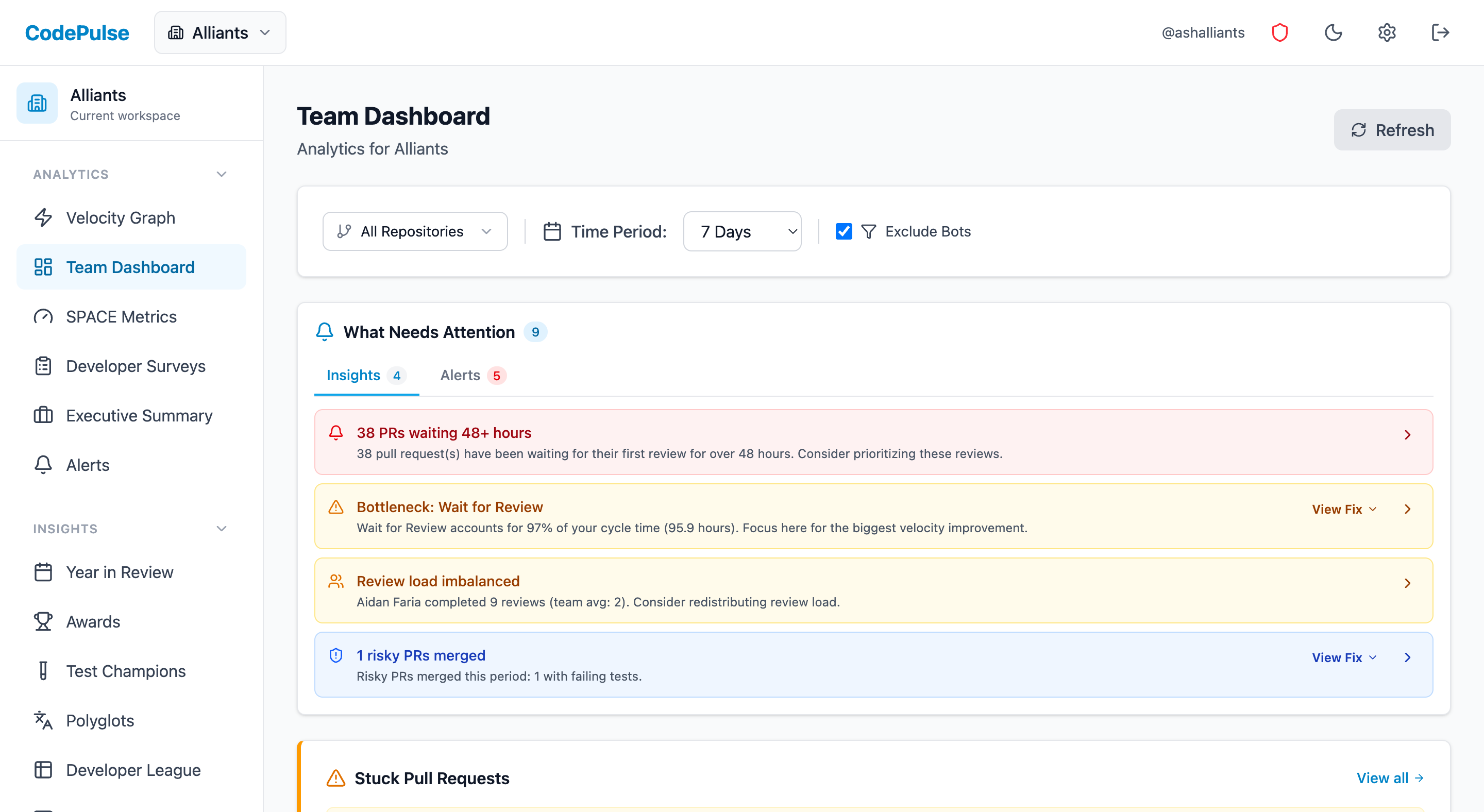
Navigate to Dashboard to see cycle time broken into 4 stages:
- Coding time (first commit to PR open)
- Pickup time (PR open to first review)
- Review time (first review to approval)
- Merge time (approval to merge)
Then explore Review Network to see collaboration patterns that metrics alone don't reveal.
Pricing: What You'll Actually Pay
Here's the real pricing comparison as of 2025:
| Plan | Haystack | CodePulse |
|---|---|---|
| Free / Trial | No free plan; must contact sales for trial | Free tier for small teams |
| Startup | $25/dev/mo | See pricing |
| Growth | $30/dev/mo | See pricing |
| Enterprise | $45/dev/mo | Custom |
| Pricing transparency | Growth tier visible, Enterprise requires contact | Fully transparent, self-serve |
Sources: Haystack, SaaSWorthy
At $20/member/month, Haystack's Growth tier is competitively priced for teams under 100 engineers. The question isn't just cost - it's value for your specific needs. Delivery Pulse alone might justify the cost if release communication is a significant pain point.
Decision Matrix
Use this matrix to make your decision. Be honest about which scenarios apply:
| Your Situation | Recommendation | Why |
|---|---|---|
| Need automated release notes for stakeholders | Haystack | Delivery Pulse is purpose-built for this |
| Use GitLab or multiple Git providers | Haystack | CodePulse is GitHub-only |
| Want zero individual metrics visibility | Haystack | Stricter anti-leaderboard design |
| Need Jira/Linear correlation | Haystack | CodePulse has no issue tracker integration |
| GitHub-only team wanting depth | CodePulse | Deeper GitHub-specific insights |
| Care about review collaboration visualization | CodePulse | Interactive Review Network is unique |
| Want positive recognition for diverse contributions | CodePulse | 15 award categories celebrate different strengths |
| Need transparent, no-sales pricing | CodePulse | Public pricing, self-serve setup |
| Both philosophies appeal, team <100 engineers | Try both | Both have free tiers; see which feels right |
The Honest Trade-Offs
"There is no 'best' engineering analytics tool. There's the tool that makes the right trade-offs for your situation."
What you give up with CodePulse
- Release communication: No Delivery Pulse equivalent for auto-generated notes
- Multi-provider support: GitHub only - no GitLab, Bitbucket, or Azure DevOps
- Issue tracker integration: No Jira or Linear correlation
- Strict anti-individual stance: Awards do recognize individuals (positively)
What you give up with Haystack
- Collaboration depth: No interactive review network visualization
- Recognition features: Anti-leaderboard means no award categories
- Enterprise pricing transparency: Custom pricing for 100+ engineers
- GitHub-native depth: Multi-provider support means less focus on any single provider
- Dashboard speed: Users report slow load times and an aging UI
- Slack and API: No communication tool integrations or API for custom reporting
- Actionable guidance: Metrics can "raise more questions than they answer"
If You're Switching
Switching between Haystack and CodePulse is straightforward since both sync directly from GitHub:
From Haystack to CodePulse
- Connect GitHub (5 minutes): One OAuth flow to authorize CodePulse
- Initial sync (30-60 minutes): Historical PR data processing
- Explore dashboards: Dashboard, Review Network, File Hotspots
- Run in parallel (recommended): Keep Haystack for 2-4 weeks while you validate
No data export needed - CodePulse builds metrics from raw GitHub data.
What transfers
- GitHub data: CodePulse syncs directly from GitHub
- Historical metrics: Last 6 months of PR data processed automatically
What doesn't transfer
- Jira correlation: If you used this, the data doesn't come over
- Delivery Pulse history: Release notes won't migrate
- Team configurations: You'll reconfigure based on GitHub org structure
Compare Other Tools
If Haystack vs. CodePulse isn't quite the right comparison, these guides might help:
- LinearB vs. CodePulse - Workflow automation and multi-provider support
- Jellyfish vs. CodePulse - Enterprise-scale analytics with business alignment
- Swarmia vs. CodePulse - SPACE framework and working agreements
- Full Tools Comparison - Overview of all engineering analytics tools
The Honest Verdict
Haystack and CodePulse share the same philosophy about engineering metrics: they should help teams improve, not surveil individuals. If that philosophy matters to you, you're choosing between two good options.
Choose Haystack if you need automated release communication, multi-provider support, or want absolutely zero individual metrics visibility.
Choose CodePulse if you're GitHub-focused, want deeper collaboration visualization, appreciate positive recognition for diverse contributions, and prefer transparent self-serve pricing.
Both companies would rather you choose the right tool than the wrong one. Try both free tiers with real data and see which dashboard you actually open after two weeks.
Ready to see if CodePulse is right for your team? Start your free trial and explore the Review Network and Awards features that differentiate us.
Frequently Asked Questions
Haystack focuses on automated release communication (Delivery Pulse) and supports multiple git providers. CodePulse goes deeper on GitHub-specific analytics, offering interactive review network visualization, 15 award categories, and transparent self-serve pricing.
Evaluate CodePulse against your own delivery history
A comparison table only goes so far. Connect read-only GitHub in about five minutes and judge the output on your repositories, at one flat price, with no per-seat math.
Read-only GitHub · Your code stays yours · Team-level by default · No credit card
See These Features in Action
Break down cycle time into coding, waiting, review, and merge phases.
Compare contribution patterns for coaching, not surveillance.
Related Guides
5 LinearB Alternatives for 2026 (With Pricing)
An honest comparison of CodePulse vs LinearB. We tell you when to choose LinearB instead, because the best tool is the one that makes the right trade-offs for your situation.
7 Jellyfish Alternatives for 2026 (Honest Ranking)
Compare 7 Jellyfish alternatives including CodePulse, LinearB, Swarmia, and more. Honest pros, cons, pricing, and integration comparisons.
Waydev Has 130+ Metrics. That's Too Many (2026)
An honest comparison of CodePulse vs Waydev. We tell you when to choose Waydev instead - because the best tool is the one that makes the right trade-offs for your situation.
Pluralsight Flow Alternative: Why Teams Are Switching
Pluralsight Flow is built for enterprise reporting - but if you need team-focused insights without leaderboards or enterprise pricing, there are better options. This guide compares the trade-offs.
5 Best Cortex Alternatives 2026: Portal or Analytics
Cortex is a developer portal, not an analytics tool. This guide explains the difference, compares 5 alternatives across both categories, and helps you pick the right tool for your actual problem.
Best Plandek Alternative for 2026 (Honest Comparison)
Plandek excels at Jira/Azure DevOps value stream management. CodePulse excels at deep GitHub analytics. This guide compares both honestly with 5 other alternatives.