
Compare the finished analysis before you choose a platform
See the report CodePulse produces from read-only GitHub workflow data, or connect your own repositories and evaluate the fit with real evidence.
Read-only GitHub · Your code stays yours · Team-level by default · No credit card
Looking for DX alternatives? DX (formerly GetDX) and CodePulse are more complementary than competitive. DX measures developer experience through surveys and qualitative data. CodePulse measures delivery efficiency through Git data and quantitative metrics. This guide breaks down what each does, where they overlap, and when you need one, the other, or both.
Since Atlassian acquired DX for $1 billion in September 2025, the market has shifted. If you're evaluating DX alternatives, you may be weighing not just surveys vs. system data, but also the implications of buying into the Atlassian ecosystem and the uncertainty that comes with major acquisitions. Also comparing tools? See our Swarmia alternative and Jellyfish alternative guides.
"Surveys tell you how developers feel about their productivity. Git data tells you what actually happened. Neither alone gives you the full picture."
What Is DX (Formerly GetDX)?
DX is a developer experience platform built around the DX framework published in ACM Queue by researchers Abi Noda, Margaret-Anne Storey, Nicole Forsgren, and Michaela Greiler. The framework identifies 25 sociotechnical factors across three dimensions that influence developer experience: feedback loops, cognitive load, and flow state.
The platform sends periodic surveys to developers, collects responses, and produces scores across those 25 factors. Leadership gets a quantified view of developer sentiment that goes far beyond "are developers happy?" into actionable dimensions like "do developers have clear requirements?" and "is the CI/CD pipeline fast enough?"
Pricing: DX does not publish pricing publicly. Based on available information, expect enterprise pricing with annual contracts. DX primarily targets organizations with 100+ engineers.
DX's research pedigree is genuine. The founding team includes Nicole Forsgren (co-author of Accelerate and creator of DORA metrics) and the framework is peer-reviewed. This is not a startup inventing metrics to sell software.
DX vs CodePulse: Surveys vs System Data
The core difference between DX and CodePulse is the data source. DX asks developers what they experience. CodePulse observes what happens in their Git workflow. Both are valid, and they reveal different things:
| Aspect | DX | CodePulse |
|---|---|---|
| Data source | Developer surveys (qualitative) | Git/GitHub activity (quantitative) |
| Primary question | "How do developers experience their work?" | "Where do delivery bottlenecks exist?" |
| Update frequency | Periodic surveys (quarterly typical) | Continuous (real-time Git data) |
| What it catches | Perception gaps, tooling frustration, cognitive load | Review delays, knowledge silos, cycle time spikes |
| What it misses | Actual delivery speed, PR-level patterns | Developer sentiment, satisfaction, perceived friction |
| Framework basis | DX 25-factor model (ACM peer-reviewed) | DORA-aligned delivery metrics |
| Setup effort | Survey design + rollout (weeks) | GitHub OAuth (minutes) |
| Pricing | Enterprise (contact sales) | Free tier, Pro from $199/mo |
| Vendor independence | Atlassian-owned (acquired Sept 2025) | Independent |
| Time to first insight | Months (survey rollout + collection cycle) | Minutes (immediate Git data) |
| Data objectivity | Subjective (perception-based surveys) | Objective (Git/PR activity data) |
What DX Does Well
DX excels in areas that system-level analytics tools cannot reach:
Measuring the Unmeasurable
Some of the biggest productivity drains are invisible to Git data: unclear requirements, slow CI pipelines that developers route around, tribal knowledge that creates hidden dependencies. DX surfaces these through structured surveys that ask the right questions. According to the DX framework research, developer experience encompasses 25 sociotechnical factors that cannot be fully captured by system metrics alone.
Research-Backed Methodology
DX is not asking "rate your happiness from 1 to 10." The survey questions are designed around a peer-reviewed framework that maps to specific, actionable improvement areas. When DX says "your team scores low on feedback loops," there is a body of research connecting that score to concrete outcomes.
Perception vs Reality Gaps
Here is where DX provides unique value: sometimes what the data says and what developers experience diverge. Your cycle time might be 2 days, but if developers perceive the review process as painful, that perception drives behavior (avoiding large PRs, not requesting reviews, working around the process). DX catches these gaps.
Change Management Signal
DX surveys are excellent at measuring the impact of organizational changes. Rolled out a new CI pipeline? Restructured teams? Adopted a new framework? Survey scores before and after provide a clear signal of whether the change helped or hurt.
Where DX Falls Short
Survey-based approaches have inherent limitations that quantitative tools address:
Survey Fatigue
Developers dislike surveys. Response rates drop over time, and the developers most burdened (your highest-output contributors) are often the least likely to respond. This creates a systematic bias in the data.
No Real-Time Signal
Surveys are periodic snapshots. If a review bottleneck emerges on Tuesday, DX will not surface it until the next survey cycle (typically quarterly). CodePulse surfaces it the same day through continuous Git analysis.
No PR-Level Granularity
DX tells you "developers feel reviews are slow." CodePulse tells you "the median wait for first review is 18 hours, 73% of that wait happens between 3pm Friday and 10am Monday, and three senior engineers are reviewing 60% of all PRs." One is directional; the other is actionable.
Subjectivity Risk
Perception-based data is influenced by recency bias, anchoring, and team dynamics. A developer who had a bad week may score everything low. System data is immune to these biases.
The Atlassian Acquisition: What It Means for You
In September 2025, Atlassian acquired DX for approximately $1 billion. This is the single most important factor in any DX evaluation today, and it deserves honest analysis. For the wider pattern - why the analytics-tools category keeps getting rolled up and what happens to customers when it does - see our analytics tool acquisitions research.
Vendor Lock-In Risk
DX will now be optimized to drive adoption of Jira, Confluence, and Atlassian's broader ecosystem rather than serving your specific strategic interests. DX leaned hard on survey-based signals, which brings its own risks - our research on survey fatigue in developer experience shows how quickly response rates collapse and bias the picture leaders get. As one analysis noted, the acquisition means DX's roadmap priorities will shift toward Atlassian's platform strategy, with uncertainty about "future pricing changes, integration priorities, or product direction." If you use GitHub, Linear, or non-Atlassian tools as your primary stack, DX's long-term alignment with your needs is now uncertain.
Atlassian's Acquisition Track Record
History provides context for what happens to products Atlassian acquires:
- HipChat: Acquired in 2012, eventually shut down, and the IP was sold to Slack. Users who invested in HipChat had to migrate entirely.
- Jira Align: Six years post-acquisition, it still suffers integration issues and customer complaints. Community forums remain filled with troubleshooting guides for problems that should have been resolved years ago.
- Trello: Long-term users describe the product as feeling "outdated" after years of incremental updates that prioritize Atlassian ecosystem integration over the product's original simplicity.
This pattern is not unique to Atlassian -- most large acquisitions follow similar trajectories. But the pattern is worth factoring into a multi-year purchasing decision.
Innovation Freeze During Integration
Major acquisitions typically require 18 to 24 months for meaningful integration, during which product innovation stagnates. Engineering resources shift from building new features to integration work, migration tooling, and organizational alignment. This integration period coincides with a moment when the developer experience space is evolving rapidly, particularly with AI tooling. While DX's innovation freezes, the market keeps moving.
"DX will now be optimized to drive adoption of Jira, Confluence, and Atlassian's broader ecosystem rather than serving your specific strategic interests."
What DX Users Are Saying
Beyond the acquisition concerns, verified reviewers have flagged several product-level issues:
Survey Fatigue Is the Core Problem
DX's entire methodology depends on developers filling out surveys, and that creates inherent friction. One analyst noted that DX's "heavy reliance on developer surveys introduces bias, fatigue, and ongoing program overhead." G2 reviewers describe difficulty separating "what they see as a problem in their team versus what they see as a problem across engineering" when filling out surveys. Response rate decay is a known pattern -- initial enthusiasm drops over time.
Slow Time-to-Value
DX requires "months-long rollouts that delay results and strain resources" compared to competitors that prove value in two weeks. A G2 reviewer noted that "aligning the platform's service catalog with internal data sources required more manual configuration and 'wiring' than expected." Keeping team rosters up to date requires ongoing manual effort. The complexity and learning curve is described as "a bit steep" for new managers.
Product Stability Concerns
Users report that "frequent product changes and limited feature stability can disrupt teams." Frequent updates "can sometimes come as a surprise and require their teams to adjust." One reviewer described some features as seeming "just a bit incomplete." For a tool that's meant to measure organizational stability, that's ironic.
Data Trust
Multiple reviewers flag trust concerns. One noted that DX "creates significant data distortions that prevent accurate impact assessments and erode engineers' trust." A G2 reviewer shared that "it took time for their team to trust the metrics" -- a significant barrier for a tool that depends on organizational buy-in to succeed.
"I've trialed DX -- it's basically a survey. Great questions, UI and integrations, but still just a survey." -- A commenter on Hacker News
* Our Take
The developer experience movement has done enormous good for the industry. DX (the company) has real research behind it, not marketing fluff. But survey data alone is like managing a factory with suggestion boxes and no production dashboards. You need both the voice of the worker and the data from the production line.
The best engineering leaders we see pair qualitative tools (DX, Swarmia surveys) with quantitative tools (CodePulse, LinearB) and use each to validate the other. When surveys say "reviews are slow" and Git data confirms median review wait is 22 hours, you have a mandate for change.
The Complementary Approach: DX + CodePulse
Rather than choosing one over the other, the strongest signal comes from using both. Here is how they complement each other:
Qualitative (DX)                  Quantitative (CodePulse)
─────────────────                  ────────────────────────
"Reviews feel slow"        ←→     Median review wait: 18hrs
"CI is frustrating"        ←→     (Use CI-specific tools)
"Knowledge is siloed"      ←→     Bus factor: 1 on 12 files
"Process is too heavy"     ←→     Avg PR size: 847 lines
"Onboarding is hard"       ←→     New dev ramp time: 6 weeks

When both signals align → strong case for investment
When they diverge → investigation opportunity
The real power is in the divergence. When DX says "developers feel productive" but CodePulse shows cycle time creeping up 30% quarter over quarter, something is wrong that neither tool would catch alone.
📊 How to See This in CodePulse
Use CodePulse to validate or investigate DX survey findings:
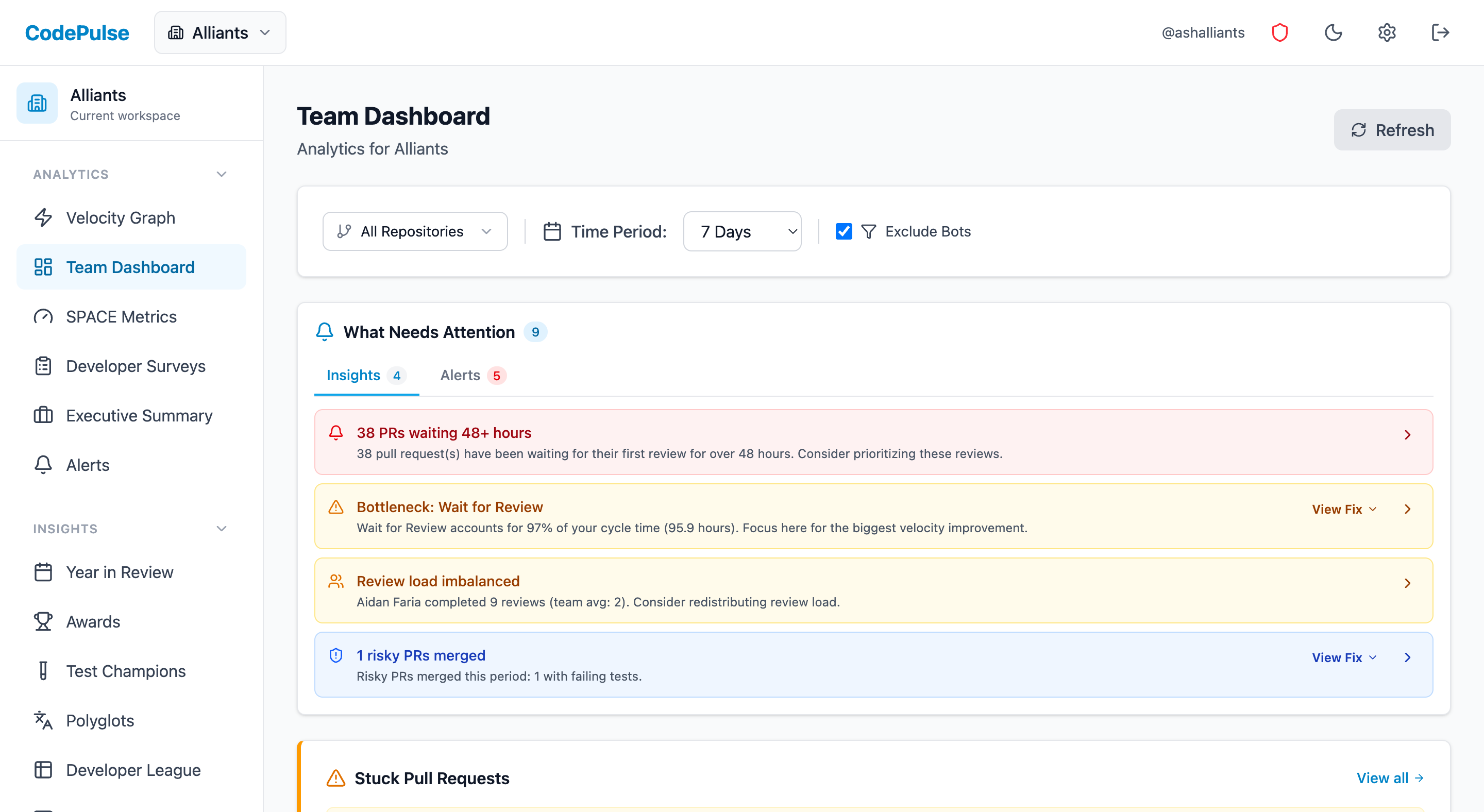
- Dashboard cycle time breakdown confirms or contradicts "reviews feel slow"
- Review Network reveals whether "knowledge silos" are real or perceived
- File Hotspots quantifies bus factor risk behind "onboarding is hard"
- Executive Summary tracks trends over time to measure impact of changes
"The best developer productivity programs triangulate: system data shows what happened, surveys show how it felt, and the gap between them shows where to dig deeper."
Other DX Alternatives to Consider
If DX's survey-based approach is not right for your team, here are alternatives across both the qualitative and quantitative spectrum:
Qualitative Alternatives
1. Swarmia (Surveys + Metrics)
Swarmia combines developer experience surveys with SPACE/DORA delivery metrics. It is the closest tool to offering both qualitative and quantitative data in a single platform. However, its survey depth is lighter than DX's research-backed 25-factor model. Read our full Swarmia comparison.
2. Custom Surveys (Google Forms / Typeform)
Some teams build their own developer experience surveys using generic survey tools. This costs less but lacks DX's research-backed question design, benchmarking data, and longitudinal tracking capabilities.
Quantitative Alternatives
3. CodePulse
Deep GitHub analytics focused on delivery efficiency. Four-stage cycle time breakdown, review network visualization, file hotspot detection, and developer recognition across 15+ categories.
4. LinearB
PR workflow automation (gitStream) plus delivery metrics. Strong for teams wanting to automate review routing alongside measurement. Read our full LinearB comparison.
5. Jellyfish
Enterprise engineering management platform connecting engineering work to business outcomes. Best for VP-level buyers at 50+ engineer organizations needing OKR alignment and investment categorization. Read our full Jellyfish comparison.
Quick Comparison Table
| Tool | Approach | Best For | Surveys | Git Analytics | Pricing |
|---|---|---|---|---|---|
| DX | Qualitative | Developer sentiment + perception | Yes (core) | Light | Enterprise |
| Swarmia | Hybrid | Surveys + delivery metrics | Yes | Yes | Free tier, from EUR 20/mo |
| CodePulse | Quantitative | PR insights + cycle time | No | Yes (deep) | Free tier, from $199/mo |
| LinearB | Quantitative | PR automation + metrics | No | Yes | Free tier, ~$420/yr |
| Jellyfish | Quantitative | Business alignment + OKRs | Yes (light) | Yes | ~$588/yr per dev |
Decision Matrix
| Your Situation | Recommendation |
|---|---|
| Need to understand developer sentiment and friction | DX |
| Need to find specific delivery bottlenecks | CodePulse |
| Want both surveys and Git metrics in one tool | Swarmia (lighter on both) |
| Want the deepest qualitative methodology | DX (research-backed 25-factor model) |
| Want the deepest quantitative PR analysis | CodePulse (4-stage cycle time, review network) |
| Need to justify changes to leadership | DX + CodePulse (qualitative + quantitative evidence) |
| Budget for only one tool, team under 50 engineers | CodePulse (free tier, immediate value) |
| Large org (200+), need cultural transformation data | DX (weigh Atlassian lock-in risk) |
| Concerned about Atlassian vendor lock-in | Swarmia (surveys) or CodePulse (quantitative) |
| Want PR automation alongside metrics | LinearB |
| Need to report engineering investment to executives | Jellyfish |
"Developer experience surveys without system data are opinions. System data without developer input is surveillance. The combination is intelligence."
Frequently Asked Questions
DX is a developer experience platform that measures developer productivity through research-backed surveys. Built on the DX framework (published in ACM Queue by Nicole Forsgren and others), it surveys developers across 25 sociotechnical factors covering feedback loops, cognitive load, and flow state. DX primarily targets organizations with 100+ engineers.
Related Comparisons
Exploring other options? Check out these guides:
- Engineering Analytics Tools Comparison - Comprehensive comparison of all major analytics platforms
- Best Engineering Analytics Tools - Top picks for engineering analytics
- Swarmia Alternative - Hybrid surveys + metrics approach
- Developer Experience Platform Guide - Complete guide to the DevEx ecosystem
- Improving Developer Experience - Practical strategies for better DevEx
Evaluate CodePulse against your own delivery history
A comparison table only goes so far. Connect read-only GitHub in about five minutes and judge the output on your repositories, at one flat price, with no per-seat math.
Read-only GitHub · Your code stays yours · Team-level by default · No credit card
See These Features in Action
Holistic developer productivity using the SPACE framework.
Compare contribution patterns for coaching, not surveillance.
Related Guides
Swarmia Alternatives: Cheaper, Deeper Analytics 2026
A Swarmia alternative worth considering: where Swarmia falls short on customization and per-seat pricing, and which cheaper, GitHub-native tools fit better.
7 Jellyfish Alternatives for 2026 (Honest Ranking)
Compare 7 Jellyfish alternatives including CodePulse, LinearB, Swarmia, and more. Honest pros, cons, pricing, and integration comparisons.
Happy Developers Leave Breadcrumbs in Git
Learn how to measure and improve developer experience using behavioral metrics from GitHub, not just surveys. Covers flow state, cognitive load, and collaboration quality.
Improve Developer Experience: Proven Strategies
A practical guide to improving developer experience through surveys, team structure, and proven strategies that actually work.