
Understand the system around the team, not a developer leaderboard
Preview team-level workload, collaboration, and delivery signals designed for process improvement rather than performance grading.
Read-only GitHub · Your code stays yours · Team-level by default · No credit card
Developer Experience (DevEx) has emerged as a critical factor in engineering team performance. This guide explains how to measure and improve developer experience using data-driven approaches that go beyond surveys.
Research from Microsoft, GitHub, and academic institutions shows that developer experience directly impacts productivity, retention, and code quality. Yet most organizations struggle to measure it effectively. This guide shows you how.
The goal is the same for mature platforms and teams just starting with developer experience metrics: reduce friction and amplify flow for every team.
What Is Developer Experience?
Developer Experience (DevEx) encompasses everything that affects how developers feel about and perform their work. It includes:
- Cognitive load: How much mental effort is required to understand code, navigate systems, and complete tasks
- Flow state: The ability to focus deeply without interruptions or context switches
- Feedback loops: How quickly developers get information about the impact of their changes
- Tooling friction: Time spent fighting tools vs. doing productive work
- Collaboration quality: How smoothly teams work together on shared codebases
Poor developer experience doesn't just slow delivery - it drives attrition. According to the Stack Overflow 2024 Developer Survey, only about one in five developers are happy at work, and the rest are complacent or unhappy. The Haystack Analytics study found 83% of developers experiencing burnout in 2021. DevEx isn't a nice-to-have - it's survival.
🔥 Our Take
"Developer Experience Platform" is usually code for "we bought Backstage and called it done."
Most DevEx initiatives focus on tools (portals, templates, golden paths) while ignoring the actual experience: waiting for code review, fighting flaky tests, navigating legacy code nobody understands. You don't need a platform - you need visibility into what's slowing developers down, and the discipline to fix it. A developer who waits 2 days for review doesn't care about your service catalog.
"The best developer experience investment is often the most boring: faster feedback loops, reliable CI, and reviewers who actually review."
Measuring Developer Experience
There are two complementary approaches to measuring DevEx. For the concrete quantitative side - what to measure from Git data, tooling telemetry, and system signals when surveys are too slow or too biased - see our quantitative developer experience data guide.
Perceptual Metrics (Surveys)
Surveys capture how developers feel about their experience. They're valuable for understanding sentiment but have limitations:
- Response bias (unhappy developers more likely to respond)
- Recall bias (recent events overweighted)
- Survey fatigue (declining response rates over time)
- Lagging indicator (problems surface after the fact)
Behavioral Metrics (System Data)
System data from Git, CI/CD, and other tools reveals what developers actuallydo. These metrics are:
- Objective and consistent
- Available in real-time
- Leading indicators of problems
- Comparable across teams and time periods
The best approach combines both: use surveys for context and system data for continuous monitoring.
DevEx Metrics You Can Extract from GitHub
GitHub data reveals more about developer experience than most teams realize. Here are the key metrics and what they indicate:
Flow State Indicators
| Metric | What It Reveals | Healthy Range |
|---|---|---|
| Time to first review | How long developers wait for feedback | < 4 hours |
| Review iteration cycles | Back-and-forth before merge | 1-2 cycles |
| PR age distribution | Work-in-progress inventory | 90% merged within 3 days |
| Commit patterns | Deep work vs. fragmented attention | Sustained daily patterns |
Cognitive Load Indicators
| Metric | What It Reveals | Warning Signs |
|---|---|---|
| PR size | Complexity of changes | > 400 lines average |
| Files changed per PR | Scope of required knowledge | > 10 files average |
| Code churn rate | Rework and instability | > 25% of changes are rework |
| Knowledge silos | Single points of failure | > 80% single-author files |
Collaboration Quality Indicators
| Metric | What It Reveals | Warning Signs |
|---|---|---|
| Review coverage | Code getting peer feedback | < 90% reviewed |
| Review load distribution | Equitable workload | Top reviewer > 3x average |
| Cross-team reviews | Knowledge sharing | < 10% cross-team |
| Review network density | Team connectivity | Isolated nodes |
Building a DevEx Dashboard
An effective DevEx dashboard combines these metrics into actionable views. CodePulse provides several features that map directly to DevEx concerns:
For Flow State Monitoring
- Dashboard → Cycle time breakdown shows where work gets stuck
- Alert Rules → Get notified when PRs exceed age thresholds
For Cognitive Load Assessment
- File Hotspots → Identify complex, high-churn areas
- Knowledge Silos → Find single points of failure
For Collaboration Health
- Review Network → Visualize team collaboration patterns
- Developer Metrics → Track review load distribution
💡 DevEx and the SPACE Framework
The SPACE framework from Microsoft Research provides a structured approach to DevEx measurement. It covers Satisfaction, Performance, Activity, Communication, and Efficiency - all dimensions that can be partially measured from GitHub data.
Improving Developer Experience
Once you're measuring DevEx, here's how to improve it systematically:
1. Reduce Feedback Loop Time
Long feedback loops are the #1 DevEx killer. Target these improvements:
DevEx Feedback Loop Targets
Review SLAs
- First review: < 4 hours (same business day)
- Final decision: < 24 hours
- Iteration cycle: < 2 hours between rounds
CI/CD Targets
- Unit tests: < 5 minutes
- Full CI pipeline: < 15 minutes
- Deploy to staging: < 30 minutes
Alert Thresholds (set in CodePulse)
- PR age warning: > 24 hours without review
- PR age critical: > 48 hours without merge
For detailed guidance on implementing review SLAs, see the PR SLA Implementation Guide and Reducing PR Cycle Time.
"Every hour a PR waits for review is an hour of context the author is losing. Fast feedback isn't just efficient - it's respectful."
2. Reduce Cognitive Load
High cognitive load leads to bugs, burnout, and slow onboarding:
- Address hotspots: Refactor files with high churn and complexity
- Spread knowledge: Pair on areas with single owners
- Improve documentation: Focus on high-traffic code areas
3. Balance Workload
Uneven workload creates bottlenecks and burnout:
- Distribute reviews: Use the Review Network to identify overload
- Rotate ownership: Spread knowledge across the team
- Monitor after-hours work: Flag unsustainable patterns early
4. Foster Collaboration
Connected teams are more productive and resilient:
- Encourage cross-reviews: Break down team silos
- Celebrate collaboration: Use awards to recognize mentoring
- Build review culture: Quality feedback over rubber-stamping
DevEx Anti-Patterns to Avoid
When implementing DevEx measurement, avoid these common mistakes:
Using DevEx Metrics for Individual Performance
DevEx metrics should inform team-level improvements, not individual evaluations. Using them for performance reviews will:
- Create gaming behavior
- Erode trust in the measurement system
- Drive away your best engineers
Over-Optimizing Single Metrics
Focusing too heavily on one metric creates perverse incentives:
- Cycle time focus → rushed reviews, smaller but more fragmented PRs
- Review coverage focus → rubber-stamp approvals
- Throughput focus → quantity over quality
Balance multiple metrics and always pair quantitative data with qualitative feedback.
Ignoring Context
Numbers without context are misleading. Consider:
- Team composition (experience levels, domains)
- Project phase (greenfield vs. maintenance)
- External factors (reorgs, technical debt sprints)
The Business Case for DevEx
Investing in developer experience has measurable business impact:
| DevEx Investment | Business Impact |
|---|---|
| Faster feedback loops | 20-30% improvement in cycle time |
| Reduced cognitive load | Fewer bugs, faster onboarding |
| Better collaboration | Higher retention, better knowledge sharing |
| Balanced workload | Reduced burnout, sustainable pace |
For a 50-engineer team with $150K average fully-loaded cost, a 10% productivity improvement from better DevEx is worth $750K annually - and that's before counting reduced attrition costs.
Getting Started with DevEx Measurement
Here's a practical roadmap for implementing DevEx measurement:
- Week 1: Baseline
- Connect CodePulse to your GitHub organization
- Review current cycle time, review coverage, and collaboration patterns
- Identify 2-3 obvious pain points from the data
- Week 2-4: Targeted Improvements
- Set up alerts for the pain points you identified
- Share findings with the team (data, not blame)
- Pick one improvement to focus on
- Month 2+: Continuous Monitoring
- Track trends over time
- Expand to additional metrics
- Combine with periodic team surveys for qualitative context
DevEx Health Check Scorecard
Use this scorecard to assess your current DevEx state:
DevEx Health Check Scorecard (Score 1-5 each)
Feedback Loops
- Time to first review
- CI/CD pipeline speed
- Review iteration cycles
- Deploy frequency
Cognitive Load
- Average PR size (< 400 lines = 5)
- Code churn rate (< 15% = 5)
- Knowledge distribution
- Documentation quality
Collaboration
- Review coverage (100% = 5)
- Review load balance
- Cross-team knowledge sharing
- Onboarding effectiveness
Total: ___ / 60
- 50-60: Excellent DevEx - maintain and refine
- 40-49: Good DevEx - targeted improvements
- 30-39: Needs attention - prioritize fixes
- <30: Critical - DevEx overhaul needed
"You can't improve developer experience without first measuring it. But measuring it without acting on it is worse - it just proves you don't care."
For related guidance on specific DevEx dimensions, see:
- Detecting Burnout Signals from Git Data - monitor for unsustainable work patterns
- Code Hotspots and Knowledge Silos - reduce cognitive load in complex areas
- Review Load Balancing - distribute work equitably
- Measuring Without Micromanaging - build trust while improving visibility
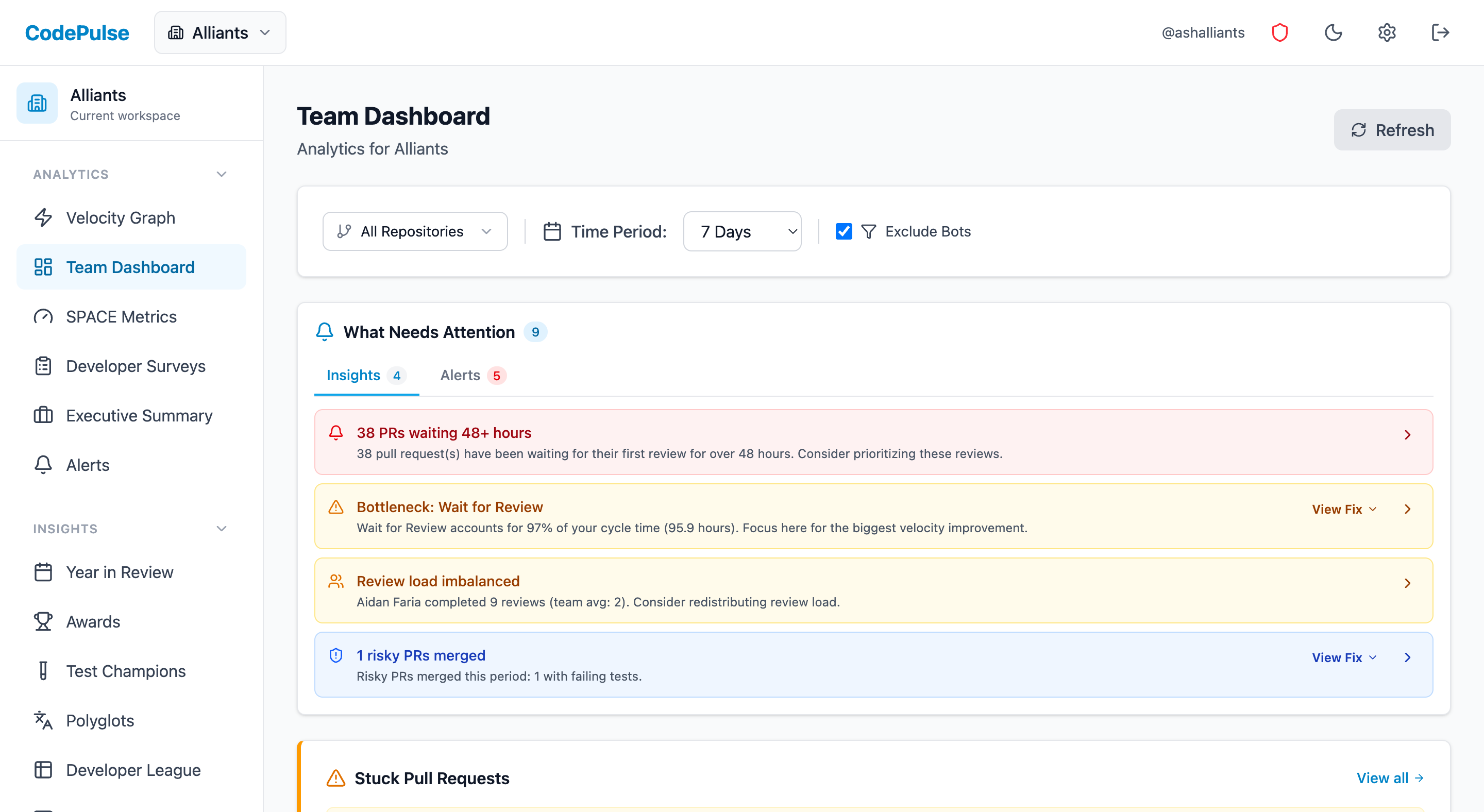
Get this view for your own teams
Connect GitHub for team-level workload, review distribution, and delivery signals. Individual views stay off unless your organisation explicitly turns them on.
Read-only GitHub · Your code stays yours · Team-level by default · No credit card
See These Features in Action
Holistic developer productivity using the SPACE framework.
Compare contribution patterns for coaching, not surveillance.
Related Guides
Why Microsoft Abandoned DORA for SPACE (And You Should Too)
Learn how to implement the SPACE framework from Microsoft and GitHub research to measure developer productivity across Satisfaction, Performance, Activity, Communication, and Efficiency.
Developer Productivity Metrics That Don't Backfire
Stop treating engineers like factory workers. Learn which developer productivity metrics destroy trust, why lines of code fail, and how to measure productivity, including with AI tools, without surveillance.
Engineering Metrics That Won't Get You Reported to HR
An opinionated guide to implementing engineering metrics that build trust. Includes the Visibility Bias Framework, practical do/don't guidance, and a 30-day action plan.
The Performance Review Framework That Doesn't Destroy Trust
Learn how to measure engineering performance fairly and effectively without creating toxic culture, gaming, or surveillance dynamics.
The 50-Engineer Cliff: Why Everything Breaks After Series B
The definitive guide to engineering metrics for the Series B transition. Learn why Hero Mode breaks at 50 engineers, how to build a tiered metrics stack, what boards actually want to see, and when to hire vs. optimize.
The EM Dashboard That Won't Get You Reported to HR
With 83% of developers suffering from burnout and a 12-point perception gap between engineers and executives, EMs need metrics that reveal team health - not just delivery. Here is what to track, what to ignore, and how to use data without destroying trust.