
Understand the system around the team, not a developer leaderboard
Preview team-level workload, collaboration, and delivery signals designed for process improvement rather than performance grading.
Read-only GitHub · Your code stays yours · Team-level by default · No credit card
Developer experience isn't about ping pong tables or free snacks. It's about removing the friction that makes talented engineers want to quit. This guide shows you how to actually improve DevEx - through surveys that reveal truth, teams that drive change, and strategies that work.
According to the 2025 JetBrains State of Developer Ecosystem, developers now rank internal collaboration and communication as equally important to technical factors like fast CI pipelines. The DevEx research from Microsoft, GitHub, and academia confirms that developer experience directly impacts productivity, retention, and code quality. Yet most organizations measure it poorly - if at all.
Why Developer Experience Matters More Than Ever
The business case for developer experience is stark:
- 60% higher revenue growth for companies prioritizing developer experience, according to McKinsey's Developer Velocity research
- 83% of developers report experiencing burnout, per the Haystack Analytics study
- 85% of developers now use AI tools regularly, fundamentally changing how they experience development work
- $750K+ annual value from a 10% productivity improvement in a 50-engineer team with $150K average fully-loaded cost
But here's what those statistics miss: developer experience compounds. Good DevEx attracts better talent. Better talent improves DevEx further. The opposite is also true - poor DevEx drives away your best people, leaving you with whoever can't find something better.
🔥 Our Take
You can't buy your way to better developer experience.
Most DevEx initiatives fail because they focus on tools (new IDEs, portals, platforms) while ignoring the actual experience: waiting 2 days for code review, fighting flaky tests, navigating legacy code nobody understands. Cultural factors - collaboration, clear decision-making, psychological safety - have outsized influence that no tool can fix.
The Three Pillars of Developer Experience
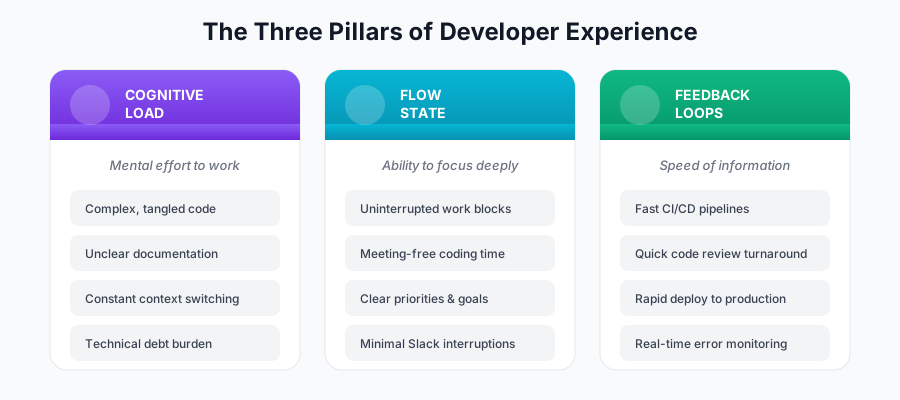
Research from Forsgren, Storey, et al. identifies three core dimensions that determine how developers experience their work:
Cognitive Load
How much mental effort is required to understand code, navigate systems, and complete tasks? High cognitive load comes from tangled code, unclear documentation, constant context switching, and accumulated technical debt. It's the mental tax developers pay before they can even start productive work.
Flow State
Can developers focus deeply without interruptions? Flow state requires uninterrupted work blocks, meeting-free coding time, clear priorities, and minimal Slack interruptions. Research shows developers need 15-23 minutes to regain focus after an interruption - and the average developer is interrupted every 10 minutes.
Feedback Loops
How quickly do developers get information about the impact of their changes? Slow feedback loops kill momentum. When a developer makes a change and waits 20 minutes for tests, they lose context. They switch to other tasks, fragmenting their attention further.
"The pillar that matters most? Feedback loops. Fast feedback is the foundation that makes the other two possible."
Running Effective Developer Experience Surveys
Surveys are essential for understanding developer experience - but they're also easy to get wrong. Here's what actually works:
When to Survey
- Quarterly if you're actively prioritizing DevEx improvements and need to track progress
- Bi-annually if you're in a stable state and want to monitor trends
- Never run surveys more frequently than you can act on the results
Question Design Best Practices
Based on Swarmia's expert-designed survey framework and Atlassian's DevEx Survey Play:
- Use 5-point Likert scales for quantitative tracking over time
- Include 2-3 open-ended questions for qualitative insights
- Keep it under 10 minutes - if it feels like homework, no one finishes
- Group questions into logical sections (Tools, Workflow, Collaboration)
Sample Survey Questions by Pillar
| Pillar | Sample Questions |
|---|---|
| Cognitive Load | "Our codebase is easy to understand and navigate." "Documentation helps me complete my tasks effectively." |
| Flow State | "I have significant time for deep work in my work days." "How often are you interrupted to work on something unplanned?" |
| Feedback Loops | "How often does it take more than 10 minutes to get an answer to a technical question?" "Our CI/CD pipeline provides timely feedback on my changes." |
Participation Targets
According to DX research, self-reported survey data needs 80-90% participation rates to be credible within the organization. Anything less creates selection bias - you're only hearing from the most engaged (or most frustrated) developers.
🔥 Our Take
Surveys without action destroy trust faster than no surveys at all.
If you run a DevEx survey and nothing changes, you've proven to your team that you don't actually care - you were just checking a box. Before surveying, commit to acting on the top 2-3 issues. Communicate what you learned and what you're doing about it. The next survey's participation depends on how you handled this one.
Building a Developer Experience Team
Not every organization needs a dedicated DevEx team, but every organization needs someone accountable for developer experience. Here's how to know when to invest:
When You Need a Dedicated DevEx Team
- You have 100+ engineers and DevEx issues are impacting delivery
- Developer satisfaction scores are declining or stagnant
- Onboarding time exceeds 3 months for new engineers to be productive
- Tooling fragmentation is creating significant overhead
- Platform engineering initiatives need dedicated ownership
The DevEx Engineer Role
A Developer Experience Engineer (sometimes called Platform Engineer or Developer Productivity Engineer) focuses on improving the systems and tools developers use daily. Key responsibilities include:
- Maintaining and improving CI/CD pipelines
- Building internal developer tooling and automation
- Reducing friction in development workflows
- Measuring and reporting on developer experience metrics
- Advocating for developer needs in architecture decisions
Team Structure Options
| Model | Description | Best For |
|---|---|---|
| Embedded | DevEx engineers sit within product teams | Organizations under 50 engineers |
| Platform Team | Centralized team serving all engineers | Organizations 50-200 engineers |
| Hybrid | Central platform team + embedded advocates | Organizations 200+ engineers |
For more on platform teams and their metrics, see our Platform Team Metrics guide.
"A DevEx team without authority to change systems is just a complaint department. Give them budget, give them influence, or don't bother."
16 Proven DevEx Improvement Strategies
Here are concrete strategies organized by the three pillars, with specific actions you can take this quarter:
Reducing Cognitive Load (6 Strategies)
- Refactor your hotspots: Identify the 5 files with the highest churn and complexity, then systematically improve them. Use File Hotspots to find them.
- Document high-traffic code paths: Add inline documentation to the code new engineers touch most in their first 90 days.
- Break up knowledge silos: Pair engineers on code areas with single owners. See our Knowledge Silos guide.
- Establish PR size guidelines: PRs over 400 lines take exponentially longer to review and understand. Enforce smaller PRs.
- Create architecture decision records (ADRs): Document why decisions were made, not just what was decided.
- Standardize development environments: One command should set up a working dev environment. Docker, devcontainers, or shell scripts - whatever works.
Enabling Flow State (5 Strategies)
- Implement "maker schedules": Block 4-hour chunks of meeting-free time for engineering work.
- Set Slack expectations: Establish response time norms (e.g., within 2 hours, not immediately) to reduce interrupt pressure.
- Batch meetings: Cluster meetings on specific days to create uninterrupted days for deep work.
- Limit work-in-progress: Engineers with 3+ active PRs suffer context switching costs. Set WIP limits.
- Clear prioritization: If everything is priority 1, nothing is. Make priority obvious and unambiguous.
Accelerating Feedback Loops (5 Strategies)
- Set review SLAs: First review within 4 hours, final decision within 24 hours. See our PR Cycle Time guide.
- Parallelize CI: Target 15-minute CI pipelines. Anything longer and developers context-switch.
- Fix flaky tests immediately: A flaky test isn't a test - it's noise. Either fix it or delete it.
- Deploy to staging automatically: Every merged PR should be in staging within 30 minutes.
- Real-time error monitoring: Developers should know within minutes when their code causes issues in production.
📊 Measuring Improvement in CodePulse
Track the impact of your DevEx improvements:
- Dashboard → Monitor cycle time trends as you improve feedback loops
- Review Network → Watch collaboration patterns as silos break down
- File Hotspots → Track complexity reduction in your target files
Measuring DevEx Improvement
Improvement without measurement is just hope. Here's how to track whether your DevEx investments are paying off:
Leading Indicators (Respond Quickly)
- Cycle time: Time from first commit to merge
- Time to first review: How long PRs wait for initial feedback
- CI pipeline duration: How fast developers get test results
- PR size: Average lines changed per pull request
Lagging Indicators (Trend Over Quarters)
- Developer satisfaction scores: From your DevEx surveys
- Onboarding time: Time for new engineers to ship their first PR
- Retention: Engineering turnover rate
- Deployment frequency: How often you ship to production
For detailed guidance on which metrics to track and how, see our Developer Experience Platform guide and SPACE Framework guide.
Quarterly Review Cadence
DevEx improvement is a continuous practice, not a project. Establish a quarterly rhythm:
- Week 1: Run DevEx survey (if quarterly) or review system metrics
- Week 2: Analyze results, identify top 3 improvement areas
- Week 3: Share findings with engineering, commit to specific actions
- Weeks 4-12: Execute improvements, track leading indicators
"The best DevEx investment is often the most boring: faster feedback loops, reliable CI, and reviewers who actually review. Not a developer portal. Not a service catalog. Just less waiting."
For related guidance on specific DevEx challenges, see:
- Detecting Burnout Signals from Git Data - monitor for unsustainable work patterns
- Review Load Balancing - distribute work equitably across the team
- Context Switching Patterns - understand and reduce focus fragmentation
Get this view for your own teams
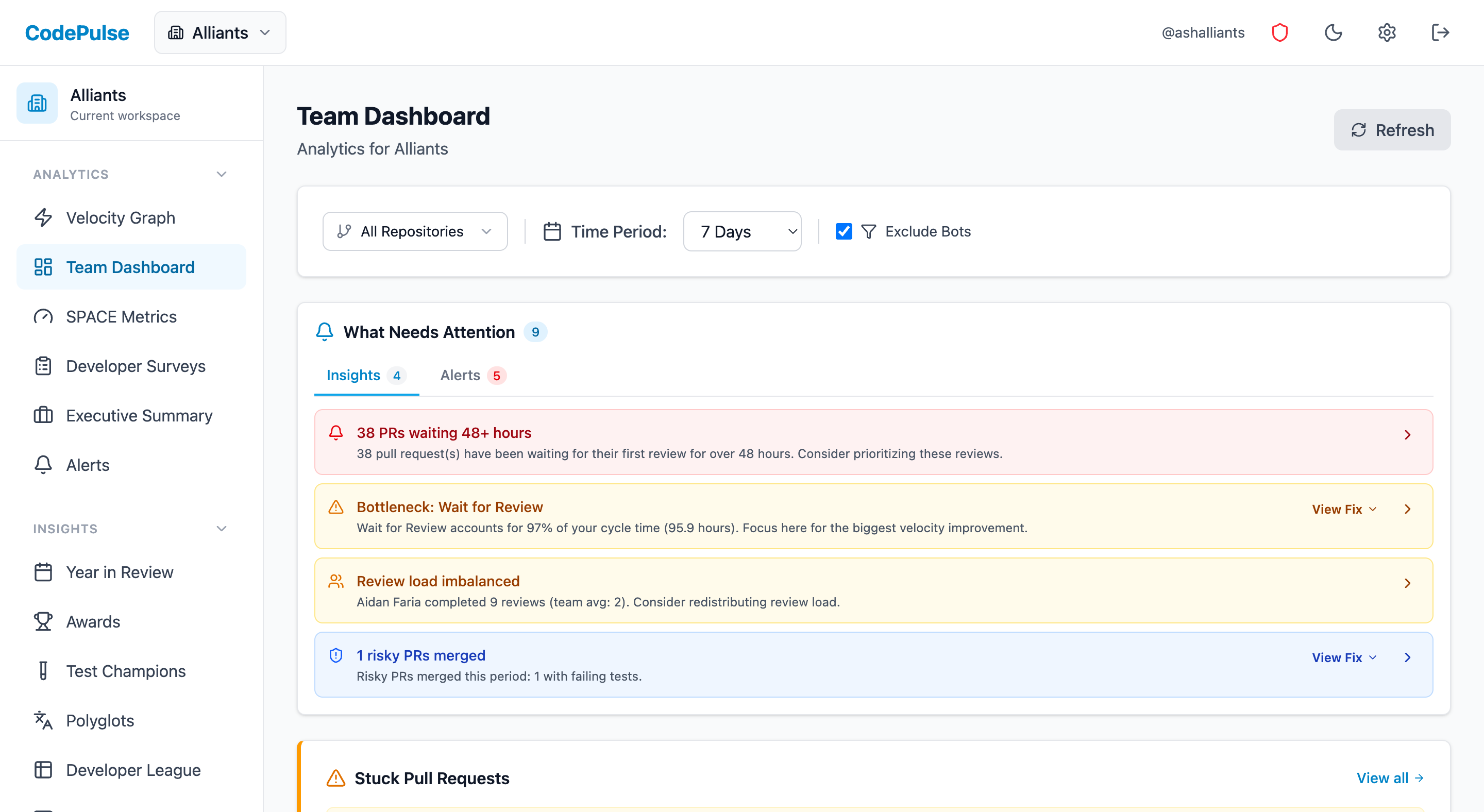
Connect GitHub for team-level workload, review distribution, and delivery signals. Individual views stay off unless your organisation explicitly turns them on.
Read-only GitHub · Your code stays yours · Team-level by default · No credit card
See These Features in Action
Holistic developer productivity using the SPACE framework.
Compare contribution patterns for coaching, not surveillance.
Related Guides
Developer Productivity Engineering: What DPE Does
Developer Productivity Engineering (DPE) is how Netflix, Meta, and Spotify keep engineers productive. Learn what DPE teams do and how to start one.
The ROI Template That Gets Developer Tools Approved
The exact ROI calculation and business case template that gets CFOs to approve developer tool purchases.
Context Switching Costs You $47K Per Developer Per Year
Learn to detect context switching costs from PR data, distinguish productive breadth from harmful fragmentation, and help developers maintain focus.
Happy Developers Leave Breadcrumbs in Git
Learn how to measure and improve developer experience using behavioral metrics from GitHub, not just surveys. Covers flow state, cognitive load, and collaboration quality.