
Turn this metric into a baseline for your team
Preview a system-level engineering health report, then connect GitHub when you are ready to compare this metric with your own delivery history.
Read-only GitHub · Your code stays yours · Team-level by default · No credit card
Internal Developer Platforms (IDPs) promise to boost developer productivity by providing self-service infrastructure and standardized tooling. But how do you know if your platform investment is paying off? This guide covers the metrics that prove IDP success.
Platform engineering has evolved from "build it and they will come" to treating platforms as products with measurable outcomes. In 2025, with platform teams facing budget scrutiny like never before, tracking the right metrics is essential for justifying continued investment.
Whether your developer platform is brand new or already supporting multiple teams, platform engineering teams need a clear, repeatable way to prove impact.
Why IDP Metrics Matter
An IDP without metrics is like flying blind. You might feel like things are better, but you can't prove it. Good metrics help you:
- Justify platform investment to leadership
- Identify which platform features deliver value
- Find adoption blockers before they become problems
- Prioritize platform roadmap based on impact
- Demonstrate ROI in concrete terms
Adoption Metrics: Are Developers Using the Platform?
The most sophisticated platform is worthless if developers bypass it. Track adoption first - everything else depends on it.
Platform Market Share
What percentage of eligible developers actively use your platform vs. alternatives (manual processes, shadow IT, direct cloud access)?
| Adoption Rate | Interpretation |
|---|---|
| >90% | Excellent - platform is the default choice |
| 70-90% | Good - identify why 10-30% bypass |
| 50-70% | Concerning - significant adoption blockers |
| <50% | Critical - platform isn't meeting needs |
Daily Active Users (DAU)
Track unique developers interacting with the platform daily. Trends matter more than absolute numbers:
- Growing DAU: Platform is becoming essential
- Flat DAU: Stable but not expanding impact
- Declining DAU: Developers finding alternatives - investigate immediately
Self-Service Rate
What percentage of developer requests are fulfilled through self-service vs. tickets to platform or ops teams?
- Target: >90% self-service for common operations
- Track: Environment provisioning, database creation, secret management, service deployment
- Anti-pattern: High self-service rate but low satisfaction (self-service is painful)
Developer Experience Metrics
Adoption tells you if developers use the platform. Experience metrics tell you if they like it - and happy developers are productive developers.
Time to First Deployment
How quickly can a new developer go from "I joined the team" to "I shipped code to production"? This is your platform's onboarding benchmark:
| Time to Deploy | Platform Maturity |
|---|---|
| <1 day | Elite - platform abstracts complexity well |
| 1-5 days | Good - some friction but manageable |
| 1-2 weeks | Needs work - too much setup required |
| >2 weeks | Platform isn't reducing complexity |
Environment Provisioning Time
How long does it take to spin up a new development, staging, or production environment?
- Manual baseline: Days to weeks (tickets, approvals, config)
- Good IDP: Minutes to hours (self-service, templated)
- Elite IDP: Seconds (fully automated, on-demand)
Developer Satisfaction Score
Regular surveys measuring developer happiness with the platform. Use Net Promoter Score (NPS) or custom scales:
- "How likely are you to recommend the platform to a colleague?" (0-10)
- "Rate the ease of deploying a new service" (1-5)
- "How often does the platform block your work?" (Never → Always)
Track trends over time. A declining satisfaction score is an early warning sign even if adoption metrics look healthy.
Cognitive Load Indicators
How much mental overhead does the platform impose? Track proxies like:
- Documentation page views (high views may indicate confusing UX)
- Support ticket volume per developer
- Time spent on platform-related tasks vs. feature development
- Number of tools developers must learn to use the platform
Delivery Metrics: Is the Platform Accelerating Teams?
The ultimate promise of an IDP is faster, safer delivery. These metrics prove that promise. To translate those delivery gains into dollars for a budget conversation, run the numbers through our DevOps ROI calculator.
Deployment Frequency
How often are teams deploying to production? Compare before and after IDP adoption:
| Frequency | DORA Classification |
|---|---|
| Multiple per day | Elite |
| Daily to weekly | High |
| Weekly to monthly | Medium |
| Monthly or slower | Low |
According to 2025 benchmarks, elite teams are pushing code from commit to production in under 26 hours, while teams needing improvement take over 167 hours.
Lead Time for Changes
Time from code commit to running in production. The IDP should reduce this by:
- Standardizing CI/CD pipelines
- Automating security and compliance checks
- Eliminating manual deployment approvals
- Providing consistent, reliable infrastructure
Track lead time by team and identify outliers - they reveal platform gaps or adoption issues.
Change Failure Rate
What percentage of deployments cause incidents or require rollback? A good IDP reduces this through:
- Standardized deployment patterns
- Automated rollback capabilities
- Consistent staging environments
- Built-in canary deployments
| Failure Rate | Assessment |
|---|---|
| <5% | Elite - deployments are routine |
| 5-15% | Good - some risk remains |
| 15-30% | Needs improvement |
| >30% | Deployments are risky events |
Mean Time to Recovery (MTTR)
When things break, how quickly can teams recover? A mature IDP provides:
- One-click rollback capabilities
- Centralized logging and observability
- Automated incident detection
- Runbooks integrated into the platform
Platform Operational Metrics
The platform itself needs monitoring - is it reliable, performant, and cost-effective?
Platform Availability
Your IDP should have higher availability than the services it hosts. Track:
- Uptime: Target 99.9% or higher
- Planned downtime: Minimize and communicate well in advance
- Degraded performance: Track partial outages, not just full outages
API Response Times
Platform APIs that developers interact with should be fast:
- Service catalog queries: <200ms
- Environment provisioning initiation: <5s
- Deployment triggers: <1s
Slow platform APIs create friction and drive developers to alternatives.
Cost per Deployment
Calculate the infrastructure and operational cost of each deployment:
- CI/CD compute costs
- Artifact storage costs
- Testing environment costs
- Platform team time allocation
Compare against manual deployment costs to demonstrate ROI. Most IDPs reduce cost per deployment by 50-80% while increasing deployment frequency.
Business Impact Metrics
Technical metrics matter, but executives want to see business impact.
Developer Productivity Ratio
How much infrastructure/ops work does each platform engineer enable?
- Without IDP: 1 ops engineer per 5-10 developers
- With mature IDP: 1 platform engineer per 50-100 developers
This ratio demonstrates platform leverage and justifies platform investment.
Time to Market
How long from "product idea" to "feature in production"? While many factors affect time to market, the IDP's contribution includes:
- Faster environment setup for new projects
- Reduced time on infrastructure decisions
- Quicker iteration cycles through automated deployments
- Less time spent on compliance and security paperwork
Infrastructure Cost Efficiency
Track infrastructure costs relative to:
- Revenue (cost per $1M revenue)
- Users (cost per 1000 active users)
- Transactions (cost per 1M API calls)
A well-designed IDP should improve these ratios through better resource utilization and standardized, optimized configurations.
💡 Platform as Product: The MONK Framework
The MONK framework provides a structured approach to IDP metrics: Market share (adoption), Onboarding time, Net promoter score, and KPI achievement. This framework emphasizes treating your platform as an internal product with measurable customer (developer) outcomes.
The IDP Metrics Dashboard
Here's what platform team leads should track:
Daily (5 minutes)
- Platform availability and performance
- Deployment failures requiring investigation
- Support tickets or blocked developers
Weekly (15 minutes)
- DAU trends - adoption increasing or declining?
- Deployment frequency by team - any outliers?
- Lead time distribution - are deployments getting faster?
Monthly (30 minutes)
- Self-service rate - what's still requiring tickets?
- Change failure rate trends - is quality improving?
- Cost per deployment - is efficiency improving?
- Developer satisfaction survey results
Quarterly (1 hour)
- Full ROI analysis for executive reporting
- Benchmark against industry standards
- Developer productivity ratio calculation
- Platform roadmap prioritization based on metrics
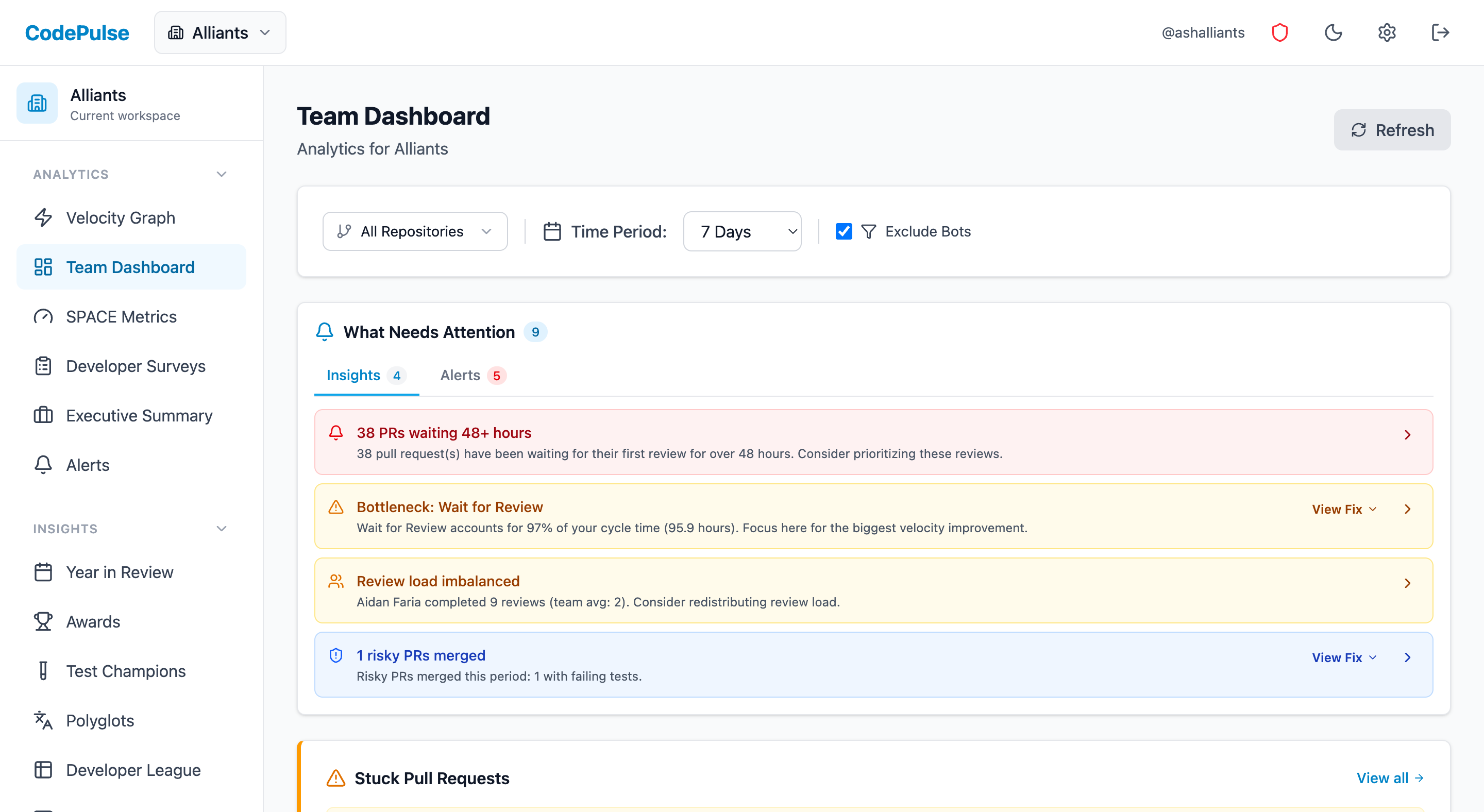
Measuring IDP Impact with CodePulse
CodePulse can help platform teams track developer-facing metrics:
- Cycle time breakdown: See where time is spent in the delivery pipeline - is it code review, CI, or deployment?
- PR throughput by team: Compare teams using the IDP vs. those still on legacy processes
- Review patterns: Are platform-related PRs creating bottlenecks?
- Deployment frequency trends: Track before/after IDP adoption
The Dashboard provides visibility into how code flows through your organization - essential for understanding IDP impact.
Common IDP Metrics Pitfalls
Vanity Metrics
Avoid metrics that look good but don't indicate real success:
- "Number of features shipped" (without quality context)
- "Total deployments" (if most are rollbacks)
- "Tickets closed" (if developers stopped reporting issues)
Ignoring Lagging Indicators
Developer satisfaction is a leading indicator - it predicts future adoption problems. Don't wait for adoption to drop to investigate satisfaction issues.
Not Segmenting Data
Aggregate metrics hide important signals. Segment by:
- Team (some teams may have unique needs)
- Service type (microservices vs. monoliths)
- Experience level (senior vs. junior developers)
- Use case (new service vs. maintenance)
Getting Started with IDP Metrics
For platform teams new to metrics:
- Start with adoption: If developers aren't using the platform, nothing else matters. Measure market share and DAU first.
- Add experience metrics: Survey developers monthly. A declining satisfaction score is an early warning system.
- Connect to DORA: Track deployment frequency and lead time before and after IDP adoption to prove velocity impact.
- Build the business case: Calculate developer productivity ratio and cost efficiency for executive conversations.
The goal is demonstrating that platform investment accelerates the entire engineering organization - not just making the platform team's metrics look good.
Now measure this metric on your own repositories
Connect read-only GitHub in about five minutes and get your baseline, your trend, and the constraint behind it. Your fourteen usable trial days start when the first repository finishes syncing.
Read-only GitHub · Your code stays yours · Team-level by default · No credit card
See These Features in Action
Track all four DORA metrics and benchmark against industry standards.
Board-ready engineering performance in a single page.
Related Guides
Platform Engineering Metrics: KPIs That Prove Infra Impact
Standard velocity metrics make platform teams look slow. These platform-specific KPIs - adoption rate, force multiplier, infra stability - show the real impact.
DORA Metrics Explained: The 4 Keys Without the Hype
A complete breakdown of the four DORA metrics - deployment frequency, lead time, change failure rate, and MTTR - with honest benchmarks and gaming traps to avoid.
Happy Developers Leave Breadcrumbs in Git
Learn how to measure and improve developer experience using behavioral metrics from GitHub, not just surveys. Covers flow state, cognitive load, and collaboration quality.
Platform Tools: The Build vs Buy Mistake
A practical guide to platform engineering tools, build vs buy decisions, and the metrics that prove platform impact.