
Compare the finished analysis before you choose a platform
See the report CodePulse produces from read-only GitHub workflow data, or connect your own repositories and evaluate the fit with real evidence.
Read-only GitHub · Your code stays yours · Team-level by default · No credit card
Platform engineering tools help platform teams deliver a reliable developer platform without drowning in tickets. This guide explains how engineering leaders can evaluate platform engineering tools, choose build vs buy, and measure impact with metrics that resonate with VPs and Directors.
If you are building an internal developer platform, the tooling stack should reduce friction for application teams while giving leadership confidence that platform investment is paying off. The 2024 State of DevOps Report found that the low-performing cluster grew from 17% to 25% year-over-year - meaning many teams are getting worse at delivery, not better. A well-instrumented platform is how you avoid that fate. The broader organisational discipline of making a platform team productive - what to programme, staff, and measure - is covered in our engineering enablement guide.
What are the essential platform engineering tools?
Platform engineering tools fall into five categories: self-service workflows (Backstage, Port), standardized delivery (GitHub Actions, Argo CD), visibility and governance (CodePulse, Swarmia), documentation/discoverability (Backstage, Cortex), and infrastructure abstraction (Terraform, Crossplane). The key is choosing tools that measurably improve cycle time and reduce ticket load, not collecting tools for their own sake.
"The best platform teams are invisible. Developers should ship code without thinking about infrastructure - and leadership should see exactly how that happens."
What Counts as a Platform Engineering Tool?
Platform engineering tools usually fall into a few categories. Your platform team may not need all of them at once, but most mature developer platforms will touch each area.
| Category | Purpose | Example Tools |
|---|---|---|
| Self-service workflows | Provisioning, environment setup, service scaffolding | Backstage, Port, Humanitec |
| Standardized delivery | Repeatable paths to build, test, deploy | GitHub Actions, GitLab CI, Argo CD |
| Visibility and governance | Delivery metrics, quality signals, risk tracking | CodePulse, LinearB, Swarmia |
| Documentation/discoverability | Service catalogs, ownership, onboarding | Backstage, Cortex, OpsLevel |
| Infrastructure abstraction | Kubernetes, cloud resources as code | Terraform, Pulumi, Crossplane |
The goal is not to buy tools for their own sake. It is to reduce cognitive load, speed up delivery, and make platform impact measurable.
🔥 Our Take
Most platform teams buy tools before defining success. That's backwards.
Before evaluating any tool, answer: "What metric will improve, and by how much?" If you can't articulate that, you're not ready to buy. You'll end up with shelfware that nobody adopts because there was no clear problem to solve.
How Do You Decide Between Building and Buying Platform Tools?
Platform teams are often tempted to build everything. That can work if your team has capacity and a clear differentiation goal. But most platform teams operate under headcount constraints and need predictable outcomes.
Use this decision matrix:
| Question | Build If... | Buy If... |
|---|---|---|
| Is this a competitive advantage? | The workflow is core to your product | It is a common need across the industry |
| Do you have platform capacity? | You can staff maintenance long-term | Capacity is limited or fragile |
| Do you need fast time-to-value? | Timeline is flexible (6+ months OK) | You need impact within a quarter |
| Is governance required? | You can guarantee auditability | You need built-in compliance features |
| Is the solution mature? | Market solutions don't fit your stack | Proven tools exist with your integrations |
The Build Trap
Platform teams love building. It's satisfying. But every internal tool you build is a tool you maintain forever. Consider:
- Opportunity cost: Every engineer maintaining analytics infrastructure is an engineer not improving developer experience
- Tribal knowledge: The engineer who built it leaves, and now you have undocumented infrastructure
- Feature lag: Vendors ship improvements monthly. Your internal tool gets updates when there's spare capacity (rarely)
Build vs Buy Cost Calculator
Compare the true cost of building internal tools versus subscribing to SaaS solutions.
Examples:
Interpretation:
For build-vs-buy analysis with metrics and ROI framing, see the Analytics as Code Guide and the Developer Tooling ROI Guide.
What Metrics Prove Platform Tool Impact?
Platform engineering leaders need metrics that demonstrate leverage, not just activity. These indicators translate platform work into outcomes leadership cares about.
The Platform Impact Framework
Organize metrics into three tiers: leading indicators, delivery outcomes, and business value.
| Tier | Metric | What It Shows |
|---|---|---|
| Leading (daily) | Self-service rate | % of provisioning done without tickets |
| Leading | Time to first deploy | New engineer productivity ramp |
| Delivery (weekly) | Cycle time reduction | Faster delivery after platform changes |
| Delivery | Review latency | Less waiting in critical repos |
| Business (quarterly) | Platform adoption | % of teams using developer platform |
| Business | Feature velocity | Features shipped per sprint/quarter |
"Platform teams that can't show cycle time improvements within 6 months are building infrastructure, not leverage."
For a deeper framework, see Internal Developer Platform Metrics and Platform Team Metrics.
What Does a Practical Platform Tooling Stack Look Like?
A common failure mode is buying tools that do not talk to each other. This lightweight blueprint keeps the stack coherent and measurable.
| Layer | Outcome | Measurement Signal |
|---|---|---|
| Source control + reviews | Consistent delivery workflow | Cycle time breakdown, review coverage |
| Self-service platform | Reduced ticket load | Time to first deploy, self-service rate |
| Operational reliability | Reduced platform incidents | Change failure rate, MTTR |
| Executive visibility | Leadership alignment | Board-ready metrics summaries |
Tool Integration Checklist
Before adding any tool to your stack, verify these integration points:
- ☐ Data export: Can you get raw data out for custom analysis?
- ☐ API access: Can you automate workflows and integrate with alerts?
- ☐ SSO/SCIM: Does it integrate with your identity provider?
- ☐ Webhook support: Can it notify other systems of events?
- ☐ Audit logging: Does it track who did what, when?
What Are the Common Platform Tool Combinations by Stage?
Here are tooling patterns we see at different stages of platform maturity:
Early Stage (1-50 developers)
Focus: Basic delivery metrics, remove obvious bottlenecksGrowth Stage (50-200 developers)
Focus: Self-service, onboarding speed, team comparisonsScale Stage (200+ developers)
Focus: Portfolio visibility, compliance, efficiency at scale🔥 Our Take
Developer portals are overrated for teams under 100 engineers.
We see teams spending 6+ months building Backstage deployments when a shared wiki and good README files would solve 80% of discoverability problems. Start with the basics: clear documentation, obvious ownership, consistent naming. You'll know when you need a portal - it's when teams can't find things despite good docs.
How Do You Evaluate Tools Without Breaking Developer Trust?
Platform tooling can easily look like surveillance if metrics are framed poorly. The Stack Overflow 2024 Developer Survey found only about one in five developers are happy at work, with the rest complacent or unhappy. Don't make it worse with surveillance tools.
Engineering leaders should make expectations explicit:
- Focus on team-level insights: Individual metrics create competition, not collaboration
- Share dashboards with developers: Transparency builds trust; secrecy breeds suspicion
- Document usage policies: Write down how metrics will (and will not) be used in performance reviews
- Make permissions visible: Who can see what? Make it obvious.
"If your developers find out about a metrics tool from someone else, you've already lost trust. Announce it first."
For rollout guidance, see Engineering Metrics Trust Guide and Measure Team Performance Without Micromanaging.
What Is the Right Platform Tool Evaluation Process?
Use this structured process to avoid expensive mistakes:
Phase 1: Define Success (Week 1)
- What problem are we solving? (Be specific)
- What metric will improve?
- Who are the users? (Platform team vs. application developers)
- What's the budget range?
- What integrations are required?
Phase 2: Shortlist (Week 2)
- Research 3-5 options (include "build" as an option)
- Create comparison matrix against your requirements
- Check G2/Reddit/HackerNews for real user feedback
- Narrow to 2-3 finalists
Phase 3: Trial (Weeks 3-4)
- Request trials with your actual repos/infrastructure
- Test integration with your existing tools
- Measure setup time and data accuracy
- Get feedback from actual users (not just decision-makers)
Phase 4: Decide (Week 5)
- Score finalists against original success criteria
- Factor in total cost of ownership (not just subscription)
- Get buy-in from stakeholders (including developers)
- Document decision rationale for future reference
How Does CodePulse Fit a Platform Engineering Tooling Stack?
CodePulse focuses on GitHub-based delivery and collaboration signals, which makes it a strong visibility layer for platform teams. You can use it to:
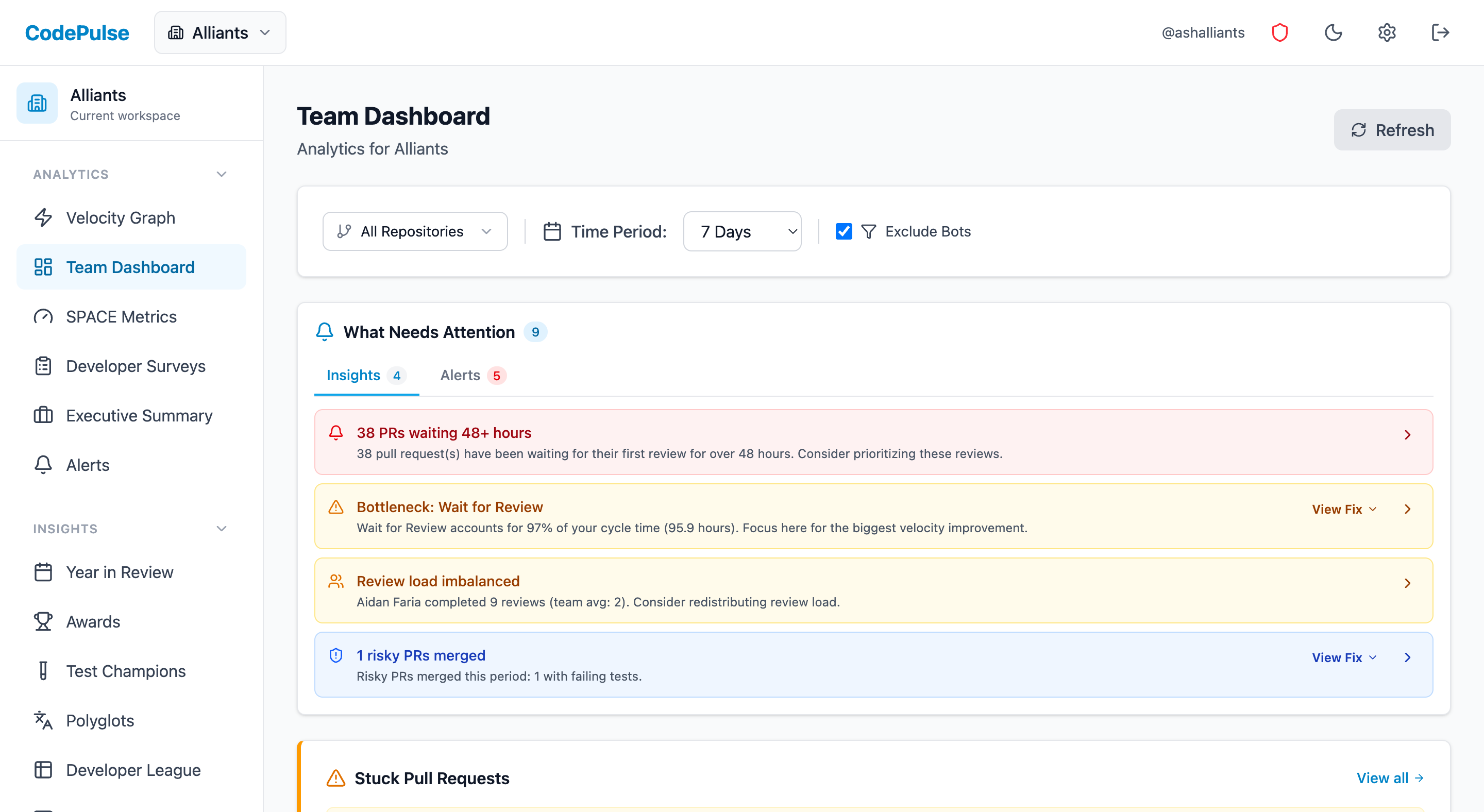
- Track cycle time and review bottlenecks in the Dashboard
- Surface review load imbalance in the Review Network
- Identify high-risk platform code in File Hotspots
- Share exec-ready summaries in the Executive Summary
- Set alert rules for stuck work in Alerts
📊 Platform Team Use Cases in CodePulse
Platform teams use CodePulse to prove impact and identify where to invest next:
- Compare cycle time before/after platform changes
- Identify which repos have the worst review bottlenecks
- Find hotspot files that need refactoring or better ownership
- Set alerts for PRs stuck longer than SLA thresholds
- Generate executive summaries for quarterly reviews
For more on platform-specific metrics, see the Internal Developer Platform Metrics guide. For rollout planning, see the Engineering Metrics Rollout Playbook.
Frequently Asked Questions
Buy when the need is common across the industry, your platform team has limited capacity, you need impact within a quarter, and proven tools exist for your stack. Build when the workflow is a competitive advantage, you can staff long-term maintenance, and market solutions do not fit your specific requirements.
Evaluate CodePulse against your own delivery history
A comparison table only goes so far. Connect read-only GitHub in about five minutes and judge the output on your repositories, at one flat price, with no per-seat math.
Read-only GitHub · Your code stays yours · Team-level by default · No credit card
See These Features in Action
Track all four DORA metrics and benchmark against industry standards.
Track deployment frequency, lead time, and release patterns.
Related Guides
Your IDP Is Failing. Here's How to Prove It (Or Fix It)
Learn how to measure the success of your Internal Developer Platform. Covers adoption metrics, developer experience, delivery impact, and ROI calculation.
Platform Engineering Metrics: KPIs That Prove Infra Impact
Standard velocity metrics make platform teams look slow. These platform-specific KPIs - adoption rate, force multiplier, infra stability - show the real impact.
The ROI Template That Gets Developer Tools Approved
The exact ROI calculation and business case template that gets CFOs to approve developer tool purchases.
Jellyfish vs LinearB vs Swarmia: Full 2026 Comparison
Compare Jellyfish, LinearB, Swarmia, Allstacks, Haystack and more engineering analytics tools. Features, pricing, cycle time benchmarks, and integrations.
Best Propelo Alternative for 2026 (Formerly LevelOps)
Compare 7 Propelo (LevelOps) alternatives including CodePulse, LinearB, Sleuth, and more. Honest pros, cons, pricing, and DORA metrics comparisons.
Best Athenian Alternative for 2026 (Honest Review)
Compare 7 Athenian alternatives including CodePulse, LinearB, Swarmia, and more. Honest pros, cons, pricing, and velocity metrics comparisons.
OpsLevel vs Cortex: $28.8k vs $75k (and Metrics Gap)
OpsLevel and Cortex compared on sourced buyer pricing ($28,800 vs $75,000 median), documented features, and the metrics gap - plus what neither portal covers and when you do not need an IDP at all.