
Compare the finished analysis before you choose a platform
See the report CodePulse produces from read-only GitHub workflow data, or connect your own repositories and evaluate the fit with real evidence.
Read-only GitHub · Your code stays yours · Team-level by default · No credit card
GitHub Insights is free, built-in, and sufficient for solo developers or small open-source projects. But if you manage a team of 10+ engineers and need to answer questions about delivery speed, review bottlenecks, or knowledge concentration, you will hit its ceiling fast. This guide breaks down exactly where GitHub Insights stops and where CodePulse starts.
GitHub ships three analytics surfaces: the Contributors graph (commit frequency over time), Pulse (activity summary for a period), and Traffic (clones and page views). In 2023, GitHub added Copilot Metrics for organizations using GitHub Copilot. None of these surfaces answer the questions engineering managers actually face in sprint retros, board meetings, or headcount conversations.
"Free tools are only free if your time has no value. The question isn't what GitHub Insights costs. It's what the gaps cost you."
What GitHub Insights Actually Gives You
Be specific about what's included before criticizing what's missing. GitHub's built-in analytics cover three areas. If one of these signals is already broken or misleading in your data, our engineering metrics troubleshooting guide walks through the common causes and fixes.
1. Contributors Graph
Shows commit count, additions, and deletions per contributor over time. Filterable by branch. This is useful for spotting whether someone has gone silent on a repo, but it tells you nothing about PR throughput, review quality, or cycle time.
2. Pulse
A period summary showing merged PRs, proposed PRs, closed issues, and new issues. Pulse is a snapshot, not a trend. You cannot compare this week to last week without manually recording numbers. There are no alerts, no breakdowns, and no way to slice by team.
3. Traffic
Clone counts and page views per repository. This is useful for open-source maintainers tracking adoption. It has no relevance to internal engineering efficiency.
4. GitHub Copilot Metrics (Organizations)
If your org uses GitHub Copilot, you get acceptance rates, suggestion counts, and language breakdowns. According to GitHub's own research, Copilot users complete tasks 55% faster. But Copilot Metrics measures AI tool adoption, not engineering delivery. You still cannot see how long PRs sit in review or which files concentrate risk.
Feature-by-Feature Comparison
This table compares GitHub's built-in analytics against CodePulse across the metrics engineering leaders actually need:
| Capability | GitHub Insights | CodePulse |
|---|---|---|
| PR cycle time breakdown | Not available | 4-phase: Coding, Waiting, Review, Merge |
| Review network visualization | Not available | Interactive graph of who reviews whom |
| Knowledge silo detection | Not available | Bus factor scoring per file/directory |
| DORA metrics | Not available | Deployment frequency, lead time, CFR, MTTR |
| File hotspot analysis | Not available | High-churn files with risk scoring |
| Alerting (stuck PRs, SLA breaches) | Not available | Configurable alert rules with Slack/email |
| Executive summary dashboard | Not available | Health grade with board-ready export |
| Commit activity graphs | Per-repo contributor graph | Cross-repo with team filtering |
| Bot filtering | Not available | Automatic detection and exclusion |
| Cross-repo aggregation | Not available (per-repo only) | Organization-wide rollups |
| Cost | Free (included with GitHub) | Free tier available; paid plans for teams |
"GitHub Insights tells you what happened. It doesn't tell you why it's slow, who's overloaded, or what's at risk. Those are the questions that cost you engineers."
The Five Gaps That Cost Engineering Teams the Most
These aren't theoretical shortcomings. They're the exact blind spots that cause EMs to lose credibility in leadership meetings and miss preventable delivery failures. Teams evaluating whether to close these gaps by building in-house should read our CodePulse vs building your own breakdown first - the maintenance cost of a homegrown analytics stack is the hidden sixth gap. Note these are analytics gaps, not security ones - GitHub's own security tooling is a separate evaluation, covered in our GitHub Advanced Security vs Azure DevOps guide.
Gap 1: No Cycle Time Decomposition
GitHub shows that a PR was merged. It does not show that the PR sat 3 days waiting for review, was reviewed in 20 minutes, then sat another 2 days waiting for merge approval. Without the breakdown, you cannot identify bottlenecks. According to the 2024 DORA Report, lead time for changes is one of four key metrics that separate elite teams from low performers.
Gap 2: No Review Load Visibility
GitHub does not surface which reviewers are overloaded. One senior engineer quietly handling 60% of all reviews is invisible in GitHub Insights but obvious in a review network visualization. Review bottlenecks are the most common cause of cycle time inflation, and they are entirely hidden in GitHub's native tooling.
Gap 3: No Knowledge Silo Detection
If one engineer is the sole contributor to a critical service, that's a bus factor of 1. GitHub's contributor graph shows commit counts but does not flag concentration risk. CodePulse's File Hotspots surface files with high change frequency and low contributor diversity.
Gap 4: No Cross-Repository View
GitHub Insights is per-repository. If your team works across 15 repos, you get 15 separate dashboards with no aggregation. For EMs tracking team velocity or VPs reporting to the board, this fragmentation is a dealbreaker.
Gap 5: No Trend Comparison or Alerting
GitHub Pulse shows a single-period snapshot. You cannot overlay Q1 vs Q2 cycle times or set an alert for "notify me if any PR sits in review for more than 48 hours." Proactive alerting is the difference between firefighting and prevention.
🔥 Our Take
GitHub Insights is designed for repository maintainers, not engineering leaders. Comparing it to an analytics platform is like comparing a car's odometer to a fleet management system.
GitHub doesn't want to build deep engineering analytics. Their business model is hosting code and selling Copilot seats. That's fine. But stop pretending the Contributors graph is "analytics." It's a commit counter with a date axis.
When GitHub Insights Is Genuinely Enough
Honesty matters. GitHub's built-in tools are sufficient in these scenarios:
- Solo developer or 2-3 person team: You don't need formal analytics when you can see everything in your PR list
- Open-source project maintainer: Traffic and contributor graphs serve the use case of tracking community engagement
- No reporting requirements: If nobody asks you for delivery metrics or engineering health summaries, the overhead of a separate tool isn't justified
- Pure Copilot ROI tracking: If your only analytics need is measuring Copilot adoption, GitHub's built-in Copilot Metrics covers it
GitHub Insights breaks down when you need to answer: "Why are we slower this quarter?" "Who's a review bottleneck?" "What's our bus factor on the payments service?" "Are we actually improving?" If those questions matter, you need something more.
For a broader comparison of analytics tools beyond GitHub, see the Engineering Analytics Tools Comparison and the Best Engineering Analytics Tools guide.
What CodePulse Adds on Top of GitHub
CodePulse connects to your GitHub organization and builds analytics from PR, review, commit, and file data. It does not replace GitHub. It reads from GitHub and surfaces patterns you cannot see natively.
📊 How to See This in CodePulse
After connecting your GitHub org (5-minute setup), navigate to:
- Dashboard for cycle time breakdown across all repos
- Review Network to spot reviewer overload instantly
- File Hotspots for bus factor and knowledge silo detection
- Executive Summary for a board-ready health grade you can export
- Alert Rules to get notified when PRs breach your SLA
Moving From GitHub Insights to Proper Analytics
You don't need to rip out anything. CodePulse reads from GitHub - it doesn't replace it. The migration path is additive:
Week 1: Connect GitHub org → CodePulse syncs historical data (6 months)
Week 2: Review cycle time dashboard → Identify your biggest bottleneck
Week 3: Set up alert rules → Catch stuck PRs before they age
Week 4: Share executive summary → Give leadership actual delivery data

Time investment: ~30 minutes setup, then 10 min/week reviewing dashboards
No GitHub configuration changes required.
For guidance on rolling out metrics without triggering team resistance, see the Engineering Metrics Rollout Playbook and Building Trust with Engineering Metrics.
"The best time to set up engineering analytics was when your team hit 10 engineers. The second best time is today."
Frequently Asked Questions
No. CodePulse reads from GitHub via API. Your developers continue working in GitHub exactly as before. CodePulse adds an analytics layer on top.
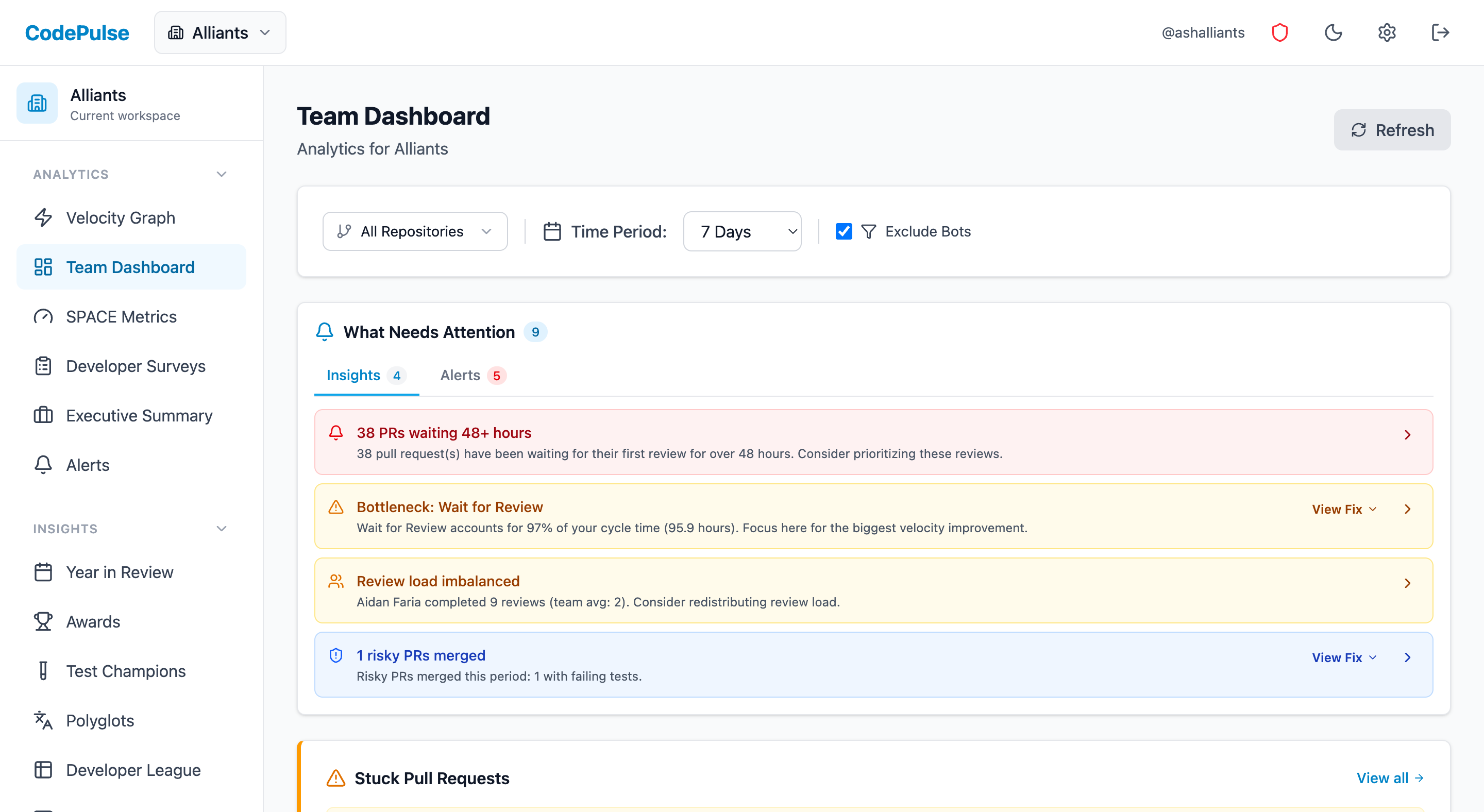
Evaluate CodePulse against your own delivery history
A comparison table only goes so far. Connect read-only GitHub in about five minutes and judge the output on your repositories, at one flat price, with no per-seat math.
Read-only GitHub · Your code stays yours · Team-level by default · No credit card
See These Features in Action
Board-ready engineering performance in a single page.
Break down cycle time into coding, waiting, review, and merge phases.
Related Guides
Jellyfish vs LinearB vs Swarmia: Full 2026 Comparison
Compare Jellyfish, LinearB, Swarmia, Allstacks, Haystack and more engineering analytics tools. Features, pricing, cycle time benchmarks, and integrations.
Best Engineering Analytics Tools for 2026 (Ranked by Real Users)
We ranked the 10 best engineering analytics tools based on metric depth, setup speed, pricing transparency, and privacy posture. Honest pros and cons for each.
Self-Hosted Analytics Looked Cheaper. Here's What Actually Happened
We ran the numbers on self-hosted vs SaaS engineering analytics. The total cost surprised us.
DORA Metrics Explained: The 4 Keys Without the Hype
A complete breakdown of the four DORA metrics - deployment frequency, lead time, change failure rate, and MTTR - with honest benchmarks and gaming traps to avoid.
Evaluating GitHub as a Code Collaboration Platform
An engineering leader's evaluation of GitHub as a code collaboration and DevOps platform: what it does well, where it falls short, and what analytics to layer on top.