
Compare the finished analysis before you choose a platform
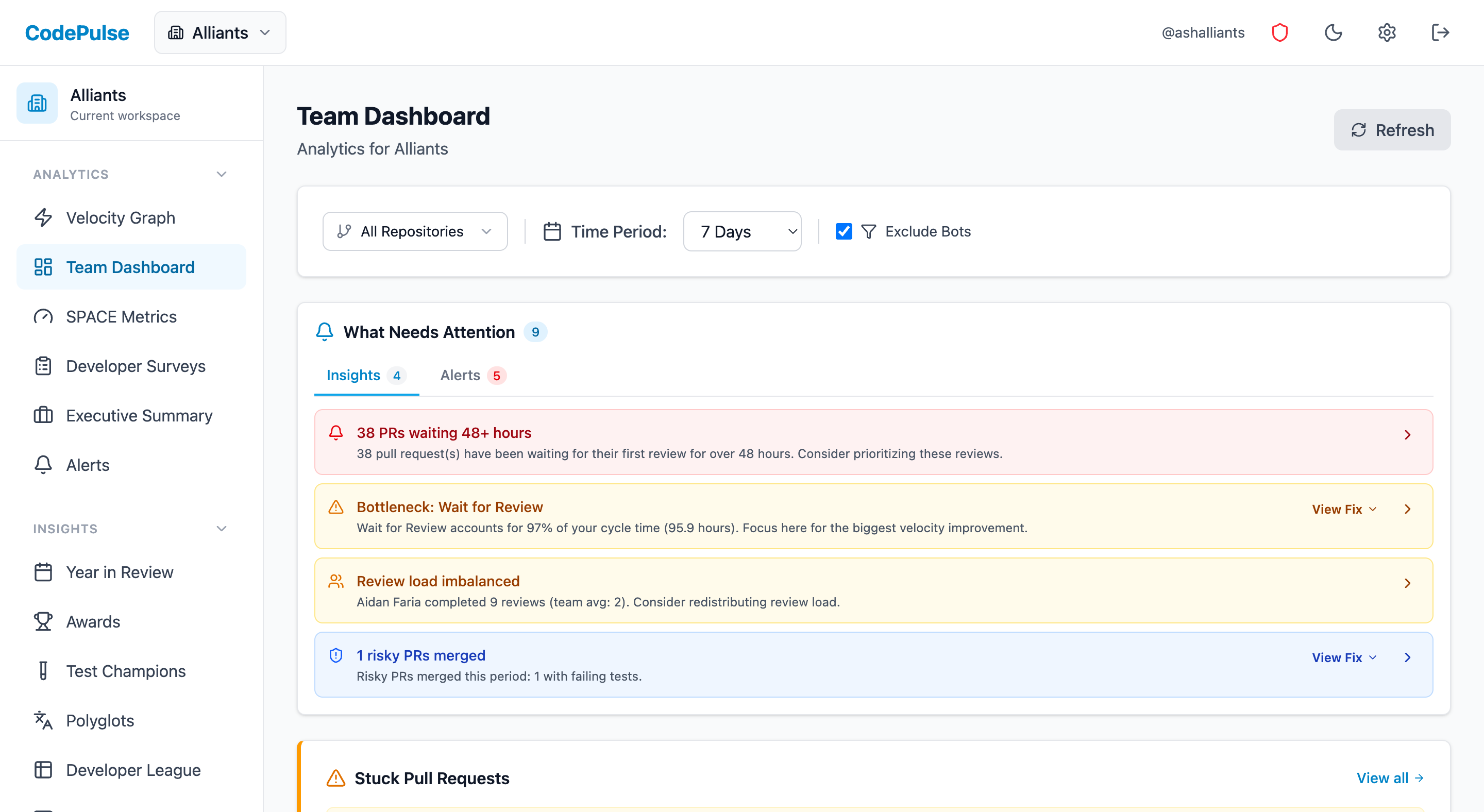
See the report CodePulse produces from read-only GitHub workflow data, or connect your own repositories and evaluate the fit with real evidence.
Read-only GitHub · Your code stays yours · Team-level by default · No credit card
You're a Staff or Principal Engineer. You've seen the GitHub GraphQL API. You know BigQuery. You've built Grafana dashboards before. Building your own engineering analytics dashboard feels like a weekend project. It's not. This guide walks through the real complexity, time estimates, and hidden costs of building a custom engineering metrics platform, based on the exact problems we solved building CodePulse.
The instinct to build is rational. Engineers solve problems by building. And the initial prototype is genuinely easy: pull PRs from the GitHub API, calculate averages, display in Grafana. The problem isn't the prototype. It's everything after.
"Building a PR dashboard takes a weekend. Building a PR analytics platform that your VP trusts takes 6 months and 3 rewrites."
The Weekend Prototype vs. The Production System
Here's what the typical "build it ourselves" journey looks like. We've seen this pattern across dozens of teams who later switched to CodePulse:
| Phase | What You Think | What Actually Happens |
|---|---|---|
| Week 1-2 | Pull PRs from GitHub API, display in Grafana | Works for 1 repo. Hit rate limits on 5+. |
| Month 1-2 | Add cycle time calculation and historical data | Realize cycle time needs 4-phase decomposition. GitHub API pagination is fragile. |
| Month 2-3 | Add incremental sync and error handling | Build watermark-based sync. Handle webhook delivery failures. Debug timezone issues. |
| Month 3-4 | Add team views and bot filtering | Realize bots skew all metrics. Need entity resolution for GitHub username → person mapping. |
| Month 4-6 | Polish UI, add alerting | Leadership wants executive dashboards. Other teams want access. Now you're building multi-tenancy. |
| Month 6+ | Done, in maintenance mode | Ongoing: API changes, rate limit handling, schema migrations, "can you add X" requests. |
The Eight Hidden Complexities
These are the problems that don't show up in the prototype but consume 80% of the engineering time in a production system:
1. GitHub API Rate Limits
GitHub's REST API allows 5,000 requests per hour per installation. The GraphQL API has a point-based system with a 5,000-point budget per hour. For an organization with 50 repos and active PRs, a full sync can exhaust your rate limit in minutes. You need: exponential backoff, rate limit budget tracking, request prioritization, and Redis-based rate limit caching. According to GitHub's documentation, a single complex GraphQL query can cost 100+ points.
2. Incremental Sync Without Gaps
Pulling all data on every sync is expensive and slow. You need watermark-based incremental sync: track the last-synced timestamp per repository, fetch only newer data, handle out-of-order updates, and checkpoint progress to survive restarts. If your sync crashes mid-batch, you need to resume without duplicating or missing records.
3. Cycle Time Decomposition
"Cycle time" sounds like a single number. It's actually four phases: Coding (first commit to PR open), Waiting for Review (PR open to first review), In Review (first review to approval), and Merge (approval to merge). Each requires different event timestamps, and edge cases abound: self-merged PRs, PRs with no reviews, PRs reopened after close, draft PRs converted to ready.
4. Bot Detection and Filtering
Dependabot, Renovate, GitHub Actions bots, Copilot-authored commits - bots inflate every metric if not filtered. Detection isn't just checking for "[bot]" in the username. Some bots use regular user accounts. You need a maintainable bot list and a filtering toggle that works retroactively.
5. Multi-Repository Aggregation
Grafana dashboards handle per-repo views well. Aggregating across 20+ repos into team-level and organization-level rollups is where complexity explodes. You need consistent metric definitions across repos, weighted averages (not simple averages), and the ability to filter by arbitrary repo groups.
6. Review Network Analysis
Knowing who reviewed what PR is easy. Building a review network visualization that shows load distribution, bottleneck reviewers, and collaboration patterns requires graph analysis that's well beyond Grafana's capabilities.
7. Metric Accuracy at Scale
Small errors compound at scale. A timezone bug that shifts cycle time calculations by hours. A GitHub API that returns "updated_at" when you needed "merged_at." A PERCENTILE_CONT query that fails without numeric casting. These bugs are subtle and erode trust in the entire system.
8. Ongoing Maintenance
GitHub deprecates API endpoints. Your PostgreSQL schema needs migrations when you add metrics. Grafana major versions break dashboard JSON. The engineer who built it gets promoted or leaves. Now you have an undocumented internal platform that nobody wants to own.
🔥 Our Take
The decision to build isn't really about capability. It's about opportunity cost. Your best engineers should be building product, not reinventing analytics infrastructure.
We built CodePulse. It took a dedicated team over a year to handle the edge cases, rate limits, sync reliability, and metric accuracy that production use demands. Could your Staff Engineer build something? Absolutely. Should they spend 6 months on it instead of shipping features? That's the real question.
Build vs. Buy: Total Cost of Ownership
Use this framework to estimate the real cost of building, not just the prototype:
BUILD COST (Custom BigQuery + Grafana + GitHub API)

Initial build (3-6 months):
- Senior/Staff engineer time:     $75,000 - $150,000
  (3-6 months × $150K-$200K fully-loaded salary, partial allocation)
- Infrastructure setup:           $2,000 - $5,000
  (BigQuery, Cloud Run/GKE, Redis, monitoring)

Ongoing annual costs:
- Maintenance engineer time:      $25,000 - $50,000/year
  (0.15-0.25 FTE for bug fixes, API changes, feature requests)
- Infrastructure:                 $6,000 - $24,000/year
  (BigQuery storage/compute, hosting, monitoring)
- Opportunity cost:               Unquantified but significant
  (what else could that engineer build?)

FIRST-YEAR TOTAL:                 $108,000 - $229,000
ONGOING ANNUAL:                   $31,000 - $74,000/year

BUY COST (CodePulse or similar):
- Subscription:                   $3,600 - $18,000/year (team size dependent)
- Setup time:                     ~30 minutes (one-time)
- No maintenance, no infrastructure, no opportunity cost
The math is clear for most teams. Building makes financial sense only when you have requirements that no vendor can satisfy and the engineering capacity to sustain an internal platform long-term.
For detailed ROI frameworks, see the Engineering Analytics ROI Guide and the Self-Hosted vs SaaS Engineering Analytics guide.
"The prototype is the easy part. Production reliability, metric accuracy, and ongoing maintenance are where custom builds die."
When Building Your Own Genuinely Makes Sense
Custom builds are the right choice in specific circumstances. Build if:
- You need to join Git data with proprietary systems: If your metrics require correlating GitHub activity with internal billing, HR, or custom deployment systems, and no vendor offers that integration, custom ETL is justified
- Your metric definitions are non-standard: If your organization defines "cycle time" differently from the industry (e.g., including design review time tracked in Figma), you need custom calculation logic
- You have a dedicated platform team: If you already operate data infrastructure (BigQuery, Airflow, dbt) and have a team that maintains internal tools, adding engineering metrics is incremental effort
- Data residency mandates: If regulatory requirements prohibit sending code metadata to SaaS vendors, custom is your only option
- Extreme scale: If you have 1,000+ repositories and need sub-minute query response times on custom aggregations, you may outgrow vendor tooling
If none of these apply, buying saves 3-6 months of engineering time and delivers better metrics accuracy from day one.
The Hybrid Approach: Buy Standard, Build Custom
The pragmatic middle ground: use a vendor for standard metrics and build custom pipelines only for what vendors cannot provide.
📊 What CodePulse Handles Out of the Box
Replace these custom-built components immediately:
- PR cycle time breakdown with 4-phase decomposition (no custom timestamp logic needed)
- Review network visualization (no graph library integration needed)
- File hotspots and knowledge silo detection (no custom file-author analysis)
- Executive summary with health grading (no custom scoring algorithm needed)
- Alert rules for stuck PRs and SLA breaches (no webhook/notification plumbing)
Then build custom for your specific needs: correlating deploy events with business metrics, joining Git data with your internal knowledge base, or calculating organization-specific productivity measures.
For a broader comparison of analytics tool options, see the Engineering Analytics Tools Comparison and the Best Engineering Analytics Tools guide.
The Five Mistakes Custom Builds Always Make
After seeing dozens of teams attempt custom builds, these mistakes recur with predictable regularity:
- Underestimating GitHub API complexity: Pagination, rate limits, webhook reliability, and GraphQL query cost budgets are each a week of work to handle correctly
- Ignoring data quality from day one: Bot filtering, branch exclusion rules, timezone normalization, and merge commit detection are "boring" problems that corrupt every metric if skipped
- Building for one team, then being asked to support five: Multi-team access controls, per-team dashboards, and cross-team aggregation are architectural decisions that are painful to retrofit
- No metric backfill strategy: Leadership wants to see trends from the last 6 months. Your system only has data from when it was deployed. Backfilling historical data from GitHub is a separate engineering project
- Treating it as a one-time build: The initial dashboard is 20% of the total effort. The remaining 80% is maintenance, feature requests, bug fixes, and keeping pace with GitHub API changes
"Internal tools don't have product managers. They have the last engineer who touched the code. That's why they stagnate."
Frequently Asked Questions
You can build a basic dashboard in 1-2 days. But "basic" means commit counts and PR counts, without cycle time decomposition, review analysis, or alerting. Evaluating a vendor takes 30 minutes for a trial. The question is whether the basic dashboard will stay basic or grow into an unplanned internal product.
Evaluate CodePulse against your own delivery history
A comparison table only goes so far. Connect read-only GitHub in about five minutes and judge the output on your repositories, at one flat price, with no per-seat math.
Read-only GitHub · Your code stays yours · Team-level by default · No credit card
See These Features in Action
Board-ready engineering performance in a single page.
Break down cycle time into coding, waiting, review, and merge phases.
Related Guides
Self-Hosted Analytics Looked Cheaper. Here's What Actually Happened
We ran the numbers on self-hosted vs SaaS engineering analytics. The total cost surprised us.
Jellyfish vs LinearB vs Swarmia: Full 2026 Comparison
Compare Jellyfish, LinearB, Swarmia, Allstacks, Haystack and more engineering analytics tools. Features, pricing, cycle time benchmarks, and integrations.
Best Engineering Analytics Tools for 2026 (Ranked by Real Users)
We ranked the 10 best engineering analytics tools based on metric depth, setup speed, pricing transparency, and privacy posture. Honest pros and cons for each.
Engineering Analytics ROI: The Budget Approval Playbook
Calculate the ROI of engineering analytics tools with formulas for time savings, payback period, and a business case template tailored to CFOs, CTOs, and CEOs.