
See exactly where your delivery flow is waiting
Preview the phase-by-phase report for review pickup, active review, and merge time. Connect in about five minutes; the initial analysis runs after sync.
Read-only GitHub · Your code stays yours · Team-level by default · No credit card
Stuck pull requests are silent productivity killers. They don't appear on burndown charts, they don't trigger alerts, and they don't show up in sprint retrospectives - until suddenly a developer mentions they've been waiting 5 days for a review. By then, the damage is done: context is lost, conflicts have accumulated, and momentum has evaporated.
This guide provides a systematic framework for identifying stuck PRs before they become problems, understanding why PRs get stuck in the first place, and implementing automated alerts that catch stale PRs early. These patterns help engineering leaders and tech leads keep the PR pipeline flowing and eliminate bottlenecks.
What is a stuck pull request and how do you detect them?
A stuck PR is one waiting for action (review or author response) longer than its SLA threshold without meaningful progress. The five primary patterns are reviewer overload, scope creep, knowledge silos, unclear ownership, and feedback stalemate. Set automated alerts at 24h (warning) and 48h (critical) thresholds. CodePulse detects stuck PRs automatically through its Alerts and Dashboard pages.
🔥 Our Take
A stuck PR isn't a developer problem - it's a system problem. The moment you start blaming individuals for stuck PRs, you've missed the point entirely.
PRs get stuck because of unclear ownership, unbalanced review loads, knowledge silos, or misaligned incentives. These are organizational issues that require organizational solutions. Track stuck PRs to understand your system, not to identify underperformers. The developer whose PR has been waiting 6 days isn't the problem - the system that allows 6-day waits is the problem.
What Is the Hidden Cost of Stuck PRs?
When a PR sits idle, the costs compound in ways that aren't immediately visible:
"Every stuck PR is borrowed time. You're paying interest in merge conflicts, context switches, and developer frustration - and the rate compounds daily."
Direct Costs
- Context decay: After 48 hours, developers have moved on mentally. Addressing review feedback requires a full context reload - studies suggest this takes 15-30 minutes per switch.
- Merge conflicts: The longer a branch lives, the higher the probability of conflicts. Each conflict resolution is pure waste - work that produces no value.
- Stale dependencies: If the PR updates libraries or depends on other code, those dependencies continue evolving while the PR waits.
- Blocked follow-up work: Features often have dependencies. One stuck PR can block multiple developers waiting for its changes.
Hidden Costs
- Demoralization: Developers lose motivation when their work sits ignored. "Why spend effort on quality if no one cares enough to look at it?"
- Abandonment: Research shows PRs waiting longer than 7 days have a 3x higher abandonment rate. Work simply gets orphaned.
- Large PR syndrome: When developers expect long waits, they batch more changes into single PRs to "make it worth the wait" - creating larger, harder-to-review PRs.
- Review quality decline: Ironically, PRs that finally get attention after days of waiting often receive rushed, superficial reviews. The reviewer feels pressure to finally unblock the author.
Quantifying the Impact
Consider a team of 8 engineers producing 30 PRs per week. If 20% of those PRs get "stuck" (waiting more than 48 hours for review):
| Metric | Healthy Team | 20% Stuck Rate |
|---|---|---|
| Stuck PRs/week | 1-2 | 6 |
| Context switches/dev/week | 2-3 | 5-8 |
| Hours lost to conflicts/week | 1-2 | 6-10 |
| Avg cycle time | 24 hours | 72+ hours |
Why Do PRs Get Stuck? The 5 Patterns
Understanding why PRs get stuck is the first step to preventing it. In our analysis of engineering teams, we've identified five primary patterns that cause PR stagnation:
Pattern 1: Reviewer Overload
What it looks like: The same 2-3 people are tagged on most PRs. Their review queues grow to 8-10 pending items. Response times stretch to days.
Root cause: Review work concentrates in senior engineers because they "know the most." But this creates a bottleneck where team velocity is limited by a few individuals' bandwidth.
Warning signs:
- Single reviewer handling >30% of team reviews
- Reviewers with 5+ pending reviews at any time
- The same names appear on every CODEOWNERS rule
Solution: Distribute review load more evenly. See our Review Load Balancing Guide for specific strategies.
Pattern 2: Scope Creep
What it looks like: A PR starts as a simple feature but grows to 800+ lines. Reviewers put it off because "they need time to properly review that." The PR ages while waiting for a magical uninterrupted review session that never comes.
Root cause: Developers batch too much into single PRs, either because they expect slow reviews (so they "make it count") or because work wasn't properly scoped.
Warning signs:
- PRs with >400 lines changed
- PRs that touch 10+ files
- PRs with vague titles like "Feature work" or "Misc updates"
Solution: Establish PR size guidelines. Consider requiring PRs over 400 lines to be split before review. See our Reduce PR Cycle Time guide for more on optimal PR sizing.
Pattern 3: Knowledge Silos
What it looks like: A PR touches a critical subsystem, and only one person on the team understands it well enough to review. If that person is busy, on PTO, or simply overwhelmed - the PR waits indefinitely.
Root cause: Lack of cross-training and intentional knowledge sharing. Critical areas develop "owners" who become irreplaceable bottlenecks.
"If only one person can review changes to a critical system, you don't have a bus factor problem - you have a PR queue problem happening right now, every day."
Warning signs:
- Directories with single-person CODEOWNERS
- PRs that can only be reviewed by specific individuals
- Review network graphs showing isolated clusters
Solution: Intentionally rotate reviewers to spread knowledge. Require at least 2 qualified reviewers for each critical area. Track knowledge distribution with tools like CodePulse's Review Network.
Pattern 4: Unclear Ownership
What it looks like: A PR is opened but no specific reviewer is assigned, or reviewers are assigned but none feel primary responsibility. Everyone assumes someone else will handle it.
Root cause: Diffusion of responsibility. When everyone is responsible, no one is responsible.
Warning signs:
- PRs with multiple reviewers but no activity
- PRs where reviewers are auto-assigned by team, not individual
- No clear "primary reviewer" designation
Solution: Establish clear primary reviewer assignment. Even when multiple reviewers are tagged, designate one as the "primary" who is responsible for initial response within the SLA.
Pattern 5: Feedback Stalemate
What it looks like: A reviewer requests changes, the author addresses them, and then... nothing. The PR sits in a "Changes Requested" state while both parties wait for the other to act.
Root cause: Unclear expectations about follow-up. The author thinks the reviewer will automatically re-review. The reviewer is waiting for the author to request re-review. Days pass.
Warning signs:
- PRs with recent commits but no recent review activity
- Multiple rounds of review without resolution
- "Changes Requested" PRs older than 48 hours
Solution: Establish re-review protocols. When an author addresses feedback, they should explicitly request re-review. Set SLAs for follow-up reviews that are tighter than initial reviews. See our Implementing PR SLA Guide for detailed SLA frameworks.
How Does the Aging PR Framework Enable Early Detection?
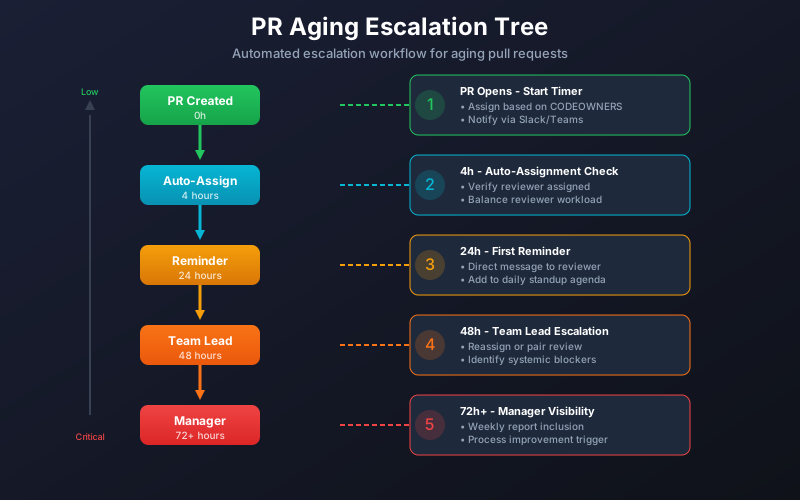
The key to preventing stuck PRs is catching them early. We recommend implementing an "Aging PR Framework" with escalating thresholds:
AGING PR DECISION TREE
======================

PR Opened
    │
    ├─── 4 hours: Is there a reviewer assigned?
    │       │
    │       ├─── NO → Auto-assign based on CODEOWNERS or rotation
    │       └─── YES → Continue monitoring
    │
    ├─── 24 hours (WARNING): Any review activity?
    │       │
    │       ├─── NO → Send Slack reminder to assigned reviewer(s)
    │       │         "PR #123 has been waiting 24h for initial review"
    │       └─── YES → Continue monitoring
    │
    ├─── 48 hours (ALERT): Any review activity?
    │       │
    │       ├─── NO → Escalate to team lead
    │       │         Consider reassignment
    │       │         Flag in daily standup
    │       └─── YES → Check if feedback addressed
    │               │
    │               ├─── Pending author action → Notify author
    │               └─── Pending reviewer action → Remind reviewer
    │
    └─── 72 hours (CRITICAL): Still open?
            │
            ├─── NO → Success! Track time-to-merge
            └─── YES → Manager intervention required
                      Root cause analysis
                      Consider blocking as process issue
Threshold Guidelines by PR Type
| PR Type | Warning (Yellow) | Alert (Orange) | Critical (Red) |
|---|---|---|---|
| Hotfix / Security | 2 hours | 4 hours | 8 hours |
| Small (<100 lines) | 12 hours | 24 hours | 48 hours |
| Medium (100-400 lines) | 24 hours | 48 hours | 72 hours |
| Large (>400 lines) | 48 hours | 72 hours | 96 hours* |
* Large PRs exceeding 72 hours should trigger a conversation about splitting, not just longer wait times.
How Do You Set Up Automated Alerts for Stuck PRs?
Manual tracking doesn't scale. You need automated systems that catch stuck PRs without requiring someone to check dashboards daily. Here's how to set up effective alerting:
Essential Alert Rules
RECOMMENDED ALERT CONFIGURATION
===============================

Alert 1: Initial Review Warning
  Trigger: PR waiting > 20 hours for first review
  Severity: Warning
  Action: Slack DM to assigned reviewers
  Message: "PR #X by @author needs initial review - approaching 24h SLA"

Alert 2: Initial Review Breach
  Trigger: PR waiting > 24 hours for first review
  Severity: Critical
  Action: Post to team channel + DM tech lead
  Message: "PR #X has exceeded 24h SLA - no review activity"

Alert 3: Stale After Feedback
  Trigger: "Changes Requested" PR with no activity for 48 hours
  Severity: Warning
  Action: Notify both author and reviewer
  Message: "PR #X has pending changes - needs author or reviewer action"

Alert 4: Aging PR Escalation
  Trigger: Any PR open > 72 hours
  Severity: Critical
  Action: Post to management channel
  Message: "PR #X is aging - requires intervention"

Alert 5: Abandoned PR Detection
  Trigger: PR with no activity for 7+ days
  Severity: Info
  Action: Weekly digest to EM
  Message: "X PRs appear abandoned - consider closing or reassigning"
📊 How to See This in CodePulse
CodePulse provides multiple tools for identifying and alerting on stuck PRs:
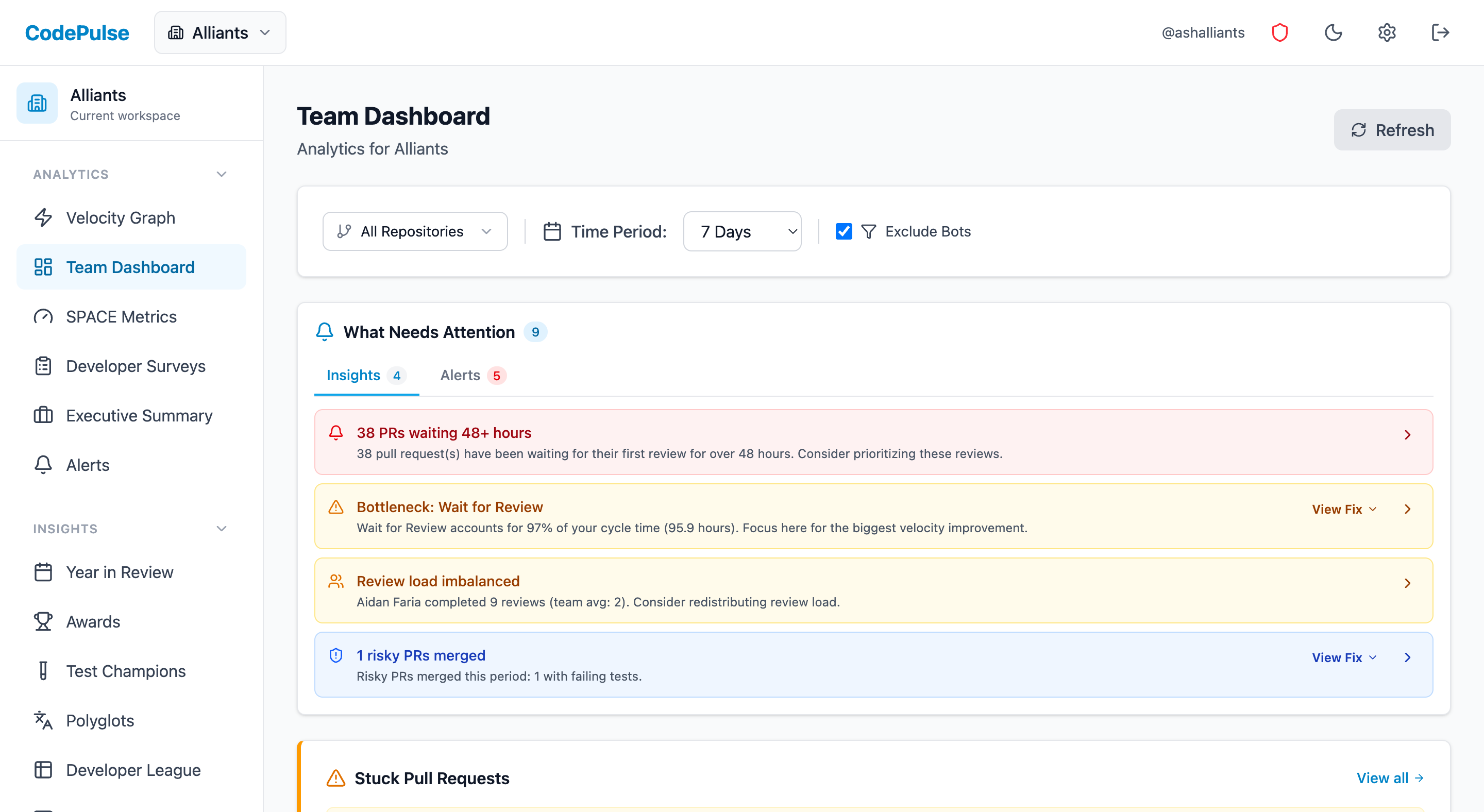
- Dashboard - The "Cycle Time Breakdown" chart shows time spent in each phase, making it easy to spot if PRs are stuck in "Waiting for Review"
- Alerts - Configure custom alert rules based on PR age, wait time, or review status. Set thresholds for warning vs. critical alerts and choose notification channels
- Review Network - Visualize who reviews whom on your team. Identify bottleneck reviewers (nodes with many incoming edges) who may be causing PR queues to back up
Pro tip: Set up a weekly digest alert for PRs older than 5 days. This catches abandoned PRs before they become a cleanup project.
Alert Fatigue Prevention
Too many alerts lead to ignored alerts. Follow these principles:
- Actionable only: Every alert should have a clear next step. "PR is old" isn't actionable. "PR #123 needs your review" is.
- Appropriate severity: Reserve "critical" for truly urgent situations. Overuse of critical alerts trains people to ignore them.
- Business hours: Don't wake people up at 3am for non-production issues. Schedule non-urgent alerts for working hours.
- Consolidate: A daily digest of "5 PRs approaching SLA" is better than 5 separate alerts throughout the day.
- Track alert effectiveness: If an alert never results in action, remove it. If you have alert types that are always ignored, that's a signal the threshold is wrong.
What Intervention Strategies Actually Work?
Detecting stuck PRs is only half the battle. You also need effective strategies for unsticking them without creating resentment or gaming behaviors. When the same patterns keep recurring, the problem is usually upstream of the queue - our unblocking engineering teams guide covers the systemic causes and how to diagnose them before they hit the PR queue.
Immediate Interventions (Same Day)
Pair review sessions: When a large PR is stuck, schedule a 30-minute video call where author and reviewer walk through the code together. This is faster than async review and creates shared understanding.
Review champion rotation: Designate a daily "review champion" whose primary responsibility is clearing the review queue. This ensures someone is always paying attention.
PR triage in standup: Start each standup with "Any PRs stuck?" before "What did you do yesterday?" This makes blocking issues visible immediately.
Systemic Interventions (Team-Wide)
Morning coffee reviews: Encourage the team to spend the first 30 minutes each day clearing their review queue before starting new work. Reviewing is higher leverage than coding - it unblocks others.
PR size limits: Implement hard limits on PR size. If a PR exceeds 400 lines, it must be split before review. This prevents the "too big to review" problem.
Review load balancing: Regularly redistribute review assignments to prevent concentration. Use CODEOWNERS teams rather than individuals where possible.
"The best intervention for stuck PRs is preventing them from getting stuck in the first place. Every systemic fix you implement today prevents hundreds of stuck PRs tomorrow."
Cultural Interventions (Long-Term)
Celebrate fast reviews: Public recognition for quick turnaround times. "Thanks @alice for the 2-hour review turnaround!" This reinforces the desired behavior.
Normalize asking for reviews: Create a culture where pinging reviewers is expected, not rude. An author shouldn't feel awkward asking "Hey, can you review my PR?" after 24 hours.
Track and share metrics: Weekly reports on stuck PR trends make the invisible visible. Teams that see their stuck PR rate declining are motivated to keep improving.
What Related Guides Should You Explore?
- How to Reduce PR Cycle Time by 30% - The complete playbook for faster delivery
- Review Load Balancing Guide - Distribute review work fairly across your team
- Implementing PR Review SLAs - Set up Service Level Agreements that work
- Code Hotspots & Knowledge Silos - Identify and address expertise concentration
- Alert Rules Guide - Configure effective engineering alerts
Frequently Asked Questions
A stuck PR is one that has been waiting for action (either review or author response) for longer than its SLA threshold without any meaningful progress. The specific threshold depends on PR type and team norms, but 24-48 hours of inactivity is a common starting point.
Find out which phase is holding your delivery up
CodePulse splits your cycle time into coding, waiting for review, active review, and merge, so you fix the queue that is actually costing you days. Read-only GitHub, no credit card.
Read-only GitHub · Your code stays yours · Team-level by default · No credit card
See These Features in Action
Break down cycle time into coding, waiting, review, and merge phases.
Get notified when cycle times spike or review patterns degrade.
Related Guides
We Cut PR Cycle Time by 47%. Here's the Exact Playbook
A practical playbook for engineering managers to identify bottlenecks, improve review processes, and ship code faster - without sacrificing review quality.
Your Best Engineer Is About to Quit (Check Review Load)
Learn how to identify overloaded reviewers, distribute review work equitably, and maintain review quality without burning out your senior engineers.
The PR SLA That Actually Worked (Without Developer Revolt)
Async doesn't mean "whenever." Learn how to set, communicate, and enforce a PR review Service Level Agreement (SLA) to unblock your team without creating bad incentives.
Agile vs DevOps: Why the Debate Is Missing the Point
Agile and DevOps are not competitors - they are complementary. Agile handles planning and prioritization; DevOps handles delivery and operations. This guide shows how they work together.