
Understand the system around the team, not a developer leaderboard
Preview team-level workload, collaboration, and delivery signals designed for process improvement rather than performance grading.
Read-only GitHub · Your code stays yours · Team-level by default · No credit card
Every engineering team knows the frustration: work that should take days stretches into weeks. Developers wait for reviews, hunt for context, or stall on dependencies that never materialize. These blockers don't show up on roadmaps or burn-down charts - but they're silently destroying your team's velocity and morale.
This guide provides a systematic framework for identifying, categorizing, and eliminating the blockers that slow engineering teams down. It covers how to use data - particularly git and PR data - to detect blockers before they become crises, and build a culture where unblocking is everyone's job.
🔥 Our Take
The biggest blockers are rarely technical - they're organizational. A slow API response time is a problem you can measure and fix. A team that doesn't know who owns a decision? That's a blocker that can persist for months.
Most engineering leaders focus on removing technical blockers because they're visible and satisfying to solve. But the blockers that truly kill velocity are ambiguous ownership, unclear priorities, and the social friction that makes developers hesitant to ask for help. If you want to move faster, stop optimizing your CI pipeline and start clarifying who can make decisions.
The Blocker Taxonomy: Types of Engineering Obstacles
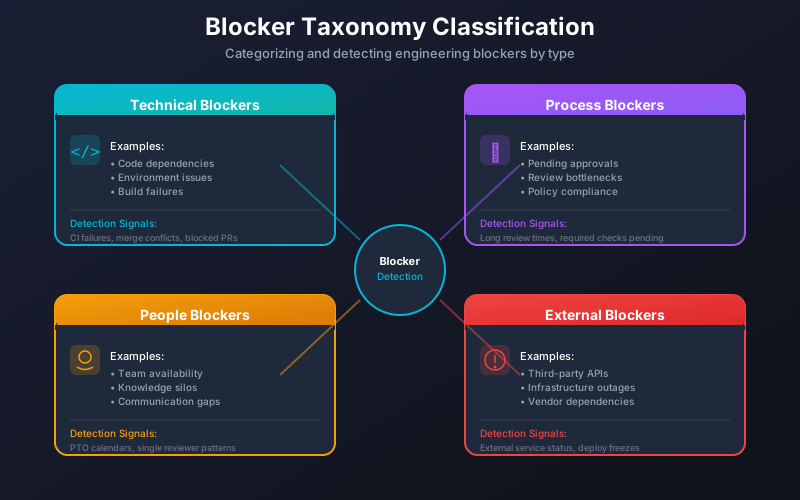
Not all blockers are created equal. Understanding the different types of obstacles helps you apply the right solutions. Here's a comprehensive taxonomy based on patterns we've observed across hundreds of engineering teams:
Technical Blockers
These are the blockers engineers think about most - and often the easiest to fix:
| Blocker Type | Example | Detection Signal | Typical Resolution |
|---|---|---|---|
| Dependency wait | API endpoint not ready | PR blocked on another PR | Mocking, interface contracts |
| Environment issues | Dev database down | Multiple devs stuck simultaneously | Platform team escalation |
| Flaky tests | CI fails randomly | High re-run rate, long merge times | Test quarantine, fix sprints |
| Build performance | 40-minute CI pipeline | Consistent long wait after push | Caching, parallelization |
| Knowledge gaps | Unfamiliar codebase area | Long time-to-first-commit | Documentation, pairing |
Process Blockers
These blockers stem from how work flows through your organization:
| Blocker Type | Example | Detection Signal | Typical Resolution |
|---|---|---|---|
| Review bottleneck | PRs waiting 3+ days for review | High time-to-first-review | Review SLAs, load balancing |
| Approval gates | Waiting for security sign-off | PRs approved but not merged | Parallel reviews, escalation paths |
| Unclear requirements | Ticket lacks acceptance criteria | Excessive back-and-forth commits | Refinement process, templates |
| Priority conflicts | Dependencies owned by busy team | Cross-team PRs languish | Shared priorities, escalation |
| Meeting overload | No focus time for deep work | Commits only in early AM/late PM | Meeting-free days, async defaults |
"The average developer loses 2.5 hours per day to interruptions and context switches. That's not a productivity problem - it's an organizational design problem."
People Blockers
The most sensitive category - but often the most impactful:
| Blocker Type | Example | Detection Signal | Typical Resolution |
|---|---|---|---|
| Single point of failure | Only Alice knows the auth system | PRs cluster around one reviewer | Cross-training, documentation |
| Vacation/leave gaps | Key reviewer on PTO | Spike in review wait times | Backup reviewers, handoffs |
| Overloaded individuals | Team lead reviewing 60% of PRs | High review load variance | Load balancing, delegation |
| Unclear ownership | No one knows who reviews infra PRs | PRs with no assigned reviewers | CODEOWNERS, ownership maps |
| Social friction | Junior afraid to ping senior | Long waits despite available reviewers | Culture work, explicit norms |
External Blockers
Blockers outside your direct control:
| Blocker Type | Example | Detection Signal | Typical Resolution |
|---|---|---|---|
| Third-party outage | Cloud provider incident | Multiple teams blocked suddenly | Status monitoring, fallbacks |
| Vendor dependency | Waiting for SDK update | Feature work paused | Abstractions, alternatives |
| Cross-team dependency | Platform team backlog | PRs depending on other repos | Shared roadmaps, contracts |
| Stakeholder decisions | Product hasn't decided on UX | PRs in draft for weeks | Decision deadlines, escalation |
Detecting Blockers in Git Data
Git and PR data contains signals that reveal blockers before they become crises. Here's how to read the data:
Review Wait Time Patterns
The most direct signal of blocking is how long PRs wait for attention:
- Time to first review > 24 hours: Either reviewers are overloaded, or no one feels responsible for the PR. Both are organizational problems.
- High variance in wait times: If some PRs get reviewed in hours while others wait days, you likely have ownership or priority issues.
- Wait time spikes by day/time: PRs opened Friday afternoon waiting until Tuesday suggests timezone or coverage gaps.
"Teams that track time-to-first-review reduce their average cycle time by 40% within 90 days - not because they pressure reviewers, but because measurement reveals the system problems they didn't know they had."
Review Load Distribution
Uneven review distribution is a leading indicator of bottlenecks:
Review Load Risk Assessment
Use the Review Load Balancing Guide for strategies to distribute review work more evenly.
PR Lifecycle Anomalies
Certain patterns in PR behavior signal specific blockers:
- Long-lived open PRs: PRs open for 7+ days often indicate either technical complexity, unclear ownership, or someone forgot about them.
- Frequent draft status: PRs moving in and out of draft suggest requirements churn or developer uncertainty.
- High commit count after review: Many commits post-first-review may indicate poor initial requirements or reviewers adding scope.
- Approved but not merged: PRs sitting approved for days point to CI/CD problems, deployment gates, or missing final approvals.
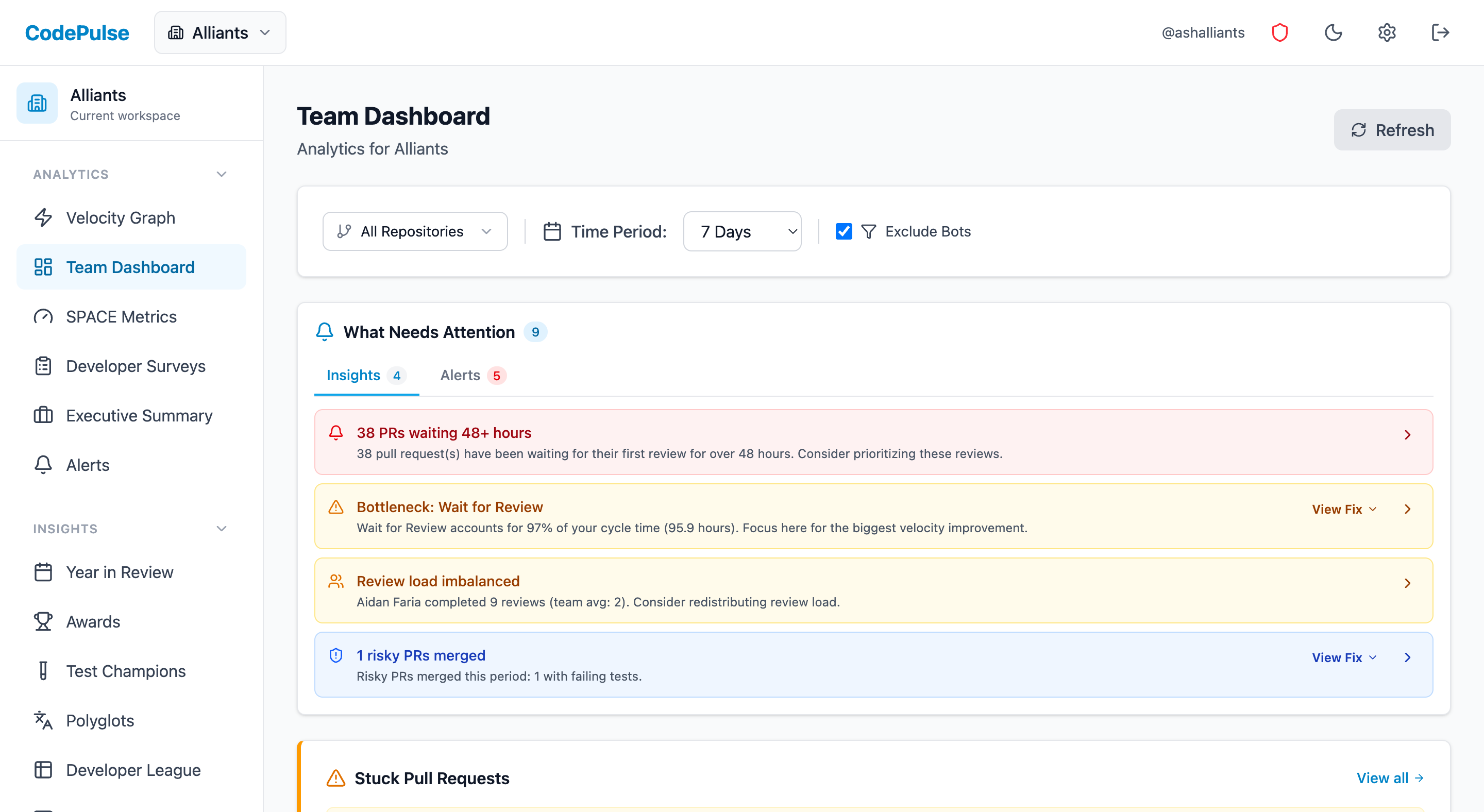
📊 How to See This in CodePulse
CodePulse surfaces blocker signals automatically:
- Review Network visualizes who reviews whom, revealing bottlenecks and knowledge silos instantly
- Alerts can notify you when PRs exceed wait time thresholds, or when review load becomes unbalanced
- The PR list highlights stuck PRs with color-coded status, showing exactly where work is waiting
- Time-to-first-review trends show whether your process is improving or degrading
Cross-Repo Signals
Dependencies across repositories create some of the hardest-to-detect blockers:
- PRs referencing other PRs: When PR descriptions mention "depends on" or "blocked by," you have explicit dependencies that need tracking.
- Parallel PRs in related repos: Frontend PR waiting for backend PR is a classic pattern. Look for correlated open PRs.
- Version bumps stalling: If library version updates sit for weeks, downstream teams are likely blocked.
The Unblocking Playbook
Once you've identified blockers, here's how to remove them systematically:
Immediate Actions (Today)
Quick Wins vs. Deeper Fixes
- Ping stuck PR reviewers directly
- Escalate blocking dependencies to owners
- Reassign PRs from overloaded reviewers
- Mark blocking issues as high priority
- Document workarounds for known blockers
- Set up review time SLAs with alerts
- Create CODEOWNERS for orphan code areas
- Cross-train on single-owner systems
- Add dependency visualization to planning
- Establish escalation paths for blockers
Review Bottleneck Solutions
When PRs are blocked waiting for review:
- Establish review SLAs: "First review within 4 business hours" creates accountability without micromanaging.
- Implement review rotation: Designate "review duty" days where one person prioritizes incoming PRs.
- Balance the load: If one person handles 60% of reviews, redistribute using team-based CODEOWNERS.
- Make waits visible: A dashboard showing "PRs waiting > 24 hours" creates healthy social pressure.
For detailed strategies, see our Stuck Pull Requests Guide.
Dependency Management
When work is blocked on other work:
- Map dependencies early: In sprint planning, explicitly identify cross-team or cross-PR dependencies.
- Use interface contracts: Define APIs before implementation. This allows parallel work with mocks.
- Establish shared priorities: When Team A depends on Team B, both teams need aligned priorities. Escalate conflicts quickly.
- Build in buffer: Assume dependencies will be late. Plan work that can proceed independently.
Knowledge Silo Solutions
When only one person can unblock certain work:
- Pair programming rotation: When experts work on critical systems, always pair them with someone learning.
- Documentation sprints: Dedicate time specifically for experts to document their domain.
- Backup reviewers: Every CODEOWNER should have at least two people qualified to review.
- Rotation through critical systems: Periodically assign non-experts to maintenance work in siloed areas.
Proactive Blocker Prevention
The best blockers are the ones that never happen. Here's how to prevent blockers from forming:
Sprint Planning Practices
- Dependency check: For each planned item, ask "What external input does this need?" If the answer is unclear, clarify before committing.
- Reviewer pre-assignment: Don't wait until PR time to think about reviewers. Identify them during planning.
- Availability check: Know who's on PTO or in meetings. Don't plan work that depends on unavailable people.
- Parallel work identification: When two items touch the same code, plan their sequence or coordination explicitly.
Daily Standup Practices
Transform standups from status updates into blocker-hunting sessions:
Better Standup Format:

Instead of:
  "Yesterday I worked on the payment feature.
   Today I'll continue working on it.
   No blockers."

Try:
  "I have an open PR for payment validation (#423).
   It's been waiting for review since yesterday.
   I need Alice or Bob to review so I can move
   to the payment flow integration today.
   Alice, can you take a look this morning?"

Key change: Make blockers explicit and
assign resolution responsibility.
Automated Alerts
Set up alerts to catch blockers before standup:
- PR wait time alert: Notify channel when any PR exceeds 4 hours without first review.
- Stuck PR alert: Daily digest of PRs open longer than 3 days.
- Review load alert: Alert when one person has 5+ pending review requests.
- Merge delay alert: Notify when approved PRs aren't merged within 4 hours.
"Teams with automated blocker alerts resolve blockers 3x faster than teams relying on manual tracking. The difference isn't awareness - it's that alerts create accountability in the moment, not in retrospect."
Building an Unblocking Culture
Tools and processes only work if the culture supports them. Here's how to build a team where unblocking is everyone's job:
Make Unblocking a First-Class Activity
- Recognize unblockers: Call out people who unblock others in team channels. "Thanks to Sarah for dropping everything to review that urgent PR."
- Include in performance discussions: Being a responsive reviewer and proactive unblocker should factor into career growth.
- Budget time for it: If you expect engineers to be responsive reviewers, don't fill 100% of their capacity with feature work.
Reduce the Cost of Asking for Help
- Normalize pinging: Make it explicit that asking for review or help is expected, not annoying.
- Create safe escalation paths: People should feel comfortable escalating blockers without it being "a big deal."
- Document response expectations: If the norm is "respond to review requests within 4 hours," write it down so people feel empowered to follow up.
Learn from Blockers
- Retro on significant blocks: When a blocker costs 3+ days, do a quick post-mortem. Not to blame - to prevent recurrence.
- Track blocker patterns: Are most blockers review-related? Dependency-related? External? Focus improvement efforts on the dominant category.
- Measure blocker resolution time: How long does it take to resolve a blocker once identified? This is a team health metric.
Frequently Asked Questions
Don't rely on self-reporting - most blockers go unreported because developers either work around them or don't recognize them as blockers. Instead, look at the data: PRs waiting longer than 24 hours for review, work items stuck in the same status for days, and patterns of commits only happening at odd hours (indicating meeting overload during core hours). The data reveals what people don't say.
Conclusion
Unblocking engineering teams isn't about heroic last-minute interventions - it's about building systems that prevent blockers from forming and catch them quickly when they do. The teams that ship fastest aren't the ones with the best individual contributors. They're the ones where unblocking is everyone's job, where waits are visible, and where asking for help is the norm, not the exception.
Start by measuring what you have: review wait times, stuck PRs, and review load distribution. These metrics will tell you where your blockers live. Then work systematically through the playbook - quick wins first, then deeper structural changes. Within 90 days, you'll see measurable improvement in cycle time and, more importantly, in team morale.
For related strategies, see our guides on reducing PR cycle time, review load balancing, and handling stuck pull requests.
Get this view for your own teams
Connect GitHub for team-level workload, review distribution, and delivery signals. Individual views stay off unless your organisation explicitly turns them on.
Read-only GitHub · Your code stays yours · Team-level by default · No credit card
See These Features in Action
Break down cycle time into coding, waiting, review, and merge phases.
Interactive graph of review relationships and workload distribution.
Related Guides
We Cut PR Cycle Time by 47%. Here's the Exact Playbook
A practical playbook for engineering managers to identify bottlenecks, improve review processes, and ship code faster - without sacrificing review quality.
Your Best Engineer Is About to Quit (Check Review Load)
Learn how to identify overloaded reviewers, distribute review work equitably, and maintain review quality without burning out your senior engineers.
Identifying Stuck Pull Requests Before They Rot
Detect and unblock stuck PRs before they become abandoned. Learn the 5 patterns that cause PRs to stall and build automated alerts for early intervention.
Engineering Team Management: Using Data to Lead Without Micromanaging
Managing software teams requires balancing delivery, quality, team health, and individual growth. This guide shows how to use data for visibility while avoiding surveillance, with practical scenarios and communication patterns.