

See exactly where your delivery flow is waiting
Preview the phase-by-phase report for review pickup, active review, and merge time. Connect in about five minutes; the initial analysis runs after sync.
Read-only GitHub · Your code stays yours · Team-level by default · No credit card
The "Agile vs DevOps" framing is wrong. It implies competition where there's actually collaboration. Agile handles how you plan and prioritize work. DevOps handles how you deliver and operate it. Together, they create a complete system for shipping valuable software reliably. This guide shows how they complement each other - and how to combine them effectively.
"Agile without DevOps delivers features nobody can deploy. DevOps without Agile deploys features nobody asked for."
The confusion exists because both emerged from frustration with traditional software development. Both emphasize iteration, collaboration, and continuous improvement. But they solve different problems at different layers of the delivery pipeline.
🔥 Our Take
Asking "Agile or DevOps?" is like asking "steering wheel or engine?" You need both to get anywhere. One helps you decide where to go; the other gets you there.
The debate persists because consultants sell methodologies, not outcomes. Organizations that focus on solving real problems - "How do we ship faster?" "How do we reduce bugs?" - naturally adopt practices from both camps without worrying about labels.
What Agile Actually Means
The Agile Manifesto (Still Relevant)
Agile emerged in 2001 when seventeen software developers published the Agile Manifesto. The core values remain surprisingly relevant:
- Individuals and interactions over processes and tools
- Working software over comprehensive documentation
- Customer collaboration over contract negotiation
- Responding to change over following a plan
Notice what's absent: story points, velocity charts, sprint planning ceremonies, Jira tickets. Those are implementations (often poor ones) of the underlying values.
What Agile Solves
Agile addresses the planning and prioritization problem. Traditional waterfall development assumed you could define requirements completely upfront, then execute a perfect plan. Reality proved otherwise: requirements change, understanding evolves, and the best ideas often emerge during development.
Agile practices help teams:
- Break large projects into deliverable increments
- Gather feedback quickly and adjust direction
- Prioritize work based on value, not just sequence
- Adapt to changing requirements without chaos
- Maintain sustainable pace rather than death marches
Common Agile Frameworks
| Framework | Best For | Key Characteristics |
|---|---|---|
| Scrum | Teams needing structure | Sprints, ceremonies, defined roles (PO, SM, Dev) |
| Kanban | Continuous flow work | WIP limits, pull-based, visualize flow |
| XP (Extreme Programming) | Technical excellence focus | Pair programming, TDD, continuous integration |
| SAFe | Large enterprise coordination | Program increments, release trains, heavy process |
| Scrumban | Teams wanting flexibility | Scrum ceremonies + Kanban flow |
"Scrum is training wheels. Once you internalize agile thinking, the specific framework matters less than the outcomes you're achieving."
What DevOps Actually Means
Beyond the Buzzword
DevOps emerged around 2008-2009 from the realization that having separate Development and Operations teams created a fundamental conflict: developers wanted to ship fast, operations wanted stability. The wall between them caused finger-pointing, slow deployments, and fragile systems.
DevOps is not a tool (despite what vendors claim). It's not a job title (though it became one). At its core, DevOps is a culture and set of practices that breaks down silos between development and operations.
What DevOps Solves
DevOps addresses the delivery and operations problem. How do you get code from a developer's laptop to production reliably? How do you operate systems at scale? How do you detect and recover from failures quickly?
DevOps practices help teams:
- Automate build, test, and deployment pipelines
- Deploy frequently with confidence
- Detect production issues before users do
- Recover from failures quickly
- Treat infrastructure as code
- Share ownership between dev and ops
The Three Ways of DevOps
Gene Kim's The Phoenix Project and The DevOps Handbook describe three underlying principles:
- Flow: Accelerate delivery from development to operations to customers. Eliminate bottlenecks and waste.
- Feedback: Create fast, constant feedback loops at every stage. Detect problems immediately.
- Continuous Learning: Create a culture of experimentation and learning from failure. Improve continuously.
Key DevOps Practices
| Practice | Purpose | Tools/Techniques |
|---|---|---|
| CI/CD | Automate build and deployment | GitHub Actions, Jenkins, GitLab CI, CircleCI |
| Infrastructure as Code | Version-controlled infrastructure | Terraform, Pulumi, CloudFormation |
| Containerization | Consistent environments | Docker, Kubernetes, containerd |
| Monitoring & Observability | Understand system behavior | Datadog, Prometheus, Grafana, OpenTelemetry |
| Feature Flags | Decouple deployment from release | LaunchDarkly, Unleash, ConfigCat |
| Chaos Engineering | Test resilience proactively | Chaos Monkey, Gremlin, LitmusChaos |
Key Differences: Agile vs DevOps
Understanding where Agile ends and DevOps begins helps you apply each appropriately. They operate at different stages of the software lifecycle.
| Dimension | Agile | DevOps |
|---|---|---|
| Primary focus | What to build and when | How to build and deliver reliably |
| Core problem solved | Planning uncertainty | Delivery friction |
| Key stakeholders | Product, Development, Business | Development, Operations, SRE |
| Feedback loop | Sprint reviews, user testing | Monitoring, alerts, metrics |
| Main artifacts | User stories, backlogs, roadmaps | Pipelines, runbooks, infrastructure code |
| Measure of success | Value delivered, velocity trends | DORA metrics, uptime, MTTR |
| Time horizon | Sprints (weeks), quarters | Continuous (minutes to days) |
| Change management | Backlog refinement, planning | Automated pipelines, rollbacks |
"Agile asks: 'What's the most valuable thing we could ship this sprint?' DevOps asks: 'How do we ship it safely and repeatedly?'"
How Agile and DevOps Complement Each Other
The magic happens when Agile and DevOps work together. Each fills gaps the other leaves open.
Agile Without DevOps: The Integration Hell Problem
Teams practicing pure Agile without DevOps often face:
- Integration bottlenecks: Sprint work completes, but deployment takes weeks
- Environment drift: "Works on my machine" becomes the team motto
- Manual testing gates: QA becomes the bottleneck before every release
- Deployment fear: Releases become high-stress events requiring all hands
- Invisible technical debt: Infrastructure problems are "someone else's job"
DevOps Without Agile: The Feature Factory Problem
Teams with strong DevOps but weak Agile practices often face:
- Fast delivery of wrong things: Ship quickly, but not what users need
- No prioritization: Everything is urgent; nothing is strategic
- Technical work dominates: Infrastructure perfect, product stagnant
- No feedback loops with users: Great monitoring, no user research
- Scope creep: No framework for saying "not now" to requests
The Combined Power
AGILE + DEVOPS FLOW:

┌─────────────────────────────────────────────────────────────────┐
│                         AGILE LAYER                             │
│                                                                 │
│  Backlog → Sprint Planning → Development → Sprint Review        │
│     ↑                                           │               │
│     │         User feedback, priorities         │               │
│     └───────────────────────────────────────────┘               │
└─────────────────────────────────────────────────────────────────┘
                              │
                              ▼
┌─────────────────────────────────────────────────────────────────┐
│                        DEVOPS LAYER                             │
│                                                                 │
│  Code → Build → Test → Deploy → Monitor → Respond               │
│    │                                         │                  │
│    │        Production feedback, metrics     │                  │
│    └─────────────────────────────────────────┘                  │
└─────────────────────────────────────────────────────────────────┘
When working together:
- Agile provides direction; DevOps provides delivery capability
- Sprint cadence aligns with deployment frequency: Smaller batches ship faster
- Retrospectives include operations: Incidents inform planning
- Technical work is visible: Infrastructure appears on the backlog
- Feedback flows both ways: User research AND production metrics inform priorities
When to Adopt Each (And Both)
Start with Agile If...
- Requirements are unclear: You're exploring product-market fit
- Priorities shift frequently: Business needs change quarterly or faster
- Stakeholder alignment is poor: Engineering and product don't share a roadmap
- Large batches cause problems: Big releases fail or take forever
- Team coordination is chaotic: Nobody knows who's working on what
Start with DevOps If...
- Deployments are painful: Releases require nights and weekends
- Environments differ: Works in staging, breaks in production
- Recovery is slow: Incidents take days to resolve
- Manual processes dominate: Humans do what machines should
- Dev and Ops fight: Blame culture between teams
Adopt Both When...
Most teams benefit from both simultaneously. The question isn't "which one?" but "what's our current bottleneck?"
- If you ship the right things slowly: Focus more on DevOps
- If you ship fast but wrong things: Focus more on Agile
- If you ship wrong things slowly: You need both (start with Agile to get direction, then DevOps for speed)
🔥 Our Take
Don't adopt methodologies because they're industry standard. Adopt practices that solve problems you actually have. Start with pain, not dogma.
A team with 2-day deployments doesn't need feature flags. A team with clear requirements doesn't need sprint planning. Match solutions to problems.
Common Integration Patterns
Pattern 1: Agile Planning with DevOps Delivery
The most common and recommended approach:
- Product planning follows Agile ceremonies (sprints, backlog refinement)
- Development follows trunk-based development with small PRs
- CI/CD pipelines deploy automatically on merge
- Monitoring provides feedback that influences sprint priorities
Pattern 2: Kanban + Continuous Delivery
For teams with continuous flow work (support, platform, SRE):
- Work flows continuously rather than in sprints
- WIP limits ensure focus
- Every merged PR deploys immediately
- Production metrics drive prioritization
Pattern 3: SAFe + Enterprise DevOps
For large organizations requiring coordination:
- Program Increments align multiple teams
- Release trains coordinate deployment windows
- Platform teams provide DevOps capabilities as a service
- Compliance gates are automated, not manual
Metrics for Agile + DevOps Teams
Effective teams track metrics from both domains. For a complete metrics approach, see our DORA Metrics Guide.
Agile Health Metrics
| Metric | What It Measures | Warning Signs |
|---|---|---|
| Sprint Completion Rate | Predictability of delivery | <80% consistently |
| Backlog Health | Clarity of upcoming work | Many stale or undefined items |
| Cycle Time (Story) | Time from start to done | Increasing trend |
| Team Satisfaction | Sustainable pace | Declining survey scores |
DevOps Health Metrics (DORA)
| Metric | What It Measures | Elite Benchmark |
|---|---|---|
| Deployment Frequency | How often you ship | Multiple deploys per day |
| Lead Time for Changes | Commit to production time | <1 hour |
| Change Failure Rate | Percentage of failures | 0-15% |
| MTTR | Recovery speed | <1 hour |
📊 How to Track in CodePulse
CodePulse bridges Agile and DevOps metrics in one dashboard:
- Dashboard - PR cycle time breakdown (DevOps delivery metrics)
- Cycle Time Analysis - Identify where work gets stuck (Agile + DevOps insight)
- Velocity Trends - Team throughput over time (Agile planning data)
- Review Network - Collaboration patterns that span process boundaries
Implementation Roadmap: Combining Agile and DevOps
Phase 1: Foundation (Weeks 1-4)
- Assess current state: What practices do you already have from each domain? What's working? What's painful?
- Identify biggest bottleneck: Is it planning (Agile) or delivery (DevOps)?
- Choose one improvement: Don't transform everything at once
- Establish baselines: Measure your current cycle time, deployment frequency, and sprint completion
Phase 2: Quick Wins (Weeks 5-8)
If delivery is the bottleneck (DevOps focus):
- Set up basic CI pipeline (build + test on every PR)
- Automate deployment to at least one environment
- Implement basic monitoring/alerting
If planning is the bottleneck (Agile focus):
- Establish regular backlog refinement sessions
- Implement sprint or iteration cadence
- Create a visible board (Kanban or Sprint)
Phase 3: Integration (Weeks 9-16)
- Connect the feedback loops: Production metrics inform sprint priorities
- Include ops work in the backlog: Infrastructure and reliability work is visible
- Align deployment with iteration: Ship at least once per sprint
- Review metrics together: Both Agile and DevOps metrics in retrospectives
Phase 4: Optimization (Ongoing)
- Reduce batch sizes: Smaller stories, smaller PRs, faster feedback
- Increase deployment frequency: Work toward continuous delivery
- Automate quality gates: Replace manual approvals with automated checks
- Expand observability: Better production feedback informs better planning
Common Mistakes to Avoid
Mistake 1: Treating Them as Mutually Exclusive
"We're an Agile shop" or "We're a DevOps organization" misses the point. You need both capabilities. The only question is emphasis based on your current needs.
Mistake 2: All Process, No Culture
Both Agile and DevOps are fundamentally about culture and collaboration. Implementing ceremonies without buy-in, or pipelines without ownership, delivers tools without transformation.
Mistake 3: Optimizing for Metrics Instead of Outcomes
Teams that optimize for "velocity" or "deployment frequency" often game the metrics. Smaller stories inflate velocity. Trivial deployments inflate frequency. Focus on outcomes: delivering value reliably.
Mistake 4: One-Size-Fits-All Adoption
Different teams need different mixes. A platform team might need heavy DevOps with light Agile. A product team exploring new features might need heavy Agile with lighter DevOps. Match practices to context.
Mistake 5: Ignoring the Human Element
Both Agile and DevOps require psychological safety. Teams need to feel safe experimenting, failing, and improving. Without trust, practices become theater.
Related Guides
Deepen your understanding with these complementary resources:
- DORA Metrics Guide - Deep dive into the key DevOps metrics and how to improve them
- Reduce PR Cycle Time - Practical playbook for improving delivery speed
- Measure Team Performance Without Micromanaging - Build trust while implementing metrics
- Developer Productivity Metrics - Ethical approaches to measuring engineering productivity
- Cycle Time Breakdown - Understand where time goes in your delivery process
Conclusion
Agile vs DevOps is a false dichotomy. Agile optimizes what you build and when. DevOps optimizes how you build and deliver it. High-performing organizations excel at both.
Don't choose between them. Start with your biggest pain point - unclear priorities (Agile) or slow/risky delivery (DevOps) - and expand from there. The goal isn't methodological purity. It's shipping valuable software reliably.
"The best engineering teams don't debate Agile vs DevOps. They're too busy shipping great software using whatever practices work."
Turn the idea in this guide into a baseline for your team
See what the finished analysis looks like, then connect GitHub when you are ready. CodePulse measures delivery systems from read-only workflow data—never individual output.
Read-only GitHub · Your code stays yours · Team-level by default · No credit card
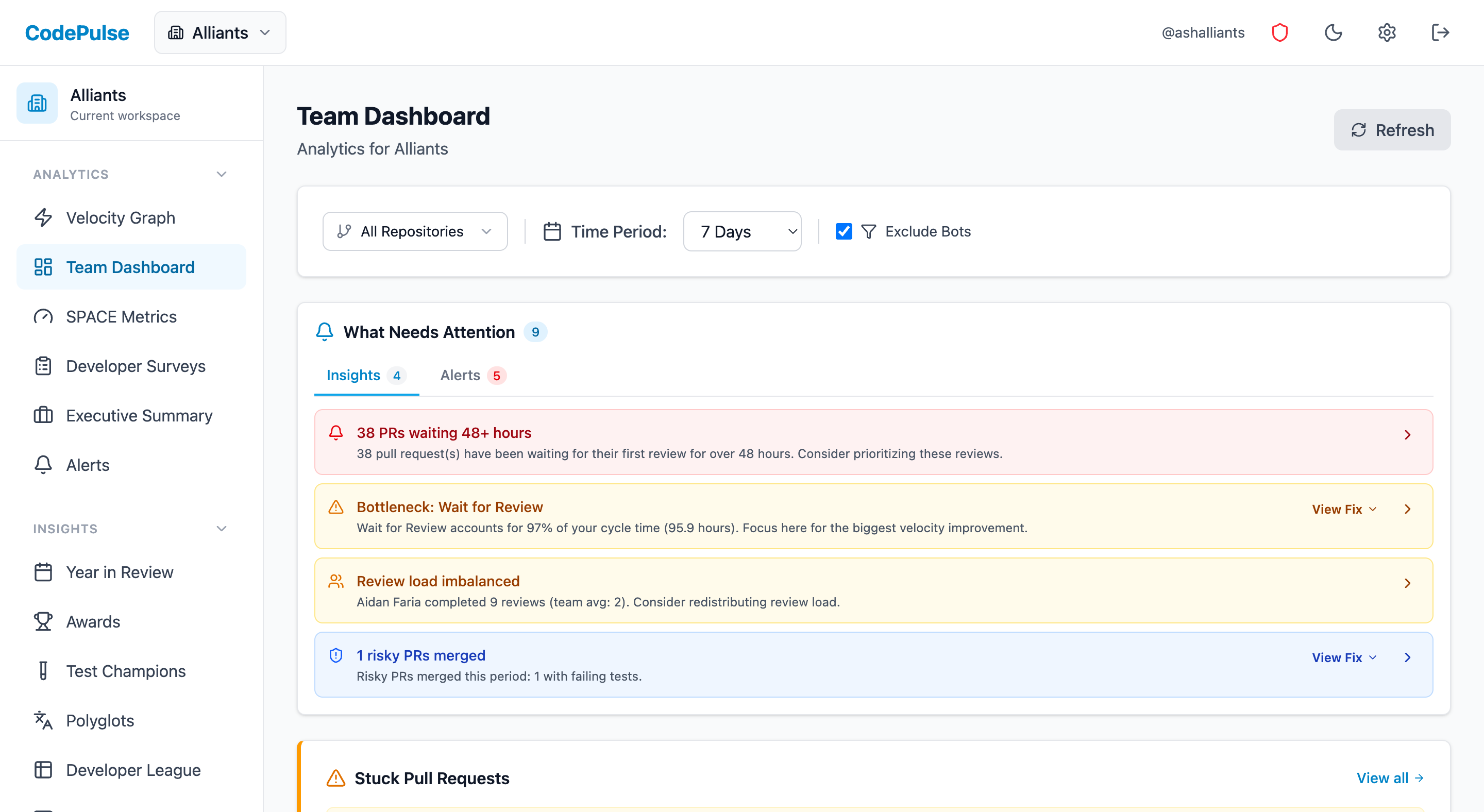
Find out which phase is holding your delivery up
CodePulse splits your cycle time into coding, waiting for review, active review, and merge, so you fix the queue that is actually costing you days. Read-only GitHub, no credit card.
Read-only GitHub · Your code stays yours · Team-level by default · No credit card
See These Features in Action
Track all four DORA metrics and benchmark against industry standards.
Break down cycle time into coding, waiting, review, and merge phases.
Related Guides
DORA Metrics Explained: The 4 Keys Without the Hype
A complete breakdown of the four DORA metrics - deployment frequency, lead time, change failure rate, and MTTR - with honest benchmarks and gaming traps to avoid.
DevOps Maturity Model: A Practical Assessment Framework
Assess your DevOps maturity across culture, CI/CD, testing, monitoring, and infrastructure. Includes self-assessment questionnaire and improvement roadmap by level.
SRE vs DevOps: Choosing the Right Model for Your Engineering Org
SRE and DevOps are complementary, not competing. This guide helps you understand when to use each, whether you need dedicated SRE, and how to implement a hybrid approach.
We Cut PR Cycle Time by 47%. Here's the Exact Playbook
A practical playbook for engineering managers to identify bottlenecks, improve review processes, and ship code faster - without sacrificing review quality.