
See exactly where your delivery flow is waiting
Preview the phase-by-phase report for review pickup, active review, and merge time. Connect in about five minutes; the initial analysis runs after sync.
Read-only GitHub · Your code stays yours · Team-level by default · No credit card
"Async" communication often becomes an excuse for "slow" communication. When a Pull Request sits waiting for review for 3 days, context is lost, merge conflicts rot, and momentum dies. The solution is a strict Service Level Agreement (SLA) for Code Reviews.
How do you implement a PR review SLA?
Set a 4-hour first-review SLA for PRs under 400 lines and 8 hours for larger PRs. Enforce it with automated Slack alerts when PRs approach the threshold. Make the SLA a team commitment, not an individual mandate. Track adherence on a shared dashboard. Teams that implement review SLAs typically see 30-50% reduction in cycle time within the first month. CodePulse tracks time-to-first-review automatically and can send alerts when PRs exceed SLA thresholds.
But here's the trap: naive SLA implementation creates worse problems than it solves. You'll get rushed reviews, gaming behaviors, and resentment. This guide shows you how to implement PR review SLAs that actually improve delivery without destroying your engineering culture.
🔥 Our Take
SLAs are guardrails, not goals. The moment you start celebrating "100% SLA compliance," you've optimized for the wrong thing. A team hitting SLAs while shipping garbage code hasn't won anything.
The purpose of a PR SLA is to prevent the worst-case scenario - PRs rotting for days - not to maximize review speed. If your team is consistently hitting SLAs with time to spare, tighten the SLA. If they're constantly scrambling to hit it, you've set the bar wrong.
Why "Best Effort" Fails
If you tell a team "please review code when you have time," they will review it:
- When they are bored.
- When they are blocked.
- Never.
Coding is "Deep Work." Reviewing is "Interruption." Without a rule, engineers prioritize Deep Work forever. But a team of individuals optimizing for their own Deep Work destroys the Team's Flow.
"The fastest individual contributor on a team of slow reviewers is still shipping slowly. Your velocity is the team's velocity, not yours."
The data supports this: according to the 2023 State of DevOps Report, teams with fast feedback loops deploy 208 times more frequently than low performers. Review latency is often the largest controllable component of that feedback loop.
The Hidden Costs of Review Delay
Every day a PR sits waiting costs you more than you think:
- Context switching: The author has moved on to other work. When reviews finally come, they must re-load the mental model of code they wrote days ago.
- Merge conflicts: The longer a PR sits, the higher the probability that someone else changes the same files. Rebasing is pure waste.
- Stale dependencies: If the PR updates a library, those updates may themselves become outdated while waiting.
- Blocked follow-up work: Other tasks often depend on the PR being merged. The delay compounds across the team.
- Demoralization: Developers lose motivation when their work sits ignored. "Why bother finishing this feature if no one cares enough to review it?"
The SLA Tier Framework: Right Response for Right Risk
Not all PRs deserve the same response time. A one-size-fits-all SLA creates perverse incentives: tiny PRs get the same urgency as critical fixes, and reviewers learn that everything is equally "urgent" (which means nothing is).
"When everything is Priority 1, nothing is. Tiered SLAs give your team permission to deprioritize the unimportant so they can focus on what matters."
Recommended SLA Tiers
| Tier | First Response | Resolution Target | Examples |
|---|---|---|---|
| Critical | 1 hour | 4 hours | Hotfixes, security patches, incident response |
| High | 4 hours | 24 hours | Blocking features, release-critical changes |
| Standard | 24 hours | 48 hours | Regular features, refactoring, tests |
| Low | 48 hours | 1 week | Documentation, dependency updates, nice-to-haves |
How to Assign Tiers
The simplest approach: use GitHub labels. When opening a PR, the author assigns a tier:
Label naming convention:
  sla:critical  (red)    - "Drop everything"
  sla:high      (orange) - "Today, please"
  sla:standard  (yellow) - "Normal queue"
  sla:low       (blue)   - "When you get to it"

Default (no label) = standard
Pro tip: Make "standard" the default. Authors who don't label their PR get normal SLA. This prevents both neglected PRs (no label = infinite wait) and inflation (everyone labels "critical" because it's fastest).
Setting a Reasonable Target (The 24h Rule)
For most teams, the gold standard for "Standard" tier is: "Every PR gets a response within 24 hours (excluding weekends)."
Note: "Response" does not mean "Merge." It means:
- Approval.
- Request for Changes.
- "I am busy, I will look at this Tuesday." (Acknowledgement).
This prevents the "Black Hole" feeling where an author doesn't know if anyone cares about their work.
Business Hours vs. Calendar Hours
This matters more than you think. A PR opened at 5pm Friday shouldn't breach SLA at 5pm Saturday. Define your SLA in business hours:
24-hour SLA in business hours:
  PR opened Monday 2pm    → Response by Tuesday 2pm
  PR opened Friday 2pm    → Response by Monday 2pm
  PR opened Friday 6pm    → Response by Tuesday 10am (assuming 9am-6pm workday)

For distributed teams across timezones:
  Consider using UTC business hours (9am-6pm UTC)
  OR define "team business hours" as the union of all team members' working hours
Defining "Response" Clearly
The most common SLA failure isn't slow reviews - it's ambiguous definitions. What counts as a "response"? Be explicit:
What Counts as a Response
- Approval: Obviously counts. PR can proceed to merge.
- Request for changes: Counts. Author has actionable feedback.
- Substantive comment: Counts. Shows engagement with the code.
- Acknowledgement with timeline: Counts. "I'll review this tomorrow, complex PR."
What Does NOT Count
- Auto-assign by CODEOWNERS: Not a human response.
- Bot comments (CI results): Not a human response.
- "LGTM" without reviewing: Gaming the system. Address culturally.
- Opening the diff: Looking isn't responding.
"The goal of a PR SLA isn't to generate responses - it's to unblock authors. A response that doesn't move the PR forward doesn't count."
Anti-Patterns: How SLAs Go Wrong
We've seen teams implement PR SLAs and make things worse. Here are the failure modes to avoid:
Anti-Pattern 1: The Rubber Stamp
Symptom: Review times drop dramatically, but so does review quality. "LGTM" comments everywhere. Bugs ship to production.
Root cause: SLA is measured but quality isn't. Engineers optimize for what's measured.
Solution: Pair SLA metrics with quality metrics. Track both "time to first review" AND "review depth" (comments per review, change requests per review). Alert on suspiciously fast approvals.
Red flag pattern to detect:
  Time from assignment to approval: < 5 minutes
  Lines changed: > 200
  Comments: 0

This is almost certainly a rubber stamp.
Anti-Pattern 2: The Priority Inflation
Symptom: Every PR gets labeled "critical" or "high." SLA tiers become meaningless.
Root cause: No accountability for tier assignment. No downside to over-prioritizing.
Solution: Cap the percentage of high-priority PRs. Example: "No more than 10% of weekly PRs can be Critical, no more than 25% can be High." Review tier assignments in retros. Call out inflation publicly.
Anti-Pattern 3: The Blame Game
Symptom: SLA breaches become ammunition in performance reviews. Reviewers feel attacked. Review culture becomes toxic.
Root cause: Individual accountability for systemic problems. A reviewer who's assigned to 5 PRs while on PTO isn't at fault - the system is.
Solution: Measure team SLA compliance, not individual. Address patterns, not incidents. If one person is consistently the bottleneck, that's a workload or expertise distribution problem - see our Review Load Balancing Guide.
Anti-Pattern 4: The Rigid Exception
Symptom: Team follows SLA religiously, even when it doesn't make sense. Critical context-heavy PRs get rushed reviews. Simple typo fixes wait in queue.
Root cause: SLA treated as law, not guideline. No mechanism for exceptions.
Solution: Build in exception handling. If an author and reviewer agree that a PR needs more time for quality reasons, that's fine. Log the exception and reason. Review exception patterns monthly.
Handling Exceptions & Edge Cases
Real-world teams have complexity that simple SLAs don't handle. Build exception handling into your process from day one.
Exception: Timezones
If your reviewer is in Tokyo and you are in NY, the SLA is 24 business hours, not 24 wall-clock hours. A PR opened at NY 5pm reaches Tokyo 6am the next day - the clock starts when their workday starts.
For highly distributed teams, consider our Async Code Review for Distributed Teams guide for more strategies.
Exception: Monster PRs
If a PR is +2,000 lines, the SLA is "Schedule a meeting to walk through it." No one can meaningfully review that much code in a few hours. The SLA response becomes: "This PR is too large for async review. Let's schedule a walkthrough."
Recommended PR size thresholds:
  < 200 lines:  Standard async review (24h SLA)
  200-500 lines: Extended async review (48h SLA)
  500-1000 lines: May need sync discussion
  > 1000 lines:  Strongly encourage splitting

See our PR Size Optimization Guide for strategies.
Link: PR Size Optimization Guide
Exception: PTO and Holidays
PRs assigned to someone on vacation shouldn't breach SLA. Options:
- Reassignment: PRs auto-reassign after 12h with no response from an out-of-office reviewer.
- SLA pause: Clock stops while assigned reviewer is OOO, restarts when they return or PR is reassigned.
- Team reviewers: Assign to a team rather than individual. Team is never "on PTO."
Exception: Expertise Requirements
Some PRs require specific expertise that only one or two people have. If that person is busy, the PR waits. This is a knowledge silo problem, not an SLA problem.
Short-term: Allow SLA exceptions for "requires expert review." Long-term: Cross-train to reduce single points of failure. See Code Hotspots & Knowledge Silos.
Shifting Culture: Review > Code
To make SLAs stick, you must change the team's hierarchy of values:
"Unblocking a teammate is higher leverage than writing your own code."
Encourage the "Morning Coffee Review": The first 30 minutes of the day are for clearing the review queue.
Making It Visible
Recognition drives behavior. Make review responsiveness visible:
- Daily standup: "How many PRs are waiting for review?" before "What did you do yesterday?"
- Team dashboard: Show SLA compliance rate prominently.
- Public kudos: Call out fast reviewers in Slack. "Thanks @alice for the quick turnaround!"
- Awards: CodePulse's Awards page recognizes top reviewers with badges like "Fastest Gun" and "Unblock Hero."
Removing Friction
Make it easy to review quickly:
- Notifications: Ensure reviewers have Slack/email notifications for new PR assignments.
- Review channel: A dedicated Slack channel where PRs are posted automatically.
- Daily digest: Morning email with "PRs awaiting your review" list.
- PR templates: Good PR descriptions make reviews faster. Enforce templates.
Tracking SLAs Manually
You can spot check this. Go to your GitHub Pull Requests page. Look at the "Oldest" open PRs.
- If a PR is open for 5 days, check the "Files Changed" tab.
- Are there comments? If yes, it's an active debate (Fine).
- If no comments, it's an SLA breach (Not fine).
For a deeper analysis, export your PR data and calculate:
Key metrics to track manually:

  Time to First Review:
    first_review_timestamp - pr_created_timestamp

  SLA Compliance Rate:
    (PRs with first_review < SLA_threshold) / total_PRs * 100

  P90 Review Time:
    90th percentile of time_to_first_review
(more useful than average, which hides outliers)Automating Accountability with Alerts
You don't want to be the "Nagging Manager." Let the bot be the bad guy.
🔔SLA Alerts in CodePulse
Configure automated nudges for SLA management:
Recommended Alert Rules for SLA Monitoring
Alert: Standard SLA Warning
  Metric: wait_for_review_hours
  Operator: >
  Threshold: 20
  Severity: warning
  Description: "PR approaching 24h SLA - needs attention soon"

Alert: Standard SLA Breach
  Metric: wait_for_review_hours
  Operator: >
  Threshold: 24
  Severity: critical
  Description: "PR has exceeded 24h SLA - immediate attention needed"

Alert: Critical SLA Warning
  Metric: wait_for_review_hours
  Operator: >
  Threshold: 3
  Severity: warning
  Description: "Critical PR approaching 4h SLA"
  (Note: Filter to PRs with sla:critical label if possible)

Alert: Review Backlog Growing
  Metric: prs_pending_review
  Operator: >
  Threshold: 10
  Severity: warning
  Description: "Too many PRs waiting - team needs to prioritize reviews"
Alert Fatigue Prevention
Too many alerts = ignored alerts. Follow these principles:
- Warn before breach: Alert at 80% of SLA (20h for 24h SLA) so there's time to respond.
- One alert per PR: Don't spam. One notification per PR is enough.
- Business hours only: Don't wake people up at 3am for SLA breaches.
- Actionable: Every alert should include what to do: PR link, assigned reviewer, suggested action.
Measuring SLA Success
How do you know if your SLA program is working? Track these metrics:
Primary Metrics
| Metric | Good Target | Warning Sign |
|---|---|---|
| SLA Compliance Rate | >90% | <80% (SLA too tight or team underwater) |
| P50 Time to First Review | <8 hours | >16 hours (consistent delays) |
| P90 Time to First Review | <24 hours | >48 hours (tail cases rotting) |
| Total Cycle Time | <48 hours | >72 hours (delivery suffering) |
Quality Guard Rails
Don't let speed kill quality. Monitor these alongside SLA metrics:
- Avg comments per review: Should stay stable or increase. Declining comments may indicate rubber stamping.
- Change request rate: Percentage of reviews requesting changes. Should stay stable - if it drops dramatically, reviewers might be approving too easily.
- Bug escape rate: Bugs found in production that should have been caught in review. This is the ultimate quality metric.
30-Day SLA Rollout Plan
Week 1: Baseline and Buy-In
- Measure current state: What's your actual time-to-first-review today?
- Share data with team: "Our median wait time is 32 hours. Here's what that costs us."
- Propose SLA: Get team input. Make them part of setting the target.
- Set up tracking: Configure alerts or monitoring for the agreed SLA.
Week 2: Soft Launch
- Enable alerts but don't enforce: Let the team see what would have breached.
- Daily check-in: "We had 3 virtual breaches yesterday. What can we learn?"
- Refine thresholds: Adjust if SLA is too tight or too loose.
- Build habits: Start "Morning Coffee Review" ritual.
Week 3: Active Monitoring
- SLA is now live: Breaches are tracked and visible.
- No punishment yet: Focus on learning, not blame.
- Address systemic issues: If same reviewer is always the bottleneck, rebalance load.
- Celebrate wins: "We hit 95% compliance this week!"
Week 4: Iterate and Institutionalize
- Retrospective: What worked? What didn't? What should change?
- Adjust SLA if needed: Tighten if too easy, loosen if unrealistic.
- Document process: Add to team wiki/runbook.
- Set up regular review: Monthly check on SLA metrics.
The Bottom Line
"A PR SLA isn't about making reviews faster. It's about making waiting visible. You can't fix what you can't see."
Done right, PR SLAs transform review from an afterthought into a first-class team priority. Done wrong, they create rushed reviews and resentment. The difference is in the implementation: clear definitions, reasonable tiers, exception handling, and quality guard rails.
Start with a 24-hour SLA for standard PRs. Measure compliance. Watch for gaming. Iterate. In 90 days, you'll wonder how you ever shipped code without it.
Related Guides
- How to Reduce PR Cycle Time by 30% - The complete playbook for faster delivery
- Review Load Balancing Guide - Distribute review work fairly
- Cycle Time Breakdown Guide - Understand all four components of cycle time
- Slack Alerts for Engineering Metrics - Set up automated notifications
- Async Code Review for Distributed Teams - SLAs across timezones
Frequently Asked Questions
A PR review SLA is a team agreement that defines the maximum time a pull request should wait before receiving its first meaningful review. It turns an implicit expectation into an explicit, measurable commitment that prevents PRs from sitting idle for days.
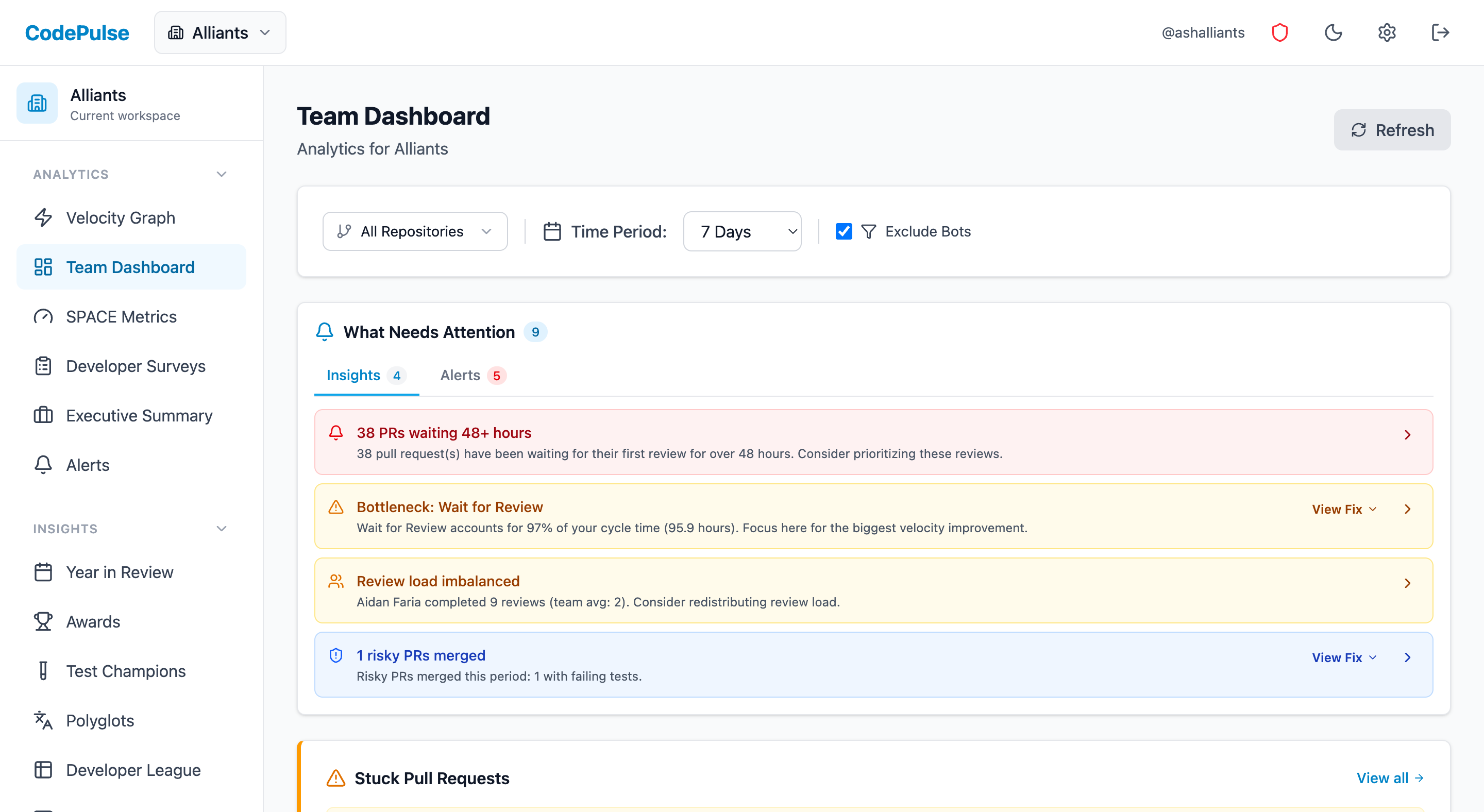
Find out which phase is holding your delivery up
CodePulse splits your cycle time into coding, waiting for review, active review, and merge, so you fix the queue that is actually costing you days. Read-only GitHub, no credit card.
Read-only GitHub · Your code stays yours · Team-level by default · No credit card
See These Features in Action
Break down cycle time into coding, waiting, review, and merge phases.
Get notified when cycle times spike or review patterns degrade.
Related Guides
We Cut PR Cycle Time by 47%. Here's the Exact Playbook
A practical playbook for engineering managers to identify bottlenecks, improve review processes, and ship code faster - without sacrificing review quality.
The Slack Alert That Catches Stuck PRs Before Standup
How to configure alerts for stuck PRs, review SLA breaches, and key metric changes to stay informed without constant dashboard checking.
Your Best Engineer Is About to Quit (Check Review Load)
Learn how to identify overloaded reviewers, distribute review work equitably, and maintain review quality without burning out your senior engineers.
The 4-Minute Diagnosis That Reveals Why Your PRs Are Stuck
Learn to diagnose exactly where your PRs are getting stuck by understanding the 4 components of cycle time and how to improve each one.