
Compare the finished analysis before you choose a platform
See the report CodePulse produces from read-only GitHub workflow data, or connect your own repositories and evaluate the fit with real evidence.
Read-only GitHub · Your code stays yours · Team-level by default · No credit card
The average engineering team navigates 7.4 tools to build software, and 75% of developers lose 6 to 15 hours per week because of it. That is not a tooling problem. It is a process problem dressed up as a purchasing decision. This guide maps the tools you actually need at each SDLC phase, gives you a framework for cutting the rest, and does not pretend every team needs the same stack.
The software development tools market hit $6.6 billion in 2024 and is growing at 14.5% annually. Teams keep buying. Productivity keeps stalling. There is a disconnect, and it starts with not understanding which tools solve which problems at which phase of development.
"Adding tools to improve productivity without understanding the bottleneck is waste. Full stop."
Why Most Teams Have 12+ Tools (And Need 6)
A 2024 survey of IT professionals across the U.S. and Western Europe found that developers use an average of 7.4 tools just for building applications. Factor in communication, project management, observability, and documentation tools, and most teams are well past 12. The real cost is not the license fees. It is the context switching. For a quick self-check on how much time each context switch is costing, try our developer time lost calculator.
Research by Dr. Gloria Mark at UC Irvine shows it takes an average of 23 minutes and 15 seconds to fully regain focus after switching context. When a developer bounces between Jira, Slack, GitHub, their IDE, a CI dashboard, a monitoring tool, and a documentation wiki, that is not a workflow. It is an interruption machine.
Tool sprawl happens for predictable reasons:
- Each team picks their own tools. Without centralized guidance, the frontend team uses Linear, the backend team uses Jira, and the platform team uses GitHub Issues. Three tools doing one job.
- Nobody owns the tooling budget holistically. Individual managers approve $15/seat tools that compound into $200K+ annual spend across the org.
- Free tiers create lock-in. A tool starts free, gains adoption, and then its paid tier becomes impossible to remove because workflows depend on it.
- New tools get added but old ones never get removed. The median SaaS tool count for companies with 1,500 to 5,000 employees dropped 18% in two years because leadership finally started auditing. Most teams have not done this yet.
The Cortex 2024 State of Developer Productivity report found that 55% of developers do not trust the data surfaced by their tool repositories, and 94% are dissatisfied with their current toolsets to some degree. You are paying for tools your team does not trust.
If you want to understand the broader SDLC process before diving into tooling, start with our SDLC process guide for a phase-by-phase breakdown.
SDLC Tools by Phase: What You Actually Need
Here is a phase-by-phase mapping. For each phase, I have listed the tool category, strong options, and what you should measure. Not every team needs every row. Skip what does not apply.
| SDLC Phase | Tool Category | Strong Options | Key Metric |
|---|---|---|---|
| Planning | Project Management | Linear, Jira, GitHub Issues | Planning-to-start time |
| Planning | Documentation | Notion, Confluence, GitBook | Spec completeness before coding |
| Coding | Source Control | GitHub, GitLab, Bitbucket | Commit frequency, PR size |
| Coding | IDE / AI Assistants | VS Code, JetBrains, Cursor, GitHub Copilot | Adoption rate, code acceptance rate |
| Review | Code Review | GitHub PRs, Graphite, Gerrit | Review cycle time, reviewer load |
| Build | CI/CD | GitHub Actions, GitLab CI, CircleCI | Build time, failure rate |
| Test | Testing Frameworks | Jest, Pytest, Playwright, Cypress | Test pass rate, flaky test count |
| Test | Security Scanning | Snyk, Dependabot, SonarQube | Vulnerability resolution time |
| Deploy | Release / Deployment | Argo CD, Flux, Octopus Deploy | Deployment frequency, rollback rate |
| Operate | Monitoring / Observability | Datadog, Grafana, New Relic | MTTR, error rate |
| Measure | Engineering Analytics | CodePulse, LinearB, Swarmia | Cycle time, DORA metrics, review health |
Notice the "Measure" phase at the bottom. Most teams treat analytics as an afterthought, bolting on a dashboard months after the toolchain is set. That is backwards. You need measurement from day one to know whether the other tools are working.
The 2024 DORA report, based on responses from over 39,000 professionals, found that teams using both managed and self-hosted CI/CD tools showed better deployment performance across all four DORA metrics. The tool matters less than consistent, measured usage.
For a deeper look at the DevOps toolchain specifically, see our DevOps toolchain guide.
Software Development Collaboration Tools That Reduce Friction
Collaboration tools deserve their own section because they span every SDLC phase and are the primary source of context switching. Project management tools like Jira track work, but the actual collaboration happens in code reviews, async messages, and shared documents.
The tools that reduce friction the most share three properties:
- They live where developers already work. GitHub PRs are better collaboration tools than most standalone review apps because developers are already in GitHub. Adding a separate review tool means one more tab, one more login, one more notification stream.
- They surface context without requiring navigation. Slack integrations that post PR status, CI results, and review requests into a channel reduce the need to check three different dashboards.
- They make async work the default. Distributed teams cannot depend on synchronous communication. Tools that require real-time presence (screen sharing for every code review, for example) create bottlenecks in different time zones.
Here is what actually matters for developer collaboration tools:
| Collaboration Need | Tool Approach | Anti-Pattern |
|---|---|---|
| Code Review | GitHub PRs with review assignments, CODEOWNERS | Separate review tool that duplicates PR context |
| Knowledge Sharing | ADRs in the repo, Notion/Confluence for broader docs | Tribal knowledge trapped in Slack DMs |
| Incident Response | PagerDuty/Opsgenie with Slack channels | Manual war rooms with no documented runbooks |
| Status Updates | Automated dashboards from git data | Weekly status emails that nobody reads |
| Review Load Balancing | Analytics showing reviewer distribution | Same 2 senior engineers reviewing everything |
"The best developer collaboration tool is the one that eliminates a meeting. If your tool creates more meetings, it is the wrong tool."
The Cortex survey found that 40% of developers cite "trouble finding context" as their biggest productivity pain, while 26% of managers agree it is the top area of productivity loss. The collaboration tools that work are the ones that push context to where developers already are, not the ones that require developers to go find it.
How CodePulse Handles Collaboration Visibility
CodePulse's Review Network visualizes who reviews whose code, so you can spot when two engineers are carrying the entire review burden for a 15-person team. The Knowledge Silos view shows which parts of the codebase only one person understands, which is a collaboration problem disguised as a technical one.
That said, CodePulse is built for GitHub-native teams. If your collaboration is centered on GitLab or Bitbucket, it is not the right fit today.
For a broader comparison of developer productivity tools across categories, see our developer productivity tools guide.
The 5-Question Framework for SDLC Tool Decisions
Before buying or adopting any new SDLC tool, run it through these five questions. If you cannot answer all five clearly, you are not ready to buy.
SDLC Tool Evaluation Framework
===============================

1. PROBLEM FIT
   "What specific bottleneck does this tool address?"
   Bad answer: "It improves productivity"
   Good answer: "Review cycle time is 4.2 days; this tool should cut it to under 2"

2. OVERLAP CHECK
   "Does this duplicate something we already have?"
   If yes: Can the existing tool be configured to do it?
   If no:  Which tool gets retired?

3. INTEGRATION COST
   "How does it connect to our existing stack?"
   Native GitHub/GitLab integration = low cost
   Custom API work required = high cost
   No integration = reject

4. ADOPTION LIKELIHOOD
   "Will developers actually use this daily?"
   Survey the team. If fewer than 70% say yes, do not buy.
   Tools that require behavior change fail 80% of the time.

5. MEASUREMENT PLAN
   "How will we know this tool is working in 90 days?"
   Define the metric before purchase.
   Review at 30, 60, 90 days.
   Kill it if the metric does not move.
This framework sounds simple, and it is. The reason most teams end up with tool sprawl is not that they lack frameworks. It is that nobody enforces the evaluation before the credit card comes out.
🔥 Our Take
Your team does not need 7 tools. They need one good one used consistently. More dashboards means less insight, not more.
We have seen teams with Jira, Linear, Asana, and GitHub Issues running simultaneously. Not because they evaluated all four and chose to keep them, but because nobody ever said "we are only using one." The consolidation conversation feels political, so people avoid it. The result is $50K+ per year in redundant tooling and developers who check three dashboards and trust none of them.
For the platform engineering perspective on tool decisions, check out our platform engineering tools guide.
The Tool Consolidation Playbook
Organizations that consolidate their tooling save 20 to 40% on IT costs. One global apparel brand reduced its observability tools from over 40 to 6 and cut spend by 30%. But cost savings are the secondary benefit. The primary benefit is that developers stop losing hours to context switching and start trusting a single source of truth.
Here is a practical consolidation playbook for engineering leaders:
Phase 1: Audit (Week 1-2)
List every tool your engineering org pays for. Include free-tier tools that have become load-bearing. For each tool, document:
- Annual cost (including per-seat fees at current headcount)
- Number of active users in the last 30 days
- Which SDLC phase it serves
- Whether it overlaps with another tool in the same phase
You will probably find 2 to 4 tools with fewer than 20% of engineers actively using them. Those are your quick wins.
Phase 2: Categorize and Decide (Week 3-4)
Group tools by SDLC phase using the table above. For each phase where you have multiple tools, pick the one that:
- Has the highest active usage
- Integrates natively with your source control platform
- Provides the data you actually reference in decisions
Be honest about "provides data you actually reference." If nobody looks at the Jira velocity charts, Jira is not your planning analytics tool. It is your ticket system. That is fine, but do not pay for analytics features you ignore.
Phase 3: Migrate and Sunset (Week 5-8)
Give teams a 30-day migration window. Provide clear documentation on how workflows transfer. Set a hard cutoff date. The teams that struggle most with consolidation are the ones that leave both tools running "just in case" and never actually consolidate.
Tool Consolidation Decision Tree
=================================

For each tool in your audit:

  Has < 20% active users?
    YES → Sunset immediately (quick win)
    NO  ↓

  Overlaps with another tool in the same SDLC phase?
    YES → Compare: which has higher adoption + better integration?
          Keep the winner. Migrate users from the loser.
    NO  ↓

  Provides unique capability no other tool covers?
    YES → Keep. Ensure it integrates with your analytics layer.
    NO  → Evaluate whether the capability is needed at all.
Phase 4: Measure the Impact (Ongoing)
After consolidation, track three things:
- Context switching frequency. Survey developers monthly. Are they checking fewer dashboards?
- Cycle time. If consolidation reduced friction, PRs should move faster from open to merge.
- Tool spend per developer. This should drop 20%+ within the first quarter.
"Tool sprawl is a symptom, not the disease. The disease is process confusion. Fix the process, and the right tool count becomes obvious."
For understanding how to measure the engineering analytics side of your toolchain, see our engineering analytics tools comparison.
Frequently Asked Questions
There is no universal number, but most teams can cover all SDLC phases with 5 to 8 core tools. The average is 7.4 according to a 2024 survey, but many teams operate effectively with fewer. The right number depends on your stack complexity, team size, and how many phases you handle in-house vs. outsource.
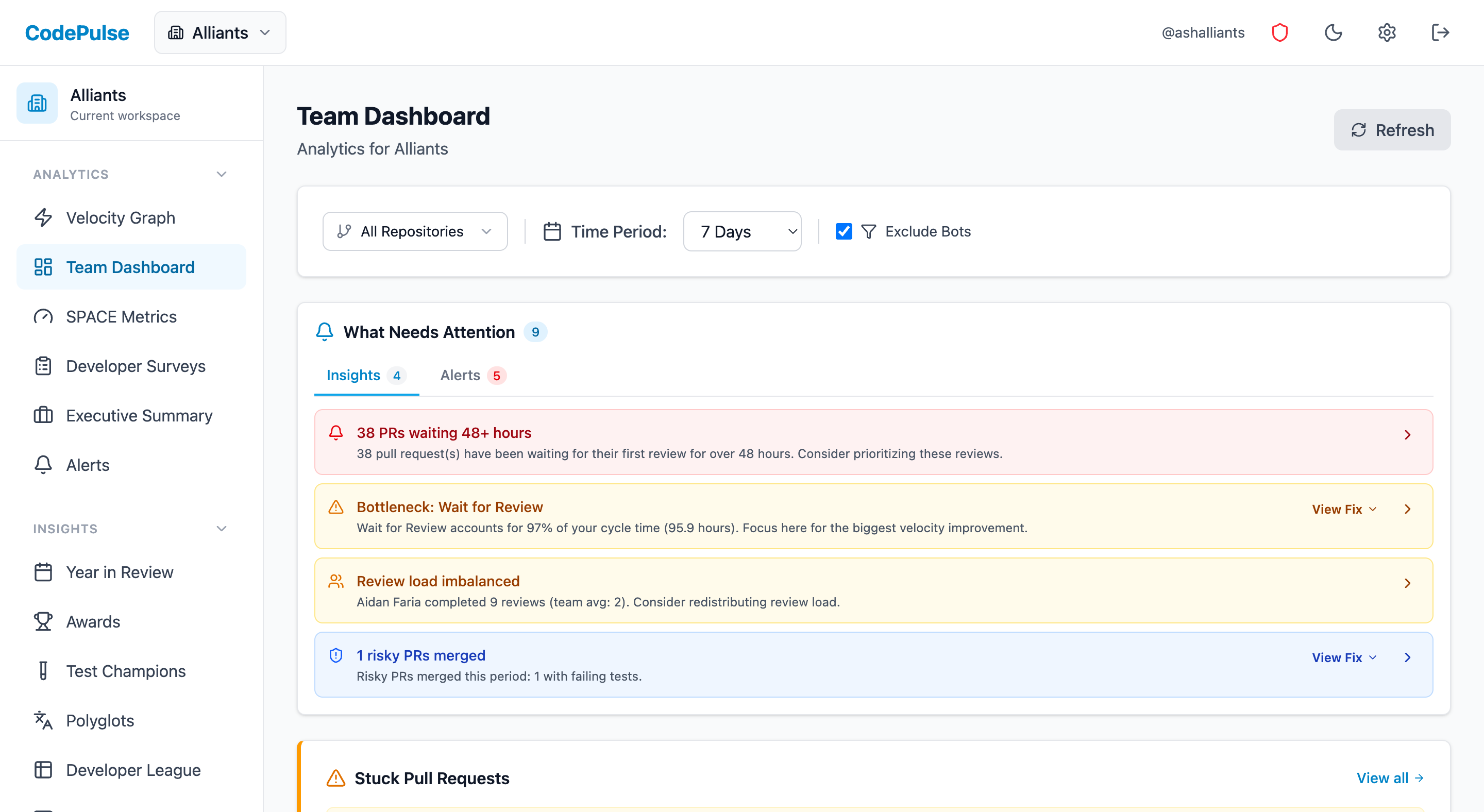
Evaluate CodePulse against your own delivery history
A comparison table only goes so far. Connect read-only GitHub in about five minutes and judge the output on your repositories, at one flat price, with no per-seat math.
Read-only GitHub · Your code stays yours · Team-level by default · No credit card
See These Features in Action
Track deployment frequency, lead time, and release patterns.
Break down cycle time into coding, waiting, review, and merge phases.
Related Guides
SDLC Process Guide: Phases and How to Improve
The Software Development Life Cycle (SDLC) is the foundation of how software gets built. Learn the phases, compare methodologies, and find where your process is broken.
The DevOps Toolchain: What to Measure at Each Stage
A DevOps toolchain enables continuous delivery. This guide maps all stages (plan, code, build, test, release, deploy, operate, monitor) with tools and metrics.
Jellyfish vs LinearB vs Swarmia: Full 2026 Comparison
Compare Jellyfish, LinearB, Swarmia, Allstacks, Haystack and more engineering analytics tools. Features, pricing, cycle time benchmarks, and integrations.
Developer Productivity Tools: The 2026 Buyer's Guide
Compare developer productivity tools across 5 categories: IDEs, AI assistants, analytics platforms, and more. Honest trade-offs included.
Platform Tools: The Build vs Buy Mistake
A practical guide to platform engineering tools, build vs buy decisions, and the metrics that prove platform impact.