
See exactly where your delivery flow is waiting
Preview the phase-by-phase report for review pickup, active review, and merge time. Connect in about five minutes; the initial analysis runs after sync.
Read-only GitHub · Your code stays yours · Team-level by default · No credit card
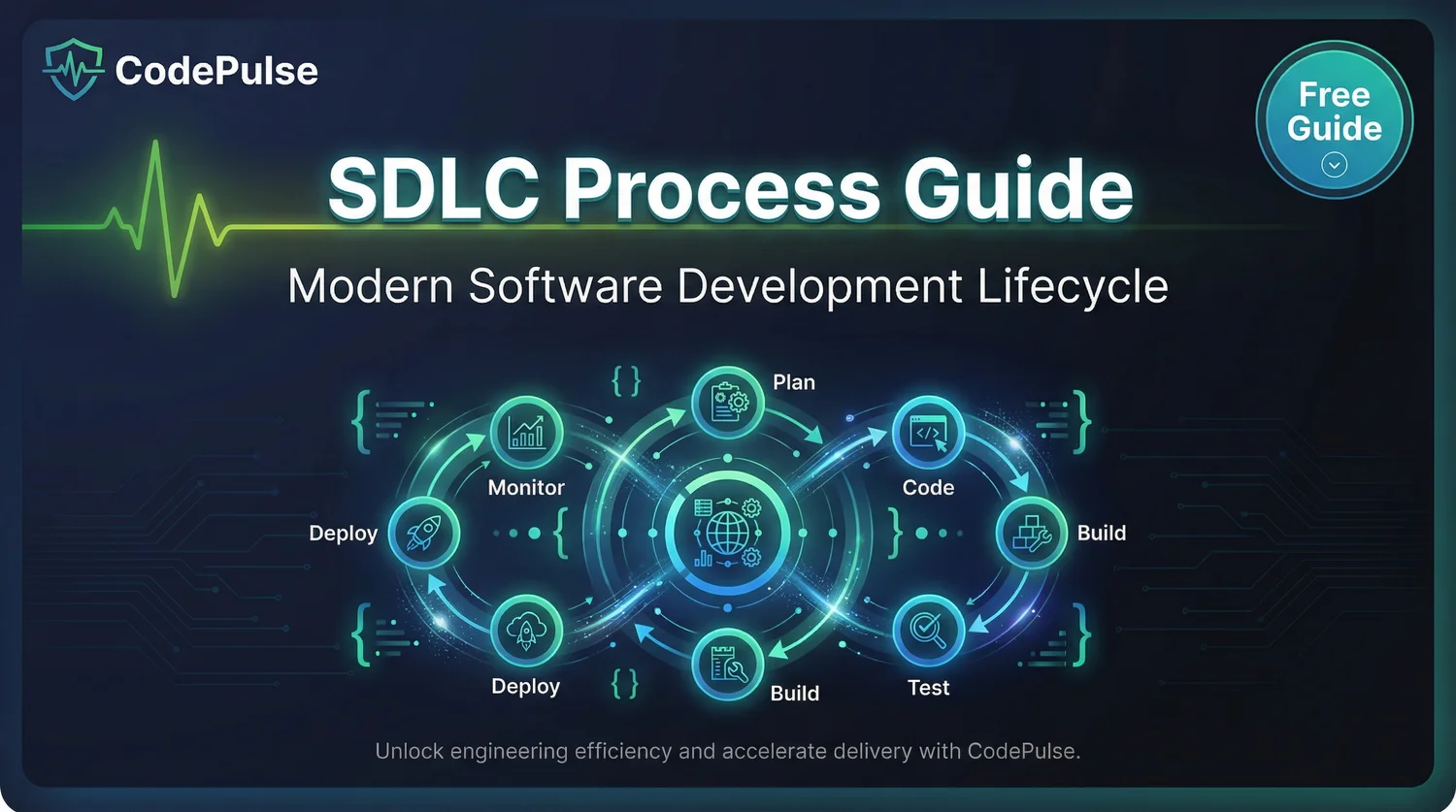
SDLC - Software Development Life Cycle - is the structured process teams use to build software. Whether you follow Waterfall, Agile, or something in between, understanding SDLC phases helps you identify bottlenecks and improve your delivery process. This guide explains the modern SDLC, how to measure each phase, and where most teams get stuck.
"The SDLC isn't a process to follow - it's a lens for understanding where value gets stuck on its way to customers."
What is SDLC?
The Software Development Life Cycle (SDLC) is a framework that describes the phases software goes through from concept to retirement. Every software project follows some version of this cycle, whether explicitly or not.
The classic SDLC phases are:
- Planning - Define goals, scope, and feasibility
- Requirements - Gather and document what needs to be built
- Design - Architect the solution
- Development - Write the code
- Testing - Verify it works correctly
- Deployment - Release to production
- Maintenance - Support, fix bugs, iterate
The Software Development Life Cycle

┌─────────────────────────────────────────────────────────────────┐
│                                                                 │
│   Planning → Requirements → Design → Development → Testing →   │
│                                                                 │
│                        ↓                                        │
│                                                                 │
│              ← ← ← Deployment → Maintenance → → →              │
│                        │                                        │
│                        │ (feedback loop)                        │
│                        ▼                                        │
│                   Back to Planning                              │
│                                                                 │
└─────────────────────────────────────────────────────────────────┘
SDLC Methodologies
Different methodologies implement the SDLC differently. The methodology you choose affects how work flows through these phases:
| Methodology | How Phases Work | Best For |
|---|---|---|
| Waterfall | Sequential phases; complete one before starting next | Fixed scope, regulatory requirements |
| Agile | Iterative cycles; all phases in every sprint | Evolving requirements, fast feedback |
| DevOps | Continuous; phases overlap and automate | High deployment frequency, SaaS products |
| Lean | Minimal viable phases; eliminate waste | Startups, experimental features |
| Spiral | Risk-driven iterations through phases | Large, high-risk projects |
/// Our Take
The debate over "which SDLC methodology is best" misses the point. All of them work when applied correctly - and all of them fail when applied dogmatically.
Focus less on methodology labels and more on flow: How long does it take for a good idea to reach customers? Where does work get stuck? That's what matters - not whether you're "doing Agile correctly."
The Modern SDLC in Practice
In modern software teams, especially those practicing DevOps and continuous delivery, the SDLC phases often overlap and happen in parallel:
1. Ideation & Planning
Ideas come from customers, stakeholders, or the team. This phase includes:
- Problem definition and user research
- Feasibility assessment
- Prioritization against other work
- Rough scoping and resource allocation
Common bottleneck: Too many ideas, unclear priorities. Work sits in "planning" indefinitely.
2. Requirements & Design
Define what to build and how. Modern teams often combine these:
- User stories or PRDs (Product Requirement Documents)
- Technical design docs for complex features
- API contracts and schema definitions
- Wireframes or prototypes for UX
Common bottleneck: Over-documentation. Spending weeks on specs for features that take days to build.
3. Development
Writing code. In modern teams, this phase is highly measurable:
- Coding time (first commit to PR opened)
- PR size and complexity
- Branch lifetime
- WIP (Work in Progress) limits
Common bottleneck: Context switching. Developers juggling too many things, none making progress.
4. Code Review & Testing
Verifying quality before merging. This is where many teams lose the most time:
- Wait for review (PR sits waiting for attention)
- Review time (reviewer examining code)
- Iteration (address feedback, re-review)
- Automated testing (CI pipeline)
Common bottleneck: Review pickup time. PRs wait hours or days before anyone looks at them.
5. Deployment
Getting code to production. Modern practices minimize this phase:
- Continuous Integration (CI) - Automated builds and tests
- Continuous Deployment (CD) - Automated releases
- Feature flags - Deploy without releasing
- Canary releases - Gradual rollout
Common bottleneck: Manual deployment processes. Waiting for "deployment windows" instead of shipping when ready.
6. Monitoring & Maintenance
Post-deployment observation and iteration:
- Production monitoring and alerting
- Bug fixes and incident response
- Performance optimization
- Feature iteration based on feedback
Common bottleneck: Bug-fixing dominates. Teams spend so much time on bugs they never ship new features.
📊 How to See This in CodePulse
CodePulse measures the Development → Review → Deployment phases automatically:
- Cycle Time Breakdown shows time spent in Coding, Waiting, Review, and Merge phases
- Deployment Frequency tracks how often you ship
- Review Network reveals bottlenecks in the review phase
Measuring Each SDLC Phase
"You can't improve what you don't measure. But measuring the wrong things makes them worse, not better."
Here are meaningful metrics for each SDLC phase:
| Phase | Metric | What It Tells You |
|---|---|---|
| Planning | Idea-to-start time | How long ideas wait before work begins |
| Requirements | Spec churn rate | How often requirements change mid-development |
| Development | Coding time, WIP count | How long active coding takes, multitasking level |
| Review | Pickup time, review time | Wait time for reviews, time spent reviewing |
| Testing | Test coverage, failure rate | Quality of automated testing |
| Deployment | Deployment frequency, lead time | How often you ship, time from commit to production |
| Maintenance | Change failure rate, MTTR | How often deploys cause issues, recovery time |
SDLC Process Improvement
Improving your SDLC means finding and eliminating bottlenecks. Here's a systematic approach:
Step 1: Map Your Current Flow
Document how work actually flows through your process (not how it's supposed to flow):
Example: Current SDLC Flow Analysis

Phase               Avg Time    Wait Time    % of Total
──────────────────────────────────────────────────────
Ideation            -           14 days      -
Requirements        3 days      5 days       16%
Development         4 days      1 day        10%
Code Review         1 day       3 days       8%   ← Most wait here
Testing             0.5 days    0.5 days     2%
Deployment          0.5 days    2 days       5%   ← Manual process
Maintenance         ongoing     -            -

Total Lead Time: ~33 days (14 days just waiting for review/deploy)
Step 2: Identify Biggest Bottleneck
Focus on the phase with the most wait time. In the example above, it's code review (3 days waiting) and deployment (2 days waiting).
Step 3: Apply Targeted Fixes
| Bottleneck | Potential Fixes |
|---|---|
| Long planning queues | Reduce WIP limits, say no more often, improve prioritization |
| Requirements churn | Smaller batches, earlier user feedback, spike prototypes |
| Slow coding | Reduce context switching, protect focus time, improve tooling |
| Review delays | Review SLAs, smaller PRs, dedicated review time blocks |
| Test failures | Fix flaky tests, improve coverage, faster test runs |
| Deployment friction | Automate with CI/CD, remove approval gates, use feature flags |
| High bug rate | More testing, better monitoring, smaller releases |
Step 4: Measure Impact
After implementing fixes, measure again. Did lead time decrease? Did the bottleneck move to a different phase?
SDLC Anti-Patterns
Common mistakes that slow down software delivery:
1. Big Bang Releases
Saving up changes for quarterly releases creates risk. Smaller, more frequent releases are safer and provide faster feedback.
2. Handoff Culture
When phases are owned by different teams (dev → QA → ops), handoffs create delays. Cross-functional teams that own the full cycle are faster.
3. Over-Process
Approval gates, change advisory boards, and heavyweight documentation slow teams without proportional safety benefits. Automate checks where possible.
4. Under-Investment in Automation
Manual testing, manual deployments, and manual code reviews don't scale. Every repetitive task is a candidate for automation.
5. Invisible Work in Progress
Without visibility into WIP, teams overcommit. Visualize all work in progress - not just development, but reviews waiting, deployments queued, bugs triaged.
"The goal isn't to follow the SDLC perfectly - it's to ship valuable software to users as quickly and safely as possible."
Related Guides
- DORA Metrics Guide - Industry-standard metrics for software delivery
- Deployment Frequency & Lead Time - Measuring your deployment pipeline
- Reduce PR Cycle Time - Speed up the code review bottleneck
- Cycle Time Breakdown - Understanding where time goes in development
Conclusion
The SDLC is a framework for understanding how software gets built - not a set of rules to follow rigidly. The best teams:
- Understand their actual flow - not the idealized version
- Measure each phase - especially wait time between phases
- Attack bottlenecks systematically - one at a time
- Automate repetitive work - especially testing and deployment
- Iterate continuously - the SDLC itself should evolve
Start by mapping your current flow. Where does work wait? That's your first improvement target. Use tools like CodePulse to measure the phases you can see in Git data - coding, review, and deployment. Then work backward from there to planning and forward to maintenance.
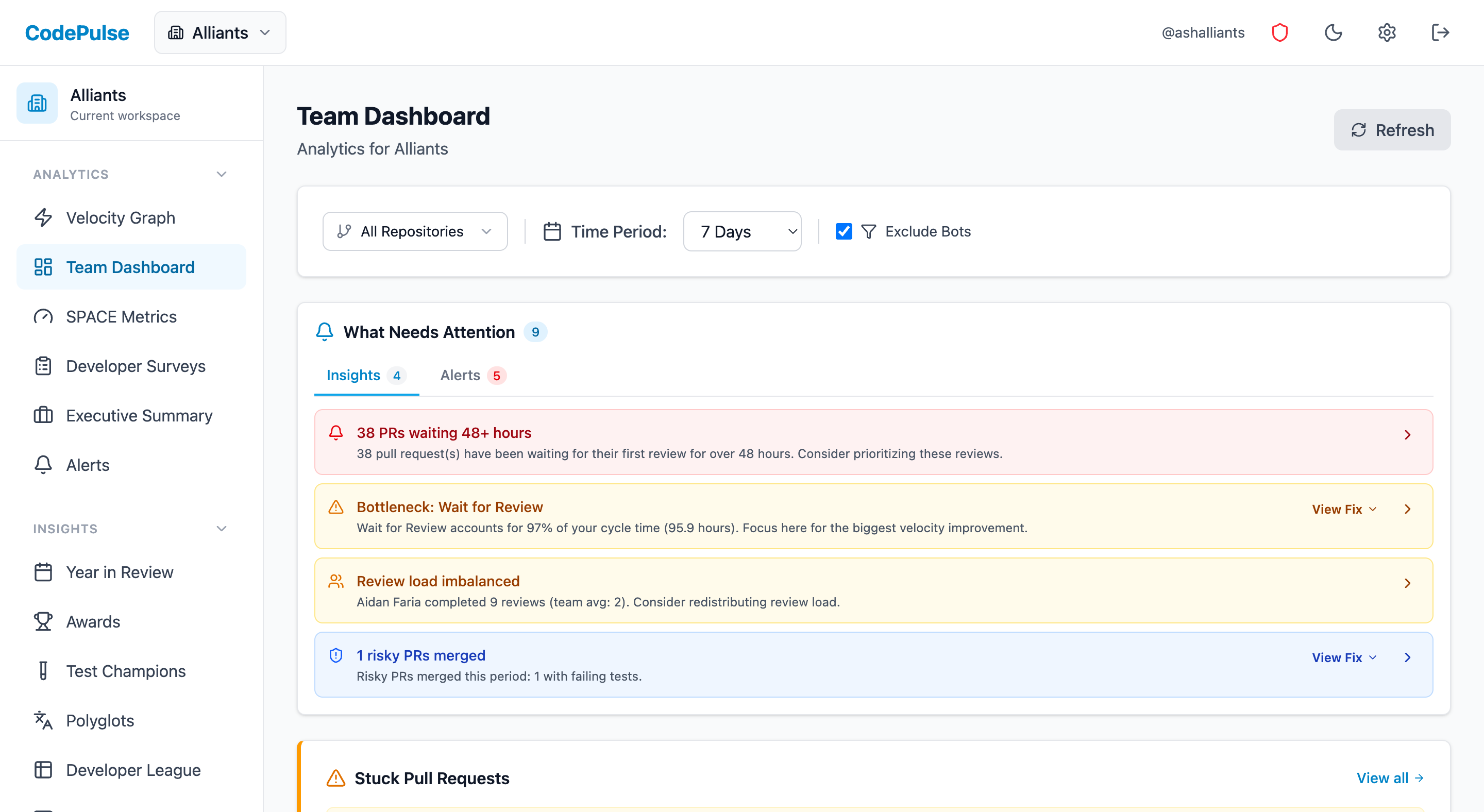
Find out which phase is holding your delivery up
CodePulse splits your cycle time into coding, waiting for review, active review, and merge, so you fix the queue that is actually costing you days. Read-only GitHub, no credit card.
Read-only GitHub · Your code stays yours · Team-level by default · No credit card
See These Features in Action
Break down cycle time into coding, waiting, review, and merge phases.
Track deployment frequency, lead time, and release patterns.
Related Guides
DORA Metrics Explained: The 4 Keys Without the Hype
A complete breakdown of the four DORA metrics - deployment frequency, lead time, change failure rate, and MTTR - with honest benchmarks and gaming traps to avoid.
Measure Deploy Frequency Without CI/CD (The Hack)
Master DORA deployment frequency and lead time using GitHub data alone, without requiring CI/CD pipeline access.
We Cut PR Cycle Time by 47%. Here's the Exact Playbook
A practical playbook for engineering managers to identify bottlenecks, improve review processes, and ship code faster - without sacrificing review quality.
The 4-Minute Diagnosis That Reveals Why Your PRs Are Stuck
Learn to diagnose exactly where your PRs are getting stuck by understanding the 4 components of cycle time and how to improve each one.