
Understand the system around the team, not a developer leaderboard
Preview team-level workload, collaboration, and delivery signals designed for process improvement rather than performance grading.
Read-only GitHub · Your code stays yours · Team-level by default · No credit card
Every time a developer switches between codebases, features, or even files, there's a cognitive cost. A University of California, Irvine study found it takes 23 minutes to fully refocus after a context switch. Our free developer time lost calculator turns that switching cost into an annual number in a couple of minutes. So how do you know if your team is drowning in context switching?
This guide shows you how to detect context switching patterns from PR data, distinguish productive breadth from harmful fragmentation, and help developers maintain focus without creating silos.
The Hidden Cost of Context Switching
What Context Switching Actually Costs
Context switching isn't just about time - it impacts quality and wellbeing:
- Cognitive load: Each context requires loading mental models, understanding state, and remembering where you left off
- Increased errors: Partially-loaded context leads to mistakes and missed edge cases
- Reduced flow state: Constant switching prevents deep work and creative problem-solving
- Longer completion times: Tasks that could take 4 hours of focused work take 8 hours when fragmented
- Burnout: The mental fatigue of constant switching compounds over time
Types of Context Switches
Not all context switches are equal:
Context Switch Severity
PR Patterns That Indicate High Context Switching
Repository Spread
A developer contributing to many repositories simultaneously is likely switching context frequently:
Repository Contribution Patterns
Context switching indicatorsFiles Per PR
The avg_files_per_pr metric reveals PR scope patterns:
- Low files per PR (1-5): Focused changes, clear scope, easy to review
- Medium files per PR (6-15): Typical feature work, reasonable scope
- High files per PR (15+): May indicate cross-cutting changes or scope creep
High files per PR can indicate a developer touching many different parts of the codebase in a single change - which itself is a form of context switching during development.
Unique Files Touched
Track how many unique files a developer touches over a period:
- High unique files: Could indicate broad knowledge (good) or constant context switching (concerning)
- Low unique files: Could indicate focus (good) or knowledge silo (concerning)
The interpretation depends on context - is the breadth intentional and sustainable, or reactive and fragmenting?
📊 How to View This in CodePulse
CodePulse tracks context switching indicators across several pages:
- Developer Analytics → Repository breakdown shows contribution distribution per developer
avg_files_per_prmetric on developer detail pagesunique_files_touchedtracked over time periods- Awards page includes "Cross-Pollinator" award for intentional breadth
Analyzing Developer Work Distribution
Repository Contributions View
On the Developer Analytics page, the repository breakdown shows where each developer's contributions are going:
- Pie chart: Visual distribution of PRs across repositories
- Trend over time: Has the distribution changed recently?
- Comparison: How does this developer's spread compare to team average?
Questions to Ask
When reviewing a developer's work distribution:
- Is this intentional? Are they supposed to be working across multiple areas, or did it happen organically?
- Is it sustainable? Can they maintain quality and momentum across this many contexts?
- Is it efficient? Would the team be better served by focused ownership?
- Are they okay? High context switching often correlates with stress and burnout.
Comparing Team Patterns
Look at the team as a whole to understand if context switching is systemic:
Team Context Switching Patterns
- Everyone contributes to many repositories
- No clear ownership or expertise areas
- Constant reactive work across the codebase
- Most developers focused on 1-2 repositories
- A few "utility players" work across codebases
- Context switching is intentional and scheduled
Questions for Retrospective
Ask Your Team
- "How often do you have to switch contexts unexpectedly?"
- "Do you feel like you have focused time for deep work?"
- "Are interruptions preventing you from finishing tasks?"
When Breadth is Good: Cross-Pollinator vs Overload
The Cross-Pollinator Role
Some context switching is valuable. The "Cross-Pollinator" award in CodePulse recognizes developers who intentionally work across boundaries:
- Knowledge transfer: Brings patterns and learnings from one area to another
- Reduced silos: Prevents "only Alice understands this code" situations
- Architectural perspective: Sees the big picture across systems
- Flexibility: Can help anywhere when needed
Cross-Pollinator vs Overloaded
Distinguishing Healthy Breadth from Harmful Fragmentation
- Forced to work across areas by circumstances
- Constant interruptions and unplanned switches
- Too shallow to be effective anywhere
- Declining productivity and quality
- Stressed and fragmented
- Chooses to work across areas
- Scheduled context switches (not reactive)
- Deep enough to add value in each area
- Maintains productivity and quality
- Enjoys the variety
Key diagnostic: Ask the developer - "Do you feel like you're choosing this breadth, or is it being imposed on you?"
The Staff Engineer Pattern
Senior engineers often have legitimately broad contribution patterns:
- They review PRs across many repositories (expected)
- They help unblock others in unfamiliar code (valuable)
- They drive cross-cutting initiatives (architectural work)
- They mentor across teams (intentional breadth)
For senior engineers, look at the nature of their contributions, not just the breadth. Are they doing deep work in many places, or shallow fixes everywhere?
Reducing Context Switching Without Siloing
Strategy 1: Batching Similar Work
Instead of switching between tasks throughout the day, batch similar work:
- Code review block: Do all reviews in a dedicated time slot, not as they come in
- Meeting-free time: Protect blocks for deep work in one context
- Repository days: If working across repos, dedicate entire days to each
Strategy 2: Clear Ownership with Backup
Define primary ownership while maintaining knowledge backup:
Ownership Model
Primary Owner (80% of work)
- Deep expertise
- First responder for issues
- Makes architectural decisions
Secondary Owner (20% of work)
- Enough context to help
- Can cover vacations/absences
- Reviews complex changes
Result
- Primary owner stays focused
- Knowledge isn't siloed in one person
- Context switching is planned, not reactive
Strategy 3: Reducing Interruptions
Unplanned context switches are the most costly. Reduce them by:
- Async communication defaults: Don't expect immediate responses to messages
- On-call rotations: Shield non-on-call developers from production issues
- Question routing: Send questions to the right person instead of everyone
- Documentation: Reduce "ask Alice" by documenting tribal knowledge
Strategy 4: Completing Work in Progress
Work in progress (WIP) is context that has to be reloaded later. Reduce it:
- Smaller PRs: Finish and merge before starting new work
- WIP limits: Don't start new work until current work is merged
- Pair on blockers: If stuck, get help to finish rather than parking and switching
For more on PR sizing, see our PR Size Optimization Guide.
Measuring Context Switching Improvement
Metrics to Track
- Repository concentration: What percentage of each developer's work is in their primary repository?
- Cycle time by developer: Are fragmented developers taking longer to complete PRs?
- Self-reported focus: Ask in surveys: "How often do you get interrupted?" "Do you have enough focus time?"
Improvement Targets
Context Switching Improvement Targets
Current state to Target stateContext switching is often invisible until you look for it. By tracking repository distribution and work patterns, you can help your team find the balance between healthy knowledge sharing and harmful fragmentation.
For related topics, see our guides on Measuring Team Performance Without Micromanaging, Capacity Planning with PR Data, and Developer Recognition Awards.
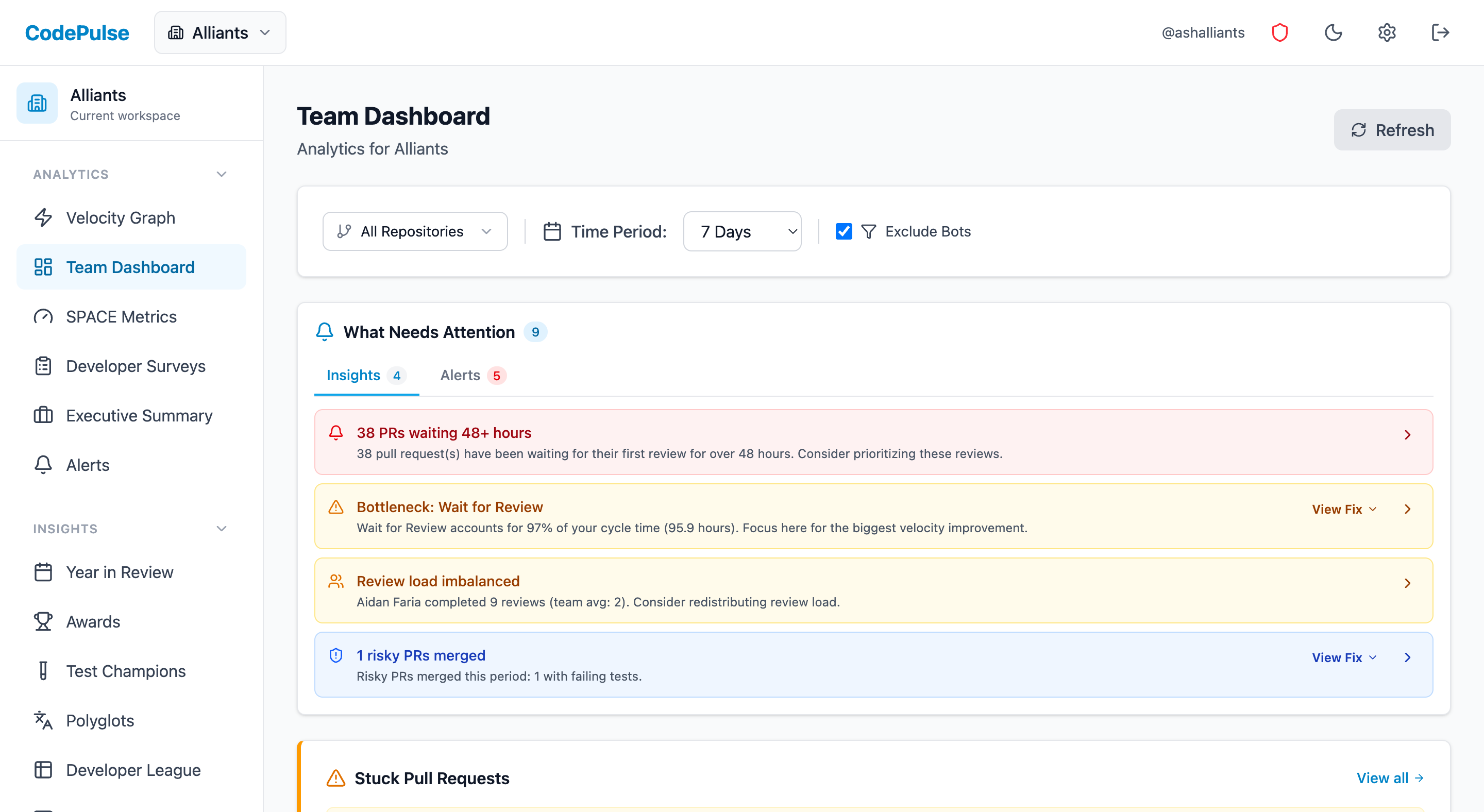
Get this view for your own teams
Connect GitHub for team-level workload, review distribution, and delivery signals. Individual views stay off unless your organisation explicitly turns them on.
Read-only GitHub · Your code stays yours · Team-level by default · No credit card
See These Features in Action
Explore all featuresRelated Guides
Engineering Metrics That Won't Get You Reported to HR
An opinionated guide to implementing engineering metrics that build trust. Includes the Visibility Bias Framework, practical do/don't guidance, and a 30-day action plan.
Stop Guessing Capacity. Your PRs Already Know
Use PR metrics to build data-driven capacity models, plan sprints realistically, and communicate engineering capacity to stakeholders.
Engineering Awards That Won't Destroy Your Culture
Build a data-driven recognition program that celebrates engineering achievements without creating toxic competition. 15 award categories, program design checklist, and measurement framework.
The Performance Review Framework That Doesn't Destroy Trust
Learn how to measure engineering performance fairly and effectively without creating toxic culture, gaming, or surveillance dynamics.
Developer Productivity Metrics That Don't Backfire
Stop treating engineers like factory workers. Learn which developer productivity metrics destroy trust, why lines of code fail, and how to measure productivity, including with AI tools, without surveillance.
How to Measure Developers Without Becoming the Villain
Learn how to implement engineering metrics that developers actually trust, focusing on insight over surveillance and team-level patterns.