
Understand the system around the team, not a developer leaderboard
Preview team-level workload, collaboration, and delivery signals designed for process improvement rather than performance grading.
Read-only GitHub · Your code stays yours · Team-level by default · No credit card
Developer Productivity Engineering (DPE) is how Netflix, Meta, and Spotify keep thousands of engineers productive. But you don't need their scale to benefit from DPE practices. This guide explains what DPE teams do, what they measure, and how to start a DPE function at any size - from a single engineer with data to a dedicated team.
If you're a VP considering investing in developer productivity, a Staff Engineer wondering if DPE could be your next career move, or an EM trying to systematically improve your team's delivery - this guide is for you.
🔥 Our Take
DPE isn't a luxury for Big Tech. Any team over 20 engineers is leaking productivity. You don't need Netflix's 80-person team - you need someone asking "what's slowing us down?" and the data to answer it.
The question isn't whether you can afford DPE. It's whether you can afford to ignore the compounding friction that accumulates as teams grow. Most productivity losses are invisible - until you start measuring.
What is Developer Productivity Engineering?
Developer Productivity Engineering is a discipline focused on systematically identifying and removing friction from the software development process. Unlike ad-hoc improvements, DPE approaches productivity as an engineering problem - with measurement, experimentation, and iteration.
The core premise: developers are expensive, and every hour they spend waiting, context switching, or fighting tooling is waste. DPE teams quantify that waste and build systems to eliminate it.
DPE vs. Platform Engineering vs. DevOps
| Discipline | Focus | Output |
|---|---|---|
| DPE | Developer experience & efficiency | Metrics, tools, process improvements |
| Platform Engineering | Internal developer platforms | Self-service infrastructure, golden paths |
| DevOps | Delivery pipeline & operations | CI/CD, monitoring, reliability |
These disciplines overlap and often work together. DPE is the umbrella - it might include platform engineering and DevOps improvements, but it starts from the question "what's making developers less productive?" rather than "what infrastructure do we need?"
"Platform Engineering builds the roads. DevOps keeps them maintained. DPE asks whether they're the right roads and measures how fast traffic is moving."
The Rise of DPE Teams
DPE emerged as companies realized that small improvements in developer efficiency compound dramatically at scale. Before you build out a dedicated DPE team, our free DPE maturity assessment shows where you sit today. The math behind the investment is simple:
DPE ROI Calculation
===================

Example: 100 engineers, $200K fully-loaded cost

If DPE improves productivity by 10%:
├─ Hours recovered: 100 engineers × 2,000 hrs × 10% = 20,000 hours/year
├─ Dollar value: 20,000 × $100/hr = $2,000,000/year
└─ ROI on 4-person DPE team ($800K): 250%

Even 5% improvement at 50 engineers justifies a dedicated DPE role.
How Big Tech Does DPE
| Company | DPE Investment | Focus Areas |
|---|---|---|
| Netflix | 80-person team | Inner dev loop, tooling, metrics |
| Meta | Hundreds of engineers | Build systems, code search, IDE plugins |
| Engineering Productivity org | Build infrastructure, testing, tooling | |
| Spotify | Platform + DPE teams | Developer portals, golden paths |
| Dedicated DPE team | Developer experience, metrics |
Netflix's DPE team owns the entire "inner development lifecycle" - from writing code through integration. They monitor build times, identify patterns in test failures, and build tools that help developers troubleshoot issues independently.
What DPE Teams Actually Do
A DPE team's work typically falls into four categories:
1. Measure Developer Experience
DPE starts with understanding where time goes and where friction exists:
- Instrument development workflows to track time spent in each phase
- Survey developers about pain points and satisfaction
- Analyze build, test, and deployment metrics
- Identify patterns in cycle time, blockers, and failures
2. Remove Systemic Friction
Based on measurement, DPE teams target the highest-impact friction:
- Speed up slow builds through caching, parallelization, or infrastructure
- Fix flaky tests that waste time and erode trust
- Streamline CI/CD pipelines for faster feedback
- Improve code search and navigation
- Automate repetitive tasks
3. Build Internal Tools
When off-the-shelf tools don't meet specific needs, DPE teams build custom solutions:
- Developer dashboards and metrics portals
- IDE plugins for common workflows
- CLIs that automate complex operations
- Integration tools connecting internal systems
4. Advocate for Developer Experience
DPE teams represent developer interests in organizational decisions:
- Influence infrastructure and tooling investments
- Push back on processes that add friction
- Educate leadership on productivity trade-offs
- Champion sustainable pace and team health
💡 DPE Team Structure
Typical DPE Team Composition (for ~200 engineers)

├─ DPE Manager (1)
│   └─ Prioritization, stakeholder management, roadmap
│
├─ Build/CI Engineers (2-3)
│   └─ Build systems, pipeline optimization, caching
│
├─ Tools/Platform Engineers (2-3)
│   └─ Internal tools, IDE plugins, CLIs
│
├─ Data/Metrics Engineer (1)
│   └─ Metrics infrastructure, dashboards, analysis
│
└─ Developer Advocate (1)
    └─ Documentation, training, feedback collection
Key Metrics for DPE Success
DPE teams measure both inputs (friction) and outputs (productivity):
Developer Experience Metrics
| Metric | What It Measures | Target |
|---|---|---|
| Build time (P50, P95) | Time to compile and test locally | <5 min P50, <15 min P95 |
| CI feedback time | Time from push to results | <10 min for unit tests |
| Flaky test rate | Tests that fail intermittently | <1% of test runs |
| Dev environment setup time | New engineer to first commit | <1 day |
Delivery Metrics
| Metric | What It Measures | Target |
|---|---|---|
| Cycle time | First commit to merge | <24 hours |
| Flow efficiency | Active time / total time | >40% |
| Deployment frequency | How often code ships | Daily or more |
| Lead time | Commit to production | <1 day for elite |
Satisfaction Metrics
| Metric | What It Measures | Method |
|---|---|---|
| Developer satisfaction score | Overall experience | Quarterly survey |
| Tool NPS | Satisfaction with specific tools | Periodic survey |
| Friction reports | Self-reported blockers | Continuous collection |
| After-hours work | Sustainability signals | Git data analysis |
For a complete framework on productivity measurement, see our What is Developer Productivity? guide.
Starting a DPE Practice
You don't need a dedicated team to start practicing DPE. Here's how to begin at any scale:
Team of 1 (20-50 Engineers)
At this size, DPE is typically a part-time responsibility for a senior engineer or EM:
- Instrument basic metrics: Start with cycle time and build time. Tools like CodePulse can provide this without custom infrastructure.
- Run a friction survey: Ask developers what slows them down. Prioritize the top 3 issues.
- Fix one thing well: Don't try to improve everything. Pick the highest-impact friction point and eliminate it.
- Share wins: When improvements land, communicate the impact. "Review wait time dropped 40%" builds support for more DPE work.
📊 How CodePulse Supports DPE
CodePulse provides the measurement foundation for DPE without building custom infrastructure:
- Cycle time breakdown shows where time goes
- Review network reveals collaboration bottlenecks
- Alerts surface issues automatically
- Benchmarks provide context for improvement goals
- Executive dashboards help communicate DPE impact to leadership
Small Team (50-150 Engineers)
At this scale, consider a dedicated DPE engineer:
- Formalize measurement: Build dashboards that track key metrics over time. Make them visible to everyone.
- Establish feedback loops: Regular developer surveys, office hours for friction reports, retrospective analysis of slow cycles.
- Target build/CI first: Build time improvements have the highest compound returns. Every developer benefits, multiple times per day.
- Create improvement roadmap: Prioritize initiatives by impact and effort. Share the roadmap with engineering leadership.
Dedicated Team (150+ Engineers)
At this scale, invest in a full DPE team:
- Staff appropriately: Typical ratio is 1 DPE engineer per 30-50 product engineers, depending on complexity.
- Define charter: What does DPE own? What does it influence but not own? Clear boundaries prevent turf wars with Platform and DevOps teams.
- Build vs. buy: Use SaaS tools where they fit; build custom where your needs are unique.
- Measure DPE impact: Track improvements over time. Quantify hours saved, not just tool adoption.
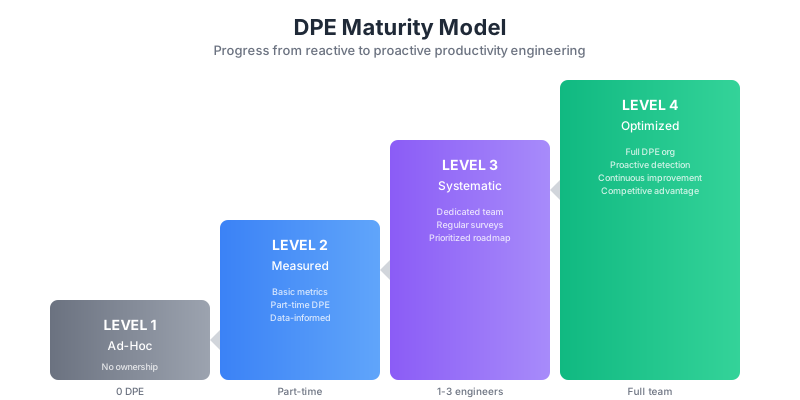
DPE Maturity Model
==================

Level 1: Ad-Hoc
├─ No dedicated DPE ownership
├─ Occasional improvements based on complaints
└─ No consistent measurement

Level 2: Measured
├─ Basic metrics in place (cycle time, build time)
├─ Part-time DPE responsibility
└─ Improvement efforts informed by data

Level 3: Systematic
├─ Dedicated DPE engineer or team
├─ Regular developer experience surveys
├─ Prioritized improvement roadmap

Level 4: Optimized
├─ Full DPE organization
├─ Proactive friction detection
├─ Continuous improvement culture
└─ DPE as competitive advantage
Tools and Platforms for DPE
DPE teams typically leverage a mix of tools across categories:
Measurement and Analytics
- Engineering analytics: CodePulse, LinearB, Jellyfish, Swarmia
- Build analytics: Gradle Enterprise, BuildKite Analytics
- Custom dashboards: Grafana, Looker, internal tools
Build and CI Optimization
- Build systems: Bazel, Buck, Gradle
- Remote execution: BuildBuddy, EngFlow
- CI platforms: BuildKite, CircleCI, GitHub Actions
Developer Experience
- Developer portals: Backstage, Port, Cortex
- Code search: Sourcegraph
- IDE plugins: Custom or vendor-provided
For guidance on selecting the right tools, see our Developer Productivity Tools Guide.
"The best DPE teams don't just measure productivity - they create the conditions where great work happens naturally."
Getting Started This Week
Here's a practical starting point, from scratch or formalizing existing efforts. If you want a structured 30-day plan, our free developer productivity improvement planner turns these steps into a prioritized roadmap:
- Get visibility: If you can't measure cycle time today, start there. Tools like CodePulse can be set up in under an hour.
- Ask developers: Send a simple survey: "What's the biggest thing slowing you down?" The answers will guide your priorities.
- Pick one metric: Don't try to improve everything. Choose one number (cycle time, build time, review wait) and focus on it.
- Make a business case: Calculate the ROI of improvement. Leadership responds to "we can recover 5,000 engineering hours per year" better than "developers are frustrated."
- Celebrate wins: When improvements land, communicate them widely. Success builds momentum for more DPE investment.
For a deeper understanding of productivity measurement, start with our What is Developer Productivity? guide. For ROI calculation frameworks, see our Engineering Analytics ROI Guide.
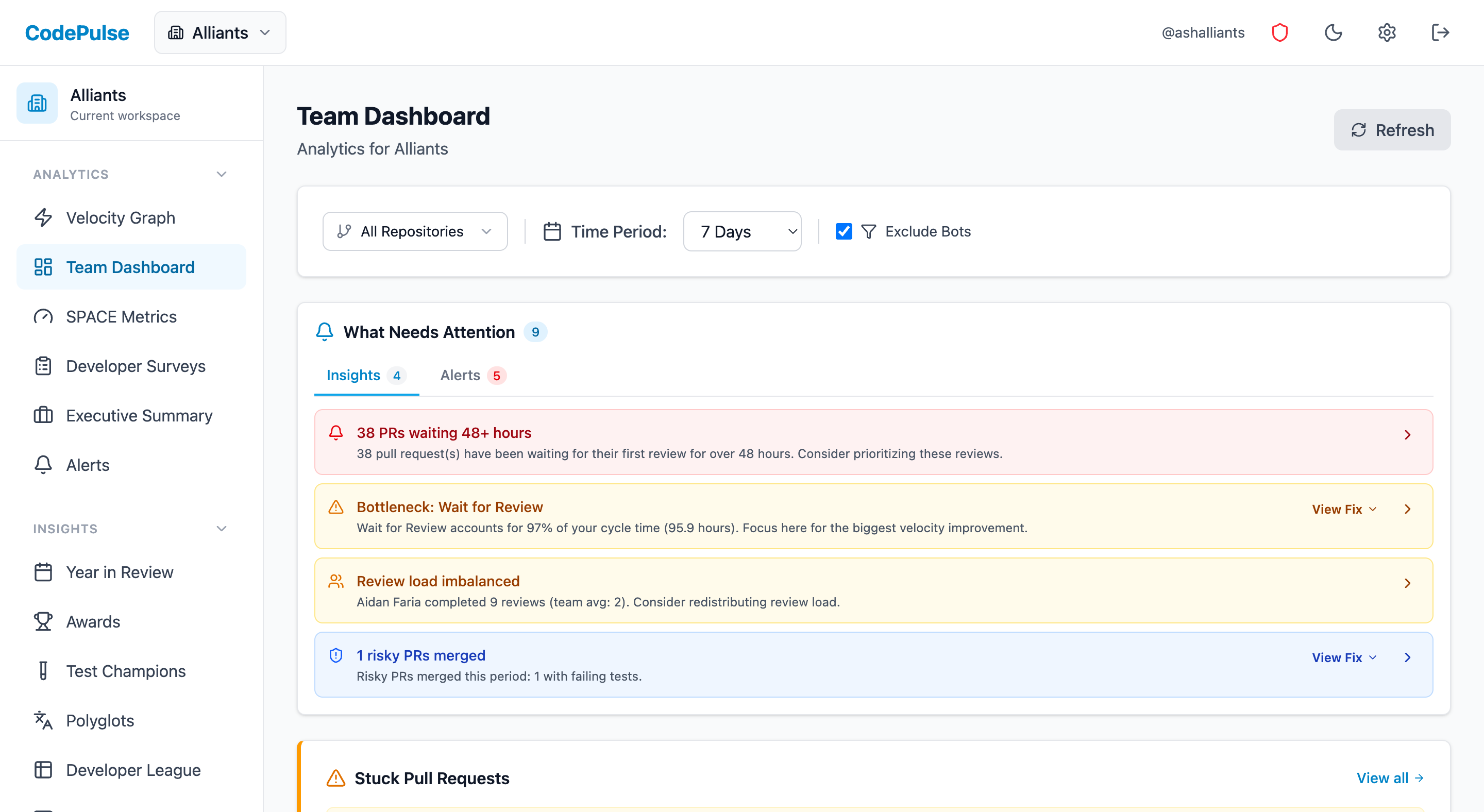
Get this view for your own teams
Connect GitHub for team-level workload, review distribution, and delivery signals. Individual views stay off unless your organisation explicitly turns them on.
Read-only GitHub · Your code stays yours · Team-level by default · No credit card
See These Features in Action
Compare contribution patterns for coaching, not surveillance.
Holistic developer productivity using the SPACE framework.
Related Guides
What is Developer Productivity? (It's Not What You Think)
Developer productivity means sustainable delivery with team health - not lines of code. Learn the frameworks, dimensions, and what NOT to measure.
Engineering Analytics ROI: The Budget Approval Playbook
Calculate the ROI of engineering analytics tools with formulas for time savings, payback period, and a business case template tailored to CFOs, CTOs, and CEOs.
Your IDP Is Failing. Here's How to Prove It (Or Fix It)
Learn how to measure the success of your Internal Developer Platform. Covers adoption metrics, developer experience, delivery impact, and ROI calculation.
Why Adding Engineers Made Us Slower (Brooks' Law Is Real)
Understand Brooks' Law and the hidden costs of scaling. Learn why adding engineers temporarily slows you down and how to minimize the efficiency dip.
Engineering Operations: Running a Software Org Like a Business
Engineering ops is the operational discipline connecting your delivery pipeline to business outcomes. The system-level approach to cost per feature, capacity, and predictability.
Engineering Portfolio Reporting: The 4-Section Template That Works
Build engineering portfolio reports that translate dev work into business language. Includes the exact 4-section template, finance translation table, and automation guide.