
Turn this metric into a baseline for your team
Preview a system-level engineering health report, then connect GitHub when you are ready to compare this metric with your own delivery history.
Read-only GitHub · Your code stays yours · Team-level by default · No credit card
If you lead a platform or infrastructure team, your standard velocity dashboards are probably making you look bad. One Terraform module that unblocks 50 app teams shows up as a single PR with a 6-day cycle time. That is not slow - it is force-multiplier work that PR counts miss entirely. This guide covers the KPIs that actually reflect platform team impact: adoption rate, force multiplier ratios, infra stability scores, and infrastructure-specific cycle time benchmarks. CodePulse's Repository Comparison view lets you show platform vs. app team metrics side-by-side with appropriate expectations for each.
What metrics should platform and infrastructure teams track?
Platform teams need different metrics than product teams. Track adoption rate (percentage of teams using your platform), developer satisfaction (NPS or survey scores), onboarding time (how long until a new team is productive on the platform), incident contribution rate (platform-caused vs app-caused incidents), and self-service ratio (requests handled automatically vs manually). Avoid tracking platform team cycle time against product team benchmarks, because infrastructure work legitimately takes longer due to blast radius and reliability requirements.
Related guides in this series
- VP Board Metrics - the 7 numbers to present at board level (delivery, cost, health)
- DORA Metrics Explained - the four keys and why platform teams affect 3 of 4
- Metrics Rollout Playbook - introducing metrics to your org without triggering resistance
- Analytics ROI Calculator - justify the budget with payback period and cost-per-hour formulas
For IDP-specific metrics, see our guide on internal developer platform metrics.
Why Do Platform Teams Need Different Metrics?
Applying the same metrics to platform teams and application teams is like comparing highway construction to food delivery - both involve vehicles, but the goals, timelines, and success criteria are completely different.
The Platform Team Reality
Platform teams deal with unique constraints that don't show up in typical velocity metrics:
- Higher stakes: Infrastructure changes affect every service. A bug in the deployment pipeline blocks the entire organization.
- Deeper scrutiny: Security reviews, architecture committee approvals, and extensive testing are necessary, not bureaucratic delays.
- Invisible success: When infrastructure works perfectly, nobody notices. Stability is the goal.
- Force multiplier impact: One platform improvement can accelerate 50 application teams, but that impact doesn't show in PR counts.
Metrics That Mislead for Platform Teams
Standard velocity metrics often paint platform teams in a negative light:
| Metric | Why It Misleads |
|---|---|
| PR Cycle Time | Infrastructure PRs require extensive review and testing. Longer is often better. |
| PRs per Developer | Platform work is complex. One Terraform module is worth 20 feature PRs. |
| Lines of Code | Good infrastructure code is concise. Fewer lines often mean better abstraction. |
| Review Coverage | Platform PRs should have multiple reviewers from security, SRE, and architecture. |
Metrics That Actually Matter
For platform teams, focus on metrics that capture stability, enablement, and impact:
- Deployment frequency across all teams: Are you making it easier for others to ship?
- Incident rate and MTTR: How stable is your infrastructure?
- Adoption of platform services: How many teams are using your tools?
- Time saved by automation: How much manual work have you eliminated?
- Test failure rate: How reliable are your CI pipelines?
🔥 Our Take
Measuring platform teams on the same velocity metrics as product teams is organizational malpractice.
A platform engineer who ships one Terraform module that unblocks 50 app teams is worth more than an app engineer who ships 20 small features. But PR counts, cycle time, and "lines of code" will make that platform engineer look slow. If your VP is comparing these teams side-by-side on the same dashboard, you have a measurement problem, not a performance problem.
How Should Platform Teams Measure Deployment Frequency?
For platform teams, deployment frequency tells a different story than it does for application teams. It's not about how often you deploy - it's about how often you enable others to deploy.
The Platform Perspective on Deployment Frequency
A reliable deployment pipeline maintained by the platform team should increase organization-wide deployment frequency. Track:
- Org-wide deployment frequency: How many times per day does the entire organization deploy to production?
- Trend over time: Is deployment frequency increasing as you improve tooling?
- Deployment success rate: What percentage of deployments complete without rollback?
- Zero-downtime deployments: Can teams deploy without customer impact?
"A platform team's success isn't measured by how many PRs they merge. It's measured by how many PRs everyone else can merge because of them."
Measuring Infrastructure Stability
For the platform team's own infrastructure changes, slower deployments with higher success rates are desirable:
- Deploy critical infrastructure weekly (not daily)
- Zero failed infrastructure deployments
- All infrastructure changes staged in sandbox first
- Comprehensive rollback plans for every deploy
- Deploy features multiple times per day
- <15% change failure rate is acceptable
- Fast iteration with quick rollback if needed
Using Deployment Frequency to Prove Impact
When reporting to leadership, show how platform improvements correlate with organization-wide velocity increases:
- Before/after analysis: "After deploying the new CI pipeline in Q2, org-wide deployment frequency increased from 12/day to 28/day."
- Time-to-deploy tracking: "Our automated deployment system reduced average deploy time from 45 minutes to 8 minutes."
- Blocked deployment tracking: "Zero blocked deployments this quarter due to platform issues (down from 14 last quarter)."
Why Is Cycle Time Different for Infrastructure Changes?
Cycle time for infrastructure PRs should be longer than application PRs - but you need to explain why and where the time goes.
The Four Components of Infrastructure Cycle Time
CodePulse breaks cycle time into four components. For platform teams, each component has a different interpretation. Learn more in our Cycle Time Breakdown Guide.
1. Coding Time: Longer is OK
Platform PRs often stay in draft longer because they require:
- Sandbox environment testing before requesting review
- Performance benchmarks to prove no regression
- Documentation updates alongside code changes
- Migration scripts for existing services
What to track: Time in draft vs ready-for-review. If 80% of cycle time is in draft, that's productive caution. If it's waiting after review request, that's a bottleneck.
2. Wait for Review: Context Matters
Infrastructure PRs may wait longer because they need specific reviewers:
- Security team sign-off on auth changes
- SRE approval for service-mesh modifications
- Architecture review for database schema changes
What to track: Average wait time for required specialist reviewers vs general reviewers. If security review adds 2 days but catches critical issues, that's time well spent.
3. Review Duration: Thorough is Better
Infrastructure reviews should be thorough. Multiple rounds of feedback are expected:
- Reviewing Terraform plans for unintended resource changes
- Validating Kubernetes manifests don't break existing deployments
- Ensuring backward compatibility with existing services
What to track: Number of review rounds before approval. If every PR goes through 5+ rounds, that indicates unclear requirements or insufficient testing before review.
4. Approval to Merge: Automation Opportunity
This is where platform teams can improve. Long delays between approval and merge often indicate:
- Slow CI pipelines running extensive test suites
- Manual staging deployment gates
- Waiting for maintenance windows to merge
What to track: CI duration and manual gate delays separately. These are both fixable with better automation.
How Do You Compare Platform vs Application Team Metrics?
When leadership asks why the platform team has longer cycle times or fewer PRs than application teams, you need a framework for fair comparison.
Using Repository Comparison
CodePulse's Repository Comparison feature lets you show side-by-side metrics for different types of repositories. Here's how to use it:
Step 1: Group Repositories by Type
Create logical groupings:
- Infrastructure: Terraform, Kubernetes configs, CI/CD pipelines
- Platform Services: Auth service, API gateway, monitoring
- Application Services: Customer-facing features
Step 2: Compare Appropriate Metrics
| Metric | Platform Expectation | Application Expectation |
|---|---|---|
| Cycle Time | 3-7 days (thorough review) | 1-3 days (fast iteration) |
| PRs per Developer | 2-5/week (complex changes) | 5-15/week (feature velocity) |
| Review Coverage | 90-100% (critical changes) | 75-90% (balanced quality) |
| Test Failure Rate | <5% (stable infrastructure) | <15% (acceptable iteration) |
Step 3: Highlight Force Multiplier Impact
One platform PR can enable hundreds of application PRs. Show the relationship:
Example Executive Summary
Q4 Platform Team ImpactSetting Different Targets
Don't hold platform teams to application team benchmarks. Set appropriate targets:
- Cycle time: Platform team target 5-7 days, application team target 1-2 days
- Deployment frequency: Platform team target weekly, application team target daily
- Test failure rate: Platform team target <5%, application team target <15%
- Review coverage: Platform team target 100%, application team target 80%
For more on managing metrics across different repository types, see our Monorepo vs Multi-Repo Metrics Guide.
How Do You Identify Infrastructure Hotspots?
High-churn infrastructure files indicate either active improvement or technical debt. Knowing which helps you tell the right story.
Using File Hotspots for Infrastructure
Navigate to File Hotspots to identify frequently-changed infrastructure files. Filter by your infrastructure repositories to find:
High-Churn Files That Are Good
- Service configurations: Frequent updates as teams onboard new services
- CI/CD pipelines: Regular improvements and optimizations
- Monitoring configs: Adding observability as services grow
Story to tell: "Our CI pipeline config is our #1 hotspot because we're continuously optimizing build times and adding new test stages."
High-Churn Files That Are Concerning
- Authentication modules: Repeated changes suggest bugs or unclear requirements
- Deployment scripts: Constant fixes indicate fragile automation
- Database migrations: Frequent rollbacks or corrections
Story to tell: "Our auth module is a hotspot due to technical debt. We're allocating 2 engineers next quarter to refactor and reduce churn."
Tracking Hotspot Trends
Use hotspot data to demonstrate platform improvements over time:
- Decreasing churn: "We refactored the deployment pipeline in Q2. Change frequency dropped 60%, indicating improved stability."
- Increasing churn (good): "Terraform config churn increased 40% as we onboarded 8 new services to our infrastructure-as-code platform."
- Churn concentration: "80% of infrastructure changes are in 3 files, making reviews efficient and predictable."
How Do You Communicate Platform Team Impact to Leadership?
Platform teams create leverage, not features. Your metrics report needs to emphasize enablement over activity.
The Executive Summary Format
Structure your platform team updates around outcomes, not outputs:
Platform Team Impact Report
Q4 2025Metrics to Show on the Executive Dashboard
The Executive Summary view shows high-level metrics. For platform teams, emphasize:
- Deployment Frequency card: Show org-wide deployment cadence and trend
- Test Failure Rate: Highlight CI reliability and stability
- Cycle Time Breakdown: Explain why platform cycle time is longer but appropriate
- Custom metrics: Add platform-specific KPIs like "Time Saved by Automation" or "Services Onboarded"
📊How to See This in CodePulse
Track platform team impact with these views:
- Dashboard shows deployment frequency, cycle time breakdown, and test failure rates
- Repository Comparison lets you compare infrastructure vs application repo metrics side-by-side
- File Hotspots identifies high-change infrastructure files for technical debt tracking
- Executive Summary provides a leadership-friendly view of org-wide velocity metrics
Telling the Platform Story
When explaining metrics to leadership, use narratives that connect platform work to business outcomes:
Story 1: The Velocity Multiplier
"Our platform team merged 23 PRs this quarter with a 6.5-day average cycle time - longer than application teams. But those 23 PRs included a new CI pipeline that cut build times by 40%, enabling all 12 application teams to deploy twice as often. The result: organization-wide deployment frequency increased from 18 to 28 per day, and customer feature velocity increased by 35%."
Story 2: The Stability Investment
"Platform PRs take longer to merge because we maintain 100% review coverage and require security sign-off on all infrastructure changes. This quarter, we had only one platform-caused incident (vs 4 last quarter), and our deployment success rate improved to 98.5%. The longer review cycle directly contributes to the stability that lets application teams deploy confidently multiple times per day."
Story 3: The Technical Debt Paydown
"Our authentication module appeared as a file hotspot with 47 changes this quarter. This represented a deliberate refactoring to eliminate technical debt. As a result, auth-related incidents dropped to zero, and teams can now integrate authentication in 30 minutes instead of 2 days. We expect this hotspot to cool significantly next quarter as the refactoring completes."
"DORA metrics are signals, not KPIs. For platform teams, they should tell you whether your infrastructure is enabling or hindering delivery, not whether your engineers are 'performing.'"
Connecting Platform Metrics to DORA
Platform teams directly influence three of the four DORA metrics. Make this connection explicit in your reporting. Learn more in our DORA Metrics Guide.
| DORA Metric | Platform Team Contribution |
|---|---|
| Deployment Frequency | CI/CD pipelines, deployment automation, infrastructure reliability |
| Lead Time for Changes | Build optimization, automated testing, deployment speed |
| Change Failure Rate | Test infrastructure, staging environments, rollback capabilities |
| Time to Restore Service | Monitoring, observability, incident response tooling |
Executive message: "Platform team investments this quarter improved three of four DORA metrics organization-wide, moving us from 'Medium' to 'High' performer category."
Quarterly Goals for Platform Teams
Set and track goals that reflect platform team responsibilities:
- Enablement goals: "Increase org-wide deployment frequency by 25%"
- Stability goals: "Reduce platform-caused incidents to <2 per quarter"
- Efficiency goals: "Cut average CI build time from 14 min to <10 min"
- Adoption goals: "Onboard 15 services to new deployment platform"
- Quality goals: "Maintain 100% review coverage on infrastructure changes"
Track these goals alongside standard metrics to demonstrate that longer cycle times and fewer PRs are intentional trade-offs for higher-impact outcomes.
What Should Platform Team Leads Do This Week?
This Week
- Segment your repositories: Label infrastructure, platform services, and application repos separately in CodePulse
- Establish baselines: Document current cycle time, deployment frequency, and test failure rate for your infrastructure repos
- Identify force multipliers: List platform improvements from last quarter and estimate teams/services impacted
This Month
- Set platform-specific targets: Define appropriate cycle time and velocity goals that differ from application teams
- Create an executive summary template: Use the format above to report platform impact, not just platform activity
- Audit file hotspots: Identify infrastructure files with high churn and categorize as "good churn" or "technical debt"
This Quarter
- Implement org-wide velocity tracking: Measure deployment frequency and lead time across all teams, showing platform team's influence
- Document platform decisions: Create a log explaining why specific infrastructure PRs took longer (security reviews, load testing, etc.)
- Educate leadership: Share this guide with executives to set appropriate expectations for platform team metrics
Remember: platform teams create leverage. Your success isn't measured by how many PRs you merge, but by how much you accelerate everyone else. Use metrics that tell that story.
Frequently Asked Questions
Standard metrics like PR cycle time and PRs per developer are designed for application teams shipping features quickly. Platform teams legitimately have longer cycle times (infrastructure changes require extensive review and testing) and fewer PRs (one Terraform module can be worth 20 feature PRs in impact). Measuring platform teams on these metrics makes them look slow when they are actually doing high-leverage work.
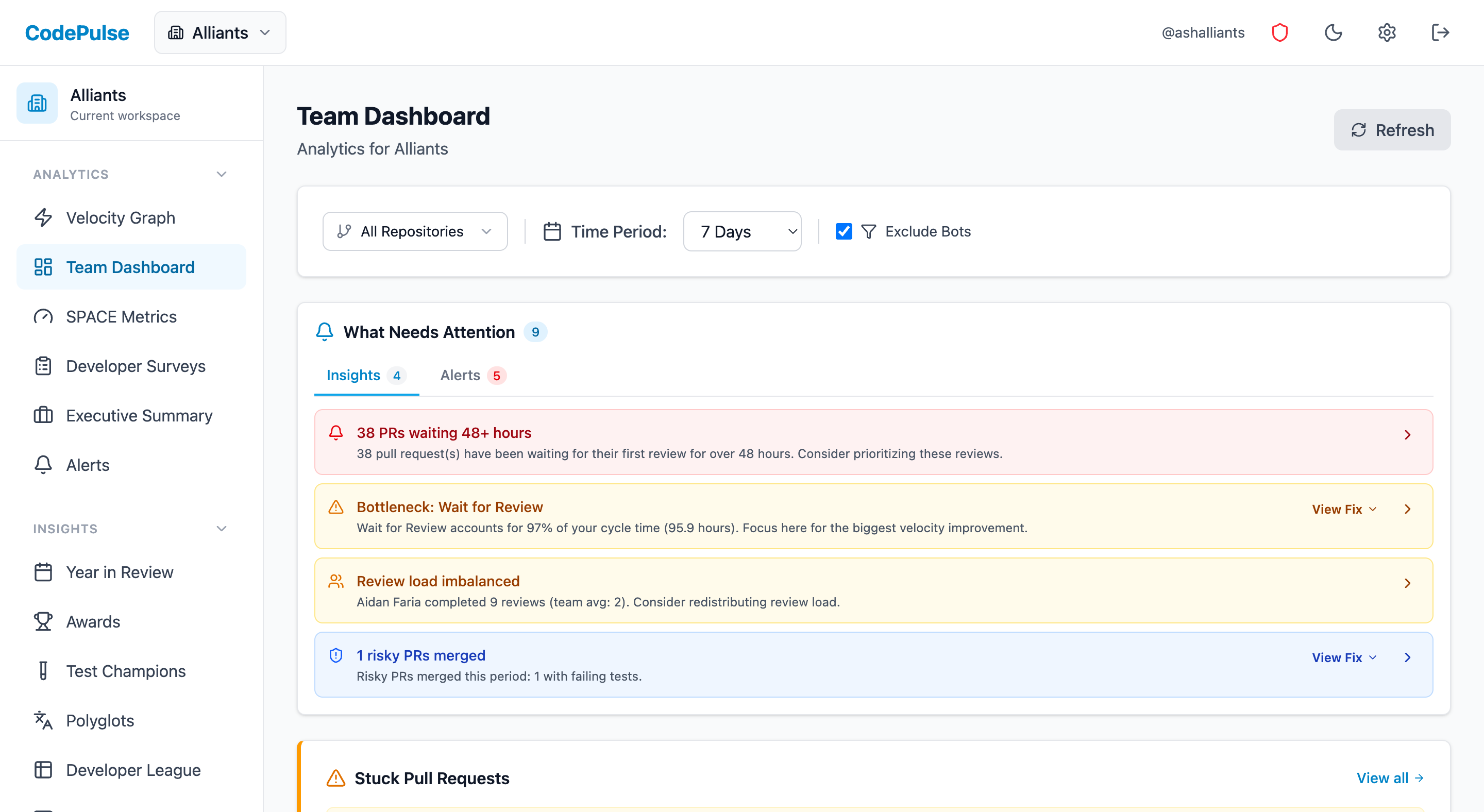
Now measure this metric on your own repositories
Connect read-only GitHub in about five minutes and get your baseline, your trend, and the constraint behind it. Your fourteen usable trial days start when the first repository finishes syncing.
Read-only GitHub · Your code stays yours · Team-level by default · No credit card
See These Features in Action
Board-ready engineering performance in a single page.
Track all four DORA metrics and benchmark against industry standards.
Related Guides
DORA Metrics Explained: The 4 Keys Without the Hype
A complete breakdown of the four DORA metrics - deployment frequency, lead time, change failure rate, and MTTR - with honest benchmarks and gaming traps to avoid.
The 4-Minute Diagnosis That Reveals Why Your PRs Are Stuck
Learn to diagnose exactly where your PRs are getting stuck by understanding the 4 components of cycle time and how to improve each one.
The Monorepo Metrics Trap (And How to Escape It)
How to aggregate, compare, and analyze engineering metrics across multiple repositories or within a monorepo structure.
Your IDP Is Failing. Here's How to Prove It (Or Fix It)
Learn how to measure the success of your Internal Developer Platform. Covers adoption metrics, developer experience, delivery impact, and ROI calculation.
Engineering Metrics Dashboard: The 7 Metrics You Need
Skip vanity metrics. Here are the 7 engineering metrics VPs actually need to track team performance, delivery, and quality.
How I Got Engineering Metrics Budget Approved in 1 Meeting
Learn how to justify engineering analytics investment to CFOs, CEOs, and boards by translating technical value into business outcomes.