
Compare the finished analysis before you choose a platform
See the report CodePulse produces from read-only GitHub workflow data, or connect your own repositories and evaluate the fit with real evidence.
Read-only GitHub · Your code stays yours · Team-level by default · No credit card
Developer tools promise productivity gains, but how do you prove they're worth the investment? With engineering budgets under scrutiny, you need data - not vibes - to justify tooling spend. This guide shows you how to calculate and communicate developer tooling ROI.
In 2025, the average mid-sized tech company spends between $100,000 and $250,000 per year on developer tools. Large enterprises with thousands of engineers often invest over $2 million annually. These aren't small numbers - and leadership expects measurable returns.
Why Developer Tooling ROI Matters
"We need this tool" isn't a business case. Engineering leaders who can quantify tooling impact:
- Get faster budget approval for necessary tools
- Avoid wasting money on underutilized software
- Build credibility with finance and executive teams
- Make informed decisions about tool consolidation
- Negotiate better pricing with vendors
According to McKinsey's 2025 Technology Investment Report, organizations with structured engineering cost-benefit analysis frameworks demonstrate 42% higher project success rates.
The Developer Tooling ROI Formula
At its simplest, ROI is:
ROI Formula
But for developer tools, the challenge is quantifying both sides of that equation.
Calculating Total Cost of Ownership (TCO)
License fees are just the start. True TCO includes:
| Cost Category | Examples |
|---|---|
| Licensing | Per-seat fees, enterprise tiers, overage charges |
| Implementation | Setup time, integration work, configuration |
| Training | Onboarding time, documentation, workshops |
| Maintenance | Updates, troubleshooting, admin overhead |
| Infrastructure | Self-hosted compute, storage, networking |
| Opportunity cost | Time spent evaluating and switching tools |
Calculating Gains
Developer tool gains typically fall into three categories:
- Time savings: Hours saved × hourly cost × number of developers
- Quality improvements: Fewer bugs, reduced incident costs
- Velocity gains: Faster time to market, more features shipped
ROI Benchmarks by Tool Category
AI Coding Assistants (GitHub Copilot, etc.)
| Metric | Typical Range |
|---|---|
| Cost per developer | $19-40/month |
| Productivity improvement | 20-42% |
| Time to positive ROI | 1-3 months |
| Code review efficiency gain | 38%+ |
At $40/month per user, costs scale to $250,000/year for 500 engineers. Organizations report 3-12% overall engineering efficiency gains, with top performers seeing up to 42% improvement in coding productivity. To put your own numbers against these ranges, our free GitHub Copilot ROI calculator models the payback for your team size and seat price. "AI Coding Assistants, etc." covers real alternatives worth pricing out too - see our GitHub Copilot alternatives comparison for how Cursor, Claude Code, and the rest of the field price and perform against it.
CI/CD Platforms
| Metric | Typical Range |
|---|---|
| Build time reduction | 30-60% |
| Deployment frequency increase | 2-10x |
| Incident reduction | 15-40% |
| Developer time saved per week | 2-5 hours |
Code Quality & Testing Tools
| Metric | Typical Range |
|---|---|
| Bug escape reduction | 20-50% |
| Code review time reduction | 15-30% |
| Security vulnerability detection | 40-70% earlier |
| Time to positive ROI | 3-6 months |
Engineering Analytics Platforms
| Metric | Typical Range |
|---|---|
| Cycle time reduction | 15-30% |
| Meeting time reduction | 20-40% |
| Bottleneck identification | 3-5x faster |
| Time to positive ROI | 2-4 months |
Step-by-Step ROI Calculation Example
Let's calculate ROI for an engineering analytics tool for a 50-person engineering team. Teams still tracking these metrics manually will also want our CodePulse vs spreadsheet tracking comparison - the hidden labor cost of spreadsheet workflows is usually the fastest-returning line item in the ROI model.
Step 1: Calculate Total Cost
| Cost Item | Annual Cost |
|---|---|
| License (50 seats × $20/month) | $12,000 |
| Implementation (40 hours × $150/hour) | $6,000 |
| Training (2 hours × 50 devs × $75/hour) | $7,500 |
| Ongoing admin (2 hours/month × $150) | $3,600 |
| Total Year 1 Cost | $29,100 |
Step 2: Calculate Gains
| Benefit | Annual Value |
|---|---|
| Status meeting reduction (1 hour/week × 50 devs × $75) | $195,000 |
| Cycle time improvement (20% faster × 10 features/year × $5,000 value) | $50,000 |
| Reduced context switching (30 min/day × 50 devs × 5% productivity) | $97,500 |
| Total Annual Gains | $342,500 |
Step 3: Calculate ROI
ROI Calculation
This example shows why engineering analytics tools often have strong ROI - the time savings across an entire team compound quickly.
Examples:
⚠️ ROI Timeframes Matter
Forrester's widely-cited 376% ROI figure for developer platforms spans three years, not three months. Benefits compound slowly as developers get better at using tools and the tools themselves improve. Set realistic expectations with stakeholders about when returns materialize.
How to Measure Developer Tool Gains
One caveat before any of the methods below: where a tool reports its own usage, check what that reporting actually covers before you build a utilization figure on it. For AI coding tools in particular, usage reports are routinely partial, and a seat with no recorded activity is unknown rather than unused.
Time Savings (Easiest to Measure)
Survey developers before and after tool adoption:
- "How many hours per week do you spend on [task X]?"
- "How long does [process Y] take?"
- "How often do you wait for [blocking activity Z]?"
Multiply time savings × developer hourly rate × number of developers affected.
Quality Improvements (Medium Difficulty)
Track these metrics before and after:
- Bug escape rate (bugs found in production)
- Incident frequency and severity
- Change failure rate
- Time spent on bug fixes vs. new features
Calculate cost savings: fewer incidents × average incident cost, or fewer bugs × average bug fix cost.
Velocity Improvements (Harder to Isolate)
These metrics help, but isolating tool impact from other factors is tricky:
- Lead time for changes
- Deployment frequency
- Feature throughput
- Time to market for new projects
Use before/after comparisons with control groups if possible, or track trends over multiple months.
Building the Business Case
For Budget Approval
Structure your business case with:
- Problem statement: What pain are you solving? Quantify current costs (time wasted, incidents caused, opportunities missed).
- Proposed solution: What tool, at what cost? Include full TCO.
- Expected benefits: Conservative, realistic, and optimistic scenarios. Show your math.
- Timeline to ROI: When will the tool pay for itself?
- Risks and mitigation: What if adoption is low? What's the exit strategy?
For Tool Renewal/Expansion
Demonstrate actual results:
- Adoption metrics (DAU, usage patterns)
- Before/after metrics comparison
- Developer satisfaction scores
- Specific wins attributed to the tool
Common ROI Calculation Pitfalls
Overstating Time Savings
"This tool saves 2 hours per developer per week" × fully-loaded salary = huge number. But does that time actually become productive work, or does it just disappear?
Fix: Track what happens with saved time. Does cycle time actually decrease? Does throughput increase?
Ignoring Adoption Reality
ROI calculations assume everyone uses the tool. Real-world adoption is often 50-70% for optional tools.
Fix: Discount benefits by expected adoption rate. If 60% of developers will use it, use 60% of projected benefits.
Cherry-Picking Metrics
Highlighting metrics that improved while hiding those that didn't undermines credibility.
Fix: Report all tracked metrics, including those that didn't improve. Explain why.
Ignoring Opportunity Cost
Time spent evaluating, implementing, and learning tools has a cost - even if the tool itself is free.
Fix: Include implementation and ramp-up time in TCO calculations.
Tracking Ongoing ROI
ROI isn't a one-time calculation. Track continuously to:
- Catch declining usage before renewal
- Identify opportunities to expand successful tools
- Build data for future tool evaluations
- Demonstrate ongoing value to stakeholders
Monthly Review Checklist
- Active users vs. licensed seats (utilization)
- Key metrics trend (improving, flat, declining?)
- Developer feedback (any pain points emerging?)
- Cost changes (pricing tier adjustments needed?)
Quarterly Business Review
- Full ROI recalculation with actual data
- Comparison to original projections
- Recommendation: expand, maintain, or sunset
How CodePulse Helps Measure Tool ROI
CodePulse provides the engineering metrics you need to measure tool impact:
- Cycle time trends: Track before/after tool adoption to quantify velocity improvements
- PR throughput: Measure if new tools increase delivery capacity
- Review efficiency: See if code review tools are actually speeding up the review process
- Team comparisons: Compare teams using a new tool vs. control groups
Check your Dashboard to see baseline metrics before your next tool evaluation.
Getting Started with Tool ROI
- Audit current tools: List every developer tool, its cost, and who uses it. You'll likely find forgotten subscriptions.
- Establish baselines: Before adopting new tools, measure current state: cycle time, deployment frequency, developer satisfaction.
- Set success criteria: Define what "success" looks like before implementation. What metrics need to improve, by how much?
- Track from day one: Start measuring immediately. Don't wait until renewal to realize you have no data.
- Report regularly: Share ROI updates with stakeholders quarterly. Build trust through transparency.
The teams that get the most value from developer tools do three things well: they support onboarding, track results regularly, and connect tool usage to their broader engineering goals.
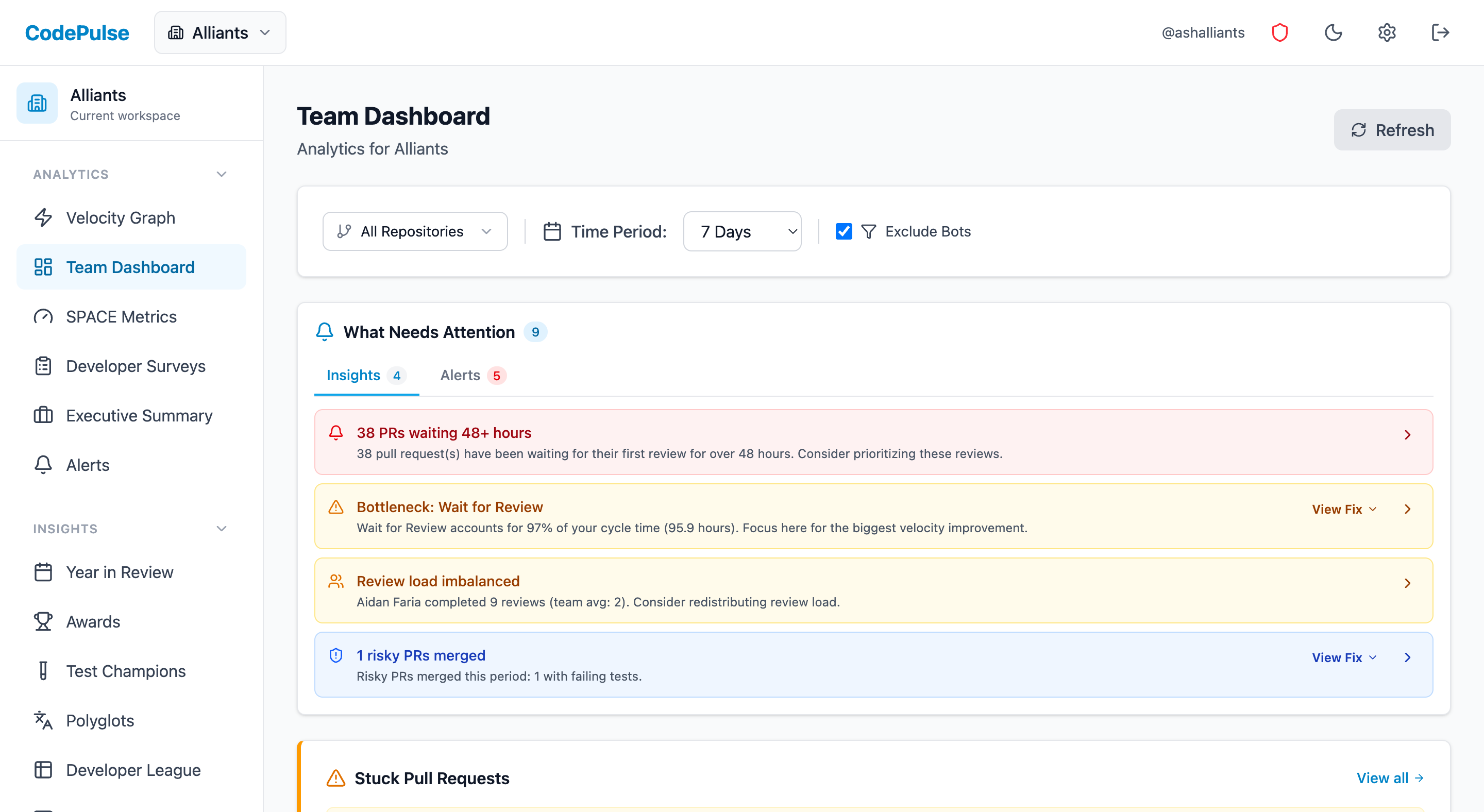
Evaluate CodePulse against your own delivery history
A comparison table only goes so far. Connect read-only GitHub in about five minutes and judge the output on your repositories, at one flat price, with no per-seat math.
Read-only GitHub · Your code stays yours · Team-level by default · No credit card
See These Features in Action
Board-ready engineering performance in a single page.
Measure the real productivity impact of AI coding assistants.
Related Guides
Engineering Analytics ROI: The Budget Approval Playbook
Calculate the ROI of engineering analytics tools with formulas for time savings, payback period, and a business case template tailored to CFOs, CTOs, and CEOs.
Jellyfish vs LinearB vs Swarmia: Full 2026 Comparison
Compare Jellyfish, LinearB, Swarmia, Allstacks, Haystack and more engineering analytics tools. Features, pricing, cycle time benchmarks, and integrations.
11 DORA Metrics Tools Ranked for 2026 (+ Pricing)
Compare the top DORA metrics tools including commercial platforms, open-source options, and native DevOps integrations. Find the right tool for your team size and needs.
Swarmia Alternatives: Cheaper, Deeper Analytics 2026
A Swarmia alternative worth considering: where Swarmia falls short on customization and per-seat pricing, and which cheaper, GitHub-native tools fit better.
Waydev Pricing in 2026: What Teams Actually Pay
Waydev Growth starts at $20/dev/month with multi-Git-provider support. We review both tiers, assess the surveillance trade-off, and compare costs with GitHub-focused alternatives.
Pluralsight Flow Pricing in 2026: Is the Bundle Worth It?
Pluralsight Flow bundle math for 25/50/100 engineers, the post-GitPrime product velocity timeline, and whether the learning + analytics platform justifies the premium over standalone tools.