
Understand the system around the team, not a developer leaderboard
Preview team-level workload, collaboration, and delivery signals designed for process improvement rather than performance grading.
Read-only GitHub · Your code stays yours · Team-level by default · No credit card
Engineering operations is the discipline nobody names but everybody needs. It is not DevOps. It is not people management. It is the operational system that connects your delivery pipeline to your business outcomes—the layer that turns a collection of talented engineers into a predictable, scalable business function. If you are a VP or Director of Engineering running 50 to 500 engineers and you do not have an explicit eng ops practice, you are flying blind with your largest expense line.
"DevOps optimizes the pipeline. Management optimizes the people. Engineering operations optimizes the system that connects both to business outcomes."
This guide lays out what engineering operations actually is, which metrics your board cares about, how to build visibility without creating a surveillance state, and the exact rhythms you need at each growth stage. No theory. No platitudes. Prescriptive steps you can start executing this week.
Engineering Operations vs. DevOps vs. Management
The confusion between these three disciplines costs organizations real money. Teams invest in DevOps tooling expecting operational visibility. They hire managers expecting process improvement. Neither delivers what the other promises, because they are fundamentally different disciplines solving different problems.
DevOps vs. Management vs. Engineering Operations
| Dimension | DevOps | Engineering Management | Engineering Operations |
|---|---|---|---|
| Focus | Delivery pipeline | People and growth | System performance |
| Primary question | "Can we ship safely?" | "Are people growing?" | "Are we running efficiently?" |
| Key metrics | Deploy frequency, MTTR | Retention, engagement, growth | Cost per feature, predictability, capacity |
| Optimizes for | Reliability and speed | Individual and team health | Organizational throughput |
| Reports to | Platform/Infra lead | VP Engineering | VP Engineering / COO |
| Failure mode | Outages, slow deploys | Burnout, attrition | Invisible waste, missed forecasts |
Engineering operations sits at the intersection. It uses data from your DevOps pipeline and your people systems to answer the questions that keep your CFO awake: "Why did that project take three months instead of six weeks?" and "Should we hire 10 more engineers or fix our process first?"
The Eng Ops Gap
Most engineering orgs have a DevOps team and an EM layer but no one explicitly owning operations. The result is predictable: decisions about headcount are made on gut feel, bottlenecks are discovered only when they cause outages, and capacity planning is a spreadsheet that nobody trusts. According to research from DX (formerly Getnef), over 300 companies implementing structured engineering metrics have achieved up to 12% increases in engineering efficiency and 15% improvements in employee engagement. That gap is the eng ops gap—and closing it starts with naming it.
For a deeper look at how boards evaluate engineering investment, see our Board-Ready Engineering Metrics Guide.
The Operational Metrics Your Board Actually Cares About
Your board does not care about lines of code, commit counts, or how many story points your teams burn per sprint. They care about five things: cost, time, predictability, quality, and capacity. Everything else is noise. For the CTO-specific view of how these roll up into a single dashboard, see our CTO dashboard guide.
1. Cost Per Feature
This is the metric that connects engineering to the P&L statement. Take your total engineering spend for a period, subtract infrastructure and KTLO costs, and divide by the number of features delivered. It is imperfect. It is also the only metric that answers the CFO's real question: "What are we getting for this money?"
COST PER FEATURE CALCULATION
═══════════════════════════════════════════════════════════════

Total Engineering Spend (Q4):              $2,400,000
  - Infrastructure/Cloud:                  -$320,000
  - KTLO/Maintenance Allocation:           -$480,000
  - Tech Debt Investment:                  -$240,000
─────────────────────────────────────────────────────────────
Feature Development Budget:                $1,360,000
Features Shipped (Q4):                     17

Cost Per Feature:                          $80,000

Trend:  Q1: $112K  →  Q2: $95K  →  Q3: $88K  →  Q4: $80K
        ↓ 29% improvement YoY
2. Time-to-Value
Not cycle time. Not lead time. Time-to-value measures the elapsed time from when work is prioritized to when it delivers measurable business impact. This is the metric that exposes the gap between "we shipped it" and "it mattered."
3. Capacity Utilization (The Real Kind)
Forget the spreadsheet that says every engineer is "100% allocated." Real capacity utilization measures how much of your engineering time goes to planned, value-creating work versus unplanned interrupts, context switching, and waiting. Research from LinearB's 2025 Engineering Benchmarks analyzing 6.1 million pull requests found that median teams achieve only 4.2 focus hours per day—meaning roughly 47% of a standard workday is consumed by non-productive overhead.
4. Delivery Predictability
The ratio of "what we committed to deliver" versus "what we actually delivered." Boards do not need you to be fast. They need you to be predictable. A team that consistently delivers 80% of committed scope is more valuable than a team that alternates between 120% and 40%.
5. Quality Cost
How much of your engineering effort goes to fixing things that should not have broken? This includes incident response, hotfixes, rollbacks, and bug-fix cycles. Track this as a percentage of total engineering effort. If it exceeds 20%, your delivery pipeline has a quality problem that no amount of velocity will fix.
For the complete framework on presenting these metrics upward, see our VP of Engineering Metrics Guide.
Building Operational Visibility Without Surveillance
Here is where most engineering operations initiatives go wrong. The instinct is to instrument everything: track individual commits, measure lines of code per developer, monitor hours logged. This approach is not just ethically questionable—it is operationally counterproductive.
🔥 Our Take
Engineering operations done right optimizes the system, not the individuals. The moment you start tracking individual output in your "eng ops" dashboard, you have converted an operations tool into a surveillance tool—and your best engineers will leave.
Goodhart's Law guarantees it: when a measure becomes a target, it ceases to be a good measure. Track individual commits and you will get smaller, more frequent, less meaningful commits. Track individual velocity and you will get inflated estimates. The system optimizes for the metric, not the outcome.
The Anti-Surveillance Framework
Operational visibility that works follows three principles:
- Team-level aggregates, not individual tracking. The unit of analysis is the team, not the person. A team's cycle time matters. An individual's cycle time is noise influenced by task complexity, interrupts, and a hundred other variables you cannot control for.
- Flow metrics over activity metrics. Measure how work moves through your system, not how busy people look. Throughput, cycle time, and work-in-progress tell you about system health. Commit counts and lines of code tell you about busywork.
- Trends over snapshots. A single data point is meaningless. A three-month trend is actionable. Build dashboards that show direction, not position.
"The best eng ops dashboards make it impossible to evaluate an individual and trivially easy to evaluate a system. That is the design constraint that separates insight from surveillance."
| Visibility Approach | What It Tells You | Risk Level |
|---|---|---|
| Team cycle time trends | System health and bottleneck detection | Safe |
| Review queue depth | Collaboration bottlenecks | Safe |
| Work type distribution (team) | Investment allocation accuracy | Safe |
| Individual commit frequency | Nothing useful | Surveillance |
| Lines of code per developer | Nothing useful | Surveillance |
| Hours logged by individual | Nothing useful | Surveillance |
For more on building a non-invasive measurement culture, read our Burnout Signals in Git Data Guide.
Systematic Bottleneck Identification
Every engineering organization has constraints. The difference between a well-run org and a chaotic one is whether those constraints are identified systematically or discovered in postmortems. Eng ops treats bottleneck identification as a continuous process, not a reactive one.
The Four Bottleneck Categories
After analyzing patterns across hundreds of engineering teams, bottlenecks cluster into four categories. Each requires different data and different interventions.
1. Review Bottlenecks
Code review is the most common bottleneck in modern software engineering. Research shows that engineers waste 20% of their time searching for information, and when that information is locked in the heads of specific reviewers, PRs queue up behind those individuals. The signals to watch: review queue depth exceeding 48 hours, review load concentrated on fewer than 20% of the team, and review turnaround variance exceeding 3x between team members.
2. Knowledge Silos
When only one person can modify a critical system, you have a single point of failure that masquerades as "expertise." Knowledge silos create the bus factor problem—and they cost real money. Companies with poor knowledge management practices spend an additional $5,500 per employee annually on wasted time and rework, according to research from Narratize. Identify silos by mapping code ownership concentration: any module where one developer accounts for more than 70% of recent changes is a silo.
3. Hot Files and Deployment Risk
Certain files attract disproportionate change activity. These "hot files" are where merge conflicts cluster, where bugs concentrate, and where deployment risk is highest. Track change frequency by file path. Any file modified in more than 30% of PRs across a quarter is a candidate for decomposition or architectural review.
4. Process Bottlenecks
The bottleneck is not always technical. Look for: excessive approval gates (more than two required reviewers), manual deployment steps, environment contention (shared staging environments), and unclear ownership (PRs bouncing between teams for review assignment).
📊Systematic Bottleneck Detection with CodePulse
CodePulse provides purpose-built views for each bottleneck category:
- Executive Summary surfaces system-wide health signals at a glance
- Review Network maps reviewer load distribution and identifies review bottlenecks
- File Hotspots shows change-frequency concentration and knowledge silo risk
- Alerts notifies you when bottleneck thresholds are breached
- Dashboard tracks flow metrics and team-level trends over time
For a comprehensive guide to efficiency at scale, see our Scaling Engineering Efficiency Guide.
The Eng Ops Playbook: Weekly, Monthly, Quarterly Rhythms
Eng ops without cadence is just ad-hoc data browsing. The value comes from consistent rhythms that catch problems early and create accountability. Here is the exact playbook.
The Engineering Operations Rhythm
Weekly: Flow Exceptions (30 minutes)
The weekly review is not a status meeting. It is an exception-driven scan. You are looking for anomalies, not reporting progress.
WEEKLY ENG OPS SCAN
═══════════════════════════════════════════════════════════════

CHECK 1: Flow Exceptions
  ☐ Any PRs open > 5 days?              → Investigate blocker
  ☐ Review queue depth > 48 hrs?        → Redistribute reviewers
  ☐ Any team cycle time spike > 2x?     → Root cause this week

CHECK 2: Risk Signals
  ☐ Any hot file with > 5 PRs touching? → Schedule decomposition
  ☐ Any developer with > 10 pending reviews? → Load balance
  ☐ Any failed deploys in the last 7 days?   → Postmortem status

CHECK 3: Blockers
  ☐ Any team waiting on external dependency > 3 days?
  ☐ Any environment contention issues?
  ☐ Any escalated incidents unresolved?
Monthly: Trend Analysis (2 hours)
The monthly review zooms out from exceptions to trends. You are asking: "Is the system getting better, worse, or staying flat?"
- Cycle time trends by team: Are any teams trending upward for three consecutive weeks? That is a process problem, not a people problem.
- Investment allocation drift: Are you spending where you planned? If maintenance crept from 15% to 25%, that is a signal worth investigating.
- Quality trends: Is code churn increasing? Are more PRs merging without approval? Are review coverage gaps widening?
- Capacity trends: Is work-in-progress growing faster than throughput? That is the leading indicator of a future delivery miss.
Quarterly: Capacity and Investment Allocation (Half day)
The quarterly review is strategic. This is where you make decisions about headcount, team topology, and investment priorities for the next quarter.
| Quarterly Review Item | Key Questions | Data Source |
|---|---|---|
| Capacity planning | Can we absorb next quarter's roadmap with current headcount? | Throughput trends + roadmap scope |
| Team topology review | Do team boundaries still match the work? | Cross-team PR patterns + dependency maps |
| Investment rebalancing | Should we shift allocation between features, debt, and platform? | Work type distribution + quality trends |
| Process retrospective | Which process changes worked? Which did not? | Before/after metric comparisons |
| Tooling audit | Are our tools helping or creating overhead? | Developer experience surveys + flow data |
For templates on turning this data into board-ready reports, see our Engineering Metrics Dashboard Guide.
Scaling Eng Ops from 20 to 200 Engineers
Engineering operations is not one-size-fits-all. What works at 20 engineers will break at 50. What works at 50 will collapse at 200. The discipline must evolve with the organization. Research consistently shows that once you pass 15 to 20 engineers, output per person drops, communication overhead jumps, and knowledge gets fragmented.
"The right time to formalize eng ops is before you need it. If you wait until bottlenecks are visible to your CEO, you are already six months behind."
20–50 Engineers: Foundation Phase
At this scale, eng ops is a part-time responsibility of the VP or a senior EM. The focus is on establishing baselines and building the data infrastructure.
- Instrument your delivery pipeline to collect cycle time, throughput, and review data automatically
- Establish the weekly scan cadence—even if it takes 15 minutes
- Build your first operational dashboard with team-level aggregates
- Define your investment allocation categories and start tracking where time goes
50–100 Engineers: Formalization Phase
This is the inflection point. Communication overhead grows quadratically. You need dedicated attention on operational efficiency. This is where 70% of engineers report burnout during rapid scaling, according to Crossbridge Global Partners research.
- Assign a dedicated eng ops owner (full-time or 50%+ allocation)
- Implement automated alerting on flow exceptions—do not rely on manual scans alone
- Establish the monthly trend review as a standing calendar event
- Build cross-team visibility: are teams blocking each other?
- Start tracking cost per feature and delivery predictability formally
100–200 Engineers: Scaling Phase
At this scale, eng ops needs its own function. The VP of Engineering cannot do this alone.
- Hire a dedicated Engineering Operations Manager or Chief of Staff, Engineering
- Build self-service dashboards for team leads—do not bottleneck insights through one person
- Automate the quarterly capacity planning process
- Implement formal bottleneck escalation paths
- Connect eng ops data to finance systems for real cost-per-feature tracking
Common Scaling Traps
| Trap | What Happens | How to Avoid It |
|---|---|---|
| Hiring before optimizing | More people amplify existing bottlenecks | Fix process constraints before adding headcount |
| Measuring individuals at scale | Gaming, attrition, loss of psychological safety | Team-level metrics only, always |
| Copying Google/Meta processes | Processes designed for 10,000 engineers crush a 100-person org | Right-size processes for your actual scale |
| Over-instrumenting too early | Dashboard fatigue, alert noise, wasted engineering on tooling | Start with 5 metrics, add only when you have a decision to make |
| No feedback loops | Data collected but never acted upon erodes trust | Every metric must connect to a decision or action |
Frequently Asked Questions
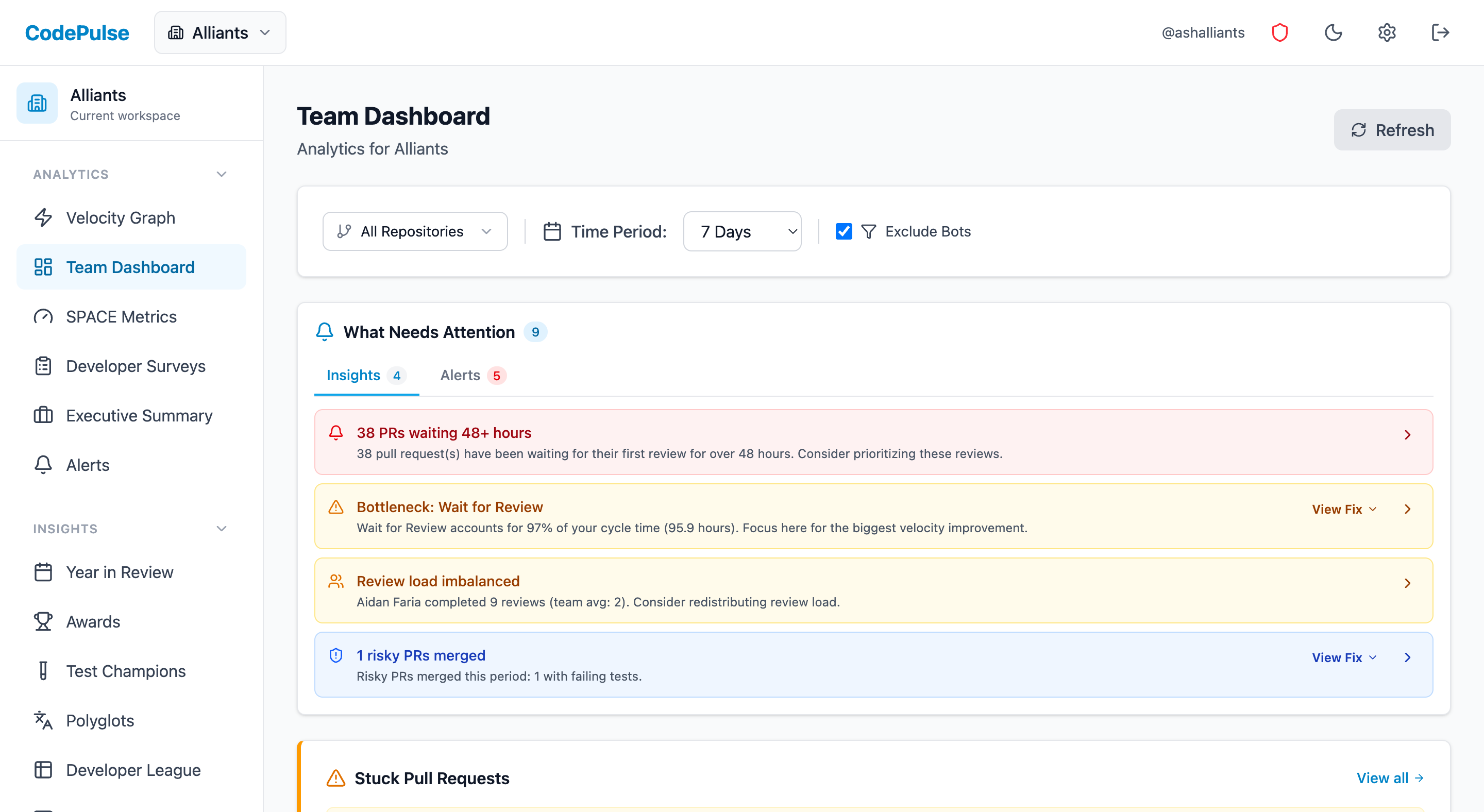
Get this view for your own teams
Connect GitHub for team-level workload, review distribution, and delivery signals. Individual views stay off unless your organisation explicitly turns them on.
Read-only GitHub · Your code stays yours · Team-level by default · No credit card
See These Features in Action
Board-ready engineering performance in a single page.
Track all four DORA metrics and benchmark against industry standards.
Related Guides
VP Engineering Board Metrics: 7 Numbers That Defend Headcount
The 7 metrics VPs of Engineering need for board presentations: delivery predictability, investment allocation, and team health - with the language to present them.
I Got $2M in Budget With These 5 Engineering Metrics
Learn how to create engineering metrics presentations that resonate with board members, investors, and C-suite executives.
Why Adding Engineers Made Us Slower (Brooks' Law Is Real)
Understand Brooks' Law and the hidden costs of scaling. Learn why adding engineers temporarily slows you down and how to minimize the efficiency dip.
Engineering Metrics Dashboard: The 7 Metrics You Need
Skip vanity metrics. Here are the 7 engineering metrics VPs actually need to track team performance, delivery, and quality.
Your Git Data Predicts Burnout 6 Weeks in Advance
Use the STRAIN Score framework to detect developer burnout from Git data. Identify after-hours patterns, review overload, and intensity creep before they cause turnover.