
Understand the system around the team, not a developer leaderboard
Preview team-level workload, collaboration, and delivery signals designed for process improvement rather than performance grading.
Read-only GitHub · Your code stays yours · Team-level by default · No credit card
You just hired 10 engineers, but velocity did not double. In fact, it might have slowed down. Your CEO is asking why. This is not a failure of leadership - it is a fundamental law of software engineering. This guide explains the "Scaling Tax," why the 50-engineer mark is particularly treacherous, and how to maintain efficiency as you grow.
This guide gives you the frameworks, metrics, and playbooks to scale without losing your edge - from Series A hiring bursts to Series C orgs wondering why 200 engineers feel slower than 50.
Brooks's Law and the Scaling Tax
In 1975, Fred Brooks coined his famous law in The Mythical Man-Month:
"Adding manpower to a late software project makes it later."
While you might not be "late," the principle holds for any rapid scaling phase. When you double your headcount, you do not double your output immediately. You enter a period of diminishing returns caused by three compounding factors:
- Ramp-up Time: New hires consume net-negative value initially. They take more time from mentors than they contribute for the first 2-4 weeks.
- Communication Overhead: As team size (N) grows, the number of communication paths grows at O(N^2). This is not linear - it is quadratic.
- Coordination Costs: More people means more meetings, more alignment, more waiting for decisions. The overhead compounds.
According to the 2024 State of DevOps Report, the percentage of teams classified as "low performers" grew from 17% to 25% year-over-year. Many of these teams were scaling rapidly. Growth without structure creates chaos.
🔥 Our Take
The instinct to "throw engineers at the problem" is almost always wrong. Hiring is the most expensive and slowest solution to most engineering challenges. Before adding headcount, exhaust your optimization options: better tooling, clearer ownership, reduced scope, eliminated meetings.
We have seen teams double their output by cutting their team size in half and focusing on execution. Headcount is a vanity metric. Output per engineer is what matters.
The Mathematics of Communication Overhead
The math behind Brooks's Law is brutal. The number of communication channels in a team follows the formula N(N-1)/2, where N is team size.
| Team Size | Communication Lines | Impact |
|---|---|---|
| 5 engineers (Seed) | 10 lines | Everyone knows everything. High velocity. Decisions are instant. |
| 10 engineers (Series A) | 45 lines | Still manageable. One standup works. Context is shared. |
| 15 engineers | 105 lines | Standups feel crowded. Decisions slow down. Silos emerge. |
| 25 engineers | 300 lines | Must split into sub-teams. "Who owns this?" becomes common. |
| 50 engineers (The Cliff) | 1,225 lines | Chaos without strict structure. The "50-engineer cliff." |
| 100 engineers | 4,950 lines | Requires formal org structure, platform teams, and governance. |
"From 5 to 50 engineers, your communication overhead increases by 122x. If you do not restructure, your engineers spend more time syncing than coding."
This is why companies that grow from 20 to 60 engineers in a year often see their velocity drop even as headcount triples. The coordination tax consumed the capacity they added.
The 50-Engineer Cliff
There is a specific inflection point that most scaling engineering orgs hit: the 50-engineer cliff. This is where informal processes that worked at 20 people catastrophically fail.
What Breaks at 50
- Tribal knowledge fails: You can no longer assume "everyone knows" how things work. New hires have no context, and there is no one person who understands the whole system.
- All-hands standups become theater: With 50 people, your standup is either 90 minutes long or so rushed that no one learns anything.
- The "ask anyone" model collapses: There is no longer one person who can answer every question. Knowledge silos are now structural.
- Informal ownership creates conflicts: Without clear boundaries, two teams modify the same code. Merge conflicts and regressions spike.
- The founders become bottlenecks: If every significant decision still flows through 2-3 people, those people are drowning.
The Symptoms
Warning signs you've hit the 50-engineer cliff:

Metric Symptoms:
- Cycle time increased 30%+ over 6 months
- Review wait time spiked (PRs sitting for 24+ hours)
- Deployment frequency declined (fewer, larger releases)
- Bug rate increased despite more testing

Process Symptoms:
- "Who owns this?" asked multiple times per day
- Meetings to schedule meetings
- PRs blocked waiting for "the expert" to review
- New hires still confused after 60 days

Cultural Symptoms:
- "Things were better when we were smaller"
- Senior engineers frustrated by "process overhead"
- Teams working at cross-purposes
- Blame shifting between teams
📉Detecting the Cliff in CodePulse
CodePulse can show you when you're approaching or have hit the efficiency cliff:
- Cycle Time Trend: Watch the Dashboard 8-week trend. A sustained increase signals coordination overhead.
- Review Wait Time: If wait-for-review hours are climbing, your review capacity is not keeping up with PR volume.
- Contributor Count vs Output: Compare total contributors to PRs merged. If contributors grow faster than output, efficiency is dropping.
- File Hotspots: The File Hotspots page shows files with high change frequency - often conflict zones.
Efficiency Metrics by Team Size
What "good" looks like changes dramatically based on your team size. Here is a framework for benchmarking efficiency at each stage. To translate these efficiency gaps into a dollar figure for a headcount or tooling conversation, our free engineering analytics ROI calculator estimates what recovering lost capacity is worth.
| Metric | 5-15 Engineers | 15-50 Engineers | 50-150 Engineers | 150+ Engineers |
|---|---|---|---|---|
| PRs/Engineer/Week | 3-5 | 2-4 | 1.5-3 | 1-2.5 |
| Cycle Time (hours) | 4-12 | 12-36 | 24-72 | 48-120 |
| Review Wait Time (hours) | 1-4 | 4-12 | 8-24 | 12-48 |
| Deploy Frequency | Multiple/day | Daily | Daily | Multiple/day* |
| Time to Onboard (weeks) | 1-2 | 2-4 | 4-8 | 6-12 |
| Coordination Overhead | ~5% | ~15% | ~25% | ~35% |
*Large organizations can achieve high deploy frequency again through platform engineering and autonomous teams, but it requires significant investment.
The coordination overhead row is critical. At 150+ engineers, over a third of your engineering capacity goes to meetings, alignment, documentation, and waiting. This is not waste - it is necessary at scale - but it means you need 3 engineers to get the output of 2. Our free meeting cost calculator puts a number on what that recurring meeting load costs your team each year.
Measuring Onboarding Drag
Every new hire creates "onboarding drag" - the tax on existing team members who must train, mentor, and review the newcomer. This drag is often invisible in planning.
The Hidden Costs
Onboarding drag calculation (per new hire):

Week 1-2: Net negative
  - New hire: 0 meaningful output
  - Senior mentor: -15 hours (30% capacity loss)
  - Team: -5 hours reviews, answering questions
  - Net impact: -20 hours team capacity

Week 3-4: Break-even approaching
  - New hire: 10 hours meaningful work
  - Senior mentor: -8 hours ongoing support
  - Team: -3 hours review overhead
  - Net impact: -1 hour (break-even)

Week 5-8: Positive but ramping
  - New hire: 25 hours meaningful work
  - Mentor: -3 hours occasional support
  - Net impact: +22 hours

Week 9+: Full productivity
  - New hire: 35+ hours meaningful work
  - Mentor: -1 hour occasional questions
  - Net impact: +34 hours

TOTAL: 8 weeks to positive ROI
      6-week cumulative drag: ~50-60 senior engineer hours
If you hire 10 engineers at once, you lose approximately 500-600 hours of senior engineer time over 6 weeks. That is 15-18 person-weeks of capacity consumed by onboarding. This is why rapid hiring often makes things slower before they get faster.
📊Tracking Onboarding Drag in CodePulse
You can see onboarding drag directly in your data:
- Review Load Spikes: Check the Review Network. Are your senior engineers doing 2x more reviews than usual?
- Cycle Time Dip: Watch Cycle Time. It often increases temporarily during hiring bursts.
- New Hire Velocity: Use Developer Metrics to track how long it takes new hires to reach the team average (Time to 5th PR).
- Review Coverage: Are new hires getting adequate review, or are PRs merging without proper oversight in the chaos?
When to Hire vs. When to Optimize
Not every capacity problem is solved by hiring. Here is a decision framework:
The Hire vs. Optimize Matrix
| Signal | Hire | Optimize First |
|---|---|---|
| PRs/engineer is healthy but total output is low | Yes - capacity issue | - |
| PRs/engineer is declining over time | - | Yes - efficiency issue |
| Cycle time growing despite same team size | - | Yes - process issue |
| Review wait time is bottleneck | Maybe - depends on cause | Usually - redistribute load first |
| New product line/market | Yes - new scope | - |
| High bug rate consuming capacity | - | Yes - fix quality first |
| Single points of failure (experts) | Yes - redundancy needed | Also cross-train |
| Engineers in meetings 30%+ of time | - | Yes - cut meetings first |
"If your engineers are only coding 50% of the time, hiring more does not give you more code. It gives you more people in meetings."
The Optimization Checklist
Before approving a headcount request, run through this checklist:
Before hiring, have we:

Process Optimizations:
☐ Audited meeting load (target: <20% of engineer time)
☐ Implemented async standups for status updates
☐ Eliminated approval bottlenecks
☐ Reduced required reviewers where safe (2 is optimal)
☐ Automated repetitive PR checks

Technical Optimizations:
☐ Improved CI/CD speed (target: <10 min)
☐ Fixed flaky tests that waste time
☐ Automated environment setup
☐ Reduced deploy friction

Scope Optimizations:
☐ Cut features that don't move metrics
☐ Deferred nice-to-haves
☐ Said no to scope creep
☐ Prioritized ruthlessly

If all boxes are checked and we still need capacity: HIRE.
If not: OPTIMIZE FIRST.
Platform Engineering: The Scale Enabler
At 50+ engineers, you need a Platform Team. Their job is to pave the roads - making CI/CD, dev environments, and deployment so smooth that adding the 51st engineer does not slow down the first 50. The broader discipline of engineering enablement sits above platform teams: shared infrastructure plus developer experience programs that compound leverage across every squad.
What Platform Teams Build
- Internal Developer Platform: Self-service infrastructure so engineers do not wait on DevOps tickets.
- Golden Paths: Opinionated templates for new services, reducing decision fatigue and inconsistency.
- Fast CI/CD: Sub-10-minute pipelines. Every minute of CI time multiplied by engineer count is waste.
- Automated Environments: Spin up a full dev/staging environment in minutes, not days.
- Observability: Debugging should not require tribal knowledge. Distributed tracing, logging, metrics out of the box.
When to Invest in Platform
Platform team investment timing:

20-30 engineers:
  - Start thinking about it
  - Assign 1-2 engineers part-time to tooling
  - Document the most painful friction points

30-50 engineers:
  - Form a dedicated platform team (2-3 engineers)
  - Focus on CI/CD, environment setup, deployment
  - Measure time-to-first-commit for new hires

50-100 engineers:
  - Scale platform team (4-8 engineers, ~8% of org)
  - Build internal developer platform
  - Create golden paths and templates
  - Add self-service capabilities

100+ engineers:
  - Platform team is 8-12% of engineering
  - Multi-team platform organization
  - Platform as a product with internal SLAs
The ROI of platform investment is massive. If your platform team saves each engineer 2 hours per week, that is 100 hours per week at 50 engineers - equivalent to 2.5 FTE of recovered capacity.
Strategies to Minimize the Scaling Tax
You cannot eliminate the Scaling Tax, but you can minimize it with these strategies:
1. Cell Division (Squads)
Do not have a 20-person team. Have four 5-person teams. This resets the communication complexity math. Each squad should be:
- Autonomous: Can ship end-to-end without dependencies
- Mission-driven: Owns a clear business outcome
- Bounded: 5-8 people maximum (Bezos's "two pizza team")
- Cross-functional: Frontend, backend, and any specialists needed
When a squad grows beyond 8, split it. The communication math makes this mandatory, not optional.
2. The "Buddy System" for Onboarding
Do not let new hires randomly assign reviews or ask questions to anyone available. Assign a dedicated "Buddy" who:
- Shields the rest of the team from basic onboarding questions
- Does the majority of the new hire's code reviews for the first 4 weeks
- Has explicit time allocated (20-30% capacity) for mentorship
- Is accountable for the new hire's time-to-productivity
This concentrates the onboarding tax on one person (who can plan for it) rather than distributing it randomly across the team.
3. Staggered Hiring
If you need 10 engineers, do not hire 10 at once. Hire 3-4, let them ramp, then hire more. This:
- Distributes onboarding drag over time
- Creates more mentors before adding more mentees
- Allows you to learn from early hires before scaling
- Reduces the "everyone is confused" chaos of mass onboarding
4. Documentation-First Culture
At scale, "ask someone" does not work. Invest in documentation:
- Architecture decision records (ADRs) for major choices
- Runbooks for operational tasks
- Onboarding guides that are actually maintained
- Service catalogs with ownership information
Good documentation reduces the number of interrupting questions by 50%+.
5. Clear Ownership Boundaries
Use CodePulse's File Hotspots and Review Network to identify files with unclear ownership. When multiple teams frequently modify the same files, either:
- Assign clear ownership to one team
- Extract shared code into a library with a defined interface
- Create explicit handoff processes
Explaining the Scaling Tax to Executives
When the CEO asks "Why are not we faster yet after hiring 10 people?", show them the data.
The Executive Brief Template
SITUATION: We added 10 engineers in Q1.

CURRENT STATE:
- Velocity dipped 15% in weeks 3-6 (expected)
- Now recovering: up 8% from the trough
- Projected to exceed baseline by Q2 end

WHY THIS HAPPENED (Brooks's Law):
1. Onboarding drag: Senior engineers invested
   ~500 hours training new hires
2. Communication overhead: Team coordination
   complexity increased 3x with new team members
3. Ramp-up time: New hires reached productivity
   at week 6 (faster than industry avg of 8 weeks)

THIS IS AN INVESTMENT, NOT A LOSS.

Evidence it's working:
1. Review Load on Staff Engineers up 40% (mentorship happening)
2. New Hire Time-to-Value: 6 weeks (better than 8-week benchmark)
3. Code quality metrics stable (no regression from new hires)
4. Total capacity growing: expect 130% baseline by Q2 end

ACTION ITEMS:
1. Approve platform team investment to reduce future drag
2. Stagger next hiring wave (3-4 engineers/month, not 10 at once)
3. Continue monitoring with CodePulse metrics

We are trading short-term velocity for long-term scale.
This is the cost of growth, paid now for returns later.
Metrics to Include in Board Presentations
When presenting to the board, include these metrics from CodePulse:
- Output per engineer trend: Shows efficiency is improving, not just headcount
- Cycle time by quarter: Shows you are maintaining velocity despite growth
- Time-to-productivity: Shows your onboarding is effective
- Review coverage: Shows quality is not sacrificed for speed
For more on executive communication, see our guide on Board-Ready Engineering Metrics.
The Scaling Playbook by Stage
Here is a practical playbook for each growth stage:
10 to 25 Engineers
Priorities:
1. Split into 2-3 squads before hitting 15 people
2. Formalize code ownership (CODEOWNERS file)
3. Establish review norms (2 reviewers, <24h turnaround)
4. Start documenting architecture decisions

Watch for:
- All-hands standups exceeding 15 minutes
- "Who owns this?" questions increasing
- Senior engineers becoming review bottlenecks

CodePulse setup:
- Enable Review Network to spot bottlenecks early
- Set up alerts for cycle time regression
- Track review wait time by team
25 to 50 Engineers
Priorities:
1. Formalize team structure (squads, pods, or tribes)
2. Invest in CI/CD (target: <10 min builds)
3. Create platform/infrastructure team (2-3 engineers)
4. Establish engineering levels and career framework
5. Implement async communication norms

Watch for:
- The 50-engineer cliff symptoms
- Knowledge silos creating bottlenecks
- Cross-team dependencies blocking work

CodePulse setup:
- Use File Hotspots to identify ownership gaps
- Compare metrics across teams
- Track onboarding velocity for new hires
50 to 100 Engineers
Priorities:
1. Scale platform team to 6-10 engineers
2. Build internal developer platform (self-service)
3. Create technical program management function
4. Implement RFC process for cross-team changes
5. Establish architecture review for major decisions

Watch for:
- Teams working at cross-purposes
- "We didn't know they were doing that" surprises
- Platform team becoming bottleneck themselves

CodePulse setup:
- Executive dashboard for leadership visibility
- Per-team efficiency tracking
- Alerts for review load imbalance
100+ Engineers
Priorities:
1. Platform organization (multiple platform teams)
2. Internal SLAs between teams
3. Guilds/communities of practice for knowledge sharing
4. Formal capacity planning process
5. Engineering effectiveness team

Watch for:
- Platform teams disconnected from product teams
- Process becoming more important than outcomes
- "Legacy" teams stuck in maintenance mode

CodePulse setup:
- Organization-wide health metrics
- Investment profile (KTLO vs innovation)
- Cross-team dependency analysis
Your Scaling Efficiency Action Plan
Start with these steps this week:
- Measure your current state: Use CodePulse to calculate PRs per engineer, cycle time, and review wait time. This is your baseline.
- Identify your growth stage: Are you approaching 15, 50, or 100 engineers? Each cliff requires different preparation.
- Run the optimization checklist: Before approving any headcount, ensure you have exhausted process and tooling improvements.
- Set up early warning alerts: Configure CodePulse alerts for cycle time increases and review wait time spikes.
- Plan your next hire wave: Stagger hiring, assign buddies, and calculate expected onboarding drag in your capacity planning.
For more on building a data-driven engineering organization, see our guides on Data-Driven Headcount Planning, Measuring Onboarding Effectiveness, and Code Hotspots and Knowledge Silos.
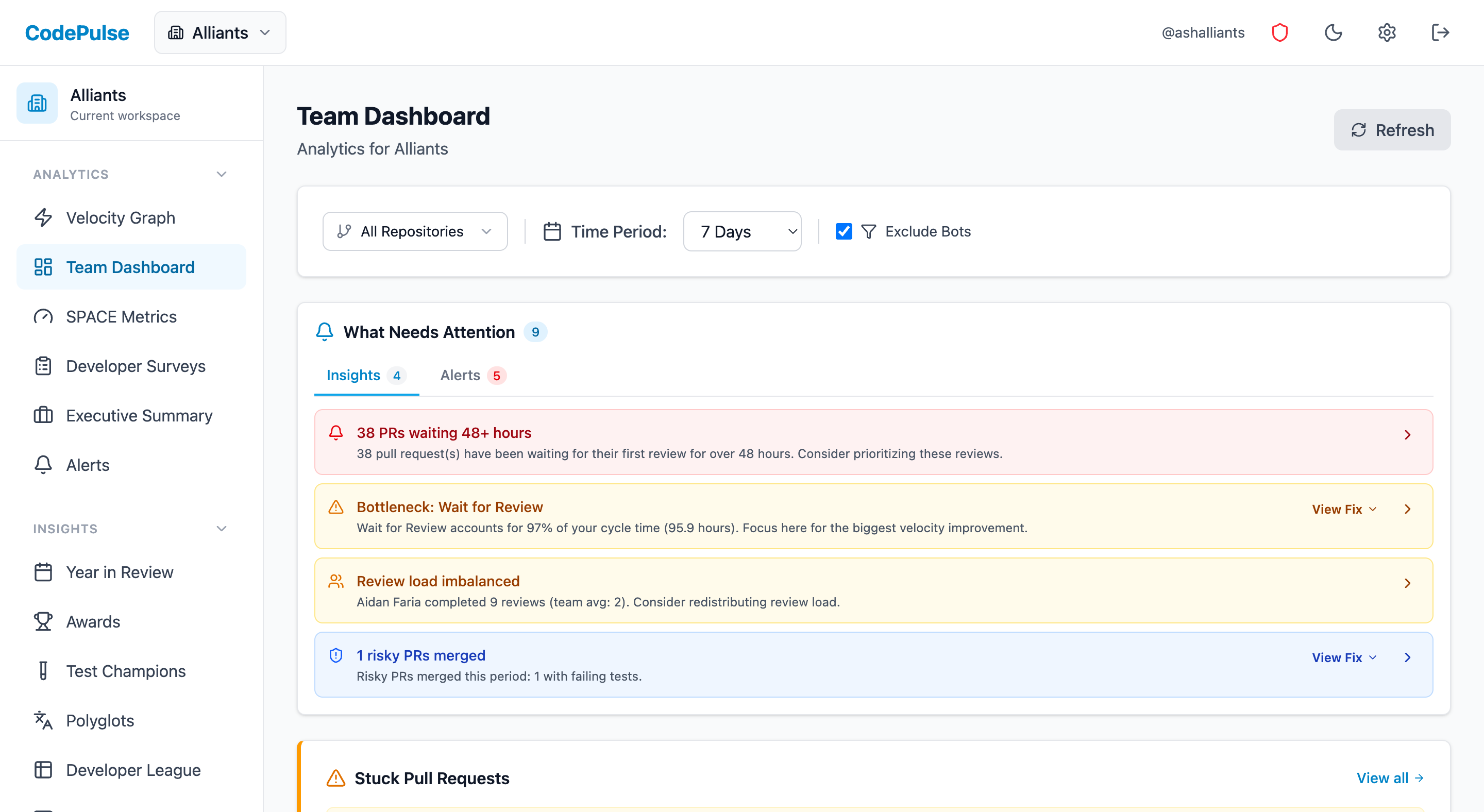
Get this view for your own teams
Connect GitHub for team-level workload, review distribution, and delivery signals. Individual views stay off unless your organisation explicitly turns them on.
Read-only GitHub · Your code stays yours · Team-level by default · No credit card
See These Features in Action
Board-ready engineering performance in a single page.
Break down cycle time into coding, waiting, review, and merge phases.
Related Guides
The Data That Made My CFO Say Yes to 5 New Engineers
Build a data-driven business case for engineering headcount using throughput metrics, benchmarks, and trend analysis that executives understand.
The Git Query That Finds Your New Hire's Perfect Mentor
Use Git activity data to accelerate new hire onboarding, identify domain experts for pairing, and track ramp-up progress.
I Got $2M in Budget With These 5 Engineering Metrics
Learn how to create engineering metrics presentations that resonate with board members, investors, and C-suite executives.
Engineering Metrics That Won't Get You Reported to HR
An opinionated guide to implementing engineering metrics that build trust. Includes the Visibility Bias Framework, practical do/don't guidance, and a 30-day action plan.
Engineering Team Management: Using Data to Lead Without Micromanaging
Managing software teams requires balancing delivery, quality, team health, and individual growth. This guide shows how to use data for visibility while avoiding surveillance, with practical scenarios and communication patterns.
Engineering Headcount Planning: The CFO Conversation
Headcount requests fail when they lack data. This guide shows you how to calculate true capacity, build cost-per-feature metrics, and present scenarios that CFOs actually approve.