
Understand the system around the team, not a developer leaderboard
Preview team-level workload, collaboration, and delivery signals designed for process improvement rather than performance grading.
Read-only GitHub · Your code stays yours · Team-level by default · No credit card
Engineering management and project management are not the same job. They never were. But somewhere between the rise of Agile, the collapse of middle management in startups, and the chronic under-investment in engineering leadership, companies started treating them as interchangeable. The result is organizational dysfunction that costs teams their best engineers and their ability to ship.
"Project managers ask 'is it on time?' Engineering managers ask 'is the system healthy?' Both matter. But they're fundamentally different questions."
An engineering manager owns the system—the people, the technical architecture, the team's capacity to deliver over months and years. A project manager owns the plan—the timeline, the scope, the stakeholder updates for a specific initiative. One manages humans and technical systems. The other manages work items and deadlines. When you collapse these into a single role, you get neither done well.
This guide breaks down exactly where these roles diverge, what metrics each role needs, and how to structure your org so both functions thrive.
Why These Roles Keep Getting Confused
The confusion has a straightforward origin: both roles involve the word "management," and both roles touch "projects." That's where the similarity ends.
In the 1990s and early 2000s, software companies had clear hierarchies. Engineering managers managed engineers. Project managers managed project plans, Gantt charts, and stakeholder communication. The roles rarely overlapped because the organizational structure was rigid enough to keep them separate.
Then Agile happened. Scrum Masters replaced project managers in name, but the function didn't disappear—it just got redistributed. Engineering managers absorbed project management responsibilities because someone had to track delivery. Meanwhile, at startups with flat hierarchies, the first "engineering manager" was usually a senior engineer promoted to handle "the people stuff," who then also got stuck running standups, updating Jira, and reporting status to the CEO.
The salary data tells part of the story. According to the U.S. Bureau of Labor Statistics, architectural and engineering managers earn a median annual salary of $165,370, while project managers in technology earn a median of approximately $98,580. That 68% premium reflects a fundamental difference in scope: engineering managers own technical strategy, people development, and system design, not just delivery timelines.
The conflation causes three specific problems:
- Engineers lose their advocate. When the EM is focused on project delivery, no one is watching for burnout, career stagnation, or knowledge silos.
- Delivery suffers anyway. An EM juggling people management and project tracking does both poorly. Context switching between "how do I grow this junior engineer" and "are we going to hit the Q3 deadline" is brutal.
- Technical debt accumulates. PMs optimize for scope and timeline. EMs optimize for system health. Without an EM voice in planning, technical debt compounds unchecked.
Responsibilities: A Side-by-Side Breakdown
The differences become stark when you lay them out. This is not a spectrum: these are categorically different jobs with different skill sets, different success criteria, and different failure modes.
| Responsibility | Engineering Manager | Project Manager |
|---|---|---|
| Technical decisions | Owns or delegates architecture, tech stack, and system design | Documents decisions; does not make them |
| People management | Primary function: hiring, 1:1s, performance reviews, career growth | Not responsible for direct reports |
| Career development | Writes promotion cases, identifies growth paths, mentors engineers | No involvement |
| Delivery timelines | Influences capacity and feasibility estimates | Primary function: tracks milestones, manages scope, reports status |
| Stakeholder management | Communicates technical constraints and trade-offs | Primary function: shields team from external noise, manages expectations |
| Metrics ownership | Engineering health: cycle time, review quality, bus factor, burnout signals | Project health: timeline adherence, budget, scope changes, velocity |
| Team structure | Designs team topology, manages hiring pipeline, balances skills | Works within existing team structure |
| Process improvement | Evolves engineering practices, CI/CD, code review culture | Optimizes project workflows, ceremonies, communication |
| Accountability horizon | Quarters to years (team capability, technical excellence) | Weeks to months (project completion, deliverable quality) |
Notice the pattern: engineering managers are accountable for the system that produces work. Project managers are accountable for the work itself. An EM who spends their days updating Jira tickets has abandoned their actual job.
Two Different Jobs, Two Different Focus Areas
The Metrics Each Role Actually Needs
This is where the role confusion does the most damage. When an EM uses project management metrics, they manage tasks instead of people. When a PM uses engineering metrics, they make technical decisions they're not equipped to make.
| Metric Category | Engineering Manager Needs | Project Manager Needs |
|---|---|---|
| Flow | Cycle time breakdown (coding, waiting, review, merge) | Sprint velocity, burndown charts |
| Quality | Review coverage, PR churn rate, merge-without-approval rate | Defect escape rate, rework percentage |
| People | Burnout signals, after-hours commit patterns, review load distribution | Resource allocation, availability |
| Knowledge | Bus factor, knowledge silos, code ownership concentration | Not tracked |
| Delivery | Throughput trends (PRs merged/week), deployment frequency | Milestone completion, timeline adherence, scope changes |
| Stakeholder | Not a primary concern | Status reports, risk registers, dependency tracking |
The overlap is narrow: both care about delivery throughput. But they care about it for different reasons. The EM watches throughput to detect systemic problems (is the team slowing down because of review bottlenecks or technical debt?). The PM watches throughput to forecast delivery dates (will we hit the deadline?).
According to Jellyfish's 2024 State of Engineering Management Report, 65% of engineering professionals experienced burnout in the past year, and there's a significant perception gap between engineers and executives about team health. These are engineering management signals, and a project manager would never surface them because they're not on a Gantt chart.
🔥 Our Take
Engineering managers who track individual velocity have become project managers without realizing it.
The moment you're comparing developer output week-over-week, you've stopped managing engineers and started managing tasks. Individual velocity is a project management metric. Engineering managers should track system-level health: Is the review process working? Are knowledge silos growing? Is after-hours work creeping up? These are the signals that determine whether your team can sustain delivery over the next year—not just the next sprint.
What Happens When Companies Combine the Roles
Every growing company hits this failure mode. It looks different depending on which direction the conflation goes, but the outcome is always the same: attrition, technical debt, and delivery problems.
The EM-Who-Is-Really-a-PM Trap
This is the most common variant. The engineering manager's calendar is full of sprint planning, backlog grooming, stakeholder updates, and status meetings. Their 1:1s with direct reports get rescheduled or cancelled. Performance reviews are rushed. Career development conversations don't happen.
The symptoms are predictable:
- Senior engineers leave because they feel invisible and stagnant
- Junior engineers plateau because no one is investing in their growth
- Technical debt accumulates because no one is advocating for engineering health
- The team "delivers" on paper while the codebase slowly rots
"The fastest way to lose a senior engineer is to assign them an engineering manager who runs standups like a project status meeting."
The PM-Who-Makes-Technical-Decisions Problem
The reverse is equally damaging. When a project manager starts influencing technical decisions—choosing frameworks, overriding architecture concerns for timeline reasons, or pushing back on refactoring—the engineering team loses agency over their own domain.
This creates a toxic dynamic where engineers feel like executors rather than craftspeople. They stop raising technical concerns because the response is always "we don't have time." The PM isn't malicious; they're optimizing for what they're measured on (delivery). But the result is a team that ships fast today and can't ship at all in 18 months.
Why Series B Companies Suffer the Most
At seed stage, one person doing everything is survivable. At Series C and beyond, companies have enough headcount to staff both roles. But Series B is the danger zone: 30–80 engineers, rapid growth pressure, and not enough management headcount. This is when the "EM who is also the PM" pattern crystallizes into permanent org design.
The Series B engineering metrics handbook covers this inflection point in detail. The core insight: if you can only hire one role, hire the engineering manager and let a Tech Lead or Staff Engineer handle project coordination temporarily. The reverse—hiring a PM and hoping they can also manage engineers—never works.
The Data-Driven Engineering Manager
Engineering managers and project managers use fundamentally different tools because they need fundamentally different data. A PM lives in Jira, Asana, or Linear, tools designed around work items, timelines, and dependencies. An EM needs data about the engineering system: how code flows through the team, where bottlenecks form, and whether the team is healthy.
Here is what that looks like in practice:
What an EM Reviews Weekly
- Cycle time trends: Are PRs moving faster or slower? Where is time being lost: in coding, in waiting for review, or in the review itself? This tells you about process health, not individual performance.
- Review network: Who is reviewing whose code? Is the load balanced, or is one person a bottleneck? Are there knowledge silos forming where only one person can review certain areas? See the engineering team management guide for how to act on this data.
- After-hours patterns: Are commits clustering outside working hours? This is a burnout signal that no project management tool will surface.
- PR quality indicators: Merge-without-approval rate, review coverage, churn percentage. These tell you whether the team's quality practices are holding or eroding under delivery pressure.
What a PM Reviews Weekly
- Sprint progress: How many story points completed vs. planned? Are there blockers?
- Milestone tracking: Is the project on schedule? What's the critical path?
- Dependency management: Are other teams delivering what this team needs?
- Stakeholder updates: What does leadership need to know? What decisions need to be escalated?
Notice that there is zero overlap in these weekly reviews. An EM looking at sprint burndown is wasting time they should spend on the review network. A PM looking at cycle time breakdowns is looking at data they can't act on because they don't control engineering processes.
📊 How CodePulse Supports Engineering Managers
CodePulse is built for engineering managers, not project managers. The Dashboard surfaces cycle time breakdowns, review health, and delivery trends: the signals an EM needs to keep the system healthy. The Review Network visualizes code review patterns so you can spot bottlenecks and knowledge silos before they become attrition risks. And Alerts notify you when something changes: a spike in after-hours commits, a drop in review coverage, or a sudden increase in merge-without-approval rate.
This is not a replacement for Jira or Asana. Those tools serve a different function for a different role. CodePulse gives EMs the data to manage the engineering system while PMs use project tools to manage the plan.
Org Design: When You Need Both, One, or Neither
The right structure depends on your company stage, team size, and engineering maturity. Here are concrete recommendations:
Org Design by Company Stage
Under 10 Engineers: Tech Lead Does Both
At this stage, a strong Tech Lead handles engineering management (1:1s, code review culture, technical direction) and basic project coordination (sprint planning, stakeholder updates). This works because the scope is small enough for one person to hold both contexts. Read the tech lead metrics guide for what to track at this stage.
10–25 Engineers: Hire the EM First
Your first dedicated management hire should be an engineering manager, not a project manager. At this size, people management is the bottleneck. Engineers need career development, the hiring pipeline needs attention, and someone needs to set the engineering culture before it sets itself. Project coordination can still be handled by Tech Leads or a lightweight process.
25–50 Engineers: Add the PM Function
This is when cross-team coordination becomes complex enough to justify dedicated project management. Multiple teams working on shared initiatives need someone tracking dependencies, managing scope, and communicating status. But—critically—this PM reports into a product or operations function, not engineering. The EM and PM collaborate as peers, not in a hierarchy.
50+ Engineers: Separate and Specialize
At this scale, you need a clear organizational separation. Engineering managers own team health, hiring, and technical excellence. Program managers (or TPMs) own cross-team coordination and delivery tracking. The VP of Engineering holds both functions accountable but keeps them structurally separate. Refer to the engineering manager guide for how EMs should operate at this scale.
The Player-Coach Problem
At every stage, resist the urge to make EMs "player-coaches" who code 50% and manage 50%. This fails predictably: management always loses in the prioritization because coding has immediate, visible output while management impact is delayed and invisible. An EM managing more than 5 engineers should not be writing production code. Period.
As your measurement practices mature, the distinction between these roles becomes even more important. EMs track system health. PMs track project health. Conflating the two guarantees you do neither well.
"An engineering manager who codes 50% of the time is a developer with a calendar full of meetings they resent. Pick a lane."
Frequently Asked Questions
Temporarily, yes, at very early stages (under 10 engineers) or for a short transition period. Permanently, no. The jobs require different mindsets, different time horizons, and different definitions of success. Trying to do both means people management gets deprioritized because project deadlines are louder. Your best engineers will leave before you notice.
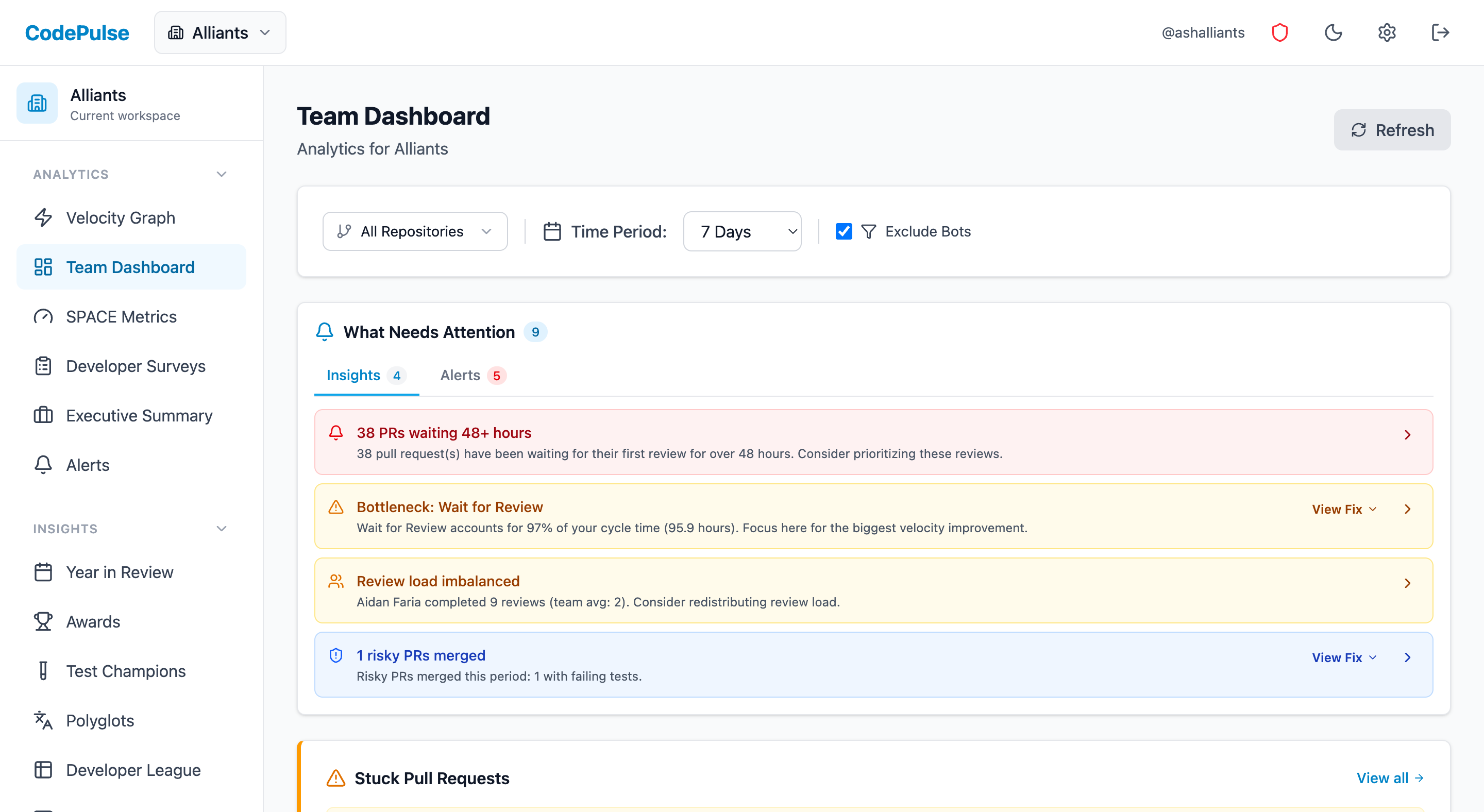
Get this view for your own teams
Connect GitHub for team-level workload, review distribution, and delivery signals. Individual views stay off unless your organisation explicitly turns them on.
Read-only GitHub · Your code stays yours · Team-level by default · No credit card
See These Features in Action
Explore all featuresRelated Guides
The EM Dashboard That Won't Get You Reported to HR
With 83% of developers suffering from burnout and a 12-point perception gap between engineers and executives, EMs need metrics that reveal team health - not just delivery. Here is what to track, what to ignore, and how to use data without destroying trust.
Engineering Team Management: Using Data to Lead Without Micromanaging
Managing software teams requires balancing delivery, quality, team health, and individual growth. This guide shows how to use data for visibility while avoiding surveillance, with practical scenarios and communication patterns.
Engineering Metrics That Won't Get You Reported to HR
An opinionated guide to implementing engineering metrics that build trust. Includes the Visibility Bias Framework, practical do/don't guidance, and a 30-day action plan.
The Tech Lead Dashboard Your Manager Shouldn't See
The metrics that matter for tech leads - code quality, technical debt, architecture decisions, and delivery. Different from EM metrics, focused on technical excellence.
Your Git Data Predicts Burnout 6 Weeks in Advance
Use the STRAIN Score framework to detect developer burnout from Git data. Identify after-hours patterns, review overload, and intensity creep before they cause turnover.