
Find quality and ownership risk before it becomes an incident
Preview how CodePulse combines review depth, risky changes, hotspots, and knowledge concentration without turning activity into individual scores.
Read-only GitHub · Your code stays yours · Team-level by default · No credit card
Tech leads sit at the intersection of technical excellence and team productivity. Unlike engineering managers who focus on people, tech leads own code quality, architecture decisions, and technical debt. But unlike pure ICs, you're also responsible for unblocking others, mentoring juniors, and ensuring the team's code is maintainable for years. This guide covers the metrics that matter for technical leadership - and the anti-patterns to avoid.
"The best tech leads write less code than they used to - but their impact on team output is 10x what it was when they were pure ICs. Your job isn't to be the best coder anymore. It's to make everyone else better."
In 2025, with AI generating more code than ever, the tech lead's role has shifted dramatically. You're no longer competing on lines of code - you're competing on judgment, architecture, and the ability to maintain quality standards when code can be generated faster than it can be reviewed.
What metrics should tech leads track?
Tech leads should track multiplier metrics over IC metrics: review turnaround time, teaching comments ratio, knowledge distribution (bus factor), code churn hotspots, and team cycle time trends. The best tech leads spend 40% on coding and 60% on force-multiplier activities like reviews, mentoring, and architecture. CodePulse surfaces these signals automatically from your Git data.
What Makes the Tech Lead's Position Unique?
Tech leads occupy a strange middle ground. You're measured partly as an individual contributor (your own PRs, commits, and technical decisions) and partly as a multiplier (how much you improve everyone else's output). This dual role creates unique measurement challenges.
IC Metrics vs. Multiplier Metrics
Most dashboards track IC metrics by default - your PRs merged, your cycle time, your code churn. But these miss the most valuable tech lead activities:
| IC Metrics (Visible) | Multiplier Metrics (Often Invisible) |
|---|---|
| PRs authored | PRs unblocked via review or advice |
| Lines of code | Architecture decisions that prevent 10x more code |
| Personal cycle time | Team cycle time improvement from your reviews |
| Commits per week | Knowledge transfer sessions, pairing time |
| Bug fixes shipped | Bugs prevented through design reviews |
Our Take
If your organization evaluates tech leads on the same metrics as senior developers, you're incentivizing the wrong behavior. A tech lead who spends 60% of their time on multiplier activities will look "less productive" on IC metrics - while actually delivering more total value to the team. Optimize for team output, not individual heroics.
The Time Allocation Challenge
Most tech leads struggle with time allocation. The pull toward "just writing the code myself" is strong - especially when you're faster than junior devs. But every hour you spend coding is an hour you're not:
- Reviewing PRs and unblocking others
- Documenting architectural decisions
- Mentoring team members through tricky problems
- Thinking ahead about technical direction
- Addressing tech debt before it compounds
TECH LEAD TIME ALLOCATION FRAMEWORK

Typical senior dev:
├── 80% Coding/implementing
├── 15% Code review
└── 5%  Meetings/planning

Effective tech lead:
├── 40% Coding/implementing (strategic work only)
├── 25% Code review (force multiplier)
├── 15% Architecture/design work
├── 10% Mentoring/pairing
├── 5%  Documentation (ADRs, tech specs)
└── 5%  Technical planning

Warning signs you're doing it wrong:
- You're the top committer every week
- Your review queue is always empty (you're not reviewing enough)
- Junior devs wait days for your help
- No one else can deploy/release
How Do Tech Lead Metrics Differ from Engineering Manager Metrics?
The focus areas differ significantly. Understanding this distinction helps you track what actually matters for your role:
| Focus Area | Tech Lead | Engineering Manager |
|---|---|---|
| Code quality | Primary owner - sets standards and enforces | Aware but trusts TL's judgment |
| Architecture | Makes and documents decisions | Ensures decisions are made |
| Technical debt | Identifies, prioritizes, and often fixes | Allocates time for debt paydown |
| Team health | Technical blockers, skill gaps | Career growth, morale, burnout |
| Code review | Quality, patterns, mentorship via feedback | Distribution, load balancing, SLAs |
| Hiring | Technical assessment, coding interviews | Culture fit, team composition |
| Estimation | Technical feasibility, effort sizing | Capacity planning, timeline commitments |
For more on engineering manager metrics, see our Engineering Manager Guide.
"A tech lead without architecture ownership is just a senior developer with extra meetings. A tech lead without code review responsibility is missing their highest-leverage activity."
How Does Code Review Become a Force Multiplier?
For tech leads, code review isn't just quality control - it's your primary teaching mechanism. Every review is an opportunity to level up team members, spread knowledge, and establish patterns. Done right, your reviews make the whole team faster. Done wrong, they become bottlenecks.
Review Quality Metrics for Tech Leads
| Metric | What It Measures | Target |
|---|---|---|
| Review turnaround time | Your speed unblocking others | < 4 hours for small PRs |
| Comments per review | Depth of feedback | 2-5 substantive comments |
| Teaching comments ratio | Comments that explain "why" | > 50% of comments |
| Review coverage | % of team PRs you review | 40-60% (not 100% - spread it) |
| Re-review rate | PRs needing multiple rounds | < 30% |
The Teaching Comment
Most review comments say "change X to Y." Teaching comments explain why:
WEAK COMMENT (what):
"Use async/await instead of .then()"

TEACHING COMMENT (why):
"Consider using async/await here instead of .then() - it makes error
handling cleaner with try/catch, and avoids the callback nesting
we've had issues with in the payments module. See ADR-023 for our
team convention on this."

WEAK COMMENT:
"This should be a separate function"

TEACHING COMMENT:
"This block is doing two things: validating input AND transforming
it. Extracting validation into validateUserInput() would make
testing easier and match our pattern in UserService. Single
responsibility isn't just theory - we caught 3 bugs last month
because validation was tangled with business logic."
Our Take
A tech lead who reviews 30 PRs a week with shallow "LGTM" comments is doing less for their team than one who reviews 15 PRs with thoughtful, teaching feedback. Volume isn't value. If your reviews don't make people better engineers, you're just a human merge gate.
Review Patterns to Watch
Use these signals to identify when your review process needs adjustment:
- Same mistakes repeated: Your teaching isn't landing. Try pairing sessions or better documentation.
- Authors waiting too long: You're a bottleneck. Delegate some reviews or set stricter SLAs for yourself.
- High re-review rate: Either PRs are too large, specs are unclear, or feedback isn't actionable enough.
- Rubber-stamp approvals: If you're approving without comments, why are you reviewing? Either delegate or engage meaningfully.
What Code Quality Metrics Should Tech Leads Own?
Test Coverage
Test coverage indicates how much of your code is exercised by automated tests. But raw percentage isn't the goal - coverage of critical paths matters more:
| Coverage Level | Interpretation |
|---|---|
| <50% | High risk - critical bugs likely escape |
| 50-70% | Acceptable for most teams |
| 70-85% | Good coverage, diminishing returns above this |
| >85% | Excellent, but watch for test maintenance burden |
Track coverage trends over time. Declining coverage with new features suggests testing discipline is slipping.
Code Churn
Code churn measures how often code is rewritten shortly after being written. High churn can indicate:
- Unclear requirements (specs change after implementation)
- Design issues (architecture doesn't fit the problem)
- Knowledge gaps (developers learning on the job)
- Hotspots that need refactoring
CodePulse tracks churn through File Hotspots- files with high change frequency may need attention.
Review Coverage
What percentage of PRs receive meaningful review before merge?
- 100% review coverage: Ideal for most teams
- Self-merges: Should be rare (emergencies only)
- Rubber-stamp approvals: Quick approvals with no comments may indicate review theater, not real review
How Do You Measure Mentorship Impact?
Mentorship is one of the hardest tech lead activities to measure - but also one of the most valuable. Here's how to track whether your mentoring is actually working:
Leading Indicators (Track Weekly)
| Indicator | What It Shows | How to Measure |
|---|---|---|
| Pairing sessions completed | Time invested in knowledge transfer | Calendar events, Tuple/pair sessions |
| Questions answered vs. delegated | Teaching vs. just answering | Slack thread pattern (do you give fish or teach fishing?) |
| Documentation created by mentees | Knowledge being externalized | Confluence/Notion contributions |
| Review complexity handled | Are mentees taking on harder reviews? | PR complexity vs. reviewer |
Lagging Indicators (Track Monthly/Quarterly)
| Indicator | What It Shows | Target Trend |
|---|---|---|
| Junior dev cycle time | Are they getting faster? | Decreasing over 3 months |
| Re-review rate by person | Are mistakes decreasing? | Decreasing over time |
| Code review quality | Can they spot issues in others' code? | More substantive comments |
| Self-sufficiency ratio | Questions they answer vs. escalate | Increasing independence |
| Area ownership | Can they own a component end-to-end? | Growing responsibility |
MENTORSHIP PROGRESS TRACKER

Developer: [Name]
Started: [Date]
Current Level: [Junior/Mid/Senior]

Week 1-4: Foundation
☐ Understands codebase structure
☐ Can complete simple tasks independently
☐ Knows how to ask good questions
☐ First PR merged with < 3 review cycles

Week 5-8: Growing Independence
☐ Handles medium complexity tasks
☐ Reviews others' code (with guidance)
☐ Identifies issues before code review
☐ Documents their own work

Week 9-12: Contributing Peer
☐ Takes on complex features
☐ Reviews independently (you spot-check)
☐ Mentors newer team members
☐ Proposes technical improvements

Graduation Criteria:
☐ Can own a feature end-to-end
☐ Other team members ask them questions
☐ Code quality matches team standard
☐ Can explain "why" not just "how"
"If your junior devs aren't visibly improving quarter over quarter, that's a tech lead failure - not a hiring failure. You own their growth curve."
What Technical Debt Metrics Should You Track?
Tech leads are responsible for balancing new features with technical debt paydown. These metrics help quantify the balance, and if you need to put a dollar figure on it for a prioritization conversation, our free technical debt calculator estimates the ongoing cost of carrying it:
New:Paid Technical Debt Ratio
For a given period, compare technical debt added vs. paid down:
- Ratio > 1: Paying down debt faster than accumulating (healthy)
- Ratio = 1: Breaking even (sustainable but not improving)
- Ratio < 1: Accumulating debt (unsustainable long-term)
This requires tagging PRs or commits as "debt paydown" vs. "feature work" - either through labels or branch naming conventions.
Rework Rate
How often do developers revisit recent code? Metrics include:
- PRs that touch code changed in the last 2 weeks
- Bug fixes in recently shipped features
- Reverted commits
Some rework is natural (iteration), but consistently high rework suggests quality issues upstream.
PRs Merged Without Review
Self-merges bypass the quality gate. Track:
- Total count of self-merges
- Who's doing them and why
- Impact on subsequent bug rates
AI AI and Technical Debt in 2025
AI-generated code accelerates development but can also accelerate debt accumulation. Code that "works" isn't always code that's maintainable. Tech leads need stronger review processes and quality gates as AI adoption increases.
Why Does Architecture Decision Documentation Matter?
One of the most underrated tech lead responsibilities is documenting architectural decisions. Every time you make a technical choice, future developers will wonder "why did they do it this way?" ADRs answer that question.
Architecture Decision Records (ADRs)
An ADR is a short document capturing the context, decision, and consequences of a significant technical choice. Track:
| Metric | Target | Why It Matters |
|---|---|---|
| ADRs created per quarter | 5-10 per team | Ensures decisions are documented |
| Time from decision to ADR | < 1 week | Context fades quickly |
| ADR references in PRs | Increasing trend | Shows team is using them |
| ADRs with "Superseded" status | Some is healthy | Shows architecture evolving |
ADR TEMPLATE

# ADR-XXX: [Title]

## Status
[Proposed | Accepted | Deprecated | Superseded by ADR-XXX]

## Context
What is the issue that we're seeing that motivates this decision?
What are the constraints? What are we trying to achieve?

## Decision
What is the change that we're proposing and/or doing?

## Consequences

### Positive
- What becomes easier?
- What problems does this solve?

### Negative
- What becomes harder?
- What new problems might this introduce?

### Neutral
- What else is affected?

## Alternatives Considered
What other options did we evaluate? Why didn't we choose them?

## References
- Related tickets: JIRA-XXX
- Related ADRs: ADR-YYY
- External docs: [links]
Our Take
Undocumented architecture is technical debt with compound interest. Every significant decision that lives only in your head is a future debugging session, a frustrated new hire, or a misguided refactor. If you're making decisions faster than you're documenting them, you're creating problems for Future You.
How Do You Measure Your Impact on Unblocking Others?
A tech lead who doesn't respond to questions for 24 hours is actively harming team velocity. Your responsiveness directly impacts everyone else's output.
Time to Resolution Metrics
| Request Type | Target Response | Target Resolution |
|---|---|---|
| Quick question (Slack) | < 2 hours | < 4 hours |
| Code review request | < 4 hours | < 24 hours |
| Architecture guidance | < 4 hours (acknowledge) | < 48 hours |
| Pairing request | Same day scheduling | Within 2 business days |
| Production incident support | < 15 minutes | Until resolved |
Tracking Unblocking Activity
While this is hard to measure perfectly, proxy metrics include:
- Slack thread response time: How quickly do you reply to technical questions?
- PR review queue depth: How many PRs are waiting on you right now?
- Meeting requests fulfilled: When someone asks for pairing time, how long until it happens?
- Escalation frequency: Are people escalating around you because you're unresponsive?
"Every hour a developer spends blocked waiting for your input is an hour of productivity you personally destroyed. Fast response times are not optional for tech leads - they're core to the job."
How Do You Assess Your Team's Bus Factor?
Bus factor measures how many people would need to be "hit by a bus" before the team can't function. For tech leads, this metric is both a team health indicator and a personal responsibility - are you creating or eliminating single points of failure? Our free bus factor calculator gives you a quick read on how concentrated your team's knowledge is.
Knowledge Silos
Architecture decisions should spread knowledge, not concentrate it. Track:
- Files with single contributors (bus factor risk)
- Services or modules owned by one person
- Critical paths with no backup expertise
The Knowledge Silos view highlights files where one contributor owns most changes.
Are You the Bus Factor Problem?
Tech leads are often the biggest bus factor risk. Audit yourself:
TECH LEAD BUS FACTOR SELF-AUDIT

Answer honestly:

1. DEPLOYMENT KNOWLEDGE
   ☐ Can at least 2 other people deploy to production?
   ☐ Is the deployment process documented?
   ☐ Has someone else done a deploy in the last month?

2. CRITICAL SYSTEMS
   ☐ Is there anything only you know how to debug?
   ☐ Could the team handle an incident without you?
   ☐ Are runbooks documented and up-to-date?

3. ARCHITECTURE CONTEXT
   ☐ Are major decisions documented in ADRs?
   ☐ Could a new hire understand why things are built this way?
   ☐ Have you explained the "history" to at least one other person?

4. RELATIONSHIPS
   ☐ Do other team members have relationships with dependent teams?
   ☐ Could someone else represent the team in architecture reviews?
   ☐ Are you the only one who talks to [security/infra/data team]?

5. DAY-TO-DAY OPERATIONS
   ☐ Can someone else run standup?
   ☐ Is there a backup for technical decision-making?
   ☐ Could the team function for 2 weeks if you were unreachable?

SCORING:
- All yes: Great bus factor health
- 3-4 no's: Start delegating immediately
- 5+ no's: You ARE the bus factor problem
Our Take
If you're indispensable, you've failed as a tech lead. Your job is to build systems and teams that don't need you for day-to-day operations. The best tech leads work themselves out of being necessary - then move on to harder problems while the team they built thrives.
Coupling and Change Patterns
Files that always change together may indicate tight coupling:
- If changing file A always requires changing file B, consider consolidation
- Cross-service changes in "independent" services suggest hidden dependencies
- Large PRs touching many files may indicate architectural issues
What Does PR Size Distribution Reveal About Your Team?
PR size affects review quality and deployment risk:
| Size | Lines Changed | Review Quality |
|---|---|---|
| Small | <100 | Excellent - easy to review thoroughly |
| Medium | 100-400 | Good - reviewable with effort |
| Large | 400-1000 | Poor - corners get cut |
| Huge | >1000 | Minimal - "LGTM" territory |
As tech lead, model good behavior: keep your own PRs small, and coach others to break up large changes. See our Reduce PR Cycle Time guide for strategies.
What Delivery Metrics Should Tech Leads Monitor?
Lead Time
From first commit to merged PR. As a tech lead, you care about:
- Coding time: Are specs clear? Is the architecture supporting fast development?
- Review time: Are PRs sized appropriately? Is review load balanced?
Deployment Frequency
How often does code reach production? Low deployment frequency may indicate:
- Complex, risky deployments (architecture issue)
- Manual deployment processes (DevOps gap)
- Fear of breaking production (testing gap)
Test Failure Rate
What percentage of CI runs fail? Track by category:
- Flaky tests: Tests that fail intermittently waste time and erode trust
- Real failures: Legitimate issues caught by CI (this is good!)
- Infrastructure failures: CI environment issues, not code issues
For more on managing test failures, see our Test Failure Rate Guide.
What Are the Common Tech Lead Anti-Patterns?
These behaviors look productive but actually harm team output:
1. The Hero Coder
Pattern: Tech lead writes most of the code, staying late to finish features, being the top committer every sprint.
Why it's harmful: Team doesn't grow, knowledge concentrates, bus factor spikes. When the hero is sick or leaves, the team collapses.
What metrics show: Tech lead has highest commit count, lowest review count, team cycle time doesn't improve.
2. The Bottleneck Reviewer
Pattern: All PRs must go through tech lead, who reviews them slowly and thoroughly - creating a 24-48 hour delay on every merge.
Why it's harmful: Flow stops, context switching kills productivity, developers become frustrated and disengaged.
What metrics show: High "wait for review" time, tech lead reviews 80%+ of PRs, team cycle time keeps increasing.
3. The Undocumented Oracle
Pattern: All architecture knowledge lives in the tech lead's head. New hires must always ask them. No ADRs, no technical documentation.
Why it's harmful: Onboarding takes forever, the tech lead is constantly interrupted, knowledge is permanently lost when they leave.
What metrics show: Zero ADRs, high Slack question volume to tech lead, long onboarding time for new hires.
4. The Standards Zealot
Pattern: Enforces rigid coding standards with long review comments about style, blocking PRs over minor issues.
Why it's harmful: Demoralizes team, slows delivery, doesn't actually improve quality (style != correctness).
What metrics show: High comment count per PR (mostly style nits), high re-review rate, decreasing team velocity.
5. The Absent Tech Lead
Pattern: Tech lead is always in meetings, never available for questions, reviews take days, architectural guidance is vague.
Why it's harmful: Team makes suboptimal decisions without guidance, junior devs don't grow, technical debt accumulates unnoticed.
What metrics show: Long time-to-first-review, low review count, increasing technical debt, team complaints in retros.
TECH LEAD ANTI-PATTERN SELF-CHECK

Rate yourself 1-5 (1=never, 5=always):

HERO CODER
__ I'm the top committer on my team
__ I feel guilty if I'm not coding
__ I'd rather write code than review it

BOTTLENECK REVIEWER
__ PRs wait for my review
__ I review > 70% of team PRs
__ I feel anxious when PRs merge without my review

UNDOCUMENTED ORACLE
__ I'm the only one who knows how X works
__ People interrupt me constantly with questions
__ There's no written documentation of our architecture

STANDARDS ZEALOT
__ I leave many style comments per PR
__ I block PRs for minor issues
__ Team members seem frustrated after my reviews

ABSENT TECH LEAD
__ My review queue often has > 5 PRs
__ I miss or reschedule pairing sessions
__ Team makes technical decisions without me

SCORING:
- 15-25: Healthy balance
- 26-50: Some patterns need attention
- 51-75: Significant anti-patterns present
How Do You Build a Weekly Tech Lead Scorecard?
Use this template to track your effectiveness as a tech lead. Fill it out every Friday in 10 minutes:
WEEKLY TECH LEAD SCORECARD
Week of: ___________

═══════════════════════════════════════════════════════
MULTIPLIER ACTIVITIES (Your highest-value work)
═══════════════════════════════════════════════════════

PRs Reviewed: _____ (target: 10-15)
Teaching Comments Given: _____ (target: 5+)
Pairing Sessions: _____ hours (target: 2-4)
ADRs Written/Updated: _____ (target: 0.5-1)
Questions Answered (Slack/meetings): _____
Developers Unblocked: _____

═══════════════════════════════════════════════════════
IC ACTIVITIES (Still important, but not your primary value)
═══════════════════════════════════════════════════════

PRs Authored: _____ (watch if > reviews given)
Lines of Code: _____ (don't optimize for this)
Commits: _____

═══════════════════════════════════════════════════════
TEAM HEALTH METRICS (From CodePulse)
═══════════════════════════════════════════════════════

Team Cycle Time: _____ hours (trend: up/down/stable)
PRs Merged: _____
Review Wait Time: _____ hours
Self-Merges: _____ (target: 0)
Knowledge Silo Files Added: _____

═══════════════════════════════════════════════════════
QUALITY INDICATORS
═══════════════════════════════════════════════════════

Test Coverage Change: _____% (trend: up/down/stable)
CI Failures This Week: _____
Bugs Found in Production: _____
Tech Debt PRs Merged: _____

═══════════════════════════════════════════════════════
REFLECTION
═══════════════════════════════════════════════════════

What went well this week?
_________________________________________________

What could I have done better?
_________________________________________________

Who on my team grew this week? How?
_________________________________________________

One thing to improve next week:
_________________________________________________
Free Download: Tech Lead Weekly Scorecard (Interactive) | PDF - A fillable template with space for all metrics plus weekly reflections.
What Should Your Daily Tech Lead Dashboard Include?
Here's what to check regularly:
Daily (5 minutes)
- Blocked PRs needing technical decisions
- CI failures requiring investigation
- PRs awaiting your review
- Unanswered questions in team channels
Weekly (15 minutes)
- PR size distribution - are PRs staying small?
- Test failure trends - any flaky tests emerging?
- Review coverage - any self-merges to investigate?
- Your review queue - are you keeping up?
- Team cycle time trend - improving or degrading?
Monthly (30 minutes)
- Code churn hotspots - any patterns to address?
- Knowledge silo changes - any new single-owner files?
- Technical debt ratio - are we paying down or accumulating?
- ADR coverage - are major decisions documented?
- Mentee progress - is each junior developer improving?
How Do You Measure Code Review Quality?
As a tech lead, you're responsible for review culture and quality. For industry percentile distributions on comment volume (what's healthy vs thin), see our PR comments benchmarks post - useful to calibrate the ranges below against 800K+ PRs rather than gut feel.
Comments Per PR
Zero comments might mean rubber-stamping. Too many might mean PRs are too large or unclear:
- 0 comments: Quick approval or rubber stamp?
- 1-5 comments: Healthy engagement
- 10+ comments: PR too large or contentious
Review Turnaround
How quickly do reviews happen after request?
- <4 hours: Excellent flow
- 4-24 hours: Acceptable
- >24 hours: Blocking flow, investigate
Review Depth
Harder to measure, but indicators include:
- Are reviewers asking clarifying questions?
- Are architectural concerns being raised?
- Are edge cases being identified?
How Do You Get Started with Tech Lead Metrics?
For tech leads new to metrics:
- Start with your own metrics: Track your review count, turnaround time, and teaching comments for one week. Are you being a multiplier?
- Add code quality basics: Review coverage and PR size are easy wins that immediately improve quality.
- Add architecture awareness: Use Knowledge Silos to identify bus factor risks before they become emergencies.
- Document one decision: Write your first ADR this week. Pick a recent technical decision and document it.
- Build the habit: 15 minutes weekly reviewing metrics beats an hour monthly - consistency matters.
- Share with the team: Make metrics visible in sprint reviews or team channels. Transparency builds ownership.
"The best tech leads make themselves progressively less necessary. Your success is measured by how well the team performs when you're not in the room."
What Related Resources Should You Explore?
Deepen your understanding with these related guides:
- Engineering Manager Guide - Understand how your metrics complement your EM's view
- Code Reviewer Best Practices - Master the art of effective code review
- Code Hotspots and Knowledge Silos - Deep dive into bus factor analysis
- Reduce PR Cycle Time - Strategies for keeping PRs small and fast
- Quantifying Technical Debt - Make the business case for debt paydown
📊 How to See This in CodePulse
CodePulse surfaces the signals tech leads care about without manual tracking:
- Navigate to Review Network to see review load distribution and identify bottleneck reviewers
- Use File Hotspots to find knowledge silos and bus factor risks
- Check the Dashboard for team cycle time trends and PR size distribution
- Set up Alert Rules for self-merges, stuck PRs, and review SLA breaches
Turn the idea in this guide into a baseline for your team
See what the finished analysis looks like, then connect GitHub when you are ready. CodePulse measures delivery systems from read-only workflow data—never individual output.
Read-only GitHub · Your code stays yours · Team-level by default · No credit card
Frequently Asked Questions
Effective tech leads spend roughly 40% of their time coding (strategic work only) and 60% on multiplier activities: 25% code review, 15% architecture and design, 10% mentoring and pairing, and 10% documentation and planning. If you are the top committer every sprint, you are likely under-investing in the activities that have the highest team-wide impact.
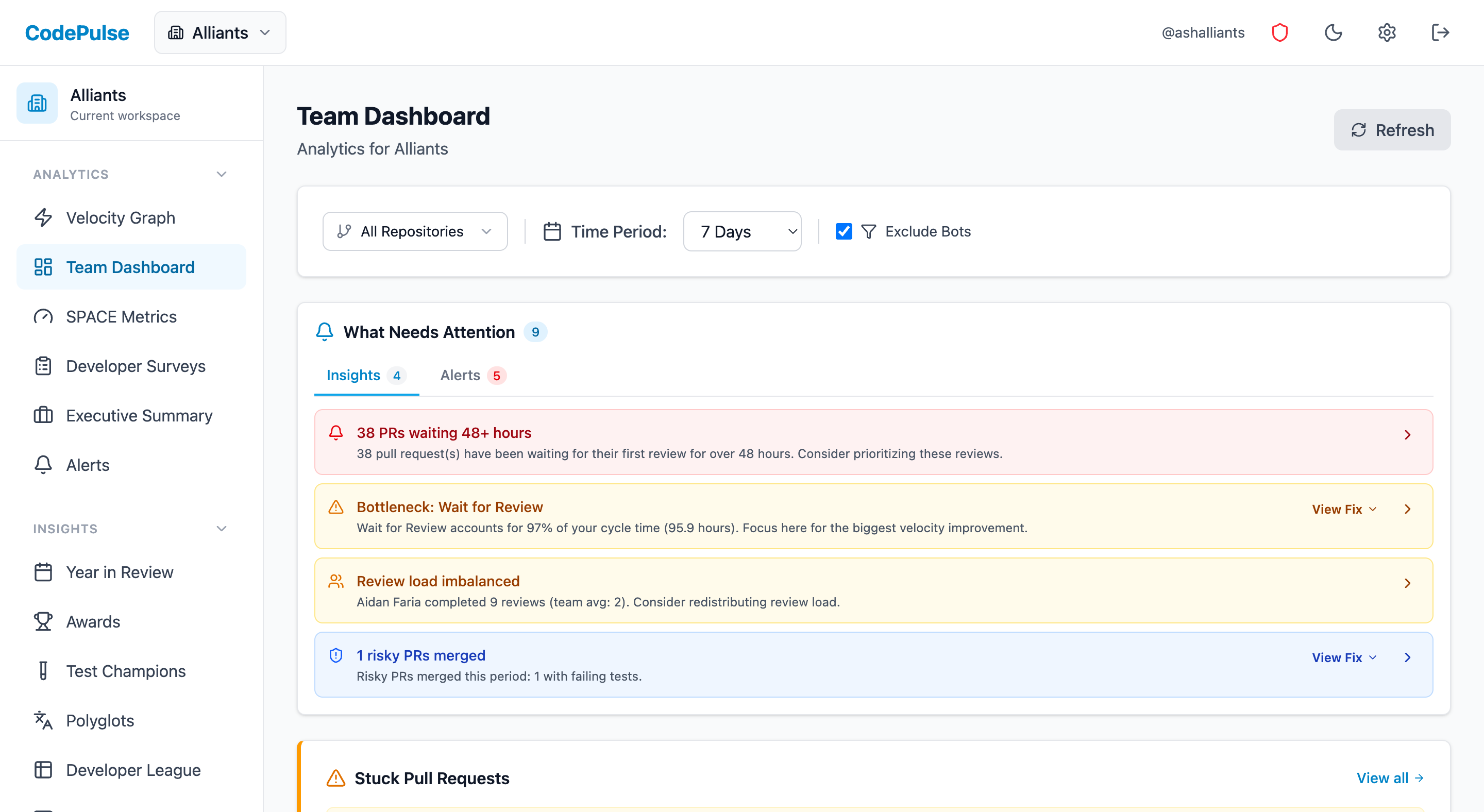
See which files and owners carry your real risk
Connect GitHub and get your churn hotspots, single-owner modules, and review-depth signals ranked by exposure. No repository cloning, no file contents read.
Read-only GitHub · Your code stays yours · Team-level by default · No credit card
See These Features in Action
Find high-churn files and correlate change frequency with ownership.
Flag large PRs, single-owner changes, and untested modifications.
Interactive graph of review relationships and workload distribution.
Related Guides
Engineering Team Management: Using Data to Lead Without Micromanaging
Managing software teams requires balancing delivery, quality, team health, and individual growth. This guide shows how to use data for visibility while avoiding surveillance, with practical scenarios and communication patterns.
7 Code Review Rules That Actually Get PRs Approved Faster
Learn code review best practices backed by metrics. Covers reviewer guidelines, author guidelines, team practices, and how to measure review effectiveness.
The 'Bus Factor' File That Could Kill Your Project
Use the Bus Factor Risk Matrix to identify where knowledge concentration creates hidden vulnerabilities before someone leaves.
High Code Churn Isn't Bad. Unless You See This Pattern
Learn what code churn rate reveals about your codebase health, how to distinguish healthy refactoring from problematic rework, and when to take action.