
Understand the system around the team, not a developer leaderboard
Preview team-level workload, collaboration, and delivery signals designed for process improvement rather than performance grading.
Read-only GitHub · Your code stays yours · Team-level by default · No credit card
Series B is the most dangerous transition in engineering leadership. You're too big for "everyone in a room" decisions but too small for Big Tech bureaucracy. Your star performers who carried the company through Seed are now bottlenecks. The heroics that got you here will kill you if you keep doing them. This handbook shows you how to navigate the transition from "Hero Mode" to "Systems Thinking" - with the metrics stack you need to survive the scale-up.
What metrics does a Series B engineering team need?
Series B teams need a tiered metrics stack: team-level process metrics (cycle time, review load, PR size), department-level delivery metrics (deployment frequency, quality trends, capacity), and strategic board metrics (engineering efficiency, ROI, headcount justification). The critical transition is moving from 'Hero Mode' where individuals carry the team to 'Systems Mode' where processes enable predictable execution at scale.
"The skills that make you a great Seed-stage CTO will destroy you at Series B. Individual brilliance doesn't scale. Systems do."
What Is the Series B Transition from Hero Mode to Systems Mode?
At Seed stage, velocity comes from individual brilliance. Your best engineer ships a feature in a weekend. Your CTO reviews every PR. Your staff engineer holds the entire architecture in their head. This is "Hero Mode" - and it works beautifully until it doesn't.
Series B is when Hero Mode breaks. You've raised $20-50M. You're expected to 3x the team in 18 months. The investors who wrote those checks expect predictable execution, not heroic saves. And the truth hits hard: you can't hire 30 people and expect them to operate like your founding 5.
| Stage | Team Size | Optimization | Success Mode |
|---|---|---|---|
| Seed | 3-10 | Speed at all costs | Hero Mode: Individual brilliance wins |
| Series A | 10-30 | Speed + reliability | Mixed Mode: Heroes + emerging process |
| Series B | 30-75 | Predictability + scale | Systems Mode: Process enables average performers |
| Series C+ | 75+ | Efficiency at scale | Process Mode: Optimization within constraints |
The inflection point is around 50 engineers. Below that, you can compensate for process gaps with heroics. Above that, the math stops working. 50 engineers means 50 different interpretations of "good code," 50 different definitions of "done," and 50 people waiting for the same 3 senior engineers to review their PRs.
🔥 Our Take
If you still have "heroes" at Series B, you don't have a team - you have a collection of single points of failure wearing capes.
The transition from Hero Mode to Systems Mode isn't optional - it's survival. The 2024 Jellyfish State of Engineering Management report found that 65% of engineers experienced burnout in the past year, and small teams (<10 people) burn out faster. Your "heroes" are your biggest burnout risk. Replace heroics with systems, or lose your best people.
Why Are Your Best People Your Biggest Risk?
"Your fastest developer is probably just your most overworked. When one person does 3x the reviews of anyone else, they're not a hero - they're a single point of failure and a burnout risk waiting to happen."
The Hero Mode trap looks like success. Your staff engineer reviews every complex PR. Your founding engineer is the only one who understands the billing system. Your CTO still writes critical code when deadlines are tight. Velocity is high. Releases ship. Everyone celebrates the heroes.
Until they quit. Or burn out. Or become such bottlenecks that nothing moves without them.
The Three Hero Mode Anti-Patterns
Hero Mode Anti-Patterns
1. The Staff Engineer Bottleneck
- Symptom: 80% of PRs go through 2-3 people
- Cause: "Only they really understand the code"
- Result: Everything queues behind the same reviewers
- Detection: Review load ratio 3x+ team average
- Detection: Star topology in review network
- Detection: Growing "wait for review" cycle time
2. The Founder-Coder Trap
- Symptom: Founders still writing production code
- Cause: "It's faster if I just do it myself"
- Result: No one else learns critical systems
- Detection: Top contributors are executives
- Detection: Knowledge silos in core systems
- Detection: Bus factor = 1 on critical paths
3. The Midnight Hero Syndrome
- Symptom: Same people always save releases
- Cause: "They're the only ones who can fix it"
- Result: Normalized after-hours work, burnout
- Detection: Recurring after-hours commits from same people
- Detection: Weekend deploys by same engineers
- Detection: High STRAIN scores (see burnout guide)
The Common Thread
- Knowledge hoarding - heroes aren't usually malicious
- They're just faster at doing it themselves than teaching others
- That's a management failure, not a character trait
🕸️Detecting Hero Mode in CodePulse
Use the Review Network to spot bottlenecks:
- Go to Review Network
- Look for "Star" topology (everyone connects to 1-2 central nodes)
- Healthy teams show "Mesh" topology (distributed connections)
- Check Developer Analytics for review load ratios above 3x average
- View File Hotspots to identify knowledge silos with low contributor counts
Breaking the Hero Dependency
The fix isn't firing your heroes - it's systematically distributing their knowledge and load. This is uncomfortable because it feels slower. It is slower, at first. But it's the only path to scalable velocity.
| Hero Pattern | Breaking Strategy | Metric to Track |
|---|---|---|
| Staff bottleneck | Review shadowing: pair reviewers on complex PRs | Review load distribution evening out |
| Knowledge silo | Forced rotation: assign new devs to "scary" areas | Contributor count on hotspot files |
| Founder-coder | Coding sabbatical: no code for 30 days | Velocity without founder contributions |
| Midnight hero | On-call rotation with documented runbooks | After-hours distribution across team |
Why Do Things Break at 50 Engineers?
Every engineering leader who's scaled a team talks about "the 50-person cliff." It's the point where informal coordination fails, oral tradition breaks down, and the processes that worked with 20 people create chaos with 50.
What Breaks at 50
The 50-Engineer Cliff
Communication Breakdown
- 20 engineers: 190 unique communication paths
- 50 engineers: 1,225 unique communication paths
- 75 engineers: 2,775 unique communication paths
- You can't maintain relationships with 50 people
- Tribal knowledge becomes unreliable
Review Bottlenecks
- At 20: Your 3 senior devs can review everything
- At 50: Those same 3 devs are now blocking 47 people
- Queue time explodes, or quality collapses
Architecture Drift
- At 20: Everyone knows the "right way"
- At 50: 5 different interpretations of the "right way"
- Inconsistency becomes technical debt
Onboarding Velocity
- At 20: New hires learn by osmosis
- At 50: Too many new hires, not enough mentors
- Time to productivity increases 50-100%
The Perception Gap (Jellyfish 2024 Research)
- 46% of engineers report team burnout
- Only 34% of executives see it
- 43% of engineers say leadership is "out of the loop"
- At 50 engineers, leadership can no longer feel what's happening on the ground
- You need systems
"At 50 engineers, your intuition becomes unreliable. The teams are too big to feel. You need metrics not because you don't trust people, but because you can't know what you can't see."
Surviving the Cliff
The teams that survive the 50-engineer cliff are the ones that transition from feeling-based management to metrics-informed management. Not micromanagement - informed management. The difference is crucial:
| Approach | Feeling-Based | Metrics-Informed |
|---|---|---|
| How do we know if things are good? | "It feels like we're moving fast" | "Cycle time is 18 hours, down from 24" |
| Who's overloaded? | "Nobody's complained yet" | "Three people have 3x review load" |
| Is quality suffering? | "I haven't heard about bugs" | "Churn rate up 40% in billing module" |
| Are we shipping? | "Lots of PRs are merging" | "Deployment frequency: 3/day, stable" |
What Should You Track at Each Level of the Metrics Stack?
You can't track everything - and you shouldn't try. At Series B, you need a tiered metrics stack that gives each level of leadership the visibility they need without drowning anyone in dashboards. Teams one stage earlier should read our engineering analytics for startups guide - the lighter stack appropriate before Series B, which naturally grows into the three-tier model below.
The Three-Tier Stack
Tier 1: Executive Metrics (Board/CEO)
Goal: Alignment and Confidence. "Are we executing on the plan?"
Cadence: Monthly board deck, quarterly deep dive
| Metric | What It Shows | Target Range |
|---|---|---|
| Investment Profile | Innovation vs. KTLO vs. Tech Debt % | 60/30/10 ideal, 50/35/15 acceptable |
| Deployment Frequency | How often you ship to production | Daily to weekly (DORA "High") |
| Change Failure Rate | % of deployments causing incidents | <15% (DORA "High") |
| Engineering Cost Ratio | Eng spend per feature/revenue | Context-dependent |
Executives don't need to see cycle time breakdowns. They need to know: "Is the investment in engineering paying off? Are we shipping at a sustainable pace?"
Tier 2: Operational Metrics (Directors/Managers)
Goal: Efficiency and Flow. "Where are the bottlenecks?"
Cadence: Weekly review, monthly trends
| Metric | What It Shows | Target Range |
|---|---|---|
| Cycle Time Breakdown | Coding/Pickup/Review/Merge phases | <24h total, pickup <4h |
| Review Load Balance | Reviews per developer per week | No one >2x team average |
| Onboarding Velocity | Time to 10th PR for new hires | <30 days (ideally <21) |
| WIP per Developer | Concurrent open PRs | 1-2 ideal, >3 problematic |
This is where you find operational problems before they become crises. A director should be able to look at these weekly and spot issues in time to fix them.
Tier 3: Team Health Metrics (Teams/Tech Leads)
Goal: Quality and Sustainability. "Is this team healthy?"
Cadence: Sprint review, continuous monitoring
| Metric | What It Shows | Target Range |
|---|---|---|
| PR Size | Lines changed per PR | <400 lines (smaller is better) |
| Code Churn Rate | % of code rewritten within 2 weeks | <15% healthy, >25% problematic |
| Test Failure Rate | CI failures per PR | <10%, investigate flaky tests |
| After-Hours Ratio | % of work outside business hours | <10%, >20% is burnout risk |
Team-level metrics should be owned by the team, not imposed by leadership. These are the metrics that teams use to self-improve, not that management uses to judge.
📊Building Your Metrics Stack in CodePulse
Set up tiered visibility:
- Executive Summary provides Tier 1 metrics with health grade
- Dashboard shows Tier 2 operational metrics with cycle time breakdown
- Repositories enables team-level Tier 3 views
- Set up Alert Rules for each tier's critical thresholds
What Do Investors Actually Want to See in Board Reports?
Board meetings are not the place for cycle time breakdowns. Investors want to know three things: Are you executing? Is the team healthy? Are there any surprises coming?
The Series B Engineering Board Slide
Engineering Health Grade: B+
Series B Board Slide ExampleQuestions Boards Ask (And How to Answer Them)
| Board Question | What They're Really Asking | How to Answer |
|---|---|---|
| "How's engineering velocity?" | Are we shipping fast enough for the plan? | Deployment frequency + lead time trends |
| "Is the team scaling well?" | Can we trust the hiring investment? | Onboarding velocity + new hire productivity |
| "What's the quality situation?" | Are we creating tech debt to hit targets? | Change failure rate + churn rate trends |
| "Any concerns?" | Will something blow up on us? | Investment profile showing debt % + risk items |
When Should You Hire Versus Optimize?
Series B comes with pressure to hire. You've got the money. Investors expect growth. The natural instinct is to throw headcount at every problem. This is usually wrong.
"The first question isn't 'how many engineers do we need?' It's 'why are the ones we have going slow?' Hiring before fixing efficiency just multiplies dysfunction."
The Efficiency-First Framework
Hire or Optimize? Decision Framework
Step 1: Diagnose the Constraint - Ask "Why are we going slow?"
- "PRs wait for review" - Optimize (distribute review load)
- "Tech debt in core paths" - Optimize (invest in refactoring)
- "Too many meetings" - Optimize (cut meetings, async more)
- "Context switching" - Optimize (reduce WIP limits)
- "Not enough hands" - Maybe hire (check other factors first)
Step 2: Check Utilization Signals Before Hiring
- Cycle time is low (< 24 hours) - If high, you have a flow problem, not a capacity problem
- Review wait time is low (< 4 hours) - If high, redistribute load before adding reviewers
- WIP per dev is low (1-2 items) - If high, too much parallel work, adding people won't help
- After-hours ratio is low (< 10%) - If high, team is overworked, but efficiency matters first
Step 3: Calculate Hire Impact
- New hire cost (all-in): ~$200k/year
- Onboarding drag: 3-6 months to full productivity
- Mentor tax: Senior dev loses ~20% output while mentoring
- One hire = $200k investment, ~4 month payback delay
Alternative $200k Investments
- 2 weeks of focused tech debt work = permanent velocity gains
- SRE improvements = less KTLO, more innovation capacity
- Better tooling = compound returns for whole team
Rule of Thumb
- If you haven't optimized to <24h cycle time and <3:1 review load ratios, optimize first
- Hiring won't fix systemic problems - it makes them worse
When You Should Hire
Hiring is the right answer when you've optimized efficiency and still have genuine capacity constraints. Signs that you actually need headcount:
- Low cycle time but still behind roadmap: Flow is good, but there's simply more work than people.
- Balanced review load but still backlogs: Everyone's pulling their weight, there's just too much weight.
- Consistently missing commitments despite good process:The team is efficient but undersized for the ambition.
- Growth opportunity requiring parallel workstreams:You need to run multiple independent initiatives.
How Do You Navigate the Founder-to-Manager Transition?
Technical founders face the hardest Series B transition: giving up code. The instinct to jump in and fix things is strong. It feels efficient. It's not.
The Founder Coding Trap
The Founder Coding Trap Cycle
The Vicious Cycle
- 1. Deadline pressure hits
- 2. Founder thinks "I can ship this faster myself"
- 3. Founder writes the code (they're still good!)
- 4. Team waits/watches instead of learning
- 5. Founder becomes bus factor on that system
- 6. Next time, founder "has to" do it because only they know the code
- 7. Knowledge silo deepens, team doesn't grow
The Core Problem
- Every time a founder codes something "because it's faster," they're training the team not to own it
The Founder Coding Math
Why 'faster' is actually slower when founders keep coding
Examples:
Interpretation:
The 30-Day Coding Sabbatical
For technical founders struggling to let go, we recommend a 30-day coding sabbatical. No production code for 30 days. Watch what happens:
- Week 1: Painful. You'll see things you want to fix. Don't. Delegate or document instead.
- Week 2: Team starts picking up things they would have waited for you to do.
- Week 3: You notice things you couldn't see when heads-down: process issues, team dynamics, hiring gaps.
- Week 4: The team is more capable than you thought. And you're better at managing than you feared.
After 30 days, you can code again - but deliberately, as teaching moments or architecture explorations, not as the default solution to deadline pressure.
How Do You Establish an Operational Cadence?
Metrics are useless without a rhythm of review and action. At Series B, establish these cadences:
The Series B Operating Rhythm
| Cadence | Participants | Focus |
|---|---|---|
| Weekly: Team Standup | ICs + Tech Lead | Blockers, PR review queue, WIP limits |
| Weekly: Eng Leadership | EMs + Directors | Cross-team dependencies, hiring pipeline, escalations |
| Bi-weekly: Skip-Levels | Directors + select ICs | Unfiltered team health, culture signals |
| Monthly: Eng All-Hands | All engineering | Strategic updates, metrics review, recognition |
| Monthly: Engineering Review | Eng Leadership + CEO | Trends, investment profile, strategic alignment |
| Quarterly: Board Prep | CTO + Finance | Board deck metrics, risk updates, headcount planning |
What to Review When
Series B Metrics Review Cadence
Weekly (Team Level)
- PR review queue depth - are we keeping up?
- Blocked PRs - what's waiting and why?
- WIP per developer - anyone juggling too much?
- This week's after-hours work - any patterns?
Monthly (Leadership Level)
- Cycle time trends - getting better or worse?
- Review load distribution - any heroes emerging?
- Onboarding velocity - are new hires ramping?
- Investment profile - where is effort going?
- Team-level STRAIN scores - burnout risk?
Quarterly (Executive Level)
- DORA metrics trends - deployment frequency, change failure rate, lead time, MTTR
- Engineering cost vs. value delivered
- Attrition and engagement signals
- Technical debt inventory and plan
- Headcount vs. productivity ratio
How Do You Scale Culture with Data?
Culture doesn't scale automatically. What you celebrate at 10 people gets lost at 50. Use metrics to reinforce the behaviors you want.
Metrics-Reinforced Culture
| Value You Want | Metric That Reinforces It | How to Celebrate |
|---|---|---|
| Collaboration | Review participation, knowledge distribution | "Best Reviewer" award for thoughtful feedback |
| Quality | Code churn rate, test coverage growth | Highlight PRs with zero rework |
| Sustainability | After-hours ratio, recovery patterns | Recognize sustainable delivery, not heroics |
| Speed | Cycle time, deployment frequency | Celebrate reduced lead times, not longer hours |
| Mentorship | New hire time-to-productivity | "Mentor of the Quarter" for best onboarding |
🏆Celebrating the Right Behaviors in CodePulse
Use data-backed recognition:
- Developer Awards provides 15 award categories based on actual metrics
- Includes collaboration awards like "Best Reviewer" and "Team Unblocker"
- Use in monthly all-hands to publicly recognize valued behaviors
- Avoid awards that glorify heroics (midnight merges, weekend deploys)
What Pitfalls Should You Avoid in the Series B Transition?
1. Weaponizing Metrics
The moment you use individual metrics for performance reviews, you've lost. Engineers will game the numbers, and you'll measure motion instead of progress.
Metrics Weaponization Warning Signs
- Comparing Alice's cycle time to Bob's in reviews
- Ranking developers by commit count
- Using PR volume as a performance indicator
- Publishing individual dashboards to management
- Using metrics as conversation starters in 1:1s
- Tracking team-level trends, not individual scores
- Investigating unusual patterns with curiosity, not judgment
- Making metrics visible to the team they measure
Rule: If you can't share the metrics with the team without causing anxiety, you're using them wrong.
2. Ignoring "Glue Work"
Not all valuable work shows up in Git data. Code reviews, architecture discussions, mentoring, documentation - this "glue work" doesn't generate commits but makes everything else possible.
- Track review contributions: Reviews given is as important as PRs authored.
- Acknowledge invisible work: Doc writers and mentors don't show up in velocity metrics. Celebrate them anyway.
- Watch for imbalances: If someone's PR count drops but review count rises, they're doing glue work. That's valuable.
3. Measuring Too Many Things
The temptation at Series B is to measure everything. Don't. Every metric you track is a tax on attention. Pick the 5-7 that matter most right now.
Start with: Cycle Time, Deployment Frequency, Review Load Balance, Investment Profile, and one quality metric (Churn or Change Failure Rate). Add more only when you've mastered these.
What Should You Do in Your First 90 Days?
Days 1-30: Establish Baseline
- Map your Hero dependencies: Who reviews everything? Who knows what systems? Where are the bus factor risks?
- Calculate current metrics: Cycle time, review load distribution, investment profile, after-hours ratio.
- Identify the biggest bottleneck: Is it review queues? Tech debt? Meeting load? Context switching? Pick one to fix first.
Days 31-60: Build the Stack
- Deploy tiered visibility: Executive metrics monthly, operational weekly, team-level continuous.
- Set up critical alerts: Cycle time exceeding threshold, review load imbalance, after-hours spikes.
- Start hero mitigation: Pair reviews, rotation assignments, documentation of tribal knowledge.
Days 61-90: Embed the Rhythm
- Establish cadences: Weekly team check-ins, monthly leadership reviews, quarterly board prep.
- Launch culture reinforcement: First metrics-based awards, recognition in all-hands.
- Review and adjust: What's working? What metrics are noise? Simplify before adding.
The Series B transition is hard. You're giving up what made you successful to build something bigger. Heroes become risks. Intuition becomes unreliable. Systems replace instinct. It's uncomfortable - and it's the only way to scale.
"The goal isn't to eliminate heroics. It's to make heroics unnecessary. When your systems work, average engineers can do excellent work. That's scale."
For more on building healthy, scalable engineering organizations, see our guides on Engineering Manager Metrics, Detecting Burnout in Git Data, Metrics Rollout Playbook, and DORA Metrics Guide.
Frequently Asked Questions
The 50-engineer cliff is the point where informal processes that worked with a small team begin to break down. Below 50 engineers, you can compensate for process gaps with heroics. Above that, 50 different interpretations of "good code" and 50 people waiting for the same 3 senior reviewers to unblock them creates systemic dysfunction.
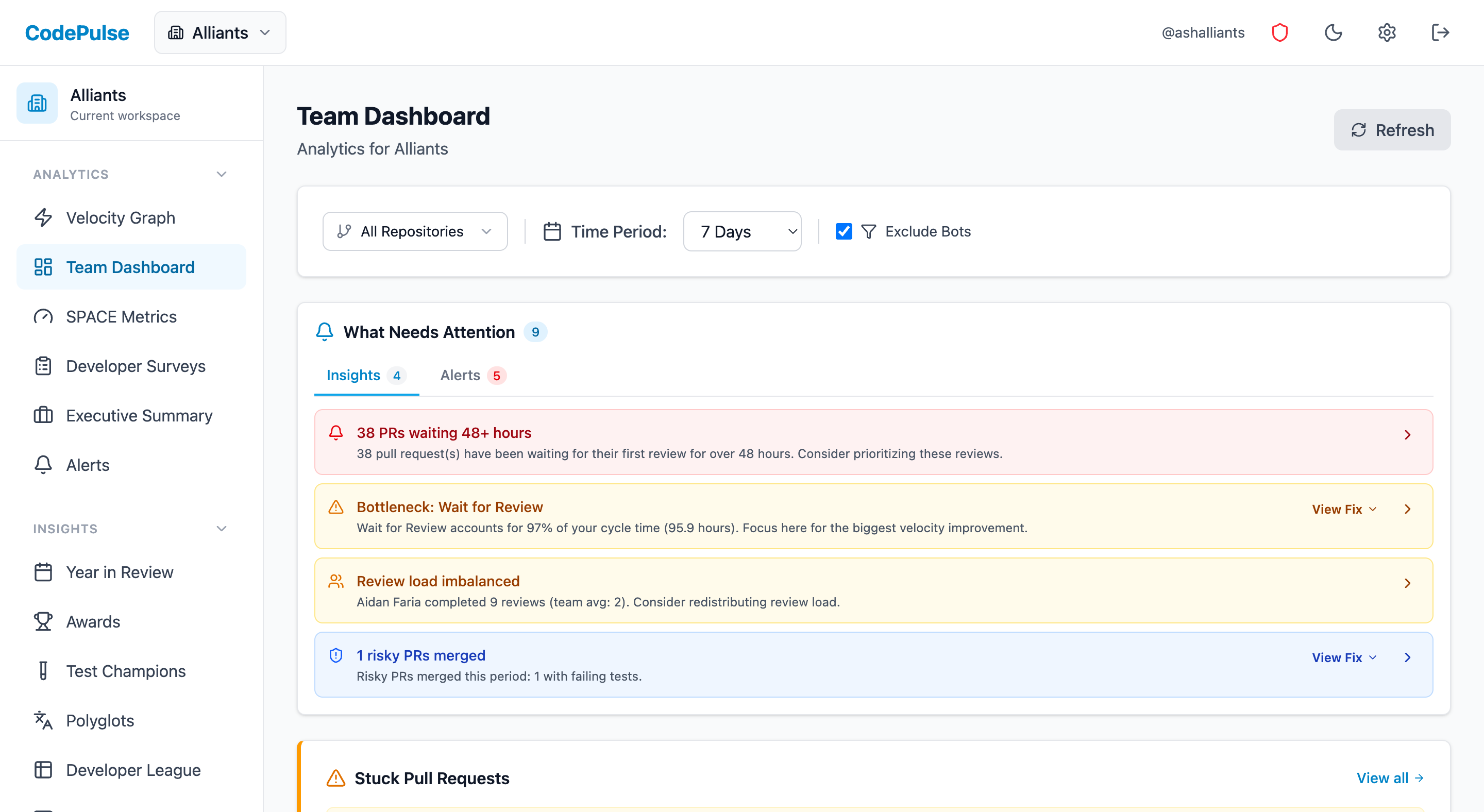
Get this view for your own teams
Connect GitHub for team-level workload, review distribution, and delivery signals. Individual views stay off unless your organisation explicitly turns them on.
Read-only GitHub · Your code stays yours · Team-level by default · No credit card
See These Features in Action
Board-ready engineering performance in a single page.
Track all four DORA metrics and benchmark against industry standards.
Related Guides
The EM Dashboard That Won't Get You Reported to HR
With 83% of developers suffering from burnout and a 12-point perception gap between engineers and executives, EMs need metrics that reveal team health - not just delivery. Here is what to track, what to ignore, and how to use data without destroying trust.
Your Git Data Predicts Burnout 6 Weeks in Advance
Use the STRAIN Score framework to detect developer burnout from Git data. Identify after-hours patterns, review overload, and intensity creep before they cause turnover.
Engineering Metrics Rollout: The Trust-First Playbook
A change management playbook for rolling out engineering metrics without triggering developer resistance. Covers communication plans, staff engineer buy-in, trial structure, and anti-gaming safeguards.
DORA Metrics Explained: The 4 Keys Without the Hype
A complete breakdown of the four DORA metrics - deployment frequency, lead time, change failure rate, and MTTR - with honest benchmarks and gaming traps to avoid.
Engineering Metrics That Won't Get You Reported to HR
An opinionated guide to implementing engineering metrics that build trust. Includes the Visibility Bias Framework, practical do/don't guidance, and a 30-day action plan.
Engineering Team Management: Using Data to Lead Without Micromanaging
Managing software teams requires balancing delivery, quality, team health, and individual growth. This guide shows how to use data for visibility while avoiding surveillance, with practical scenarios and communication patterns.