

Understand the system around the team, not a developer leaderboard
Preview team-level workload, collaboration, and delivery signals designed for process improvement rather than performance grading.
Read-only GitHub · Your code stays yours · Team-level by default · No credit card
Managing a software development team is one of the hardest jobs in tech. You're responsible for delivery, team health, individual growth, and technical quality - often without clear metrics for any of them. This guide shows how to manage engineering teams using data for visibility while avoiding the surveillance trap.
"The best engineering managers don't manage code - they manage context, priorities, and blockers. The code takes care of itself."
The Core Management Challenges
Engineering managers face unique challenges:
| Challenge | Wrong Approach | Right Approach |
|---|---|---|
| Visibility into work | Micromanage tasks | Track team-level flow metrics |
| Individual performance | Measure output (commits, LOC) | Assess outcomes and growth |
| Team productivity | Push for more output | Remove blockers and friction |
| Technical quality | Review every PR | Build review culture, monitor trends |
| Career development | Annual reviews only | Continuous feedback with data |
/// Our Take
The biggest mistake new engineering managers make is trying to stay technical by reviewing every PR and making architecture decisions. Your job now is to multiply your team's effectiveness - not to write code through them.
Great engineering management is mostly about creating conditions for your team to succeed: clear priorities, removed blockers, psychological safety, and career growth. Data should inform these efforts, not replace your judgment.
Team-Level Metrics That Matter
Focus on team metrics, not individual scorecards:
Flow Metrics
- Cycle time - How fast does work flow through your team?
- Throughput - How many items completed per week?
- Work in progress (WIP) - How much parallel work?
- Blockers - What's stuck and why?
Quality Metrics
- Bug rate - Bugs per feature shipped
- Change failure rate - Deploys causing incidents
- Review coverage - PRs with meaningful review
- Test coverage trends - Direction, not absolute
Health Metrics
- Review load distribution - Is anyone overloaded?
- Knowledge silos - Bus factor on critical code
- After-hours commits - Potential burnout signal
- Team satisfaction - Regular surveys
Individual Performance Assessment
Individual metrics are dangerous but sometimes necessary. Use them carefully:
What NOT to Measure
- Lines of code - Encourages bloat
- Number of commits - Encourages small, meaningless commits
- Hours worked - Encourages presence over productivity
- PR count - Encourages artificial splitting
Better Indicators
- Quality of reviews given - Thorough, helpful feedback
- Mentorship activity - Helping others level up
- Technical leadership - Architecture decisions, tech debt reduction
- Project outcomes - Did the feature achieve its goal?
- Peer feedback - 360 reviews from collaborators
Using Data in 1:1s
Data can inform 1:1 conversations without becoming surveillance:
Good: "I noticed your PRs have been taking longer to get reviewed
       lately. Is there something blocking you, or do you need help
       finding reviewers?"

Bad:  "Your PR throughput is down 20% this month. What's going on?"

Good: "You've been doing a lot of reviews for the team - thank you.
       How's the load feeling? Do we need to redistribute?"

Bad:  "You reviewed 47 PRs last month - that's 12% more than anyone
       else. Good job."

Good: "I see the auth service has been getting a lot of changes.
       What's driving that? Anything I should know?"

Bad:  "Why have you touched 15 files in the auth service this week?"
📊 How to See This in CodePulse
Use CodePulse for team management insights:
- Dashboard for team-level cycle time and throughput
- Review Network to see review load distribution
- Knowledge Silos to identify bus factor risks
- Developer Comparison for understanding work patterns (not ranking)
Common Management Scenarios
Scenario 1: Delivery is Slowing
Symptoms: Cycle time increasing, fewer PRs merged, stakeholders complaining.
Investigation steps:
- Check cycle time breakdown - is it coding, review, or merge time?
- Look for WIP buildup - too much parallel work?
- Review blockers - external dependencies? Waiting on decisions?
- Talk to the team - what's frustrating them?
Scenario 2: Quality is Declining
Symptoms: More bugs, incidents, or customer complaints.
Investigation steps:
- Check code churn - are changes being rushed and then fixed?
- Review PR sizes - large PRs harder to review well
- Look at review depth - rubber-stamping?
- Assess test coverage trends - declining?
Scenario 3: Team Member Struggling
Symptoms: Lower output, longer cycle times, less engagement.
Approach:
- Have a private 1:1 - ask, don't assume
- Check for blockers - unclear requirements? Waiting on others?
- Assess workload - overwhelmed or under-challenged?
- Consider external factors - personal issues, burnout
- Create support plan - coaching, pairing, clearer scope
Scenario 4: Team Conflict
Symptoms: Heated PR comments, avoiding collaboration, complaints.
Approach:
- Don't ignore it - conflicts don't resolve themselves
- Talk to parties individually first
- Facilitate direct conversation if needed
- Set clear norms - working agreements, code review guidelines
- Follow up - ensure resolution sticks
"When something goes wrong on your team, your first question should be 'what's the system problem?' not 'who's at fault?'"
Building a High-Performing Team
Psychological Safety
High-performing teams have psychological safety - people feel safe taking risks and admitting mistakes. Signs it's working:
- People ask questions in public channels
- Mistakes are discussed openly without blame
- Junior engineers challenge senior decisions
- Retrospectives have honest discussion
Clear Priorities
The team should always know what matters most:
- Top 3 priorities, reviewed weekly
- Why these priorities matter to the business
- Permission to say no to other requests
- Clear escalation path for conflicts
Technical Excellence
Create conditions for good engineering:
- Time for tech debt reduction (20% rule)
- Encourage documentation and knowledge sharing
- Invest in developer experience (build times, tooling)
- Celebrate technical improvements, not just features
Communication Patterns
Team Meetings
- Daily standup - 15 min, blockers and help needed
- Weekly sync - 30 min, priorities and progress
- Bi-weekly retro - 60 min, what to improve
- Monthly planning - 90 min, upcoming work
Individual Meetings
- Weekly 1:1 - 30 min, their agenda first
- Career conversation - Quarterly, growth and goals
- Performance review - Semi-annual, no surprises
Async Communication
- Write decisions and context in docs, not just Slack
- Over-communicate on priorities and changes
- Share team wins publicly
- Document processes for onboarding
Related Guides
- Engineering Manager Guide - Role, responsibilities, and success metrics
- Measure Team Performance Without Micromanaging - Balanced measurement approaches
- Engineering Metrics Without Surveillance - Building trust with data
- Working Agreements Guide - Setting team norms
Conclusion
Managing software development teams requires balancing multiple priorities: delivery, quality, team health, and individual growth. Data can help you do this effectively - but only if you use it to understand and improve, not to judge and control.
- Focus on team metrics - cycle time, throughput, quality
- Use individual data carefully - to help, not to rank
- Create psychological safety - so people can do their best work
- Remove blockers - your job is to multiply effectiveness
- Communicate constantly - priorities, context, feedback
Use CodePulse to get visibility into your team's delivery flow without surveillance. Understand bottlenecks, review load, and knowledge distribution - then use that understanding to make your team more effective.
"Your success as an engineering manager is measured by your team's success - not by the code you write or the decisions you make."
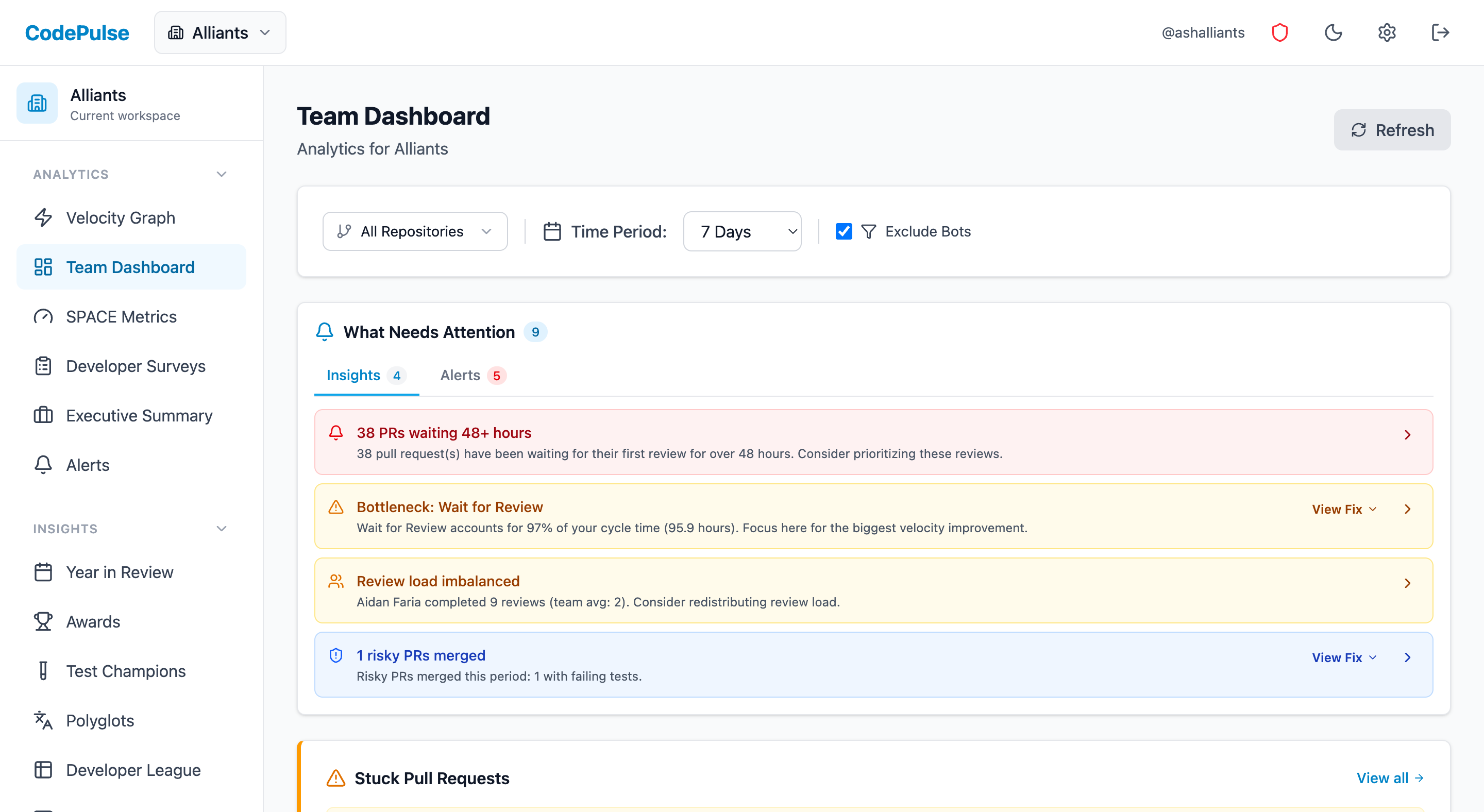
Get this view for your own teams
Connect GitHub for team-level workload, review distribution, and delivery signals. Individual views stay off unless your organisation explicitly turns them on.
Read-only GitHub · Your code stays yours · Team-level by default · No credit card
See These Features in Action
Board-ready engineering performance in a single page.
Compare contribution patterns for coaching, not surveillance.
Related Guides
The EM Dashboard That Won't Get You Reported to HR
With 83% of developers suffering from burnout and a 12-point perception gap between engineers and executives, EMs need metrics that reveal team health - not just delivery. Here is what to track, what to ignore, and how to use data without destroying trust.
The Tech Lead Dashboard Your Manager Shouldn't See
The metrics that matter for tech leads - code quality, technical debt, architecture decisions, and delivery. Different from EM metrics, focused on technical excellence.
Engineering Metrics That Won't Get You Reported to HR
An opinionated guide to implementing engineering metrics that build trust. Includes the Visibility Bias Framework, practical do/don't guidance, and a 30-day action plan.
How to Measure Developers Without Becoming the Villain
Learn how to implement engineering metrics that developers actually trust, focusing on insight over surveillance and team-level patterns.