
See exactly where your delivery flow is waiting
Preview the phase-by-phase report for review pickup, active review, and merge time. Connect in about five minutes; the initial analysis runs after sync.
Read-only GitHub · Your code stays yours · Team-level by default · No credit card
Most DevOps assessments are surveys. Someone sends a Google Form, teams spend 20 minutes rating themselves 1-5 on vague criteria, and the results land in a slide deck that nobody opens again. Meanwhile, your Git history contains months of objective data about how your organization actually builds and ships software. This guide shows you how to run a 30-minute DevOps assessment using data you already have, not opinions people think you want to hear.
"Over 45% of organizations believe they are excelling at automation, while only 14% have actually achieved automation excellence." - Puppet State of DevOps Report
This guide is about auditing your team's current maturity from data you already have. If you are instead weighing whether GitHub alone covers what your organization needs, that is a platform question: see our guide to evaluating GitHub as a platform.
Why DevOps Assessments Fail (And How to Do Them Right)
The gap between self-reported DevOps maturity and actual performance is enormous. According to Puppet's 2024 State of DevOps Report, 62% of organizations say they're stuck in mid-evolution on their DevOps journey despite reporting high levels of automation. Almost half have to rerun deployments more than four times to get them right.
That disconnect exists because traditional assessments rely on self-perception. Teams rate themselves based on what they plan to do, not what they actually do. A team that just installed Kubernetes scores themselves as "advanced infrastructure" even though they deploy manually every two weeks.
The fix is straightforward: pull data from your Git repositories, CI/CD pipelines, and deployment logs. Let the numbers tell you where you stand. A data-driven DevOps assessment takes about 30 minutes. It produces a repeatable baseline. And it can't be gamed by optimistic self-reporting.
If you want the theoretical framework behind maturity levels, read our DevOps Maturity Model Guide. This guide is the practical companion: how to actually run the assessment.
The 6 Dimensions of a DevOps Assessment
Every DevOps assessment framework covers similar ground, from DORA's four key metrics to CALMS (Culture, Automation, Lean, Measurement, Sharing). We've distilled these into six dimensions that can be measured with data. No surveys required.
| Dimension | What It Measures | Data Source | Red Flag |
|---|---|---|---|
| Delivery Speed | Lead time from commit to production | Git + CI/CD logs | Median lead time > 1 week |
| Deployment Cadence | How often you ship to production | Deployment/release logs | Less than weekly deploys |
| Change Stability | Percentage of changes causing failures | Incident/rollback data | Change failure rate > 15% |
| Review Throughput | How fast code gets reviewed and merged | Git PR/MR data | PR cycle time > 83 hours |
| Collaboration Health | Distribution of reviews, bus factor | Git author/reviewer data | > 50% of PRs merged without review |
| Recovery Capability | Time to restore service after failure | Incident management system | MTTR > 24 hours |
The 2024 DORA Accelerate State of DevOps Report found that only 19% of teams reached elite performance levels, while the low-performing cluster grew from 17% to 25% year-over-year. That means one in four engineering organizations is getting worse, not better. If you are not measuring, you could be in that group without knowing it.
The median organization averages a PR cycle time of 83 hours. The fastest quarter of organizations average under 58 hours. These numbers are useful because they come from actual data, not self-assessments. Your Git history tells you exactly where you fall on that spectrum.
/// Our Take
DORA metrics were designed to study thousands of organizations, not manage your specific team. They're signals, not goals. Use them to understand where you are, but don't build your roadmap around hitting "Elite" on every dimension.
The teams we see struggling the most are often the ones chasing DORA benchmarks as targets. They optimize deployment frequency by splitting releases into smaller chunks without reducing batch size. They game lead time by starting the clock later. Real improvement comes from understanding your specific bottlenecks, not from matching someone else's numbers. For more on this trap, see our DevOps Metrics & KPIs Guide.
Running a Data-Driven DevOps Assessment from Git Data
Here is the 30-minute process. You need access to your Git repositories and, ideally, your CI/CD system. No consultants. No workshops. Just data.
Step 1: Gather Your Baseline Metrics (10 minutes)
Pull these numbers from the last 30 days of your primary repositories:
30-DAY DEVOPS ASSESSMENT SCORECARD
===================================

DELIVERY SPEED
  Median PR cycle time:          _____ hours
  90th percentile cycle time:    _____ hours
  Median time-to-first-review:   _____ hours

DEPLOYMENT CADENCE
  Total deploys (last 30 days):  _____
  Deploys per developer per week: _____
  Days with zero deploys:        _____ / 22 working days

CHANGE STABILITY
  Rollbacks or hotfixes:         _____
  Failed deployments:            _____
  Change failure rate:           _____ %

REVIEW THROUGHPUT
  PRs opened:                    _____
  PRs merged:                    _____
  PRs merged without review:     _____ %
  Avg review cycles per PR:      _____

COLLABORATION HEALTH
  Active reviewers (30 days):    _____
  Bus factor (files with 1 author): _____ %
  Self-merged PRs:               _____ %

RECOVERY
  Incidents (last 30 days):      _____
  Median time to restore:        _____ hours
If you use GitHub, most of these numbers are available through the API or a tool like CodePulse. The point is not precision on day one. The point is having a baseline you can compare against in 90 days.
Step 2: Score Each Dimension (10 minutes)
Map your numbers to the scoring rubric below. This scoring system is deliberately simple. It uses the DORA performance benchmarks as reference points, adjusted with data from our analysis of PR patterns across engineering teams.
| Dimension | Score 1 (Critical) | Score 2 (Below Avg) | Score 3 (Average) | Score 4 (Strong) | Score 5 (Elite) |
|---|---|---|---|---|---|
| Delivery Speed | > 1 month | 1–4 weeks | 1–7 days | 1 day–1 week | < 1 day |
| Deploy Cadence | Monthly or less | Bi-weekly | Weekly | Daily | On demand |
| Change Stability | > 40% CFR | 20–40% | 10–20% | 5–10% | < 5% |
| Review Throughput | > 124 hrs | 83–124 hrs | 58–83 hrs | 24–58 hrs | < 24 hrs |
| Collaboration | > 60% unreviewed | 40–60% | 20–40% | 5–20% | < 5% unreviewed |
| Recovery | > 1 week | 1 day–1 week | 1–24 hours | 1–4 hours | < 1 hour |
Your total score (6–30) gives you a rough maturity level: 6–12 is Level 1–2 (significant gaps), 13–18 is Level 3 (functional but inconsistent), 19–24 is Level 4 (strong practices), and 25–30 is Level 5 (elite). See our DevOps Maturity Model Guide for what each level means in practice.
Step 3: Identify the Constraint (10 minutes)
Look at your scores. The lowest-scoring dimension is where you should focus first. Not the most interesting one, not the one with the shiniest tool solution, but the actual bottleneck.
According to the 2024 DORA report, the high-performance cluster shrank from 31% of respondents in 2023 to 22% in 2024, while the low-performing cluster grew from 17% to 25%. Teams are regressing. The most common reason: they invested in the wrong dimension. They optimized CI/CD pipelines when the actual bottleneck was review wait time. They bought observability platforms when the real problem was that nobody looked at the dashboards.
"Tool sprawl costs engineering teams an average of 6 to 15 hours per week in lost productivity. The problem is almost never a missing tool. It's a missing process."
A 2024 survey found that 44% of teams juggle 10 or more DevOps tools, with significant overlap in functionality. Teams navigate an average of 7.4 tools to build applications. If your assessment reveals low scores, your first instinct should be to simplify, not to add another tool.
From Assessment to Roadmap: Prioritizing Improvements
You have your scores. Now what? The most common mistake is trying to fix everything at once. Here is a prioritization framework that works.
Priority 1: Unblock the Flow
If your review throughput or delivery speed scored 1 or 2, start here. Nothing else matters if code sits in queues for days. Common fixes:
- Set a 24-hour SLA for first review
- Reduce PR size targets (under 400 lines changed)
- Assign reviewers automatically via CODEOWNERS
- Track and publicize time-to-first-review metrics
Our DevOps Transformation Guide covers the organizational change management side of these improvements.
Priority 2: Stabilize the Pipeline
If change stability scored low, focus on reducing failure rates before increasing speed. Shipping faster while 30% of changes break production just creates more fires.
- Add automated tests that run before merge (not after)
- Implement staging environments that actually mirror production
- Require at least one approval before merge, with no exceptions
- Track change failure rate weekly and review in standups
Priority 3: Build Visibility
Once flow and stability are acceptable (score 3+), invest in visibility. You cannot improve what you cannot see.
- Set up a team dashboard showing DORA metrics
- Track collaboration health (review distribution, bus factor)
- Make metrics visible to the team, not just leadership
- Review trends monthly. The direction matters more than the absolute number.
📊 How CodePulse Supports This
CodePulse automates the data-gathering step of your DevOps assessment. Instead of pulling Git metrics manually, you get:
- Industry Benchmarks to compare your delivery speed, review throughput, and collaboration health against peer organizations
- Engineering Health Score (A–F grade) that maps directly to the 6-dimension framework above
- Cycle Time Breakdown showing exactly where time is spent: coding, waiting for review, in review, and merge
- DORA metrics tracked automatically from your GitHub data, with historical trends
The 30-minute assessment becomes a 5-minute check-in when the data is already collected and scored for you.
DevOps Assessment Is Not a One-Time Event
The number one reason DevOps assessments fail to produce improvement is that they happen once. Someone runs the assessment, builds a slide deck, presents it to leadership, and the results sit in a shared drive forever.
According to Spacelift's analysis of DevOps statistics, Gartner estimated that 90% of DevOps initiatives fail to fully meet expectations. The inability to measure progress consistently is a primary driver of that failure rate.
Here is a cadence that works:
- Weekly: Review one or two metrics that correspond to your current improvement focus. If you are working on review throughput, look at time-to-first-review and PR cycle time in your standup.
- Monthly: Run the full 6-dimension scorecard. Compare against last month. Are you improving where you expected? Are any dimensions regressing?
- Quarterly: Share results with leadership. This is where the assessment becomes a planning tool, not just a diagnostic. Use score changes to justify investments, hiring, or process changes.
"The teams that improve are the ones that measure consistently and act on trends. A single assessment tells you where you are. Monthly assessments tell you where you're going."
The difference between an assessment that collects dust and one that drives change comes down to two things. First, the assessment must use objective data, not opinions. Second, it must happen on a regular cadence with clear ownership.
For the broader picture of which metrics to track and how to report on them, see our DevOps Toolchain Guide for evaluating your tooling stack and our DevOps Metrics & KPIs Guide for a complete metric catalog.
Frequently Asked Questions
A data-driven assessment takes about 30 minutes if you have access to your Git repositories and CI/CD system. The first time takes longer because you need to figure out where to pull each metric. After that, the process is repeatable. With an automated tool, it takes less than 5 minutes.
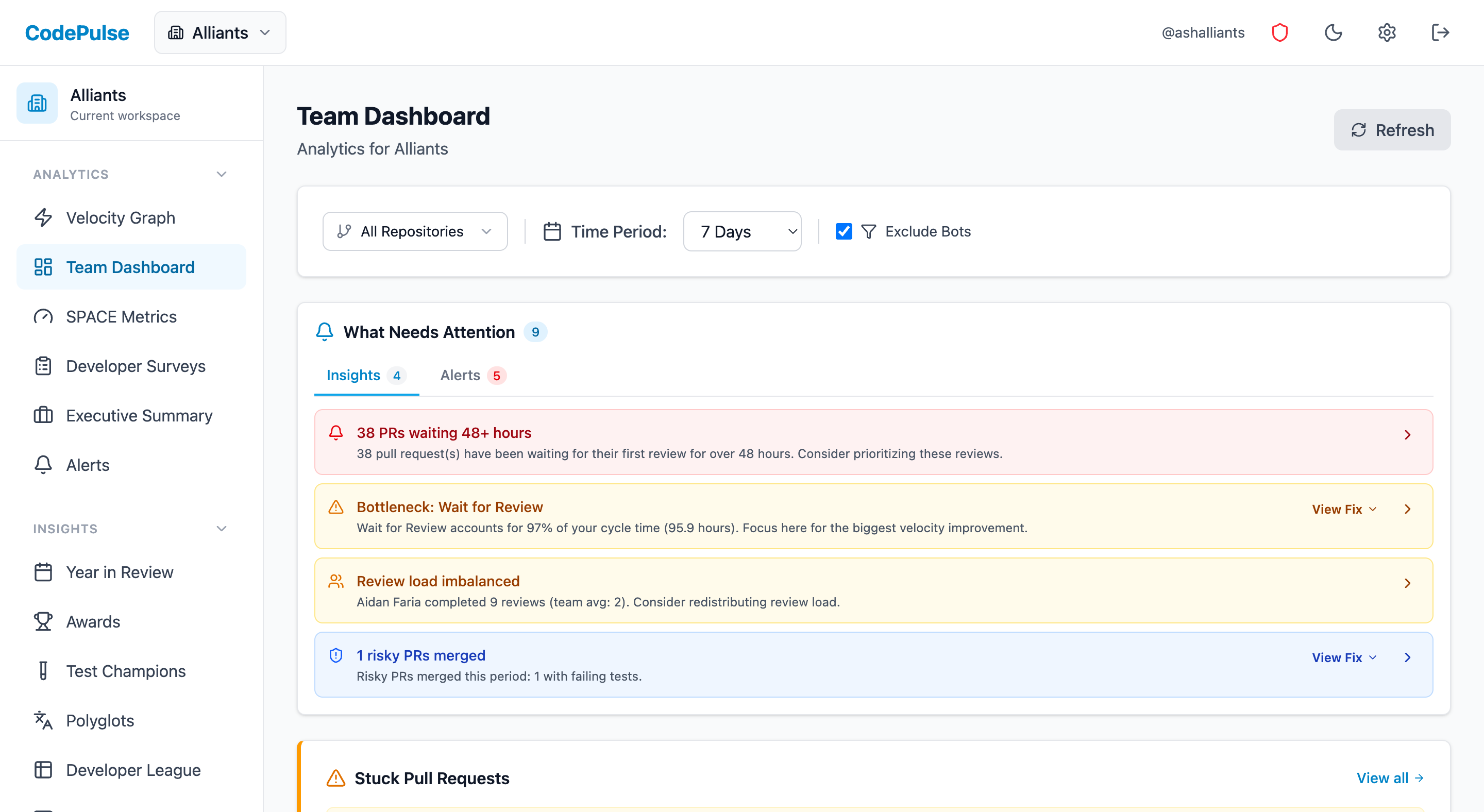
Find out which phase is holding your delivery up
CodePulse splits your cycle time into coding, waiting for review, active review, and merge, so you fix the queue that is actually costing you days. Read-only GitHub, no credit card.
Read-only GitHub · Your code stays yours · Team-level by default · No credit card
See These Features in Action
Track all four DORA metrics and benchmark against industry standards.
Track deployment frequency, lead time, and release patterns.
Related Guides
DevOps Maturity Model: A Practical Assessment Framework
Assess your DevOps maturity across culture, CI/CD, testing, monitoring, and infrastructure. Includes self-assessment questionnaire and improvement roadmap by level.
DevOps Transformation: Why Most Fail (How to Win)
DevOps transformation is one of the most commonly failed initiatives in enterprise software. This guide shows how to avoid the pitfalls, measure success with real metrics, and achieve lasting cultural change.
DevOps Metrics & KPIs That Actually Drive Change
Most DevOps dashboards measure too much and improve nothing. This guide covers the essential DevOps KPIs (DORA + supporting metrics), how to build an actionable dashboard, and which tools can help.
DORA Metrics Explained: The 4 Keys Without the Hype
A complete breakdown of the four DORA metrics - deployment frequency, lead time, change failure rate, and MTTR - with honest benchmarks and gaming traps to avoid.
The DevOps Toolchain: What to Measure at Each Stage
A DevOps toolchain enables continuous delivery. This guide maps all stages (plan, code, build, test, release, deploy, operate, monitor) with tools and metrics.