

See exactly where your delivery flow is waiting
Preview the phase-by-phase report for review pickup, active review, and merge time. Connect in about five minutes; the initial analysis runs after sync.
Read-only GitHub · Your code stays yours · Team-level by default · No credit card
DevOps transformation is one of the most common - and most commonly failed - initiatives in enterprise software. The technology is the easy part; changing culture, processes, and incentives is hard. This guide shows how to measure transformation success and avoid the pitfalls that derail most initiatives.
"You can't buy DevOps. You can buy tools, but transformation happens through people and processes - and those don't come in a box."
What is DevOps Transformation?
DevOps transformation is the organizational change from siloed development and operations teams to a culture of shared responsibility for the entire software delivery lifecycle. It typically involves:
- Culture change - From "throw it over the wall" to shared ownership
- Process change - From manual gates to automated pipelines
- Technical change - From monoliths to microservices, infrastructure as code
- Organizational change - From functional silos to cross-functional teams
Why DevOps Transformations Fail
| Failure Mode | Root Cause | Prevention |
|---|---|---|
| Tool-only focus | Bought tools, didn't change process | Invest 70% in people/process, 30% in tools |
| No executive sponsorship | Middle management initiative | Get VP+ commitment and involvement |
| Big bang approach | Tried to change everything at once | Start with one team, prove value, expand |
| No metrics | Can't prove progress or ROI | Baseline and track DORA metrics from day 1 |
| Culture ignored | Old incentives remained | Change performance metrics, celebrate collaboration |
/// Our Take
Most DevOps transformations are actually DevOps theater. Organizations adopt the tools and vocabulary while keeping the old silos and incentives. Six months later, they declare success based on tool adoption while delivery metrics haven't changed.
Real transformation is measured by outcomes: Are you deploying more frequently? Is lead time shorter? Is change failure rate lower? If those numbers haven't moved, you haven't transformed - you've just bought expensive tools.
Transformation Phases
Phase 1: Assess (4-6 weeks)
Understand your current state before changing anything:
- Baseline DORA metrics (deployment frequency, lead time, CFR, MTTR)
- Map current deployment process end-to-end
- Identify top 5 bottlenecks and pain points
- Survey teams on collaboration and tooling satisfaction
- Document existing tools and integrations
Phase 2: Pilot (8-12 weeks)
Prove the concept with one willing team:
- Choose a motivated team with a greenfield or low-risk project
- Implement CI/CD pipeline for that team
- Introduce infrastructure as code
- Establish new deployment workflows
- Measure improvement vs. baseline
Phase 3: Expand (3-6 months)
Roll out proven practices to more teams:
- Train additional teams on new practices
- Create internal platform team to support adoption
- Document and templatize successful patterns
- Address resistance with data from pilot success
- Continue measuring and iterating
Phase 4: Optimize (Ongoing)
Continuous improvement becomes BAU:
- Regular reviews of DORA metrics
- Investment in developer experience
- Platform team matures capabilities
- Community of practice shares learnings
- External benchmarking to stay competitive
Measuring Transformation Success
Primary Metrics (DORA)
| Metric | Pre-Transform Typical | Post-Transform Target |
|---|---|---|
| Deployment Frequency | Monthly or less | Daily or more |
| Lead Time for Changes | Weeks to months | Hours to days |
| Change Failure Rate | 30-50% | Under 15% |
| Mean Time to Recovery | Days | Under 1 hour |
Supporting Metrics
- Time spent on manual tasks - Should decrease
- Deployment success rate - Should increase
- Developer satisfaction scores - Should improve
- Time to onboard new developers - Should decrease
- Incident response time - Should decrease
Anti-Metrics (What NOT to Track)
- Tool adoption percentage - Doesn't mean transformation
- Training hours completed - Doesn't mean behavior changed
- Number of pipelines created - Doesn't mean they're used
📊 How to See This in CodePulse
Track your DevOps transformation progress:
- Dashboard for deployment frequency and lead time trends
- Executive Summary for DORA metrics snapshot
- Repository Comparison to compare pilot vs. non-pilot teams
Common Transformation Challenges
Challenge 1: Resistance from Operations
Ops teams may feel threatened by automation and dev-led infrastructure.
Solution: Reframe as elevation, not elimination. Ops becomes platform engineering, focusing on enabling developers rather than gatekeeping deployments.
Challenge 2: Legacy Systems
Old monoliths can't be deployed continuously without significant work.
Solution: Start with new services. Use the strangler pattern to gradually modernize legacy systems. Don't try to transform everything at once.
Challenge 3: Security and Compliance Concerns
Security teams may resist faster deployments and less manual review.
Solution: Shift security left. Implement automated security scanning in CI/CD. Show that frequent, small changes are actually more secure than infrequent large releases.
Challenge 4: Measuring ROI
Executives want to see return on transformation investment.
Solution: Translate DORA metrics to business value. Faster lead time = faster time to market. Lower CFR = fewer customer incidents. Quantify developer time saved.
Sample Transformation Roadmap
DEVOPS TRANSFORMATION ROADMAP
───────────────────────────────────────

MONTH 1-2: ASSESS
□ Baseline DORA metrics
□ Process mapping workshop
□ Tooling audit
□ Stakeholder interviews
□ Executive alignment session

MONTH 3-4: PILOT
□ Select pilot team
□ Set up basic CI/CD pipeline
□ Implement automated testing
□ Infrastructure as code for one service
□ Measure pilot team metrics weekly

MONTH 5-6: LEARN & ADJUST
□ Document pilot learnings
□ Address unexpected challenges
□ Refine tooling and templates
□ Create internal documentation
□ Present results to leadership

MONTH 7-9: EXPAND
□ Train 3-5 additional teams
□ Establish platform team
□ Create self-service capabilities
□ Track metrics across all teams
□ Regular cross-team sharing

MONTH 10-12: OPTIMIZE
□ Address remaining legacy systems
□ Advanced automation (ChatOps, etc.)
□ External benchmarking
□ Culture assessment
□ Plan next year's improvements
"Transformation isn't a project with an end date. It's a new way of working that requires ongoing investment and continuous improvement."
How Do You Measure the Success of a DevOps Transformation?
You measure DevOps transformation success by tracking the trend in your DORA metrics over time, not by whether you've hit an "elite" label. Deployment frequency, lead time for changes, change failure rate, and mean time to recovery only mean something relative to your own baseline. A team that cuts lead time from three weeks to three days has transformed, even if an "elite" benchmark still puts them a tier below a company shipping multiple times a day.
Treating DORA metrics as a fixed target instead of a signal invites Goodhart's Law: once a number becomes the goal, people find ways to game it that don't reflect real improvement. Deployment frequency climbs because someone split releases into meaningless commits. Change failure rate looks better because incidents get reclassified as "known issues." None of that is transformation.
The practical approach:
- Baseline first - capture DORA metrics before you change anything, so every later number has something to compare against
- Track deltas, not absolutes - review the direction of travel on deployment frequency, lead time, change failure rate, and MTTR every month, not the raw score against an industry table
- Pair quantitative with qualitative - developer experience surveys and voluntary attrition catch problems (burnout, process friction) that DORA numbers alone can miss
- Watch for gaming - if a metric improves without a matching change in team behavior or tooling, investigate before you celebrate
For a deeper breakdown of which platforms track these trends well, see the DORA metrics tools guide. And if you're still deciding which metrics belong on your transformation scorecard in the first place, the DevOps metrics and KPIs guide covers the full set beyond the four DORA keys.
Related Guides
- DevOps Maturity Model - Assessing your current level
- DORA Metrics Guide - Deep dive into the four key metrics
- DORA Four Keys Implementation - Implementing DORA tracking
- Platform Engineering Tools Guide - Building internal developer platforms
Conclusion
DevOps transformation is a multi-year journey, not a one-time project. Success requires executive sponsorship, cultural change, and relentless measurement. The organizations that succeed treat transformation as ongoing capability building, not a checkbox to complete.
- Start with metrics - baseline before you change anything
- Prove with pilots - show value before scaling
- Focus on outcomes - not tool adoption or training hours
- Change incentives - reward collaboration and delivery, not heroics
- Never stop improving - transformation is ongoing
Use CodePulse to track your transformation progress with objective DORA metrics. Are your deployment frequency and lead time improving? Is your change failure rate decreasing? These numbers tell the true story of your transformation - not how many tools you've bought.
"The goal of DevOps transformation isn't to do DevOps - it's to deliver value to customers faster and more reliably. Never lose sight of why you're transforming in the first place."
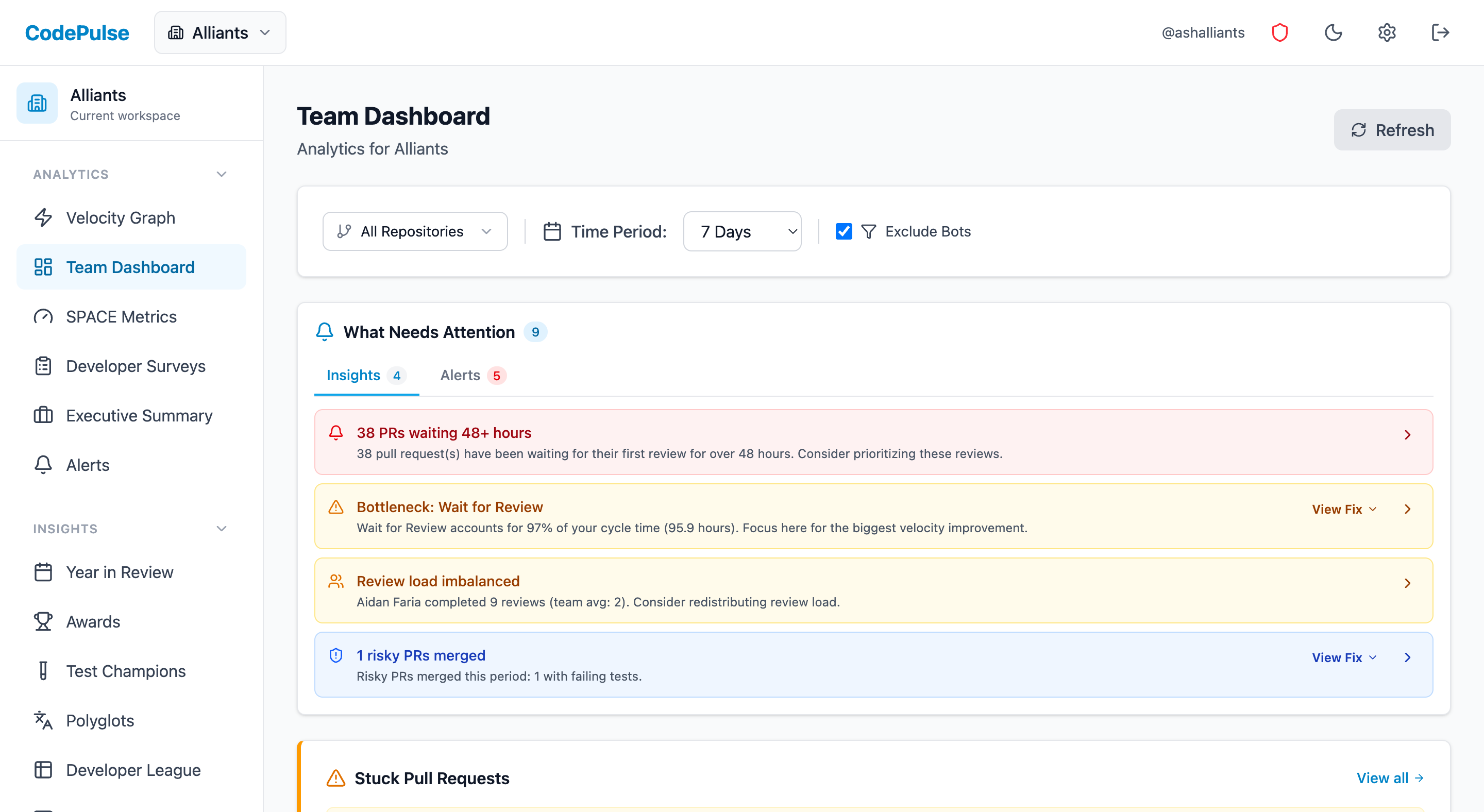
Find out which phase is holding your delivery up
CodePulse splits your cycle time into coding, waiting for review, active review, and merge, so you fix the queue that is actually costing you days. Read-only GitHub, no credit card.
Read-only GitHub · Your code stays yours · Team-level by default · No credit card
See These Features in Action
Track all four DORA metrics and benchmark against industry standards.
Track deployment frequency, lead time, and release patterns.
Related Guides
DevOps Maturity Model: A Practical Assessment Framework
Assess your DevOps maturity across culture, CI/CD, testing, monitoring, and infrastructure. Includes self-assessment questionnaire and improvement roadmap by level.
DORA Metrics Explained: The 4 Keys Without the Hype
A complete breakdown of the four DORA metrics - deployment frequency, lead time, change failure rate, and MTTR - with honest benchmarks and gaming traps to avoid.
No CI/CD Access? Here's How Google Measures DORA Anyway
Measure DORA Four Keys (deployment frequency, lead time, change failure rate, time to restore) using only GitHub data - no CI/CD integration required.
Platform Tools: The Build vs Buy Mistake
A practical guide to platform engineering tools, build vs buy decisions, and the metrics that prove platform impact.