

Turn this metric into a baseline for your team
Preview a system-level engineering health report, then connect GitHub when you are ready to compare this metric with your own delivery history.
Read-only GitHub · Your code stays yours · Team-level by default · No credit card
DevOps metrics tell you whether your engineering organization is actually improving - or just staying busy. But with dozens of possible KPIs to track, most teams either measure too much (analysis paralysis) or too little (flying blind). This guide cuts through the noise to show you which DevOps metrics actually matter, how to build a dashboard that drives action, and which tools can help.
"The best DevOps dashboard fits on one screen and tells you in 10 seconds whether things are getting better or worse."
What Are DevOps Metrics?
DevOps metrics measure the effectiveness of your software delivery process - from code commit to production deployment and beyond. They help answer questions like:
- How fast can we ship changes to customers?
- How stable are our releases?
- How quickly can we recover when things break?
- Is our process improving over time?
Unlike traditional software metrics (lines of code, story points), DevOps metrics focus on flow and outcomes - not activity.
Essential DevOps KPIs
The DORA Four Keys
The most validated DevOps metrics come from the DORA (DevOps Research and Assessment) research program. These four metrics correlate with both organizational performance and developer satisfaction (DORA now also publishes a fifth, deployment rework rate, and calls mean time to recovery failed deployment recovery time):
| Metric | What It Measures | Elite Benchmark |
|---|---|---|
| Deployment Frequency | How often you release to production | On demand (multiple times/day) |
| Lead Time for Changes | Time from commit to production | Less than one hour |
| Change Failure Rate | % of deployments causing incidents | 0-15% |
| Mean Time to Recovery | Time to restore service after incident | Less than one hour |
The power of DORA metrics is that they balance speed (deployment frequency, lead time) with stability (change failure rate, MTTR). You can't game them by optimizing one at the expense of others.
/// Our Take
Start with DORA. Don't invent your own DevOps metrics framework. DORA metrics are backed by years of research across thousands of organizations. They work.
Only add additional metrics once you've mastered the four keys. Most teams that struggle with DevOps metrics have too many, not too few. Simplicity drives action; complexity drives dashboards that nobody looks at.
Supporting DevOps KPIs
Once you have the DORA four keys in place, consider these supporting metrics:
| Category | Metric | Why It Matters |
|---|---|---|
| Flow | Cycle Time | Time from work started to deployed |
| Flow | Work in Progress (WIP) | Parallel work creates bottlenecks |
| Quality | Test Coverage Trend | Direction matters more than absolute |
| Quality | Escaped Defects | Bugs found in production |
| Efficiency | Build Time | Slow builds slow everything |
| Efficiency | Flaky Test Rate | Unreliable tests erode trust |
| Collaboration | PR Review Time | Where most waiting happens |
| Collaboration | Knowledge Distribution | Bus factor risk |
Building a DevOps Metrics Dashboard
Dashboard Design Principles
- One screen, one story - If it doesn't fit on one screen, it's too complex
- Trends over absolutes - Show direction, not just current state
- Actionable insights - Every metric should suggest what to do
- Team-level focus - Avoid individual leaderboards
- Refresh automatically - Stale data is ignored data
Recommended Dashboard Layout
DEVOPS METRICS DASHBOARD
═══════════════════════════════════════════════════════════

┌─────────────────────────────────────────────────────────┐
│  OVERALL HEALTH: 🟢 Good (improving)                    │
│  Last updated: 5 minutes ago                            │
└─────────────────────────────────────────────────────────┘

┌─────────────────────────┐  ┌─────────────────────────┐
│  DEPLOYMENT FREQUENCY   │  │  LEAD TIME FOR CHANGES  │
│  ━━━━━━━━━━━━━━━━━━━━   │  │  ━━━━━━━━━━━━━━━━━━━━   │
│  This week: 12/day      │  │  This week: 4.2 hours   │
│  Last week: 8/day  ↑50% │  │  Last week: 6.1h  ↓31%  │
│  [trend chart]          │  │  [trend chart]          │
└─────────────────────────┘  └─────────────────────────┘

┌─────────────────────────┐  ┌─────────────────────────┐
│  CHANGE FAILURE RATE    │  │  MEAN TIME TO RECOVERY  │
│  ━━━━━━━━━━━━━━━━━━━━   │  │  ━━━━━━━━━━━━━━━━━━━━   │
│  This week: 8%          │  │  This week: 45 min      │
│  Last week: 12%   ↓33%  │  │  Last week: 1.2h  ↓38%  │
│  [trend chart]          │  │  [trend chart]          │
└─────────────────────────┘  └─────────────────────────┘

┌─────────────────────────────────────────────────────────┐
│  SUPPORTING METRICS                                     │
│  PR Cycle Time: 18h (↓12%)  │  Build Time: 8min (→)   │
│  WIP: 12 items              │  Flaky Tests: 3% (↓)    │
└─────────────────────────────────────────────────────────┘
What NOT to Put on a DevOps Dashboard
- Individual developer metrics - Creates gaming and destroys trust
- Lines of code - Encourages wrong behaviors
- Commit counts - Meaningless activity metric
- Story points - Team-relative, can't compare
- Too many metrics - If everything is important, nothing is
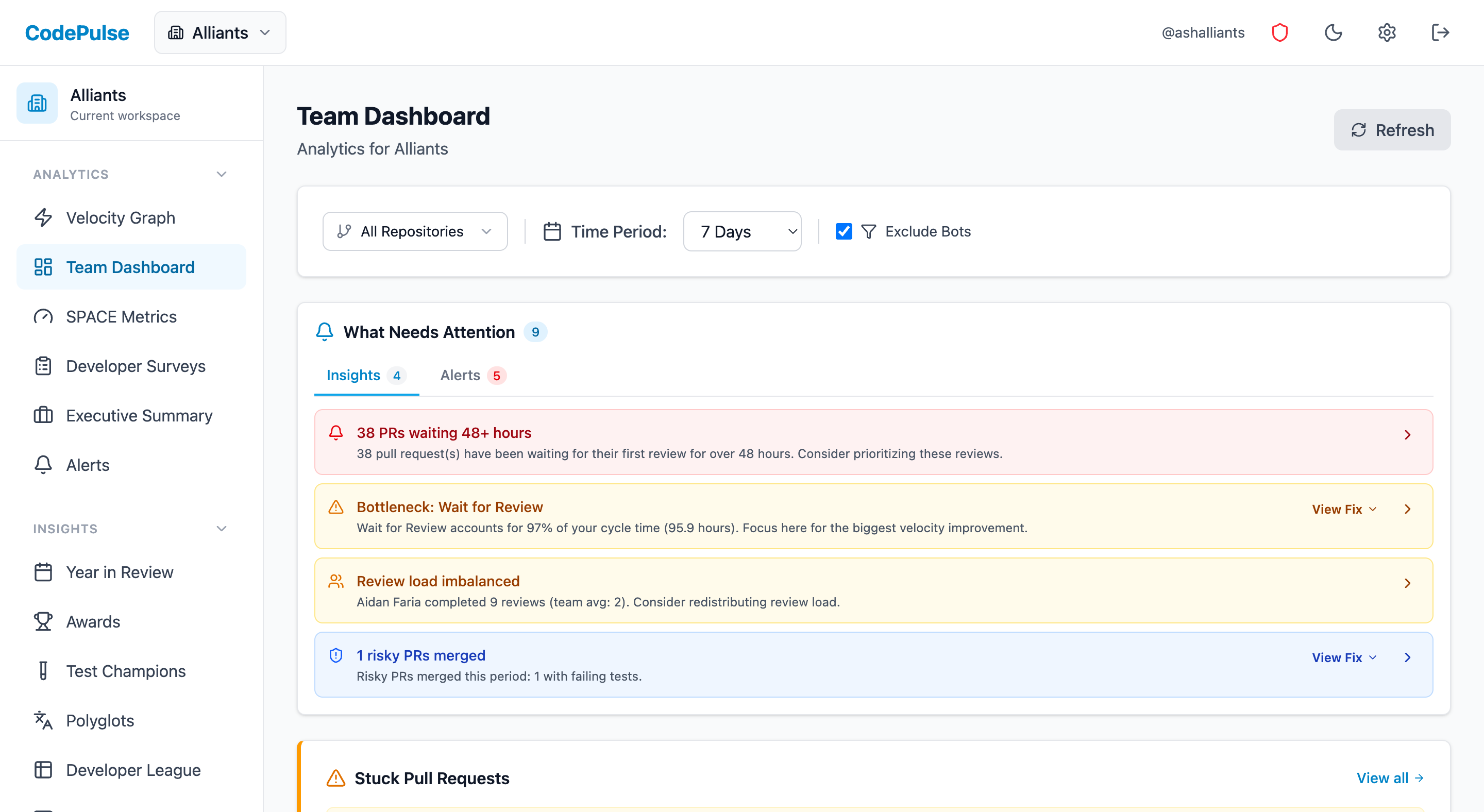
📊 How to See This in CodePulse
CodePulse provides a ready-made DevOps metrics dashboard:
- Executive Summary for DORA metrics at a glance
- Dashboard for deployment frequency, lead time, and cycle time trends
- Repository Comparison for cross-team DevOps metrics
- Alerts to get notified when metrics drift
DevOps Metrics Tools
There are several categories of tools for tracking DevOps metrics:
Engineering Intelligence Platforms
Purpose-built for engineering metrics with git-based data collection:
- CodePulse - DORA metrics, cycle time, team analytics from GitHub
- LinearB - Git analytics with workflow automation
- Jellyfish - Engineering management platform
- Swarmia - Developer productivity metrics
- Waydev - Git analytics with 130+ metrics
CI/CD Platform Analytics
Built into your deployment pipeline:
- GitHub Actions Insights - Workflow metrics
- GitLab Value Stream Analytics - Built-in DevOps metrics
- CircleCI Insights - Pipeline performance
- Jenkins - With plugins for metrics
Observability Platforms
Focus on production metrics and incidents:
- Datadog - APM with deployment tracking
- New Relic - Observability with change tracking
- Sleuth - DORA metrics focused
- Faros AI - Engineering operations platform
DIY Options
Build your own with open-source tools:
- Four Keys - Google's open-source DORA dashboard
- DevLake - Open-source engineering metrics
- Grafana + custom queries - Flexible but requires work
How to Choose a DevOps Metrics Tool
| Factor | Questions to Ask |
|---|---|
| Data sources | Does it integrate with your git host, CI/CD, and incident tools? |
| Setup time | How long to get first insights? Minutes or months? |
| Team size fit | Is it designed for your scale (10 devs vs 1000)? |
| Privacy approach | How does it handle individual vs team metrics? |
| Customization | Can you define custom metrics and dashboards? |
| Cost | Per-seat pricing vs flat rate vs usage-based? |
"The best DevOps metrics tool is the one your team actually uses. A simple dashboard that gets checked daily beats a sophisticated platform that nobody opens."
Implementation Guide
Week 1: Foundation
- Choose your primary metrics (start with DORA four keys)
- Identify data sources (git, CI/CD, incident management)
- Select or build your dashboard tool
- Establish baseline measurements
Week 2-4: Rollout
- Connect data sources and validate accuracy
- Share dashboard with team for feedback
- Establish review cadence (weekly recommended)
- Identify first improvement target
Month 2+: Optimization
- Track trends and celebrate improvements
- Add supporting metrics as needed
- Set up alerts for regression
- Expand to additional teams
Common Pitfalls
Pitfall 1: Measuring Too Much
Teams track 20+ metrics but act on none. Start with 4-6 metrics maximum. Add more only when you've mastered what you have.
Pitfall 2: Vanity Metrics
Metrics that look good but don't drive improvement. Deployment count without failure rate is a vanity metric. Always pair speed with quality.
Pitfall 3: Set and Forget
Building a dashboard and never looking at it. Schedule weekly reviews. Make metrics part of retrospectives.
Pitfall 4: Individual Rankings
Using DevOps metrics to rank developers destroys trust and encourages gaming. Keep focus on team-level improvement.
Related Guides
- DORA Metrics Guide - Deep dive into the four key metrics
- DORA Metrics Tools Comparison - Detailed tool comparison
- DevOps Maturity Model - Assessing your overall DevOps capability
- Engineering Metrics Dashboard Guide - Broader engineering dashboard design
Conclusion
DevOps metrics help you understand whether your software delivery process is improving. Start with the DORA four keys - they're research-backed and proven to correlate with organizational success. Build a simple dashboard that fits on one screen, review it weekly, and focus on trends over time.
- Start with DORA - deployment frequency, lead time, CFR, MTTR
- Keep it simple - 4-6 metrics max to start
- Focus on teams - not individual rankings
- Track trends - direction matters more than absolute numbers
- Review weekly - metrics you don't look at don't help
Get started with CodePulse to see your DevOps metrics in minutes. Connect your GitHub repositories and get DORA metrics, cycle time breakdown, and team analytics without building anything yourself.
"DevOps metrics exist to help teams improve, not to prove they're productive. The moment metrics become surveillance, they stop working."
Now measure this metric on your own repositories
Connect read-only GitHub in about five minutes and get your baseline, your trend, and the constraint behind it. Your fourteen usable trial days start when the first repository finishes syncing.
Read-only GitHub · Your code stays yours · Team-level by default · No credit card
See These Features in Action
Track all four DORA metrics and benchmark against industry standards.
Track deployment frequency, lead time, and release patterns.
Related Guides
DORA Metrics Explained: The 4 Keys Without the Hype
A complete breakdown of the four DORA metrics - deployment frequency, lead time, change failure rate, and MTTR - with honest benchmarks and gaming traps to avoid.
11 DORA Metrics Tools Ranked for 2026 (+ Pricing)
Compare the top DORA metrics tools including commercial platforms, open-source options, and native DevOps integrations. Find the right tool for your team size and needs.
DevOps Maturity Model: A Practical Assessment Framework
Assess your DevOps maturity across culture, CI/CD, testing, monitoring, and infrastructure. Includes self-assessment questionnaire and improvement roadmap by level.
Engineering Metrics Dashboard: The 7 Metrics You Need
Skip vanity metrics. Here are the 7 engineering metrics VPs actually need to track team performance, delivery, and quality.