
Compare the finished analysis before you choose a platform
See the report CodePulse produces from read-only GitHub workflow data, or connect your own repositories and evaluate the fit with real evidence.
Read-only GitHub · Your code stays yours · Team-level by default · No credit card
Code Climate has been through a lot: a free tier killed and user data permanently deleted in March 2024, their code quality product spun off into a separate company (Qlty Software), and a pivot to enterprise-only pricing. Users report opaque metrics that are "difficult to understand," data quality issues where "one outlier PR can skew results," and a tool that "creates mistrust and makes developers feel watched." If you are here looking for alternatives, you have good reasons.
What are the best alternatives to Code Climate Velocity?
CodePulse, LinearB, Swarmia, and Jellyfish are the top alternatives. Code Climate split its quality and velocity products in 2025, forcing teams to choose between speed metrics and code health. CodePulse combines both in a single GitHub-native platform at a lower price point. LinearB adds workflow automation. Swarmia includes developer satisfaction surveys. If you valued Code Climate for quality analysis specifically, the spun-off Qlty Software continues that product independently.
"The irony of Code Climate's pivot: they built their reputation on code quality, then separated it from velocity analytics - as if the two aren't fundamentally connected. Your shipping speed means nothing if what you ship is broken."
This guide helps you evaluate alternatives to Code Climate Velocity, with a particular focus on tools that don't force you to choose between understanding how fast you ship and understanding what you're shipping.
What Users Actually Say About Code Climate Velocity
Code Climate has a long history, and not all of it is flattering. Beyond the strategic instability, users report real problems with the product itself.
Surveillance and Trust Concerns
"Different views create mistrust and make developers feel watched."-- TrustRadius reviewer
When your analytics tool creates different visibility levels for managers and developers, trust erodes. Teams start optimizing for the metrics rather than for outcomes. A G2 reviewer put it directly: "If these metrics are being really used by management, it just leads to changing people's behavior to satisfy metrics, not the good purpose."
Opaque and Gameable Metrics
Code Climate's proprietary "Impact" metric has drawn consistent criticism. Users report finding it "difficult to understand what inputs drive the calculation." When engineers cannot understand how a metric is calculated, they cannot meaningfully act on it. Worse, reviewers note that "the metrics (no matter what they are) are hardly comparable across teams, and teams usually work in not exactly same schema."
Data Quality Issues
"Data hygiene is a recurring concern. One outlier PR can skew results" without easy cleanup. One team reported that "a team's endpoint missed roughly 10% of records" when pulling from the API, and that "all results that seem significant require substantial manual review to confirm their significance." When you cannot trust the data, the analytics platform becomes a liability rather than an asset.
No Context for Absences
A telling gap: there is "no mechanism to flag when someone was on PTO, in training, or at a conference." Absences affect daily and weekly averages with no way to exclude them. This is the kind of missing context that turns a reporting tool into a source of unfair comparisons.
Free Tier Killed, Data Deleted
On March 18, 2024, Code Climate ended support for "Velocity for Teams" (their free tier). Accounts were deactivated, integrations disconnected, and customer data was permanently deleted. The stated reason: "We have changed our company priorities to focus more on the Enterprise." If you were on the free tier, your history is gone.
Code Climate's Evolution: From Quality Pioneer to SEI Platform
Understanding Code Climate's history helps explain why you might be looking for alternatives:
The Original Vision (2011-2018)
Code Climate launched as an automated code review tool focused on maintainability metrics, test coverage, and technical debt tracking. It was genuinely innovative - one of the first platforms to bring static analysis into the developer workflow with meaningful, actionable insights.
The Velocity Addition (2018-2024)
Recognizing that engineering leaders needed more than code quality metrics, Code Climate launched Velocity - their Software Engineering Intelligence (SEI) platform. This gave organizations visibility into cycle time, deployment frequency, and team performance alongside their existing quality analysis.
The Free Tier Death (March 2024)
In March 2024, Code Climate ended support for "Velocity for Teams," their free tier. Accounts were deactivated, integrations disconnected, and customer data was permanently deleted. The stated reason: "We have changed our company priorities to focus more on the Enterprise." This was the first sign of strategic instability.
The 2025 Split
In 2025, Code Climate spun off their Quality product into a separate company called Qlty Software, while focusing Code Climate entirely on enterprise-grade velocity and SEI solutions. This means:
- Quality and Velocity are now separate products from separate companies
- Code Climate Velocity is pivoting toward large, complex enterprise organizations
- The integrated quality + velocity experience that many valued is gone
- Free tier users had their data permanently deleted with no migration path
/// Our Take
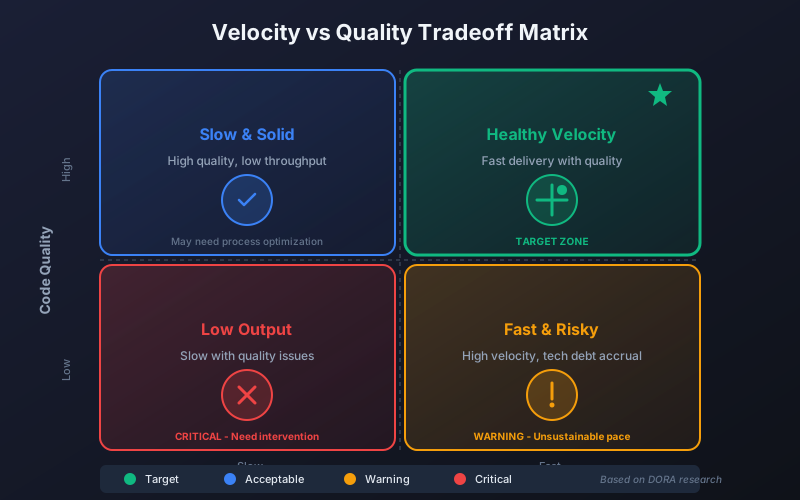
Code Climate's split reveals a fundamental tension in the engineering analytics market: should you measure speed or quality? Our answer: that's a false choice.
High-performing teams optimize for both. Shipping fast with poor quality creates technical debt that slows you down later. Obsessing over quality without shipping creates analysis paralysis. The tools that force you to choose between these concerns are solving the wrong problem. CodePulse combines velocity metrics (cycle time, throughput, deployment patterns) with quality insights (hotspots, knowledge silos, review health) in a single platform because they're two sides of the same coin.
Velocity vs Quality: The False Dichotomy
For the eight concrete quality metrics that predict incidents (and the ones that look useful but don't), see our software quality metrics guide.
The engineering analytics industry has fractured into "velocity" tools and "quality" tools, as if these are separate concerns. This creates problems:
"Measuring velocity without quality is like measuring how fast you're driving without checking if you're heading toward a cliff. DORA metrics are meaningless if your deployments are full of bugs that you'll spend the next sprint fixing."
The Velocity-Only Problem
- Goodhart's Law: When cycle time becomes a target, teams find ways to game it - smaller PRs that are harder to review, skipped tests, deferred refactoring
- Hidden debt: Fast shipping often means accumulated technical debt that slows future development
- Burnout risk: Optimizing for speed without monitoring team health leads to unsustainable practices
The Quality-Only Problem
- Analysis paralysis: Perfect code that never ships delivers zero customer value
- Over-engineering: Quality metrics can encourage premature optimization and gold-plating
- Missing context: Code quality without delivery context doesn't tell you if your team is effective
The Integrated Approach
The best engineering organizations track both velocity and quality because they understand the relationship between them:
| Pattern | What It Means | Action |
|---|---|---|
| High velocity + high quality | Team is performing well | Maintain, share practices |
| High velocity + low quality | Speed at the cost of sustainability | Slow down, pay tech debt |
| Low velocity + high quality | Over-engineering or process bottlenecks | Streamline, reduce friction |
| Low velocity + low quality | Team struggling, systemic issues | Major intervention needed |
CodePulse vs Code Climate Velocity: Feature Comparison
Here's how CodePulse compares to Code Climate Velocity across key dimensions:
| Capability | Code Climate Velocity | CodePulse |
|---|---|---|
| Primary focus | Enterprise SEI / velocity analytics | Combined velocity + quality for all team sizes |
| DORA metrics | Yes | Yes |
| Cycle time breakdown | Yes | Yes (4-stage: coding, wait, review, merge) |
| Code quality analysis | Separate product (Qlty Software) | Integrated (hotspots, silos, churn) |
| Knowledge silo detection | No (was in Quality) | Yes |
| File hotspot mapping | No (was in Quality) | Yes |
| Review network visualization | Basic | Interactive collaboration graph |
| Git provider support | GitHub, GitLab, Bitbucket | GitHub only |
| Setup time | Hours to days (enterprise onboarding) | Minutes (single OAuth flow) |
| Target market | Large enterprises (500+ engineers) | All sizes (startups to enterprise) |
| Pricing model | Per-seat, enterprise contracts | Transparent, self-serve |
| Free tier | Killed March 2024 (data deleted) | Available (10 developers) |
| Metric transparency | "Impact" metric calculation unclear to users | Documented, transparent calculations |
| PTO/absence handling | No mechanism to exclude absences | Working days configuration |
| Developer trust | Users report feeling "watched" | Anti-surveillance philosophy by design |
What Code Climate Velocity Does Better
- Multi-platform support: If you use GitLab or Bitbucket alongside GitHub, Code Climate aggregates across providers. CodePulse is GitHub-only.
- Enterprise customization: Large organizations with complex hierarchies may benefit from Code Climate's tailored enterprise solutions.
- Jira integration depth: Code Climate offers deeper project management tool integration for investment tracking.
What CodePulse Does Better
- Integrated quality + velocity: No need for separate tools or subscriptions to get both perspectives.
- Knowledge silo detection: Visual identification of bus factor risks at the file level.
- Transparent pricing: No sales calls required to understand cost.
- Fast time-to-value: Working dashboards in minutes, not weeks.
- Developer recognition: 15 award categories that celebrate diverse contributions beyond just output.
// How to See This in CodePulse
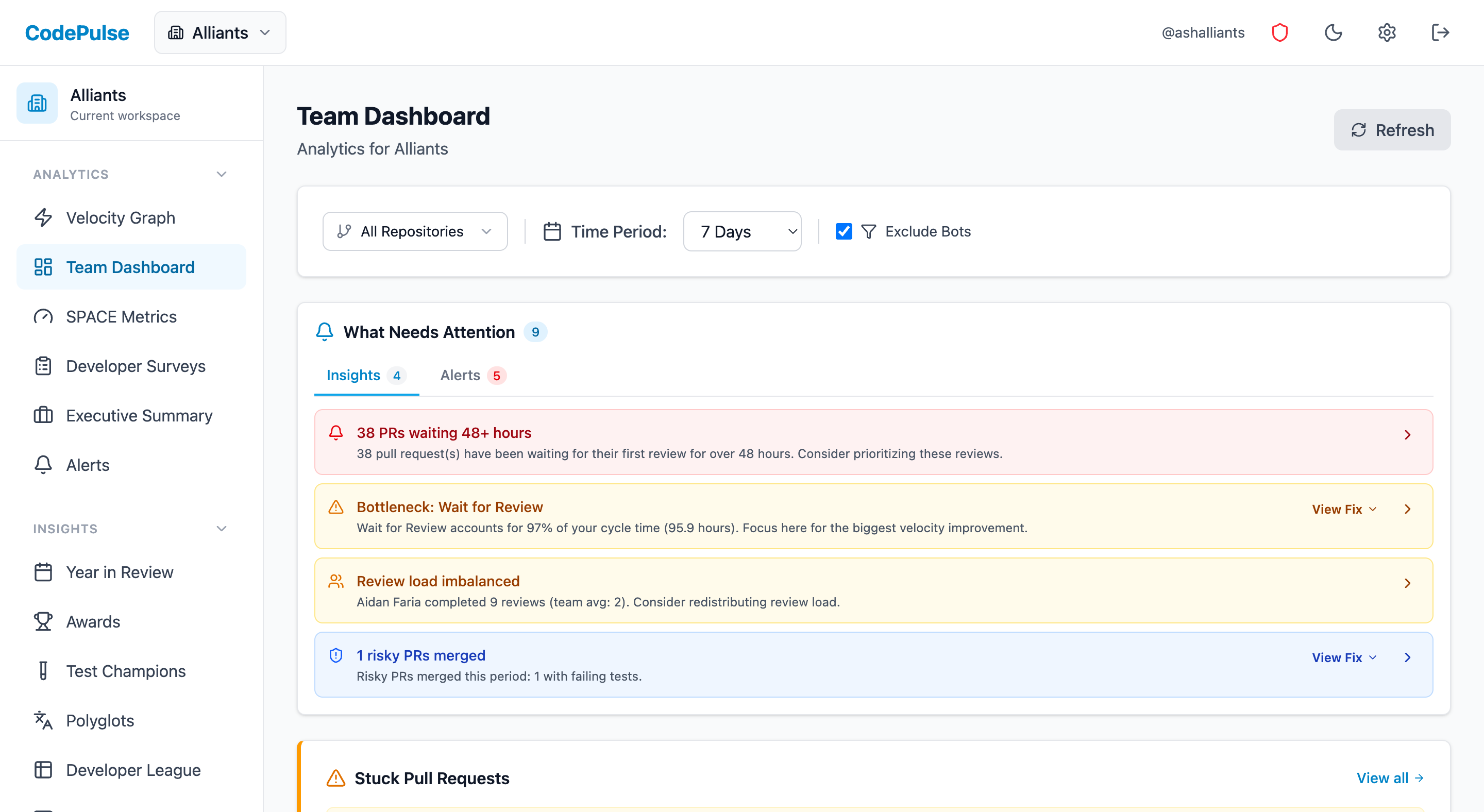
CodePulse combines velocity and quality in a single dashboard:
- Dashboard - Cycle time, throughput, and quality metrics at a glance
- File Hotspots - Visual map of high-change, high-risk areas
- Knowledge Silos - Bus factor risks identified by file
- Review Network - Interactive graph showing collaboration patterns
- Executive Summary - A-F health grades for board-level reporting
Code Climate Velocity Pricing vs Alternatives
Code Climate Velocity uses per-seat pricing that varies by team size:
| Team Size | Code Climate Basic | Code Climate Premium | CodePulse |
|---|---|---|---|
| 3 developers | ~$112/month | ~$162/month | Free tier available |
| 10 developers | ~$374/month | ~$540/month | See pricing |
| 50 developers | ~$1,870/month | ~$2,700/month | See pricing |
| Enterprise | Custom (median ~$43K/year) | Custom | |
Sources: G2, TrustRadius
Important considerations:
- Code Climate Velocity pricing doesn't include quality analysis - that's now a separate product from a separate company (Qlty Software)
- Enterprise customers report significant negotiation on pricing, but this requires sales engagement
- CodePulse includes both velocity and quality metrics in all tiers, including the free tier
When to Choose Which
"Don't choose based on features alone. Choose based on what questions you need answered and how much friction you can tolerate to get those answers."
Choose Code Climate Velocity When:
- You're a large enterprise (500+ engineers) with complex organizational hierarchies that need custom reporting structures
- You use multiple Git providers (GitHub + GitLab + Bitbucket) and need aggregated analytics across all of them
- Deep Jira integration is critical and you need investment allocation tied to project management data
- You already use Qlty Software (the spun-off quality product) and are comfortable running two separate analytics platforms
- You have budget for enterprise contracts and value white-glove onboarding support
Choose CodePulse When:
- You want velocity AND quality in one platform without managing multiple tools and subscriptions
- GitHub is your primary source of truth and you want maximum depth from that data source
- You value fast time-to-value and want insights in minutes, not weeks
- Transparent pricing matters and you don't want to engage with sales to understand costs
- You're a mid-sized team (10-200 engineers) that needs enterprise-grade insights without enterprise-grade complexity
- Knowledge silos and bus factor are concerns - CodePulse's hotspot and silo detection are genuinely differentiated features
Decision Framework: Code Climate vs CodePulse

START HERE
    │
    ▼
Do you need multi-Git-provider support (GitLab, Bitbucket)?
    ├── YES → Code Climate Velocity (CodePulse is GitHub-only)
    │
    ▼ NO
Is code quality analysis important to you?
    ├── YES → Do you want it integrated with velocity?
    │         ├── YES → CodePulse (combined platform)
    │         └── NO  → Code Climate + Qlty Software (separate)
    │
    ▼ VELOCITY ONLY
Are you an enterprise with 500+ engineers?
    ├── YES → Evaluate both; Code Climate has enterprise focus
    │
    ▼ NO
Do you value transparent pricing and fast setup?
    ├── YES → CodePulse (self-serve, minutes to deploy)
    │
    ▼ NO → Either could work; trial both
Migration Considerations
If you're moving from Code Climate Velocity to CodePulse, here's what to expect:
What Transfers Automatically
- GitHub data: CodePulse syncs directly with GitHub - no data export/import needed
- Historical metrics: CodePulse processes 6+ months of PR and commit history automatically
- Team structure: Based on your GitHub organization, no separate configuration
What You'll Gain
- Integrated quality metrics: Hotspots, knowledge silos, and churn analysis without a separate subscription
- Review network visualization: Interactive collaboration graph showing who reviews whose code
- Developer awards: 15 categories recognizing diverse contributions
- Faster setup: Working dashboards in minutes vs enterprise onboarding
What You'll Lose
- Multi-provider aggregation: If you use GitLab or Bitbucket alongside GitHub, you'll need separate solutions
- Deep Jira integration: CodePulse's issue tracker integration is less comprehensive
- Enterprise customization: Custom hierarchies and reporting structures available in Code Climate's enterprise tier
Migration Timeline
- Day 1: Connect GitHub (5 minutes), initial sync starts automatically
- Hours 1-2: Historical data processing completes
- Day 1-2: Explore dashboards, set up alert rules
- Week 1-2: Run both tools in parallel to validate insights
- Week 3+: Transition team to CodePulse, cancel Code Climate
Frequently Asked Questions
Code Climate killed its free tier ("Velocity for Teams") in March 2024, permanently deleting user data. In 2025, they spun off the code quality product into Qlty Software, refocusing Code Climate entirely on enterprise SEI. The original quality analysis tool that built their reputation is now a different product from a different company. Teams using both quality and velocity now need separate subscriptions from separate companies.
Related Comparisons
Evaluating other tools? These guides might help:
- Engineering Analytics Tools Comparison - Full overview of the market
- Pluralsight Flow Alternative - Another tool with roots in code analysis (formerly GitPrime)
- Code Quality Tools Comparison - Deep dive into quality-focused analytics platforms
- LinearB Alternative - Comparison with another popular engineering intelligence platform
Making Your Decision
Code Climate's 2025 pivot represents a broader trend in engineering analytics: the fragmentation of velocity and quality into separate tools. We think that's the wrong direction. High-performing engineering teams need visibility into both how fast they're shipping and what they're shipping.
If you valued Code Climate's original promise of combined velocity and quality insights, CodePulse carries that torch forward - with transparent pricing, fast setup, and features like knowledge silo detection that neither Code Climate Velocity nor Qlty Software offer.
Start your free trial to see how CodePulse combines velocity and quality analytics in a single, GitHub-native platform. Setup takes minutes, and you'll have actionable insights the same day.
Evaluate CodePulse against your own delivery history
A comparison table only goes so far. Connect read-only GitHub in about five minutes and judge the output on your repositories, at one flat price, with no per-seat math.
Read-only GitHub · Your code stays yours · Team-level by default · No credit card
See These Features in Action
Break down cycle time into coding, waiting, review, and merge phases.
Compare contribution patterns for coaching, not surveillance.
Related Guides
Jellyfish vs LinearB vs Swarmia: Full 2026 Comparison
Compare Jellyfish, LinearB, Swarmia, Allstacks, Haystack and more engineering analytics tools. Features, pricing, cycle time benchmarks, and integrations.
GitPrime Alternative: 3 Owners in 6 Years, Time to Move On
GitPrime became Pluralsight Flow, then was sold to Appfire. Three owners, stagnant development, and a history of stack ranking. Find a modern replacement.
Code Quality Tools in 2026: Most Are Useless (3 Aren't)
Compare engineering analytics tools specifically for code quality features: hotspot detection, knowledge silos, test analytics, and review sentiment.
Hatica Alternative: Engineering Analytics Without the Complexity
Compare Hatica vs CodePulse for engineering analytics. Understand the trade-offs between integration breadth and GitHub-native simplicity.